


Marine grade aluminum alloys deliver a rare combination in the maritime industry: the exceptional corrosion resistance to survive decades at sea, and the ultra-low density to cut fuel costs from day one.
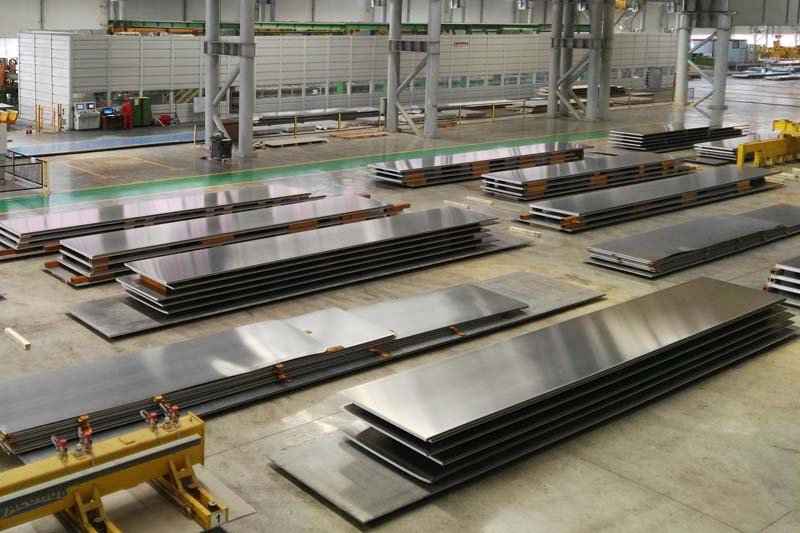
Whether you are a naval architect designing a high-speed ferry or a procurement manager sourcing materials for LNG carriers, this comprehensive guide covers everything you need to know about alloy selection, mechanical properties, fabrication methods, and marine certifications.
Why Choose Marine Grade Aluminum?
Unmatched Corrosion Resistance
- Self-Healing Oxide Film: A dense, self-healing Al₂O₃layer (~4 nm) forms instantly upon exposure to air, sealing the surface against further saltwater attack.
- Salt Spray Life: >1, 500 hours bare (per ASTM B117); >5, 000 hours when combined with marine epoxy coatings or hard anodizing.
- Ultra-Low Corrosion Rate: Only 0.02–0.03 mm/year in seawater—roughly 1/5 the corrosion rate of standard commercial aluminum.
- Alloy Chemistry: 5xxx series alloys utilize 4–6% Magnesium (Mg) for passivation, keeping Copper (Cu <0.1%) and Iron (Fe <0.4%) extremely low to suppress galvanic cell formation.
Weight Reduction & Extreme Strength
- Density Advantage: At just 2.7 g/cm³, aluminum is one-third the weight of steel. A full-aluminum superstructure typically achieves a 35–40% hull weight reduction, translating to 15–20% fuel savings on displacement vessels.
- Exceptional Cryogenic Performance: Unlike carbon steel, which suffers from ductile-to-brittle transition, 5083 aluminum actually increases in strength and retains >25% elongation at−196°C. This makes it the global standard for LNG cargo tank walls up to 100 mm thick.
Cost Considerations vs. Steel (ROI)
While marine grade aluminum has a higher initial material cost, shipowners achieve a positive Return on Investment (ROI) within 2-3 years due to:
- Zero requirement for sandblasting and heavy marine paint maintenance.
- Massive daily fuel savings and increased payload capacity.
- High end-of-life residual scrap value (aluminum is 100% recyclable).
Marine Aluminum Alloy Selection Guide (ASTM B928 / B209)
Quick Comparison Table
| Alloy & Temper | Tensile (MPa) | Yield (MPa) | Typical Thickness | Best For / Applications |
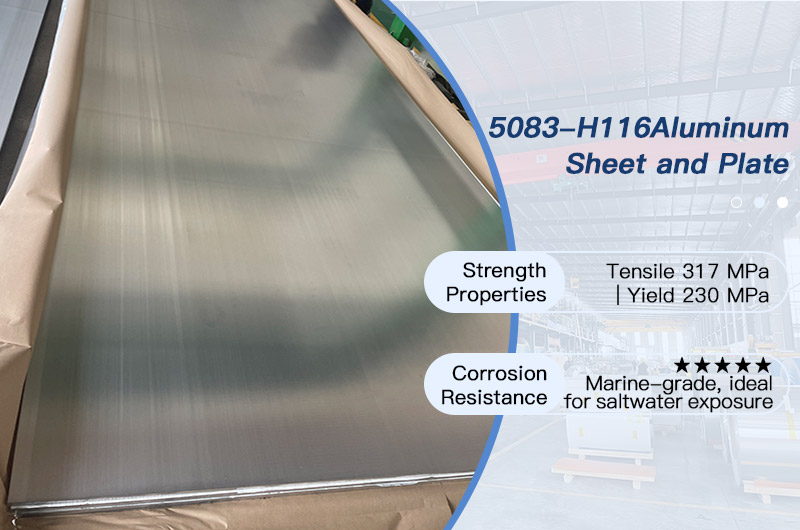
| 5083-H116 | ≥ 303 | ≥ 215 | 3mm - 150mm | Main hull plating, LNG tanks, submarine pressure hulls |
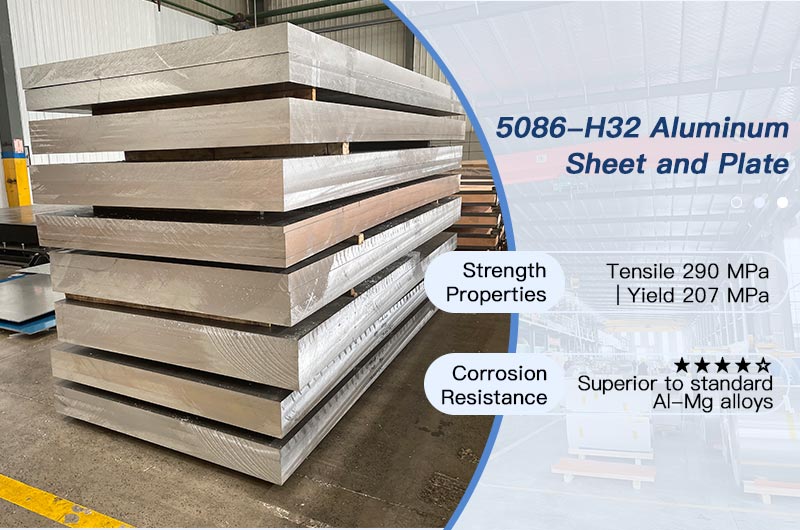
| 5086-H32 | ≥ 275 | ≥ 195 | 2mm - 50mm | High-speed craft, patrol boats, ballast tanks |
| 5456-H321 | ≥ 315 | ≥ 230 | 3mm - 100mm | Naval armor plate, extreme environments, icebreakers |
| 5454-H32 | ≥ 250 | ≥ 180 | 3mm - 50mm | Chemical/oil tankers, seawater desalination piping |
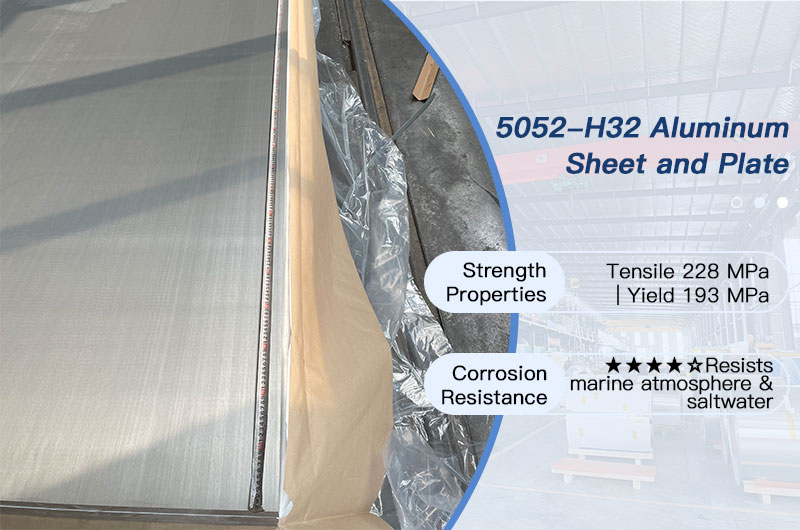
| 5052-H32 | ≥ 228 | ≥ 159 | 0.5mm - 12mm | Fuel tanks, non-structural bulkheads, ventilation |
| 5754-O | 190–240 | ≥ 80 | 0.5mm - 8mm | Ship interiors, cabin wall panels, deep-drawn parts |
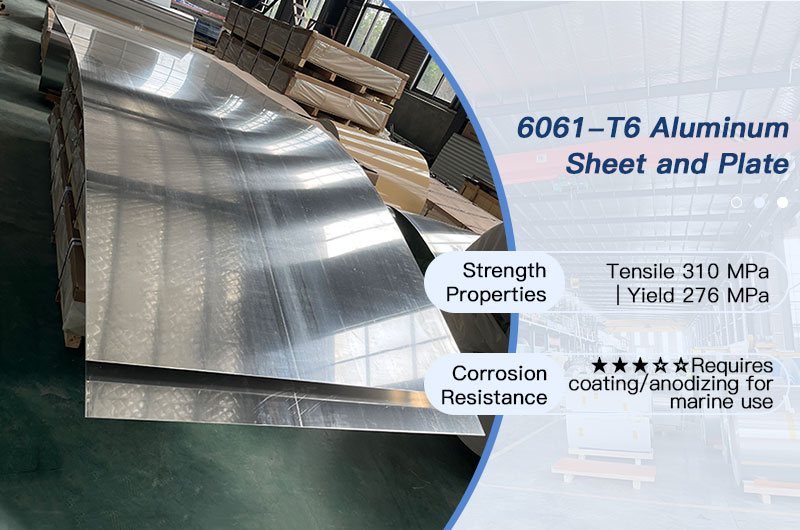
| 6061-T6 | ≥ 290 | ≥ 241 | 1mm - 200mm | Masts, deck fittings, CNC machined parts |
Procurement Note: Need current mill pricing or availability for specific alloys? [Contact Our Sales Team for a Quick Quote]
Detailed Marine Alloy Specifications
5083-H116 Sheet — The Structural Hull Standard
- The Edge: Highest weld-strength retention among 5xxx alloys (>90% with ER5356 filler). The H116 temper is specifically engineered to resist intergranular corrosion and exfoliation (passes ASTM G66 & G67).
- Economics: Near-zero corrosion maintenance over a 25+ year service life.
5086-H32 Sheet — High-Speed & Fatigue Resistant
The Edge: Superior vibration fatigue resistance—delivering 20% longer fatigue life than 5083 in cyclic, rough sea-state loading.
5052-H32 Sheet — Cost-Effective Forming
The Edge: Outstanding formability with >95% first-pass yield and up to 40% material cost savings vs. 5083. Perfect for complex bends in fuel tanks.
6061-T6 Plate — Precision-Machined Parts
- The Edge: 30% higher CNC cutting speed than 5xxx alloys; excellent dimensional stability.
- Critical Warning: Because of its copper content, 6061-T6 is not recommended for continuous below-waterline exposure without heavy cathodic protection and specialized marine epoxy coatings.
Fabrication and Welding Guidelines for Boat Building
| Method | Key Parameters | Recommended Alloys | Notes |
| TIG / MIG Welding | Heat input ≤1.5 kJ/mm; 100% Argon shielding; Filler ER5356 or ER5183 | 5083, 5086, 5456 | Plates >8 mm: preheat 80–120°C; interpass temp 60–100°C |
| Cold Bending | Bend radius ≥2t (O temper); ≥3t (H32) | 5052, 5754 | Use polished dies to prevent galling |
| Hot Forming | Heat to 350–450°C (O/T4); avoid >175°C for T6 | 6061, 6082 | Must re-age (to T6) after forming to recover strength |
| Friction Stir Welding | Ideal for thick plate (>6 mm) butt joints | 5083, 5086 | ≥95% parent strength; zero porosity, minimal distortion |
Shipyard Pro-Tip (Pre-Weld Prep): Remove the oxide layer with a dedicated stainless-steel wire brush used only for aluminum. Never use standard grinding wheels previously used on steel. Iron particle cross-contamination is the #1 cause of localized galvanic corrosion and weld failure in aluminum boats.
Specialty Marine Panel Products
To accelerate shipyard assembly and improve vessel performance, we offer value-added panel solutions:
- Ultra-Wide Aluminum Plates: Widths up to 3, 000mm. Reduces hull weld seams by up to 70%, drastically improving hull airtightness and assembly speed.
- Aluminum Honeycomb Panels: Density is only 3.6–5.3 kg/m³ (40% lighter than solid sheets). Offers >30 dB noise reduction and B1 fire rating. Perfect for luxury yacht interiors.
- Aluminum Tread Plates (5052/6061): Diamond, 5-rib, or compass patterns provide an 80% grip improvement over flat plates. Essential for engine room walkways and wet decks.
Surface Treatment & Anti-Galvanic Design Rules
Even the best marine aluminum needs proper installation to survive harsh seawater environments.
Anti-Galvanic Design Rules for Naval Architects:
- Isolate Dissimilar Metals: Never bolt aluminum directly to copper, bronze, stainless steel, or carbon fiber. Always use nylon bushings, Tef-Gel, or dielectric insulating gaskets when the galvanic potential exceeds 0.15 V.
- Cathodic Protection: Specify Al-Zn-In (Aluminum-Zinc-Indium) sacrificial anodes for hull protection. They offer >80% current efficiency per MIL-DTL-24779.
- Below-Waterline Coatings: Use multi-layer marine epoxy or polyurethane coatings for cargo tanks and submerged hulls to guarantee >5, 000 hours of salt spray resistance.
How to Specify and Order Marine Aluminum
When requesting a B2B quote or issuing a tender, ensure you provide the following details to get the fastest and most accurate pricing:
- Alloy & Temper: e.g., 5083-H116, 5086-H111, or 5052-H32.
- Dimensions: Thickness (mm) × Width (mm) × Length (mm).
- Classification Society Certifications: State if your project requires DNV, ABS, LR, BV, or CCS stamps.
- Documentation: Request 3.1 or 3.2 Mill Test Certificates (MTC) to ensure full traceability of chemical composition and mechanical properties.
Frequently Asked Questions (FAQ)
Q: What is the most common marine grade aluminum alloy?
A: 5083-H116 is the undisputed industry standard for structural hull plating. It offers the best balance of high tensile strength (≥303 MPa), weld integrity, and seawater corrosion resistance.
Q: Is 5052 considered a marine grade aluminum?
A: Yes, 5052 has excellent resistance to marine atmospheres. However, because its tensile strength is lower than 5083, it is primarily used for non-structural applications like small recreational boat hulls, fuel tanks, and interior cabin panels.
Q: What welding filler wire is recommended for 5083 aluminum?
A: ER5356 (Al-5Mg) or ER5183 (Al-4.5Mg-0.7Mn). Both achieve ≥90% of the parent-metal tensile strength when welded per AWS D1.2 standards.
Q: Is marine aluminum truly sustainable?
A: Yes. Aluminum is 100% recyclable with no loss of mechanical properties. Recycling end-of-life ship hulls uses only 5% of the energy required for primary aluminum production, making it a highly sustainable material choice for modern green shipbuilding.