


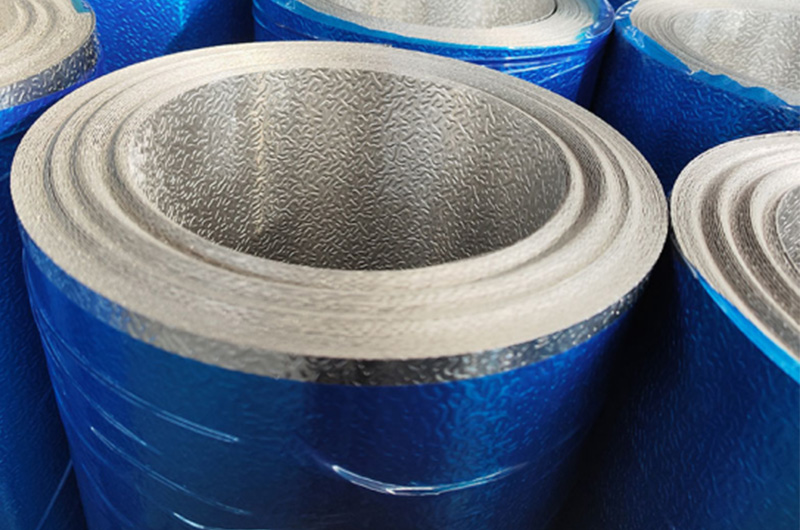
Aluminum Jacketing
Worthwill's aluminum jacketing uses 1060, 1100, 3003, 3105 and other aluminum, and the surface treatment covers mill finished, embossed, Polysurlyn Moisture Barrier (PSMB), etc.
- Alloy
- 1050, 1060, 1100, 3003, 3105, 5005, 5052
- Temper
- H14, H16, H24, H26
- Thickness
- .016" (0.4 mm) – .032" (0.8 mm), custom 0.15–2 mm
- Width
- 36", 48", 914 mm, 1000 mm, 1200 mm, 1219 mm
- Standards
- ASTM B209 · ASTM C1729 · EN 573-1
What Is Aluminum Jacketing
Aluminum jacketing is a thin-gauge aluminum sheet or coil that serves as the outermost protective layer of a pipe, duct, or equipment insulation system. It is installed over insulation materials — such as rock wool, glass wool, polyurethane foam, expanded polystyrene (EPS), and PVC — to shield them from moisture, UV radiation, mechanical impact, and chemical exposure.
Compared with galvanized steel (iron jacketing), aluminum jacketing is becoming the most popular metal jacketing choice due to its light weight, natural corrosion resistance, ease of fabrication and installation, and full recyclability. It is widely referred to as aluminum roll jacketing, aluminum insulation jacketing, or aluminum pipe jacketing.
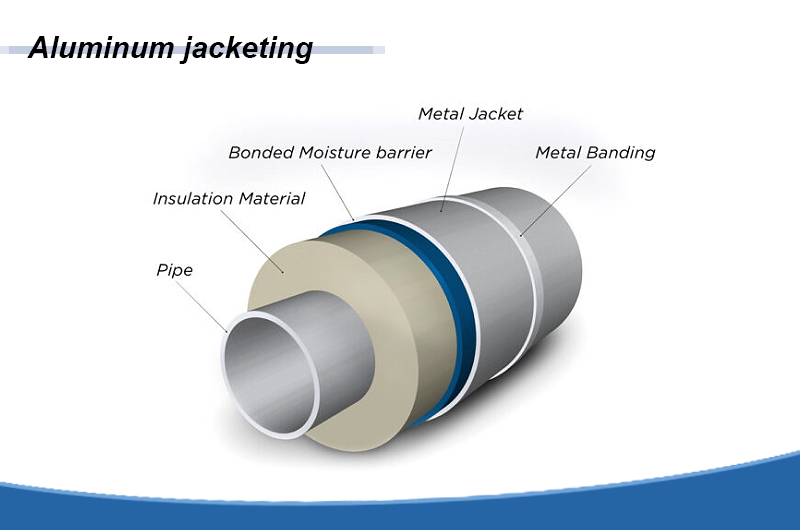
Types of Aluminum Jacketing
Aluminum insulation jacketing is available in several surface treatments, each designed for specific performance requirements. Choose the right type based on your environment, temperature, and moisture exposure.
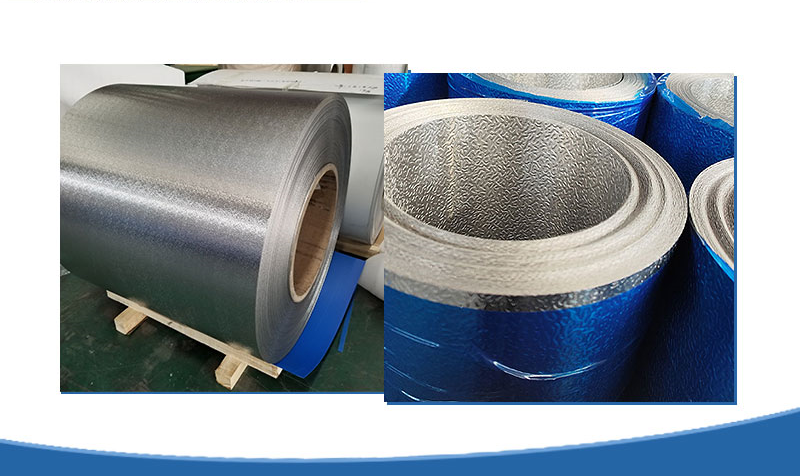
Stucco Embossed Jacketing
An orange-peel texture is mechanically rolled onto the surface, improving heat dissipation, increasing rigidity, and reducing glare. Ideal for outdoor pipe and equipment insulation.
- Common alloys: 1060, 1100, 3003
- Thickness: 0.3 mm – 1.5 mm
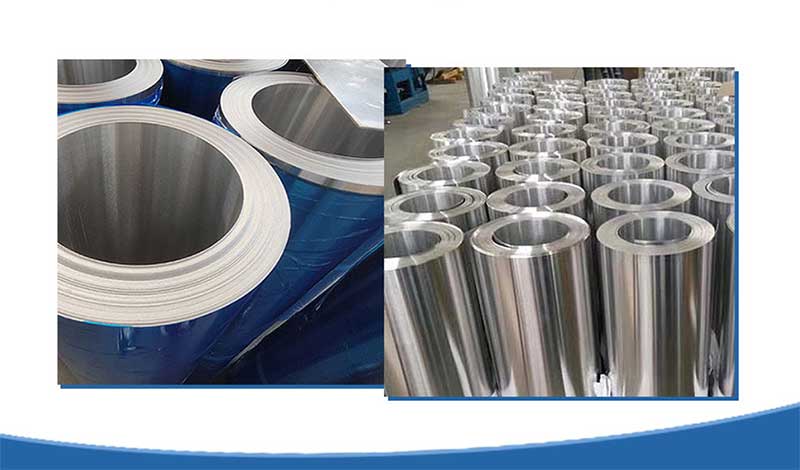
Mill Finish Jacketing
The most economical option with a smooth, bright surface. Widely used for general-purpose pipe and equipment insulation in moderate environments.
- Common alloys: 1050, 1060, 1100, 3003, 3105, 5005, 5052
- Thickness: 0.3 mm – 2 mm
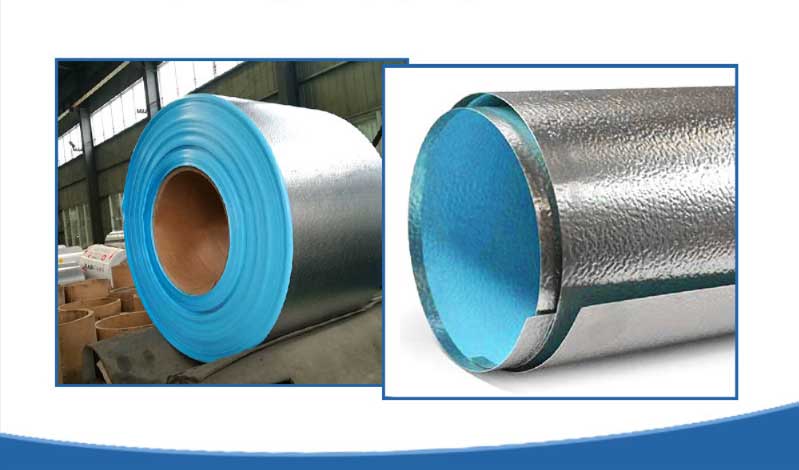
Jacketing with Polysurlyn Moisture Barrier
A polysurlyn film is laminated to the inner surface, preventing moisture ingress and galvanic corrosion. The go-to choice for cold-service and outdoor insulation systems.
- Common alloys: 1060, 1100, 3003, 3105, 5052
- Thickness: 0.3 mm – 1.5 mm
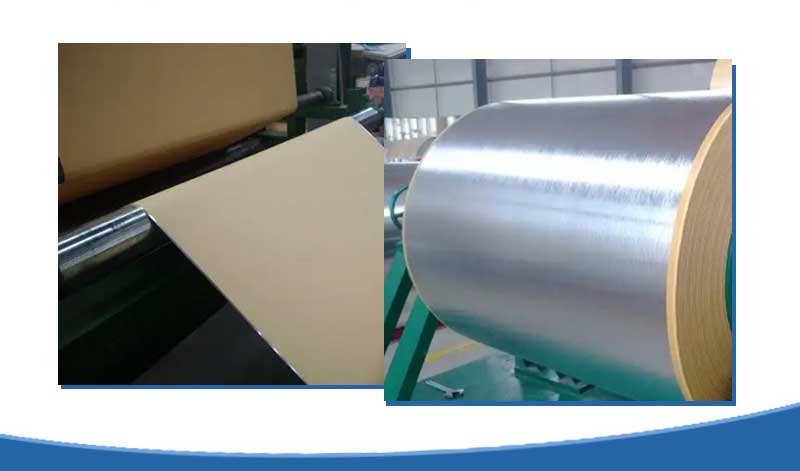
Jacketing with Polykraft Moisture Barrier
Kraft paper bonded with polyethylene is laminated to the inner surface, providing moisture protection and cushioning. A cost-effective alternative to polysurlyn for moderate environments.
- Common alloys: 1060, 1100, 3003, 3105, 5052
- Thickness: 0.3 mm – 1.5 mm
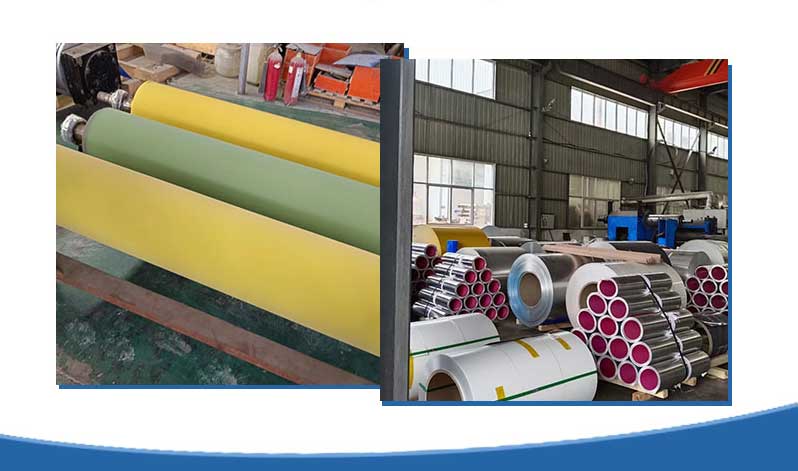
Color Coated Jacketing
Coated with polyester (PE), PVDF, or epoxy paint in a wide range of colors. Polyester coatings suit indoor use; PVDF coatings offer superior UV and weather resistance for outdoor installations.
- Common alloys: 1050, 1060, 1100, 3003, 3105
- Thickness: 0.3 mm – 2 mm
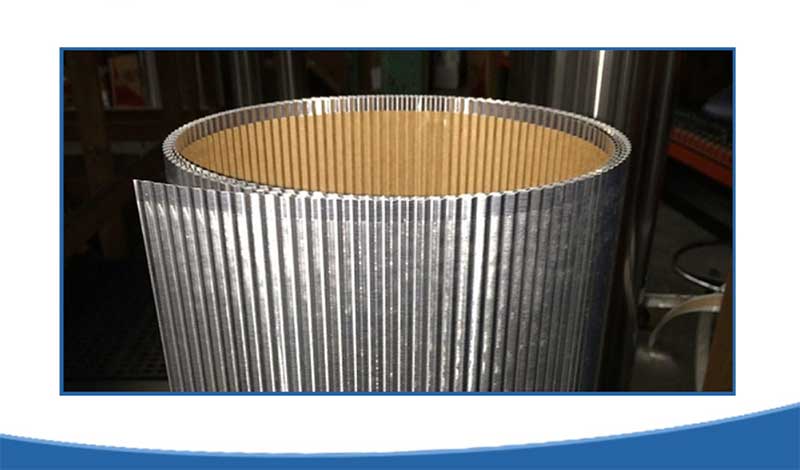
Corrugated Jacketing
The corrugated profile significantly increases rigidity and impact resistance while allowing thermal expansion. Well suited for large-diameter pipes and vessels in industrial plants.
- Common alloys: 1060, 3003
- Thickness: 0.3 mm – 1.5 mm
Aluminum Jacketing Alloy Comparison
Choosing the right alloy determines corrosion resistance, formability, and strength. Below is a side-by-side comparison of chemical composition and mechanical properties for the most commonly used aluminum jacketing alloys.
Chemical Composition (wt%, max unless range shown)
| Alloy | Si | Fe | Cu | Mn | Mg | Cr | Zn | Ti | Al |
|---|---|---|---|---|---|---|---|---|---|
| 1050 | 0.25 | 0.40 | 0.05 | 0.05 | 0.05 | — | 0.05 | 0.03 | ≥ 99.50 |
| 1060 | 0.25 | 0.35 | 0.05 | 0.03 | 0.03 | — | 0.05 | 0.03 | ≥ 99.60 |
| 1100 | Si + Fe ≤ 0.95 | 0.05–0.20 | 0.05 | — | — | 0.10 | — | ≥ 99.00 | |
| 1200 | Si + Fe ≤ 1.00 | 0.05 | 0.05 | — | — | 0.10 | 0.05 | ≥ 99.00 | |
| 3003 | 0.60 | 0.70 | 0.05–0.20 | 1.0–1.5 | — | — | 0.10 | — | Balance |
| 3105 | 0.60 | 0.70 | 0.30 | 0.30–0.80 | 0.20–0.80 | — | 0.40 | 0.10 | Balance |
| 5005 | 0.30 | 0.70 | 0.20 | 0.20 | 0.50–1.10 | 0.10 | 0.25 | — | Balance |
| 5052 | 0.25 | 0.40 | 0.10 | 0.10 | 2.2–2.8 | 0.15–0.35 | 0.10 | — | Balance |
Typical Mechanical Properties (H14 Temper)
| Alloy | Tensile Strength (MPa) | Yield Strength (MPa) | Elongation (%) | Best For |
|---|---|---|---|---|
| 1050 | 110–150 | ≥ 100 | ≥ 6 | General insulation, cost-sensitive projects |
| 1060 | 110–150 | ≥ 95 | ≥ 6 | Chemical plants, petrochemical pipes |
| 1100 | 110–150 | ≥ 95 | ≥ 5 | HVAC, commercial building insulation |
| 3003 | 150–200 | ≥ 130 | ≥ 4 | Industrial pipes, tanks, higher-strength needs |
| 3105 | 160–210 | ≥ 130 | ≥ 3 | Building insulation, roofing, color coating base |
| 5005 | 160–200 | ≥ 130 | ≥ 4 | Architectural applications, anodizing base |
| 5052 | 230–280 | ≥ 180 | ≥ 4 | Marine, offshore, harsh-environment insulation |
Aluminum Jacketing Size Chart
Jacket size is determined by the nominal pipe diameter and insulation thickness. The table below shows standard jacket girth values for common combinations. For sizes not listed, please contact us for a custom cut.
| Nominal Pipe Size | Pipe O.D. (in) | Jacket Girth by Insulation Thickness (inches) | ||||
|---|---|---|---|---|---|---|
| 1/2" | 1" | 1-1/2" | 2" | 3" | ||
| 1/2" | 0.840 | 8 | 11 | 14 | 17 | 24 |
| 3/4" | 1.050 | 8 | 12 | 15 | 18 | 24 |
| 1" | 1.315 | 9 | 12 | 15 | 19 | 25 |
| 1-1/2" | 1.900 | 11 | 14 | 17 | 21 | 27 |
| 2" | 2.375 | 12 | 16 | 19 | 22 | 29 |
| 3" | 3.500 | 16 | 19 | 23 | 26 | 33 |
| 4" | 4.500 | 19 | 23 | 26 | 29 | 36 |
| 6" | 6.625 | 26 | 29 | 33 | 36 | 43 |
| 8" | 8.625 | 32 | 36 | 39 | 43 | 49 |
| 10" | 10.750 | 39 | 43 | 46 | 49 | 56 |
| 12" | 12.750 | 45 | 49 | 52 | 55 | 62 |
| 14" | 14.000 | 49 | 53 | 56 | 59 | 66 |
| 16" | 16.000 | 55 | 59 | 62 | 66 | 72 |
| 18" | 18.000 | 62 | 66 | 69 | 72 | 79 |
| 20" | 20.000 | 68 | 72 | 75 | 78 | 85 |
| 24" | 24.000 | 81 | 85 | 88 | 91 | 98 |
Girth = π × (Pipe O.D. + 2 × Insulation Thickness) + 2" overlap. Values rounded to nearest inch. Custom sizes available on request.
Application of Aluminum Jacketing
From industrial piping to commercial buildings, aluminum jacketing protects insulation systems across a wide range of scenarios.
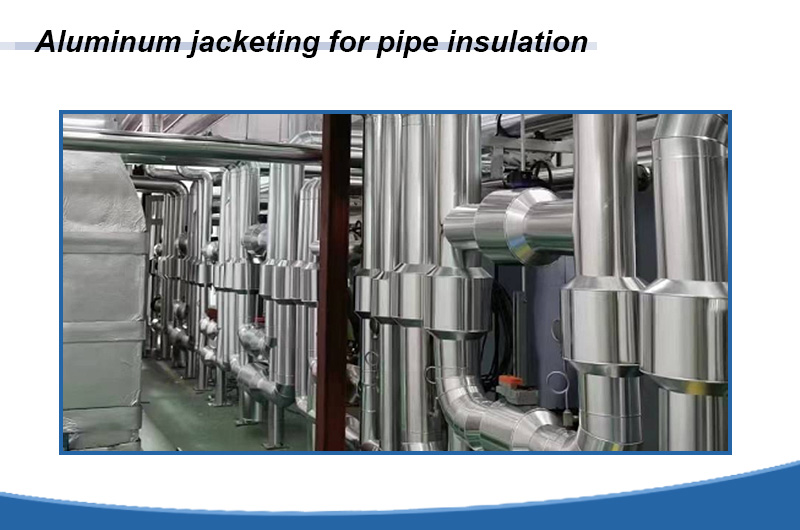
Pipe Insulation
The most common application. Aluminum jacketing wraps around insulated pipes in refineries, power plants, HVAC systems, and chemical facilities, protecting insulation from weather, moisture, and mechanical damage while maintaining thermal efficiency.
Equipment & Vessel Insulation
Storage tanks, heat exchangers, boilers, and acid vessels require robust jacketing to prevent corrosion under insulation (CUI). 1060 and 3003 alloys are commonly selected for their balance of formability and strength.
Building Insulation
Color-coated aluminum jacketing is used on exterior walls, roofing, and curtain wall systems. It offers an attractive appearance alongside thermal and weather protection. 1000-series and 3000-series alloys are typically used.
HVAC Ductwork
Aluminum jacketing protects duct insulation in heating, ventilation, and air conditioning systems, reducing energy loss and preventing condensation in both commercial and industrial buildings.
Aluminum Jacketing vs. Iron Jacketing
Both aluminum and galvanized steel (iron) jacketing are used in insulation systems. The table below highlights the key differences to help you choose the right material for your project.
| Feature | Aluminum Jacketing | Galvanized Steel (Iron) Jacketing |
|---|---|---|
| Weight | Lightweight (density ≈ 2.7 g/cm³) | Heavy (density ≈ 7.8 g/cm³) |
| Corrosion Resistance | Excellent — natural oxide layer, will not rust | Moderate — zinc coating protects initially but can corrode over time |
| Bending & Forming | Easy — highly malleable, conforms to complex shapes | More difficult, especially with thicker gauges |
| Installation | Fast — light weight reduces labor time and cost | Slower — heavier panels require more manpower |
| Maintenance | Low — rust-free, long service life | Regular inspection needed for zinc layer integrity |
| Thermal Conductivity | Higher (≈ 205 W/m·K) | Lower (≈ 50 W/m·K) |
| Fire Resistance | Melting point ≈ 660 °C | Melting point ≈ 1,500 °C |
| Recyclability | Highly recyclable, retains value | Recyclable, but processing is more complex |
| Material Cost | Moderate | Lower |
| Total Lifecycle Cost | Lower — less maintenance, longer lifespan | Higher — more frequent replacement and repair |
| Best For | Outdoor, coastal, chemical, long-term projects | Indoor, short-term, budget-constrained projects |
Installation Guide
Proper installation ensures that aluminum jacketing delivers maximum protection and lifespan. Follow these steps for a professional, weather-tight installation per ASTM C1729 guidelines.
Preparation
- Verify that aluminum jacketing alloy, temper, thickness, and surface treatment match the project specification.
- Prepare tools: tin snips or electric shears, measuring tape, chalk line, pop rivet gun, sealant, and self-tapping screws or banding.
- Ensure weather conditions are suitable — avoid installation during rain or high winds.
Measurement & Cutting
- Measure the outer circumference of the insulated pipe or equipment and add a 2" (50 mm) overlap.
- Mark and cut using aviation snips or a power shear. Deburr all edges to prevent injury and ensure a clean seam.
Surface Cleaning
- Ensure the insulation surface is dry, clean, and free of dust, oil, or debris before applying the jacketing.
- If a moisture barrier (PSMB or PKMB) is used, confirm the barrier side faces inward toward the insulation.
Wrapping & Fastening
- Wrap the jacketing around the insulation with the longitudinal seam positioned to shed water (typically at 4 or 8 o'clock on horizontal runs).
- Secure with pop rivets, self-tapping screws, or stainless-steel banding at recommended intervals.
- On vertical runs, overlap upper pieces over lower pieces (shingle style) to prevent water entry.
Sealing
- Apply sealant or weatherproof tape to all longitudinal and circumferential seams.
- Pay special attention to end caps, elbows, tees, and valve covers — these are the most vulnerable points for water ingress.
Final Inspection
- Inspect all fasteners for tightness and all seams for continuous sealant coverage.
- Verify flatness and alignment — the finished surface should be smooth and professional in appearance.
- Clean the area and remove any metal shavings or debris.
Standards & Quality Assurance
Every roll of aluminum jacketing we produce is manufactured and tested in strict accordance with international standards.
ASTM B209
Standard Specification for Aluminum and Aluminum-Alloy Sheet and Plate. Covers alloy composition, mechanical properties, dimensional tolerances, and surface quality.
ASTM C1729
Standard Guide for Use of Metal Jacketing for Thermal Insulation. Provides guidance on material selection, thickness, surface treatment, and installation practices for metal jacketing.
EN 573-1
European standard for aluminum and aluminum alloys — chemical composition and forms of wrought products. Ensures traceability and consistency for projects requiring European compliance.
Why Choose Worthwill
As a specialized aluminum jacketing manufacturer, we deliver consistent quality, competitive pricing, and reliable export packaging to customers in over 80 countries.
- Full alloy & surface coverage — 1050 to 5052, mill finish, stucco embossed, PSMB, PKMB, color coated, and corrugated.
- Custom cutting — any width from 100 mm to 1500 mm, any length per roll, thickness from 0.15 mm to 2 mm.
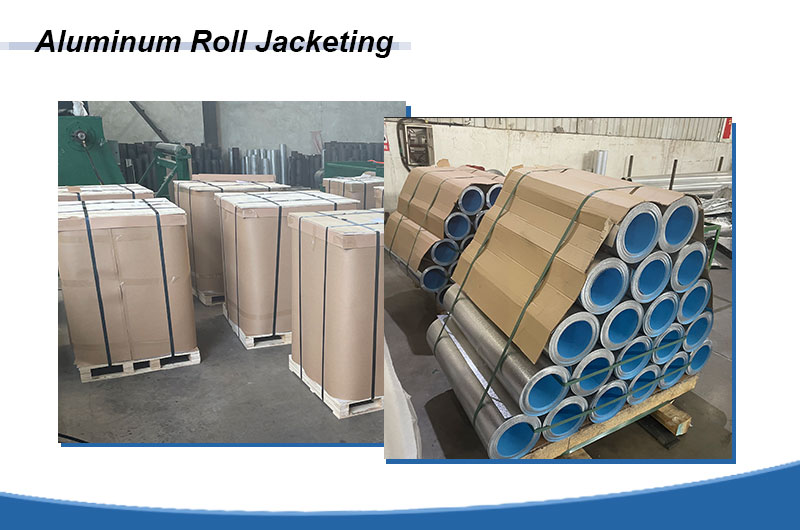
- Export-grade packaging — eye-to-wall or eye-to-sky, wooden pallets, moisture-proof wrapping, and steel strapping for safe ocean freight.
- Mill test certificate — every shipment includes a certificate confirming chemical composition and mechanical properties per ASTM B209.
- Fast lead time — standard sizes ship within 15–20 days; stock items available for urgent orders.
- 300,000+
- Tons Annual Capacity
- 90,000+
- Customers Served
- 86
- Countries Exported
Frequently Asked Questions
Is aluminum good for insulation jacketing?
Yes. Aluminum is the most widely used metal for insulation jacketing worldwide. Its natural oxide layer prevents rust, it is one-third the weight of steel, and it is 100% recyclable. These properties make it superior to galvanized steel (iron jacketing) in most applications.
What is the difference between aluminum jacketing and insulation materials?
They serve completely different roles. The insulation material (rock wool, glass wool, polyurethane foam, PVC, etc.) sits directly on the pipe and provides thermal resistance. The aluminum jacketing is the outer metal shell that protects the insulation from moisture, UV, physical damage, and corrosive elements. Both components work together as a complete insulation system.
What standards does aluminum jacketing need to comply with?
The most commonly referenced standards are ASTM B209 (alloy sheet and plate specification), ASTM C1729 (guide for metal jacketing use), and EN 573-1 (European aluminum alloy composition). These ensure the material meets requirements for chemical composition, mechanical strength, and installation suitability.
What is polysurlyn moisture barrier (PSMB)?
PSMB is a thin polymer film (typically 2–3 mils / 0.05–0.08 mm) heat-laminated to the inner surface of aluminum jacketing. It prevents moisture from reaching the insulation and eliminates galvanic corrosion between the aluminum and dissimilar metals. It is especially important in cold-service and outdoor applications.
Which alloy should I choose: 1100 or 3003?
1100 is a commercially pure aluminum with excellent corrosion resistance and good formability — ideal for standard pipe insulation in moderate environments. 3003 contains manganese for higher strength (about 20% stronger than 1100) and is better suited for larger diameters, industrial equipment, or applications requiring greater mechanical durability.
What thickness of aluminum jacketing should I use?
The most common thicknesses are .016" (0.4 mm) and .020" (0.5 mm) for small- to medium-diameter pipes. For larger pipes (10" and above) or high-traffic areas, .024" (0.6 mm) or .032" (0.8 mm) is recommended. For extreme conditions or heavy mechanical exposure, thicknesses up to 1.0 mm or more may be required.
Can aluminum jacketing be used outdoors?
Absolutely. Aluminum naturally resists corrosion and UV degradation, making it an excellent choice for outdoor installations. For maximum outdoor performance, stucco embossed finish reduces glare and improves rigidity, while PVDF color coating provides superior weather and UV resistance for architectural applications.
Ready to Get Started?
Tell us your alloy, thickness, width, and surface treatment requirements. We will respond with a detailed quotation within 24 hours.
Something You Might Be Interested In
You may be interested in some other information about aluminum roll jacketing