


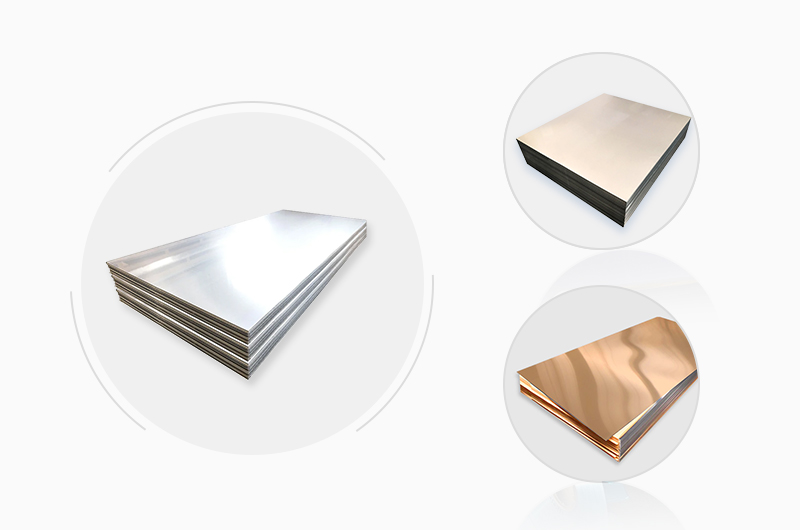
What Is 1050 Aluminum?
1050 aluminum is a commercially pure wrought aluminum alloy containing a minimum of 99.5% aluminum. As a member of the 1xxx series, it is characterized by excellent electrical and thermal conductivity, superior corrosion resistance, and outstanding ductility. Although its mechanical strength is relatively low compared with alloyed grades, 1050 aluminum is ideal for applications where conductivity, formability, and chemical inertness are more critical than structural load-bearing.
Common applications include chemical equipment, food-processing machinery, heat-exchanger fins, electrical busbars, lighting reflectors, and architectural cladding panels. Its high purity also makes it an excellent substrate for anodizing, producing uniform and aesthetically pleasing oxide finishes.
International Equivalent Designations
| Designation System | Equivalent Name |
|---|---|
| Aluminum Association (AA) | 1050 |
| UNS | A91050 |
| ISO | Al 99.5 |
| EN (Europe) | EN AW-1050A |
| DIN (Germany) | Al99.5 |
| NF (France) | A5 / 1050A |
| BS (UK) | 1B |
| JIS (Japan) | A1050P |
| GB (China) | 1050A / 1A50 |
1050 Aluminum Specifications Available at Worthwill
| Product Type | Specification | Details |
|---|---|---|
| General Information | Alloy | 1050 |
| Temper | O, H12, H14, H16, H18, H24, H26, H28 | |
| Forms | Sheet, plate, strip, coil, circle & disc | |
| 1050 Aluminum Sheet & Plate | Thickness | 0.2 mm – 260 mm |
| Sheet: 0.2 – 6.0 mm | Plate: 6.0 – 80 mm | Extra-thick plate: 80 – 260 mm | ||
| Width | 500 – 2650 mm (standard: 1000 / 1250 / 1500 / 2000 mm) | |
| Length | Customized (standard: 2000 / 2500 / 3000 / 6000 mm) | |
| Tolerance | Thickness ±0.02 – ±0.15 mm (per EN 485-4) | |
| 1050 Aluminum Strip | Thickness | 0.08 – 3.0 mm |
| Ultra-thin: 0.08 – 0.5 mm | Standard: 0.5 – 3.0 mm | ||
| Width | 10 – 600 mm | |
| Coil Weight | 500 – 3000 kg (inner diameter: 150 / 300 / 505 mm) | |
| Slitting Precision | Width tolerance ±0.1 mm (<300 mm), ±0.2 mm (≥300 mm) | |
| 1050 Aluminum Coil | Thickness | 0.1 – 6.0 mm |
| Thin coil: 0.1 – 1.0 mm | Standard coil: 1.0 – 6.0 mm | ||
| Width | 100 – 2000 mm (slitting tolerance ±0.2 mm) | |
| Coil Diameter | OD 600 – 2000 mm (ID: 508 / 610 mm) |
Physical and Chemical Properties of 1050 Aluminum
Basic Physical Properties
| Property | Value | Testing Standard |
|---|---|---|
| Density | 2.71 g/cm³ | ASTM B311 |
| Melting Range | 646 – 657 °C | ASTM E794 |
| Coefficient of Thermal Expansion | 23.6 × 10⁻⁶ /K (20–100 °C) | ASTM E228 |
| Elastic Modulus | 69 GPa | ASTM E111 |
| Thermal Conductivity | 222 W/(m·K) | ASTM E1461 |
| Electrical Conductivity | 61 % IACS | ASTM B193 |
| Electrical Resistivity | 2.83 μΩ·cm | ASTM B193 |
| Poisson's Ratio | 0.33 | ASTM E132 |
Chemical Composition (per ASTM B209 / EN 573-3)
| Element | Content (wt %) | Role / Control Purpose |
|---|---|---|
| Al | ≥ 99.50 | Base metal — ensures high conductivity and corrosion resistance |
| Fe | ≤ 0.40 | Controlled to limit grain-boundary brittleness |
| Si | ≤ 0.25 | Affects fluidity and oxide film quality |
| Cu | ≤ 0.05 | Must be low for optimal corrosion resistance |
| Mn | ≤ 0.05 | Influences work-hardening behavior |
| Mg | ≤ 0.05 | Kept low to maintain ductility |
| Zn | ≤ 0.05 | Controlled to prevent intergranular corrosion |
| Ti | ≤ 0.03 | Grain refiner during casting |
| V | ≤ 0.05 | Trace element control |
| Others (each) | ≤ 0.03 | Total others ≤ 0.03 % |
Mechanical Properties by Temper
The table below summarizes the typical mechanical properties of 1050 aluminum across common tempers. Values are measured per ASTM E8 (tensile) and ASTM E10 (Brinell hardness).
| Temper | Condition | Tensile Strength (MPa) | Yield Strength (MPa) | Elongation (%) | Brinell Hardness (HB) |
|---|---|---|---|---|---|
| O | Fully annealed | 65 – 95 | 25 – 40 | ≥ 35 | 20 |
| H12 | Strain-hardened ¼ hard | 85 – 125 | 70 – 95 | 12 – 18 | 28 |
| H14 | Strain-hardened ½ hard | 105 – 145 | 95 – 115 | 10 – 16 | 35 |
| H16 | Strain-hardened ¾ hard | 120 – 160 | 110 – 130 | 6 – 10 | 40 |
| H18 | Fully strain-hardened | ≥ 140 | ≥ 125 | ≤ 5 | 44 |
| H24 | Strain-hardened & partially annealed | 105 – 145 | 75 – 105 | 12 – 18 | 32 |
| H112 | As-fabricated (hot rolled) | 70 – 100 | 50 – 70 | ≥ 20 | 23 |
Welding Performance
1050 aluminum is readily weldable by most fusion methods. Because of its high thermal conductivity, preheating and proper heat-input control are essential to avoid incomplete fusion and porosity.
| Welding Method | Applicable Thickness (mm) | Typical Parameters | Key Notes |
|---|---|---|---|
| TIG (GTAW) | 0.5 – 6.0 | AC, 80 – 200 A, HF start | Pure argon shielding (≥ 99.99 %); AC provides oxide cleaning action |
| MIG (GMAW) | 3.0 – 25.0 | DCEP, 18 – 26 V | Preheat 100 – 150 °C for thickness > 6 mm; use ER1100 filler |
| Resistance Spot | 0.5 – 3.0 | 8 – 12 kA | Optimize electrode force; clean surfaces critical |
| Laser | 0.2 – 8.0 | 2 – 6 kW fiber/CO₂ | Defocus control ±0.2 mm; use argon shielding |
How Temper Affects Key Properties
Cold working (strain hardening) increases strength and hardness but moderately reduces conductivity and ductility. The table below compares the softest (O) and hardest (H18) tempers.
| Property | O Temper | H18 Temper | Change |
|---|---|---|---|
| Electrical Conductivity (% IACS) | 61 | 58 | ↓ 5 % |
| Thermal Conductivity (W/m·K) | 222 | 210 | ↓ 5.4 % |
| Elongation (%) | ≥ 35 | ≤ 5 | ↓ 86 % |
| Tensile Strength (MPa) | ~76 | ≥ 140 | ↑ 84 % |
| Reflectivity (total, visible spectrum) | ~86 % | ~82 % | ↓ 4.7 % |
Standard Products
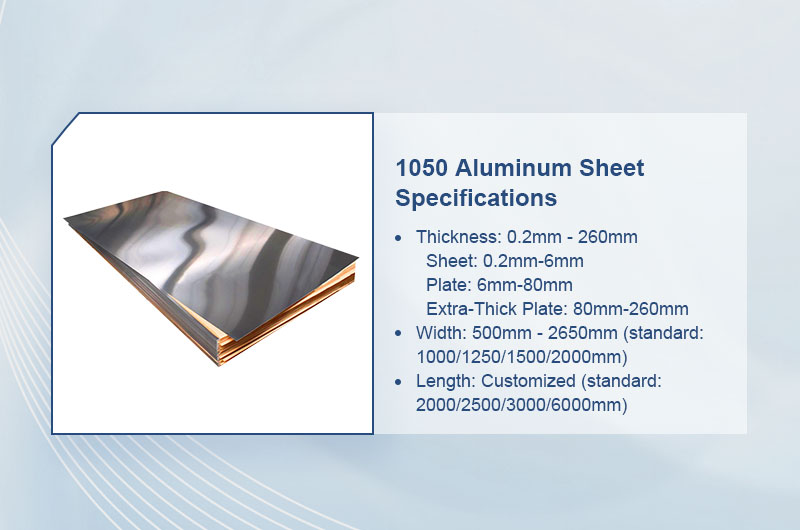
1050 Aluminum Sheet & Plate
- Thickness: 0.2 – 260 mm.
- Processing: Laser / waterjet cutting, CNC shearing.
- Applications: Architectural cladding, chemical containers, reflectors.
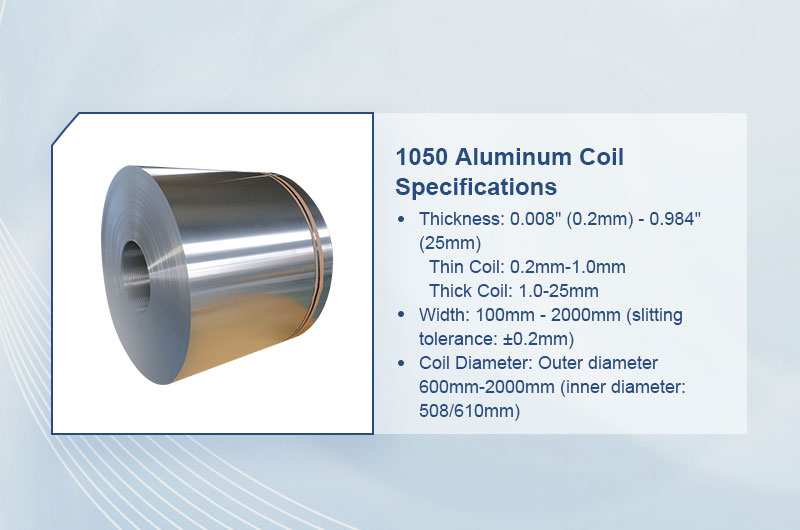
1050 Aluminum Coil
- Thickness: 0.1 – 6.0 mm.
- Processing: Continuous stamping, roll forming.
- Applications: Fin stock, food packaging, electronic shielding.
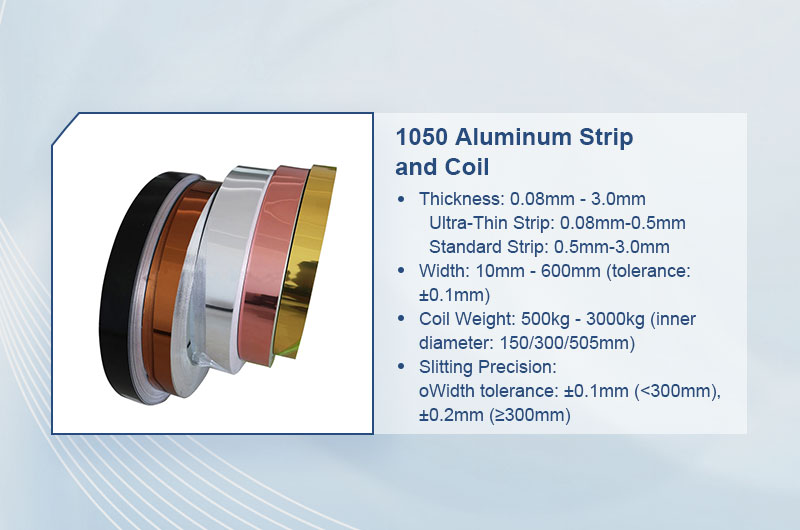
1050 Aluminum Strip
- Thickness: 0.08 – 3.0 mm.
- Processing: Precision slitting, edge conditioning.
- Applications: Transformer windings, channel letters, lamp reflectors.
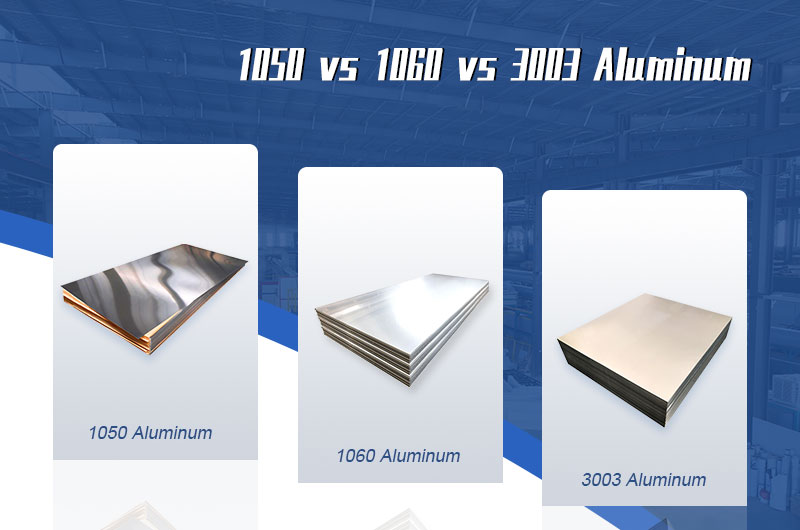
1050 vs 1060 vs 3003 Aluminum — Which Alloy to Choose?
All three are popular non-heat-treatable aluminum alloys, but they differ in purity, strength, and conductivity. The table below helps you choose the right grade for your project.
| Parameter | 1050 | 1060 | 3003 |
|---|---|---|---|
| Al Content (%) | ≥ 99.50 | ≥ 99.60 | ~96.8 (bal.) |
| Key Alloying Element | — | — | Mn 1.0 – 1.5 % |
| Tensile Strength, H14 (MPa) | 105 – 145 | 100 – 140 | 145 – 175 |
| Conductivity (% IACS) | 61 | 62 | 42 |
| Corrosion Resistance | Excellent | Excellent | Very Good |
| Formability | Excellent | Excellent | Good |
| Relative Cost | Low | Low | Low-Medium |
| Best For | Electrical conductors, reflectors | Capacitor foil, deep drawing | Tanks, cookware, roofing |
Summary: Choose 1050 when conductivity and purity matter most. Choose 1060 for even higher purity and deep-drawn parts. Choose 3003 when you need noticeably higher strength and moderate corrosion resistance.
Surface Treatments for 1050 Aluminum
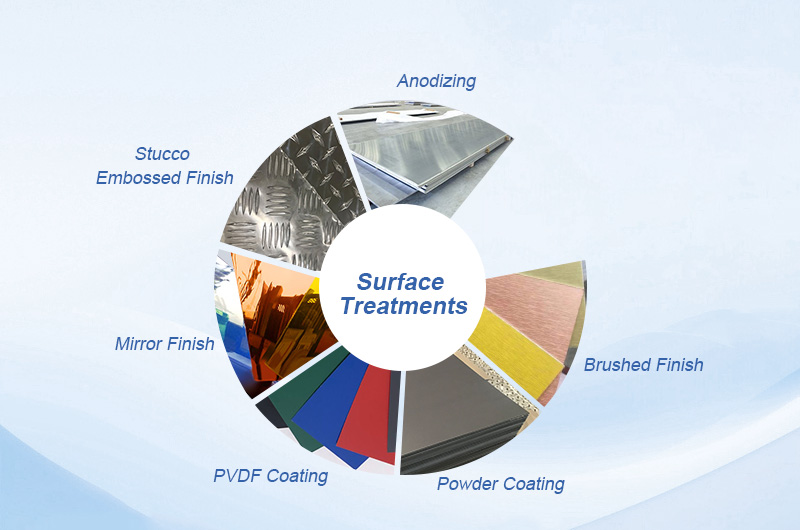
Thanks to its high purity, 1050 aluminum responds exceptionally well to a wide range of surface finishes. Below are the most commonly requested treatments.
Anodizing
- Film Thickness: 10 – 25 μm (Type II); up to 50 μm (Type III hard-coat).
- Standard: MIL-A-8625.
- Performance: Salt-spray resistance ≥ 1000 h; uniform color across surface.
Stucco Embossed Finish
- Pattern Depth: 0.3 – 1.2 mm.
- Benefits: Anti-slip, conceals scratches, increases effective surface area for heat exchange.
Mirror Finish
- Surface Roughness: Ra ≤ 0.05 μm.
- Total Reflectivity: ≥ 86 % (visible spectrum).
- Applications: Lighting reflectors, solar concentrators, decorative panels.
PVDF Coating
- Film Thickness: ≥ 25 μm.
- Standards: AAMA 2605, QUALICOAT Class 3.
- Weathering: Color retention ≥ 30 years for architectural facades.
Powder Coating
- Film Thickness: 60 – 120 μm.
- Standards: AAMA 2604.
- Colors: RAL / Pantone custom matching available.
Brushed Finish
- Patterns: Straight-line, cross-hatch, random orbital.
- Grit Range: #120 – #400.
- Applications: Consumer electronics housings, nameplates, interior trim.
Applications of 1050 Aluminum
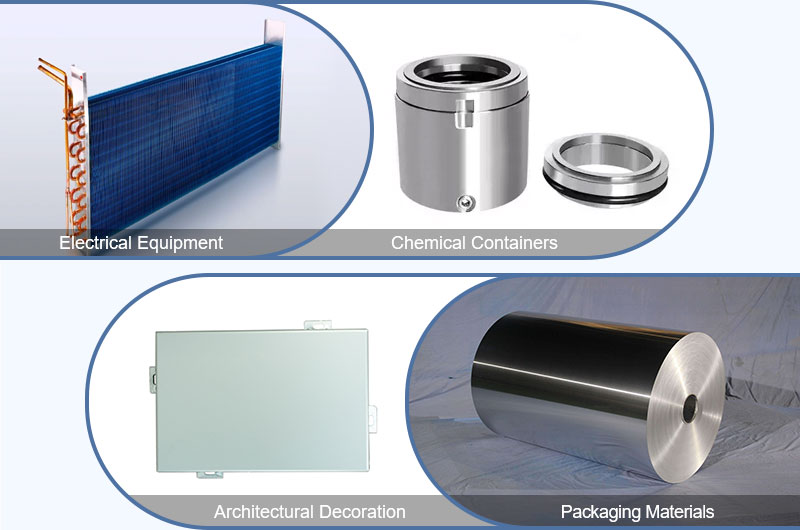
Electrical & Thermal Equipment
-
Busbars & Conductors (Conductivity > 58 MS/m):
- Temper: H112 or O
- Thickness: 6.0 – 12.5 mm
- Conductivity: ≥ 60 % IACS
- Why 1050: Lowest resistivity among cost-effective alloys
-
Heat-Exchanger Fins:
- Temper: H14 or H24
- Thickness: 0.1 – 0.5 mm; fin height 10 – 15 mm, spacing 2 – 3 mm
- Why 1050: 222 W/(m·K) thermal conductivity + excellent deep-draw formability
Chemical & Process Equipment
-
Acid / Alkali Tank Liners:
- Temper: H14 / H112
- Thickness: 3.0 – 6.0 mm
- Why 1050: Natural oxide film resists pH 4 – 9; optional PTFE liner (50 – 80 μm) extends range
-
Reactor Gaskets & Seals:
- Temper: O
- Thickness: 0.5 – 2.0 mm
- Why 1050: Low impurities (Fe + Si ≤ 0.65 %), excellent conformability
Architectural & Decorative
-
Composite Cladding Panels (ASTM B209):
- Temper: H14 / H24
- Thickness: 1.5 – 4.0 mm
- Features: Wind-load resistance + anodized or PVDF finish for aesthetics
-
Anti-Slip Tread Plates:
- Temper: O, H12, H14
- Pattern height: 0.5 – 1.5 mm
Packaging & Consumer
-
Food-Grade Foil (0.006 – 0.2 mm):
- Temper: O
- Certifications: FDA 21 CFR 175.300, EU 1935/2004
-
Pharmaceutical Blister Packaging:
- Thickness: 0.02 – 0.06 mm
- Certifications: FDA, EMA, ISO 15378
Processing Technology for 1050 Aluminum
1050 aluminum can be processed through a wide range of metalworking techniques. Below are the critical parameters for common operations.
Annealing
- Full anneal (O temper): 350 – 410 °C, hold 1 – 2 h, furnace cool at ≤ 30 °C/h to 260 °C, then air cool.
- Partial anneal (H2x tempers): 250 – 350 °C, hold 1 – 2 h, air cool.
- Stress relief: 200 – 250 °C, hold 1 – 2 h.
Cold Forming Parameters
| Process | Max. Reduction per Pass | Springback Factor | Recommended Die Clearance |
|---|---|---|---|
| Deep Drawing | 25 – 35 % | 1.02 – 1.05 | 1.05 t – 1.10 t |
| Spinning | 30 – 40 % | 1.03 – 1.07 | 1.10 t |
| Bending (V-die) | — | 1.01 – 1.03 (O); 1.04 – 1.08 (H14) | 1.0 t (O); 1.5 t (H14) |
| Roll Forming | 15 – 20 % per station | Material-dependent | 1.05 t |
Note: "t" = material thickness. Springback factor is the ratio of formed angle to die angle.
Chemical Conversion Treatment
- Chromate conversion: pH 1.8 – 2.2, temperature 35 – 40 °C, immersion 3 – 5 min (per MIL-DTL-5541).
- Chrome-free conversion: Zirconium / titanium-based system, coating weight 200 – 400 mg/m² (per MIL-DTL-81706 Class 3).
Laser Cutting Parameters
| Thickness (mm) | Laser Power (W) | Cutting Speed (m/min) | Assist Gas |
|---|---|---|---|
| 0.5 | 1000 | 8.0 | N₂ at 15 bar |
| 3.0 | 4000 | 2.5 | N₂ at 12 bar |
| 6.0 | 6000 | 1.2 | N₂ at 10 bar or compressed air |
Note: Nitrogen is preferred over oxygen for aluminum cutting to produce oxide-free, bright edges.
Quality Control
Worthwill's Quality Assurance Process
- Incoming inspection: Raw-material purity verification (OES spectrometer), chemical composition per ASTM B209.
- In-process control: Real-time monitoring of casting temperature, rolling reduction, and annealing cycles.
- Final inspection: Surface appearance, dimensional accuracy, mechanical properties, and corrosion-resistance testing.
- Certification: Each shipment accompanied by EN 10204 Type 3.1 mill test certificate.
Testing Standards
- Dimensional tolerance: EN 485-4 (sheet & plate), EN 485-2 (mechanical properties)
- Tensile testing: ASTM E8 / E8M
- Hardness testing: ASTM E10 (Brinell), ASTM E384 (micro-Vickers)
- Metallographic analysis: ASTM E3 (preparation), ASTM E112 (grain size)
- Surface roughness: ISO 4287
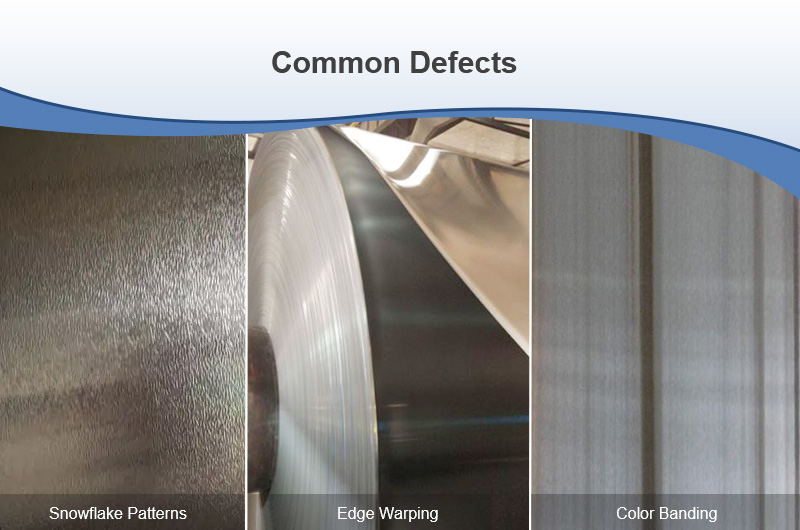
Common Defects and Prevention
| Defect | Root Cause | Prevention / Solution |
|---|---|---|
| Snowflake patterns | Residual rolling oil on surface | Enhanced alkaline degreasing before annealing |
| Edge waviness / warping | Residual stress from slitting | Tension leveling + 24 h natural aging before dispatch |
| Color banding (streaks) | Non-uniform annealing temperature | Upgrade to circulating-air furnace; optimize load arrangement |
| Pitting / pinhole | Inclusions in cast slab | Improved melt filtration (CFF ≥ 40 ppi); degassing |
| Thickness deviation | Roll deflection / thermal crown | CVC roll grinding; real-time AGC (automatic gauge control) |
Special Specifications & Tight Tolerances
| Parameter | Standard Tolerance | Testing Method | Special Requirements |
|---|---|---|---|
| Flatness | ≤ 0.3 mm/m | Laser flatness scanner | ≤ 0.15 mm/m for lithographic applications |
| Edge burr | ≤ 0.05 mm | Optical microscope / SEM | ≤ 0.02 mm for medical & electronics grade |
| Grain size | Grade 5 – 7 (ASTM E112) | Metallographic cross-section | ≥ Grade 6 for aerospace & precision forming |
| Residual stress | ≤ 50 MPa | X-ray diffraction (XRD) | ≤ 30 MPa for precision-machined parts |
| Conductivity uniformity | Surface variation ≤ 5 % | Eddy-current / four-probe method | Mandatory for electrode and busbar materials |
Temper Selection Guide
Choosing the right temper for 1050 aluminum is critical. Use the guide below to match your application requirements.
| Application Scenario | Recommended Temper | Key Selection Criteria |
|---|---|---|
| Deep-drawn containers & cookware | O or H24 | Maximum ductility and formability |
| Architectural cladding & curtain walls | H14 or H16 | Balance of strength, flatness, and surface quality |
| Electrical busbars & conductors | O or H112 | Maximize electrical conductivity |
| Lighting reflectors | H18 or H16 | Hard surface for mirror-polishing; maintain reflectivity |
| Heat-exchanger fins | H14 or H24 | Formability + moderate rigidity for fin geometry |
| General-purpose / cost-sensitive | H12 | Lowest cost with adequate formability |
| Gaskets & seals | O | Maximum conformability and ductility |
Case Studies
Project Examples
-
Lithium-Ion Battery Casing (puncture-resistance focus):
- Alloy & Temper: 1050-H24
- Thickness: 0.5 mm
- Key requirement: Consistent wall thickness (±0.02 mm) for deep-drawn cylindrical cells
- Result: Zero puncture failures in 50,000-unit batch
-
Photovoltaic Module Back Sheet (weathering focus):
- Alloy & Temper: 1050-H16
- Thickness: 1.2 mm
- Surface: Mill finish + anodized 15 μm
- Result: Passed 3000 h damp-heat test (IEC 61215)
-
HVAC Fin Stock (thermal performance):
- Alloy & Temper: 1050-H14
- Thickness: 0.12 mm
- Width: 1200 mm coil, slit to 98 mm strips
- Result: 8 % improvement in heat-transfer efficiency vs. previous 8011 alloy
In-Stock 1050 Aluminum Sheet (Ready to Ship)
The following standard sizes are available for immediate dispatch. For custom dimensions, tempers, or surface finishes, contact our sales team.
| Item | Thickness | Size (mm) | Size (inches) | Standard | Action |
|---|---|---|---|---|---|
| 1050-H14 Sheet | 0.5 mm | 1500 × 3020 | 48" × 144" | EN 485, ASTM B209 | |
| 1050-H14 Sheet | 0.7 mm | 1500 × 3020 | 48" × 144" | EN 485, ASTM B209 | |
| 1050-H14 Sheet | 0.8 mm | 1500 × 3020 | 48" × 144" | EN 485, ASTM B209 | |
| 1050-H14 Sheet | 0.9 mm | 1500 × 3020 | 48" × 144" | EN 485, ASTM B209 | |
| 1050-H14 Sheet | 1.0 mm | 1500 × 3020 | 48" × 144" | EN 485, ASTM B209 | |
| 1050-H14 Sheet | 1.5 mm | 1500 × 3020 | 48" × 144" | EN 485, ASTM B209 | |
| 1050-H14 Sheet | 2.0 mm | 1500 × 3020 | 48" × 144" | EN 485, ASTM B209 | |
| 1050-H14 Sheet | 3.0 mm | 1500 × 3020 | 48" × 144" | EN 485, ASTM B209 |
H24 temper also available for all thicknesses above. Contact us for pricing and lead time.
Packaging & Shipping
- Moisture protection: PE film wrapping + VCI paper + silica-gel desiccant (maintain < 30 % RH).
- Mechanical protection: Steel strapping + cardboard edge guards + hardwood or fumigated pallets (ISPM 15 compliant).
- Coil packaging: Eye-to-sky or eye-to-wall orientation, steel cradle for OD > 1200 mm.
- Documentation: EN 10204 Type 3.1 mill test certificate, packing list, and certificate of origin with every shipment.
- Shipping: FOB, CIF, DDP available. Standard lead time 15 – 25 days for custom orders; in-stock items ship within 3 – 5 business days.
Frequently Asked Questions About 1050 Aluminum
What is the difference between 1050 and 1060 aluminum? ▼
Both are commercially pure aluminum alloys. The primary difference is purity: 1050 contains ≥ 99.50 % Al while 1060 contains ≥ 99.60 % Al. This gives 1060 slightly higher electrical conductivity (62 vs. 61 % IACS) and marginally better deep-drawing performance. In practice, 1050 is more widely available and costs less. Choose 1060 only when the extra 0.1 % purity is specified by your application standard (e.g., capacitor foil).
Can 1050 aluminum be welded? ▼
Yes. 1050 aluminum has excellent weldability. TIG welding (AC mode) and MIG welding (DCEP) are the most common methods. Use ER1100 or ER4043 filler wire. Because of its high thermal conductivity, preheat to 100 – 150 °C for material thicker than 6 mm to ensure complete fusion. The heat-affected zone will revert to O temper, so plan for localized softening in strain-hardened material.
Is 1050 aluminum food-safe? ▼
Yes. 1050 aluminum is widely used for food-contact applications including foil, trays, and processing equipment. Its high purity and low heavy-metal content make it compliant with FDA 21 CFR 175.300 and EU Regulation 1935/2004. Worthwill can supply material with full food-contact certification upon request.
What is the minimum order quantity (MOQ)? ▼
For standard in-stock sheet sizes, there is no MOQ — you can order as little as one sheet. For custom sizes, tempers, or surface treatments, the typical MOQ is 2 – 5 metric tons depending on the specification. Contact our sales team for a quotation tailored to your requirements.
How does 1050 aluminum compare with 3003 for tank and vessel applications? ▼
For tanks requiring only corrosion resistance and moderate pressure, 1050 is often sufficient and more economical. However, if you need higher mechanical strength — such as for pressurized vessels, trailer tanks, or applications with cyclic loading — 3003 (with ~20 % higher tensile strength) is the better choice. 3003 also offers superior resistance to pitting in chloride-containing environments.
What temper of 1050 aluminum should I choose? ▼
It depends on your primary requirement:
- Maximum formability: O temper (fully annealed, softest).
- Moderate strength + good formability: H14 or H24.
- Maximum hardness and strength: H18 (fully strain-hardened).
- Best electrical conductivity: O or H112.
Refer to our Temper Selection Guide above for detailed recommendations.
Can 1050 aluminum be anodized? ▼
Absolutely. In fact, 1050 is one of the best alloys for anodizing thanks to its high purity. It produces a clear, uniform anodic oxide layer with excellent decorative appearance. Film thickness of 10 – 25 μm (Type II) or up to 50 μm (Type III hard-coat) can be achieved. The resulting surface offers enhanced corrosion resistance, abrasion resistance, and can be dyed in a wide range of colors.
What is the maximum operating temperature for 1050 aluminum? ▼
1050 aluminum can be used continuously at temperatures up to approximately 200 °C without significant loss of properties. Above 200 °C, strain-hardened tempers (H1x, H2x) will begin to soften as recovery and recrystallization occur. The O temper can tolerate higher temperatures since it is already fully annealed. For applications above 150 °C, verify that the temper and mechanical property requirements are still met at the operating temperature.