


What Is 6061 Aluminum?
6061 is a heat-treatable Al-Mg-Si wrought alloy — the most widely used aluminum alloy in the world. With magnesium (0.8–1.2%) and silicon (0.4–0.8%) forming the strengthening phase Mg₂Si, plus a small copper addition (0.15–0.4%) for enhanced age-hardening, 6061 delivers a rare combination of:
| Key Advantage | Detail |
| Medium-High Strength | T6 temper: UTS ≥290 MPa, Yield ≥241 MPa |
| Excellent Machinability | One of the easiest aluminum alloys to machine; clean chip formation |
| Heat Treatable | O → T4 → T6/T651 temper progression for tailored properties |
| Anodizable | Accepts Type II/III anodizing for corrosion protection and decorative color |
| Weldable | TIG/MIG compatible (strength loss in HAZ recoverable with PWHT) |
| Lightweight | Density 2.70 g/cm³ — ~65% lighter than steel |
Often called the "all-purpose aluminum alloy", 6061 is the default choice for structural parts, CNC-machined components, jigs/fixtures, and general engineering where a good balance of strength, corrosion resistance, machinability, and cost is needed.
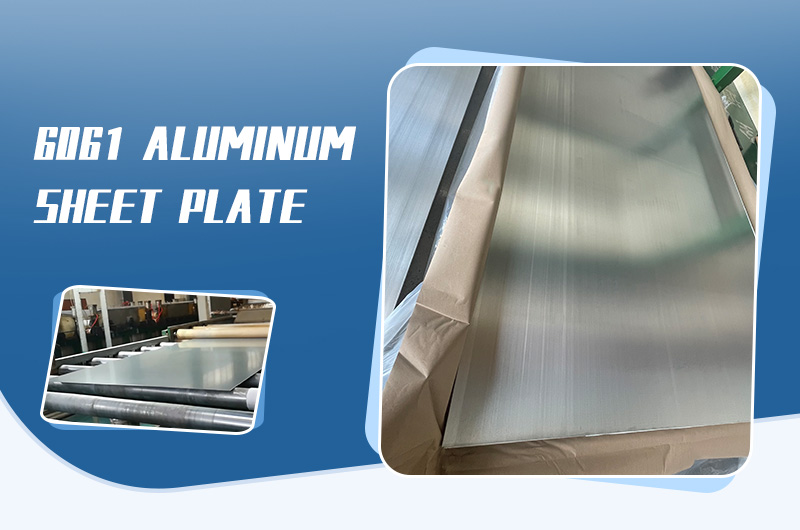
Equivalent Designations
| Standard | Designation |
| AA / UNS | 6061 / A96061 |
| ASTM | B209 (sheet/plate) |
| AMS | 4027 (T6 sheet/plate), 4117 (T651 plate) |
| EN | EN AW-6061 / AlMg1SiCu |
| DIN (W.Nr) | 3.3211 |
| JIS | A6061 |
| China (GB) | 6061 (old: LD30) |
| BS (UK) | HE20 |
| GOST (Russia) | АД33 |
Product Specifications
| Parameter | Details |
| Alloy | 6061 (UNS A96061 / EN AW-6061) |
| Tempers | O, T4, T451, T6, T651, T652 |
| Sheet Thickness | 0.2–6.0 mm (cold-rolled) |
| Plate Thickness | 6–250 mm (hot-rolled; T651 stress-relieved by stretching) |
| Width | 900–2650 mm |
| Length | Up to 6000 mm standard; custom-cut available |
| Surface | Mill finish, bright, polished, brushed, sandblasted, anodized, checkered, embossed |
| Protection Film | Blue / clear / B&W PE film (50 or 80 μm) |
| Standards | ASTM B209, AMS 4027 (T6), AMS 4117 (T651), AMS-QQ-A-250/11, EN 485-2, GB/T 3880 |
Temper Selection Guide
Quick Comparison
| Temper | Process | Tensile (MPa) | Yield (MPa) | Elongation (%) | Hardness (HB) | Best For |
| O | Full anneal | ≤150 | ~55 | ≥25 | ~30 | Deep forming, subsequent heat treatment |
| T4 | Solution treated + naturally aged | ≥205 | ≥110 | ≥22 | ~65 | Complex cold forming before aging to T6 |
| T6 | Solution treated + artificially aged | ≥290 | ≥241 | ≥8 | ~95 | General structural, machined parts (sheet ≤6 mm) |
| T651 | T6 + stretch stress-relieved | ≥290 | ≥241 | ≥8 | ~95 | Precision machining, thick plate (≥6 mm), jigs/fixtures |
Quick rule: O for maximum forming → T4 for form-then-age → T6 for general-purpose strength → T651 for thick plate and precision machining stability.
Temper Details
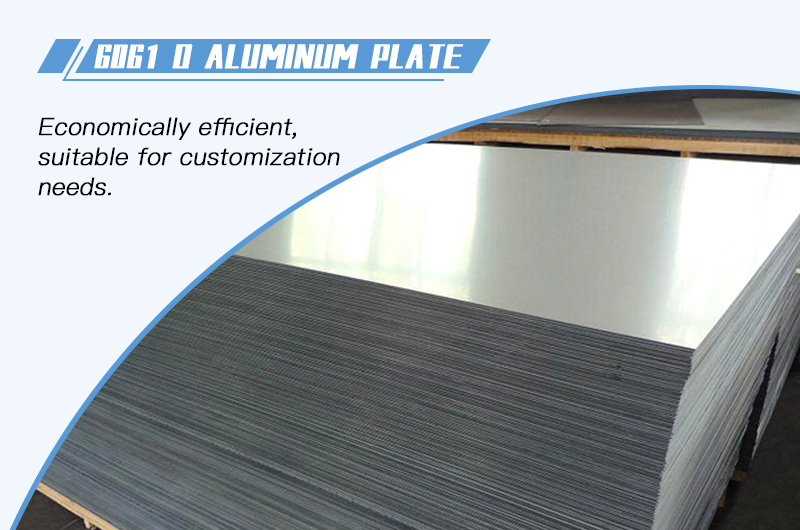
6061-O — Maximum Formability
- Fully annealed: lowest strength but highest ductility (≥25% elongation).
- Ideal for deep drawing, spinning, and complex cold forming.
- Can be subsequently solution-treated and aged to T6 strength.
6061-T4 — Form Then Age
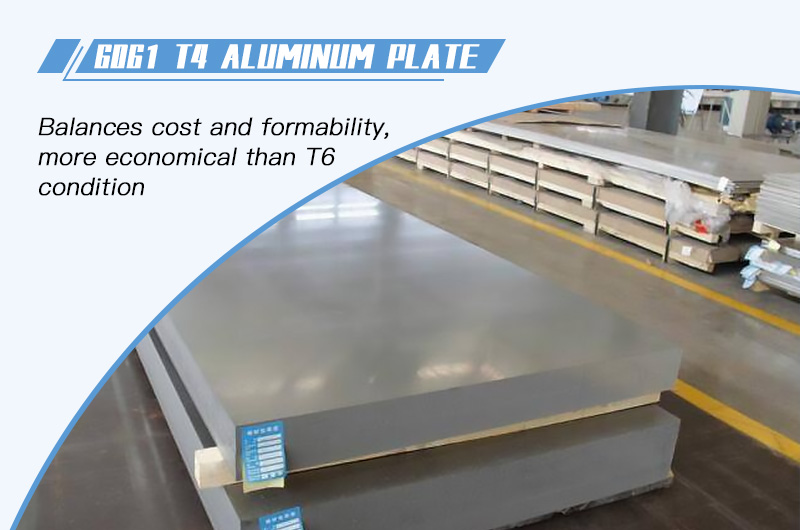
- Solution treated at ~530°C (water quenched) + naturally aged at room temperature.
- Retains high ductility (≥22% elongation) for complex forming, then can be artificially aged to T6.
- Use when: Parts require severe forming that T6 cannot tolerate.
6061-T6 — The Standard
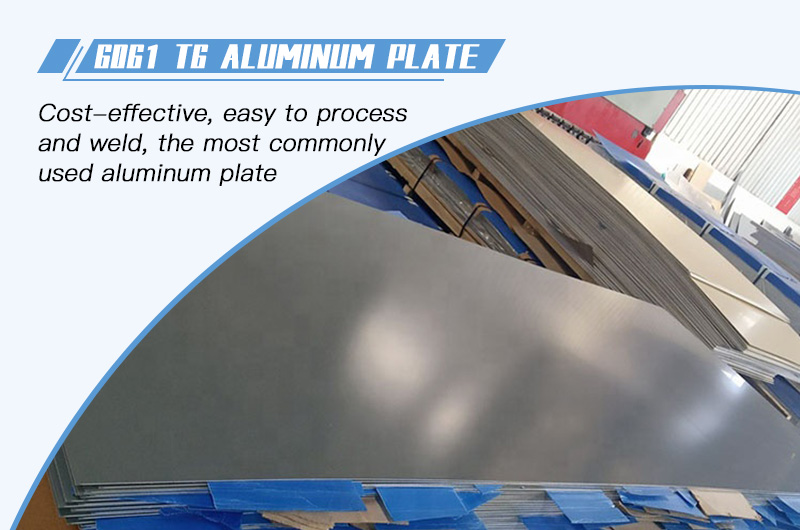
- Solution treated + artificially aged (160–175°C for 8–18 hr).
- UTS ≥290 MPa, Yield ≥241 MPa — the benchmark for structural aluminum.
- Excellent machinability, good anodizing response.
- Best for sheet-gauge parts (≤6 mm) and general CNC machining.
6061-T651 — Precision Plate
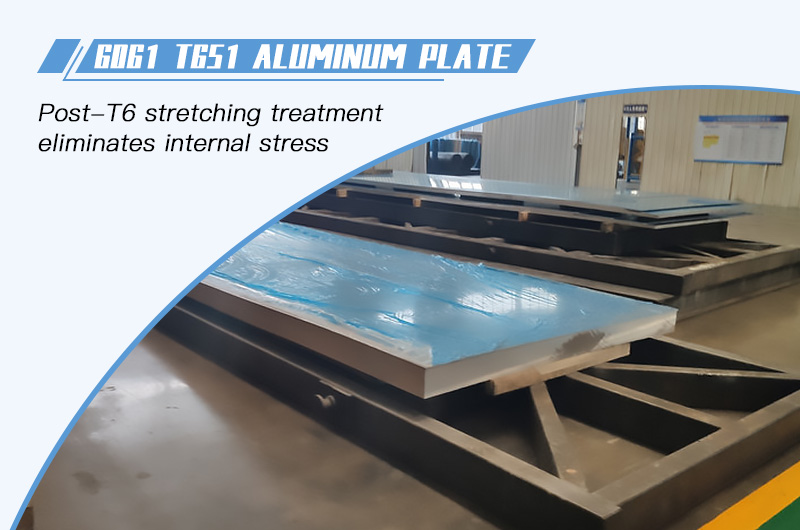
- T6 aging + 1–3% controlled stretching to relieve residual stress.
- Near-identical strength to T6 but with superior dimensional stability during machining.
- Mandatory for: Thick plate (≥6 mm), precision molds, jig plates, optical benches, aerospace tooling.
Heat Treatment Parameters
| Stage | T4 | T6 / T651 |
| Solution Treatment | 530°C, water quench | 530°C, water quench |
| Aging | Room temp, ≥4 days (natural) | 160–175°C, 8–18 hr (artificial) |
| Stress Relief | — | T651: 1–3% stretch after quench, before aging |
Chemical Composition (per ASTM B209)
| Element | Range (%) | Role |
| Si | 0.40–0.80 | Forms Mg₂Si strengthening precipitates with Mg |
| Mg | 0.80–1.20 | Primary strengthener; enhances corrosion resistance |
| Cu | 0.15–0.40 | Improves age-hardening response and strength |
| Cr | 0.04–0.35 | Inhibits intergranular corrosion; controls grain structure |
| Fe | ≤0.70 | Impurity — reduces ductility at high levels |
| Mn | ≤0.15 | Minor grain refiner |
| Zn | ≤0.25 | Impurity |
| Ti | ≤0.15 | Grain refiner |
| Al | Balance | Base metal |
Physical Properties
| Property | O Temper | T6 / T651 | Unit |
| Density | 2.70 | 2.70 | g/cm³ |
| Melting Range | 582–652 | 582–652 | °C |
| Thermal Conductivity | 180 | 167 | W/m·K |
| Electrical Conductivity | 47 | 40–43 | % IACS |
| CTE (20–100°C) | 23.6 | 23.6 | μm/m·K |
| Elastic Modulus | 68.9 | 68.9 | GPa |
Mechanical Properties
| Temper | Tensile (MPa) | Yield (MPa) | Elongation (%) | Hardness (HB) | Shear (MPa) |
| O | ≤150 | ~55 | ≥25 | ~30 | ~83 |
| T4 / T451 | ≥205 | ≥110 | ≥22 | ~65 | ~130 |
| T6 | ≥290 | ≥241 | ≥8 | ~95 | ~207 |
| T651 | ≥290 | ≥241 | ≥8 | ~95 | ~207 |
Notes:
- Values per ASTM B209 for standard thicknesses. Very thick plate (>100 mm) may have slightly lower yield.
- Fatigue strength: ~97 MPa at 5 × 10⁸cycles (T6, R =−1).
- T651 has identical strength to T6 but superior dimensional stability for precision machining.
Processing & Fabrication
Machining
6061-T6/T651 is one of the most machinable aluminum alloys — a primary reason for its popularity.
| Parameter | Recommendation |
| Tool Material | Carbide (preferred); HSS acceptable for low-volume |
| Cutting Speed | 200–400 m/min (HSS); 500–1000+ m/min (carbide) |
| Feed Rate | 0.1–0.3 mm/tooth |
| Coolant | Water-soluble emulsion or kerosene-based; flood preferred |
| Chip Formation | Clean, curled chips in T6; gummy in O temper (use T6 for machining) |
Tip: Always machine in T6 or T651 temper. O temper produces long, stringy chips and poor surface finish.
Forming
| Operation | O / T4 | T6 | Notes |
| Min. Bend Radius | ≥1.5t | ≥3t | Bend ⊥ to rolling direction |
| Deep Drawing | Good (O) / Good (T4) | Poor | Form in O or T4, then age to T6 |
| Hot Forming | — | 400–480°C | Re-solution treat + age after forming |
Welding
| Parameter | Recommendation |
| Process | TIG (GTAW) or MIG (GMAW) |
| Filler | ER4043 (general) or ER5356 (higher strength, better corrosion) |
| Shielding | 100% Argon |
| HAZ Effect | Weld zone reverts to ~O temper (~124 MPa UTS) |
| Recovery | Post-weld re-aging at ~175°C recovers HAZ to ~T4 level (~75% of T6 strength). Full recovery requires re-solution treatment + aging |
Critical: Unlike 5xxx alloys, 6061 loses significant strength in the HAZ when welded in T6 condition. Design weld joints for O-temper strength unless PWHT is planned.
Surface Treatment
| Method | Result | Notes |
| Anodizing (Type II) | 5–25 μm oxide; decorative colors; corrosion protection | 6061-T6 anodizes well; recommended for marine and outdoor use |
| Hard Anodizing (Type III) | 25–75 μm; high wear resistance (HV 350–500) | Wear-critical surfaces, aerospace components |
| Powder Coating | Durable colored finish; UV resistant | Architectural, consumer products |
| Chromate Conversion | Thin protective film; maintains conductivity | Electronics, grounding components |
6061 vs. Other Alloys
| Property | 6061-T6 | 6063-T6 | 5052-H32 | 7075-T6 |
| Series | 6xxx (Al-Mg-Si) | 6xxx (Al-Mg-Si) | 5xxx (Al-Mg) | 7xxx (Al-Zn-Mg-Cu) |
| Tensile (MPa) | ≥290 | ≥205 | ≥228 | ≥510 |
| Yield (MPa) | ≥241 | ≥170 | ≥160 | ≥434 |
| Elongation (%) | ≥8 | ≥8 | ≥7 | ≥7 |
| Machinability | ★★★★★ | ★★★ | ★★★ | ★★★★ |
| Corrosion | ★★★★ (anodized) | ★★★★ | ★★★★★ (bare) | ★★★ (needs protection) |
| Weldability | ★★★ (HAZ softening) | ★★★★ | ★★★★★ | ★ (not recommended) |
| Formability | ★★★ (T6); ★★★★★ (O) | ★★★★★ (extrusion) | ★★★★★ | ★★ |
| Cost | ●●○○ | ●●○○ | ●●○○ | ●●●● |
| Best For | Machined structural parts, jigs, marine fittings | Architectural extrusions, trim | Sheet metal forming, tanks, marine | Aerospace primary structure, high-load |
When to Choose 6061
| Scenario | Best Alloy | Why |
| CNC-machined structural parts | 6061-T6/T651 | Best machinability + anodizing in Al-Mg-Si family |
| Precision jig plate / mold base | 6061-T651 | Stress-relieved for dimensional stability |
| Maximum corrosion resistance (unwelded) | 5052-H32 | Higher Mg, no Cu → superior bare corrosion |
| Sheet-metal forming + welding | 5052 or 5754 | No HAZ strength loss; better formability |
| Architectural extrusions | 6063-T5 | Superior surface finish, easier extrusion |
| Maximum strength (aerospace primary) | 7075-T6 | UTS ≥510 MPa; ~75% stronger than 6061 |
Applications
Aerospace & Defense
- Tooling & jigs: T651 plate for molds, fixtures, optical benches (superior dimensional stability)
- Structural parts: Wing ribs, fuselage frames, landing gear brackets (AMS 4027 / 4117 certified)
- UAV frames: Lightweight + machinable
Marine & Offshore
- Structural fittings: Masts, deck hardware, porthole frames (anodized T6)
- Desalination equipment: Housings and frames with Type III hard anodizing
Note: For structural marine hull plate in seawater, 5083-H116 is the classification-required alloy. 6061 is used for fittings and above-waterline structures.
Transportation
- Automotive: Bumper beams, battery trays, structural reinforcements (T6)
- Bicycle & motorcycle: Frames, swingarms, handlebar stems
- Rail: Interior structural members, equipment racks
Electronics & Electrical
- Heat sinks: Thermal conductivity 167 W/m·K (T6); CNC-machined fin arrays
- Enclosures: 5G base station housings, instrument cases, laptop chassis
- Battery trays: EV battery pack structural frames
Precision Machining & Industrial
- Mold bases: T651 with flatness ≤0.1 mm/m
- Hydraulic manifolds: CNC-machined from T651 plate
- Robotic components: Arm links, end-effector plates
- Pressure vessels: ASME-coded (moderate pressure/temperature)
Stock Inventory (Excerpt)
We stock 6061 in T6 (sheet) and T651 (plate) across a comprehensive thickness range. Contact us for full availability and custom cutting.
6061-T6 Sheet
| Thickness (in) | Width (in) | Length (in) | Standards |
| 0.032 | 48 | 120, 144 | ASTM B209, AMS 4027 |
| 0.040 | 48 | 120, 144 | ASTM B209, AMS 4027 |
| 0.050 | 48 | 120, 144 | ASTM B209, AMS 4027 |
| 0.063 | 48 / 60 | 120, 144 | ASTM B209, AMS 4027 |
| 0.080 | 48 / 60 | 120, 144 | ASTM B209, AMS 4027 |
| 0.090 | 48 / 60 | 120, 144 | ASTM B209, AMS 4027 |
| 0.100 | 48 / 60 | 120, 144 | ASTM B209, AMS 4027 |
| 0.125 | 48 / 60 | 120, 144, 192 | ASTM B209, AMS 4027 |
| 0.160 | 48 / 60 | 120, 144 | ASTM B209, AMS 4027 |
| 0.190 | 48 / 60 | 120, 144 | ASTM B209, AMS 4027 |
6061-T651 Plate
| Thickness (in) | Width (in) | Length (in) | Standards |
| 0.250 | 48 / 60 / 96 | 120, 144, 240 | ASTM B209, AMS 4027 |
| 0.375 | 48 / 60 / 96 | 144, 240 | AMS 4117, QQ-A-250/11 |
| 0.500 | 48 / 60 / 96 | 144, 240 | AMS 4117 |
| 0.625 | 48 / 96 | 144, 240 | AMS 4117 |
| 0.750 | 48 / 96 | 144, 240 | AMS 4117 |
| 1.000 | 48 / 60 / 96 | 144, 240 | AMS 4117 |
| 1.250 | 48 / 96 | 144, 240 | AMS 4117 |
| 1.500 | 48 / 96 | 144, 240 | AMS 4117 |
| 2.000 | 48 / 96 | 144, 240 | AMS 4117 |
| 2.500–4.000 | 48 / 60 | 144 | AMS 4117 |
All material supplied with mill test reports. O and T4 tempers available on request.
Packaging & Shipping
| Item | Detail |
| Packing | ISPM-15 fumigated wooden pallets; ≤2 tons each; stackable 3 high |
| Protection | PE film + interleaving paper + VCI wrap + steel corner guards (50G impact rated) |
| Container | Dry, clean 20'/40' GP; no co-loading with reactive chemicals |
| Delivery | FOB / CIF / DDP; standard lead time ~7 days for stock items |
Pricing
FOB Price = SMM A00 Ingot Price + Processing Fee
Transparent formula; quoted in USD / EUR / CNY. 72-hour rush delivery available.
Why Choose Us for 6061?
When precision matters, the quality of your raw material dictates the success of your final product.
- State-of-the-Art German Mills: Rolled on an SMS Group 4500mm hot rolling line and a 2800mm CVC cold rolling mill. This guarantees ultra-low thermal deformation and surface roughness (Ra ≤ 0.8μm).
- Certified for the Skies: We operate under strict ISO 9001, AS9100 (Aerospace), Nadcap, and TS16949 (Automotive) quality management systems.
- Flawless Delivery: All T6/T651 plates are laminated with protective PVC film in dust-free workshops and shipped on IPPC fumigated wooden pallets to ensure zero transit damage.
Ready to start your next machining or
structural project?
Contact our engineering sales team today for rapid quoting, custom cutting
requirements, and full material test reports (MTRs).
FAQ
What is the tensile strength of 6061-T6?
Per ASTM B209, the minimum tensile strength of 6061-T6 is 290 MPa (42 ksi), with a typical value of ~310 MPa. Minimum yield strength is 241 MPa (35 ksi). These values apply to standard sheet and plate thicknesses; very thick plate (>100 mm) may have marginally lower minimums.
What is the difference between 6061-T6 and T651?
Mechanical properties are essentially identical (UTS ≥290 MPa, Yield ≥241 MPa). The difference is stress relief: T651 is stretched 1–3% after quenching to eliminate residual internal stresses. This makes T651 the correct choice for thick plate (≥6 mm) and any part requiring precision machining — it resists warping and distortion during material removal.
Can 6061 be welded?
Yes — 6061 is weldable with TIG or MIG using ER4043 (general purpose) or ER5356 (higher weld strength, better corrosion resistance) filler. However, the heat-affected zone (HAZ) reverts to near-O temper strength (~124 MPa) — a ~57% loss from T6. Post-weld re-aging at ~175°C can recover HAZ strength to approximately T4 level (~205 MPa). Full T6 recovery requires complete re-solution treatment + aging.
6061 vs 7075 — which should I choose?
6061-T6 is the all-purpose choice: good strength (290 MPa), excellent machinability, weldable, anodizable, moderate cost. 7075-T6 offers ~75% more strength (510+ MPa) but is harder to machine, essentially unweldable, less corrosion-resistant, and significantly more expensive. Choose 7075 only when maximum strength is the overriding requirement (aerospace primary structure, high-load military components).
Is 6061 suitable for marine use?
Yes — for above-waterline fittings, masts, deck hardware, and structural brackets, 6061-T6 with anodizing performs well. For submerged or splash-zone hull plating on classified vessels, 5083-H116 is required by class societies (DNV, ABS). 6061 contains Cu (0.15–0.4%), which makes bare 6061 more susceptible to pitting in seawater than Cu-free 5xxx alloys.
What is the minimum bend radius for 6061-T6?
Approximately 3× material thickness (bend ⊥ to rolling direction). For tighter bends, use O or T4 temper (min. radius ~1.5t), then age to T6 after forming.
Can 6061 be anodized?
Yes — 6061 is one of the best aluminum alloys for anodizing. Type II (5–25 μm) provides corrosion protection and accepts decorative dyes. Type III hard anodize (25–75 μm) delivers high wear resistance (HV 350–500) for aerospace and industrial applications.