


What is 2024 Aluminum Plate?
2024 aluminum plate is a typical hard aluminum alloy in the aluminum-copper-magnesium (Al-Cu-Mg) system. It belongs to the 2xxx series, with copper as the main alloying element. This alloy has a reasonable composition ratio and excellent comprehensive performance, making it the most heavily consumed alloy among hard aluminum alloys currently. Since this alloy was first applied to aircraft wing skins in 1936, it remains one of the most commonly used structural aluminum alloys in the aviation, aerospace, and military fields today.
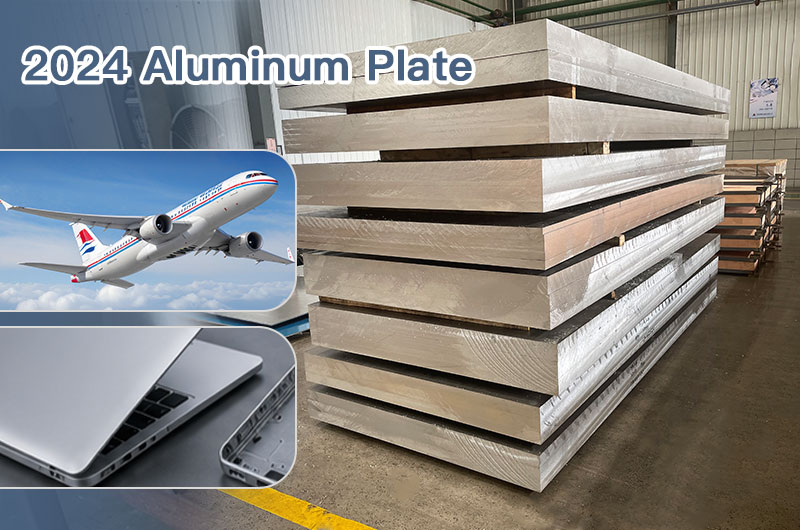
Its main alloying element is copper (about 3.8%~4.9%), supplemented by magnesium and manganese, possessing the following core advantages:
- High strength, light weight
- Excellent fatigue resistance
- Good machinability
Another significant feature of the 2024 aluminum alloy is that it can be processed into a wide variety of semi-finished products, including plates/sheets, bars, tubes, profiles, and even foils. Worthwill has long focused on the production and global supply of 2024 aluminum plates. With strict quality control and rich specification reserves, we provide customers with stable and reliable aluminum material solutions.
Chemical Composition of 2024 Aluminum Plate
The 2024 aluminum alloy strictly follows the Aluminum Association (AA) standards, and the content of each element is as follows:
| Element | Content (wt.%) |
|---|---|
| Aluminum (Al) | Remainder (90.7~94.7) |
| Copper (Cu) | 3.8~4.9 |
| Magnesium (Mg) | 1.2~1.8 |
| Manganese (Mn) | 0.30~0.90 |
| Iron (Fe) | ≤0.50 |
| Silicon (Si) | ≤0.50 |
| Zinc (Zn) | ≤0.25 |
| Titanium (Ti) | ≤0.15 |
| Chromium (Cr) | ≤0.10 |
Functions of main elements
- Copper: The most core strengthening element. It forms strengthening phases after heat treatment, substantially increasing strength.
- Magnesium: Works synergistically with copper to further improve strength and heat resistance.
- Manganese: Refines grains and improves thermal stability.
Iron and silicon are strictly limited as impurity elements; excessive content will form brittle phases, impairing the alloy's ductility and toughness.
Mechanical Properties of 2024 Aluminum Plate
The mechanical properties of 2024 aluminum plate vary significantly due to different heat treatment states (tempers), which is also the core parameter requiring the most attention when selecting materials.
Mechanical Properties Comparison of Various Tempers
| Temper | Tensile Strength (MPa) | Yield Strength (MPa) | Elongation (%) | Hardness (HB) | Fatigue Strength (MPa) |
|---|---|---|---|---|---|
| O (Annealed) | 170~220 | 70~100 | 15~20 | 47 | 89.6 |
| T3 | 400~483 | 270~345 | 10~18 | 120 | 138 |
| T4/T351 | 469 | 324 | 19~20 | 120 | 138 |
| T361 | 496 | 393 | 13 | 130 | 124 |
| T6 | 427~476 | 345~393 | 5~10 | 125 | 124 |
| T851 | ≥455 | ≥400 | 4.9 | 140 | 117 |
Other Key Physical and Mechanical Parameters
| Parameter | Value |
|---|---|
| Density | 2.78 g/cm³ |
| Elastic Modulus | 73.1 GPa |
| Shear Modulus | 28 GPa |
| Shear Strength (T3) | 283 MPa |
| Ultimate Bearing Strength | 814~855 MPa |
| Fracture Toughness KIC (L-T direction) | 37 MPa·m½ |
| Poisson's Ratio | 0.33 |
| Machinability Score | 70% (100-point scale for aluminum alloys) |
| Thermal Conductivity | 121 W/m·K |
| Electrical Conductivity | 30% IACS |
| Thermal Expansion Coefficient | 23.2 µm/m·°C |
| Melting Range | 502~638℃ |
The T3/T4 temper achieves the best balance between strength and ductility, making it the first choice delivery temper for formed parts like aviation skins; the T851 temper has the highest yield strength, suitable for the most strictly loaded structural parts; the O temper has the best ductility and is often used as an intermediate temper for deep drawing and forming.
Core Performance Advantages of 2024 Aluminum Plate
| Performance | Data | Advantage Description |
|---|---|---|
| Specific Strength | Density 2.78 g/cm³, Tensile strength ≥469 MPa | About 1/3 the weight of steel, strength comparable to structural steel |
| Fatigue Resistance | Fatigue strength 138 MPa (500 million cycles) | Far superior to most structural materials, ensuring flight safety |
| Fracture Toughness | KIC up to 37 MPa·m½ (L-T direction) | Effectively inhibits crack propagation, meets damage tolerance design |
| Machinability | Score 70% (Aluminum alloy percentage scale) | Smooth cutting, suitable for CNC precision machining |
| High-Temp Performance | Stable performance below 150℃ | Strength surpasses 7075 aluminum alloy above 125℃ |
| Recyclability | 100% recyclable and reusable | Complies with green manufacturing and carbon neutrality trends |
Corrosion Resistance and Protection Solutions for 2024 Aluminum Plate
Due to its relatively high copper content, 2024 has weak corrosion resistance in its bare aluminum temper and is prone to intergranular corrosion and stress corrosion cracking in humid, salt spray, or chloride-ion environments.
The T73 overaged temper improves anti-stress corrosion capability by several times compared to T6 through a triple mechanism: grain boundary precipitate coarsening, widening of the PFZ (Precipitate Free Zone), and relaxation of residual stress, making it the first choice temper for corrosive environments.
Three main protection solutions:
- Alclad Treatment: The most commonly used; covering a thin layer of high-purity aluminum on both sides of the core plate to form a "high-strength core + corrosion-resistant surface" composite structure, while also improving fatigue and fracture toughness. It is the standard product form for aviation skins.
- Anodizing: Generates a dense oxide film on the surface to improve corrosion resistance, hardness, and wear resistance, suitable for the protection of precision machined parts.
- Coating Protection: Epoxy primer or polyurethane topcoat; works even better when used in combination with anodizing, suitable for highly corrosive environments.
Welding Performance of 2024 Aluminum Plate
The 2024 aluminum alloy is extremely unfriendly to conventional fusion welding (TIG/MIG). High copper content easily leads to solidification cracking, and the strength and corrosion resistance of the heat-affected zone drop significantly after welding.
| Connection Method | Applicability | Description |
|---|---|---|
| Riveting | Preferred | Aerospace structural parts industry standard, no galvanic corrosion risk |
| Friction Stir Welding (FSW) | Recommended | Solid-temper welding, no melting, high retention rate of mechanical properties |
| Laser Welding | Usable | Can reduce crack risk, but process requirements are harsh |
| TIG/MIG Fusion Welding | Not Recommended | Prone to solidification cracks, massive performance loss |
Aviation riveting tip: 2024 rivets must be refrigerated immediately after heat treatment ("Icebox rivets") to delay natural age hardening and maintain sufficient ductility during installation.
Hot-Selling 2024 Aluminum Plates
The reason 2024 aluminum plate can leap from an ordinary strength of 170 MPa to an ultra-high strength of over 480 MPa relies entirely on this strict set of heat treatment processes: Solid solution (heating), quenching (extremely fast cooling), and aging (strengthening and setting).
2024-T3 Aluminum Plate
- Features: The most perfect comprehensive performance, balancing high strength with good fatigue resistance.
- Uses: The first choice for aircraft skins and conventional load-bearing structures.
2024-T351 Aluminum Plate
- Features: Based on T3, "stretching and straightening" is performed to completely eliminate internal stress.
- Uses: Exclusively built for precision CNC machining, absolutely no warping or deformation after cutting and milling.
2024-T851 / T6 Aluminum Plate
- Features: Through artificial high-temperature aging treatment, hardness and strength reach their highest peak.
- Uses: Suitable for structural parts bearing extremely heavy loads (Note: T851 has the highest strength but low elongation, making it relatively difficult to bend).
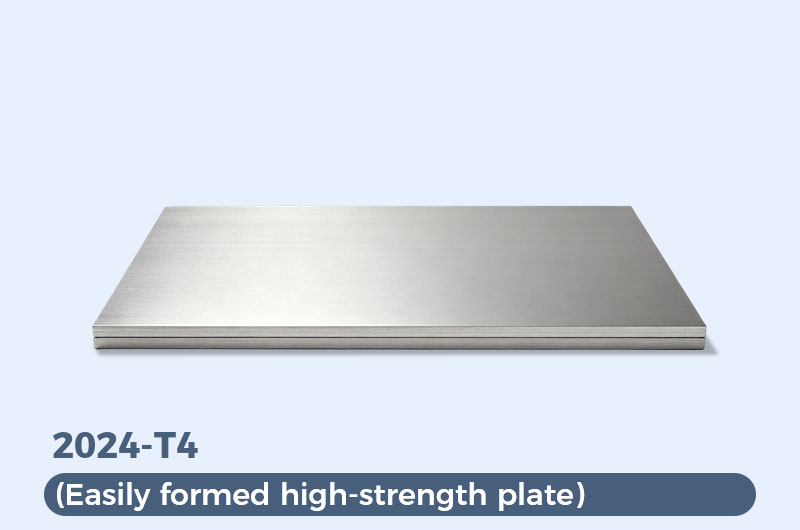
2024-T4 Aluminum Plate
- Features: Strength is slightly lower than T3, but formability is better.
- Uses: Suitable for parts that require subsequent stamping and bending.
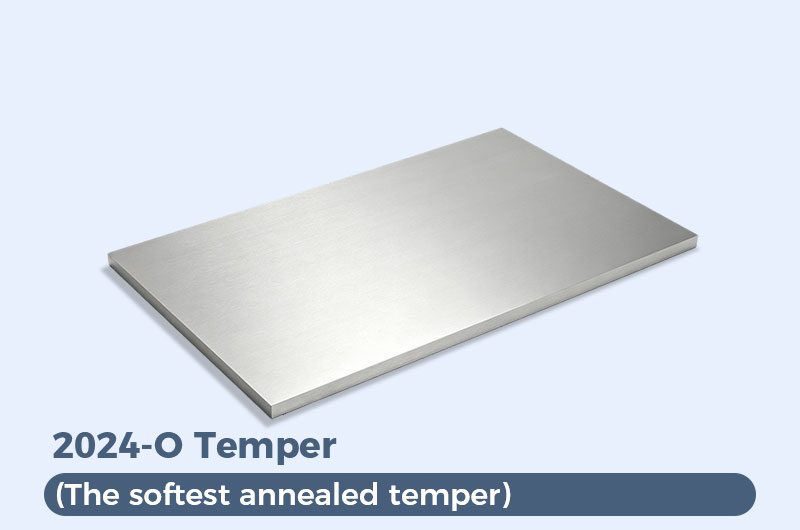
2024-O Aluminum Plate
- Features: Lowest strength, but best ductility.
- Uses: Exclusively designed for severe deformation and complex stamping; after forming and processing, customers perform heat treatment reinforcement themselves.
Process and Performance Comparison of 2024 Aluminum Plate in Various Tempers
| Temper | Solid Solution | Quenching | Cold Deformation | Aging | Tensile Strength | Elongation |
|---|---|---|---|---|---|---|
| O Temper | 350~415℃ furnace cooling | — | — | — | Lowest | Highest |
| T3 | 500±2℃/20min | Water cooling + resting 8h | 1.5% | Natural aging >96h | 400~483 MPa | 10~18% |
| T361 | 500±2℃/20min | Water cooling + resting 8h | 6.0% | Natural aging >96h | Higher than T3 | Lower than T3 |
| T4 | 500±2℃/20min | Water cooling | None | Natural aging >96h | Slightly lower than T3 | Slightly better than T3 |
| T351 | 500±2℃/20min | Water cooling + stretching/straightening | None | Natural aging >96h | Similar to T3 | Similar to T3 |
| T6 | 493℃/2h | Water cooling | None | 191℃/8~16h | Close to peak | Average |
| T81 | 500±2℃/20min | Water cooling + resting 8h | 1.5% | 190℃/12h | Higher than T6 | Lower |
| T851 | 500±2℃/20min | Water cooling + stretching/straightening | None | Artificial aging | ≥455 MPa | Approx. 4.9% |
| T861 | 500±2℃/20min | Water cooling + resting 8h | 6.0% | 190℃/8h | Highest | Lowest |
Corresponding Mechanical Properties by Temper (Compared with AA Standard)
| Temper | Measured Tensile Strength (MPa) | AA Standard Value (MPa) | Measured Yield Strength (MPa) | AA Standard Value (MPa) | Measured Elongation (%) |
|---|---|---|---|---|---|
| T3 | 477 | 420 | 388 | 275 | 17.1 |
| T361 | 481 | 440 | 388 | 330 | 12.3 |
| T81 | 463 | 445 | 423 | 385 | 5.5 |
| T861 | 508 | 475 | 461 | 440 | 5.5 |
Corrosion performance of T3/T361 temper: Both show level 3 intergranular corrosion, and exfoliation corrosion is level N (no exfoliation).
Microscopic Strengthening Mechanism
The strengthening essence of 2024 aluminum alloy is a series of microscopic phase transitions; different transition stages result in different performance expressions.
Phase transition path: Quenching → GP Zones → θ'/S' metastable phase (peak) → θ/S equilibrium phase (overaged)
| Stage | Features | Corresponding Temper |
|---|---|---|
| GP Zones | Nanoscale aggregation of copper atoms | T3/T4 |
| θ'/S' Metastable Phase | Semi-coherent, strongly hinders dislocations, highest strength | T6/T8 |
| θ/S Equilibrium Phase | Coherency disappears, strength drops slightly, corrosion resistance massively improved | T73 |
The slow precipitation speed of the S phase grants the 2024 alloy excellent thermal strength. When the temperature is higher than 125℃, the strength of the 2024 alloy exceeds that of the 7075 alloy.
Development History of 2024 Aluminum Alloy and its Variants
The development direction of 2024 aluminum alloy is very clear: on the premise of keeping the main alloying elements largely unchanged, it continuously evolves toward high purification to improve the alloy's ductility, toughness, and strength.
Except for 2024A (developed by France) and 2224A (developed by Russia), all other generations were invented by the Aluminum Company of America (Alcoa).
| Alloy Grade | Year Introduced | Si (max) | Fe (max) | Cu | Mg | Main Features |
|---|---|---|---|---|---|---|
| 2024 | 1954 | 0.50 | 0.50 | 3.8–4.9 | 1.2–1.8 | Original alloy |
| 2024A | 1996 | 0.15 | 0.20 | 3.7–4.5 | 1.2–1.5 | French high-purification version |
| 2124 | 1970 | 0.20 | 0.30 | 3.8–4.9 | 1.2–1.8 | Reduced Fe/Si |
| 2224 | 1978 | 0.12 | 0.15 | 3.8–4.4 | 1.2–1.8 | Further impurity reduction |
| 2324 | 1978 | 0.10 | 0.12 | 3.8–4.4 | 1.2–1.8 | Ultra-low impurities |
| 2424 | 1994 | 0.10 | 0.12 | 3.8–4.4 | 1.2–1.6 | Optimized Mn content |
| 2524 | 1995 | 0.06 | 0.12 | 4.0–4.5 | 1.2–1.6 | Newest generation, lowest Fe/Si |
It can be clearly seen from the table: The allowable content of Fe and Si has been gradually reduced from 0.50% in the first generation to 0.06% (Si) and 0.12% (Fe) in the newest generation 2524. The alloy purity has significantly increased, and ductility, toughness, and fatigue performance have improved remarkably as a result.
2024 Aluminum Plate vs. 7075 Aluminum Plate vs. 6061 Aluminum Plate
When selecting high-strength aluminum alloys, 2024, 7075, and 6061 are the three most frequently compared alloys, each with its own application scenarios.
2024 Aluminum Plate vs. 7075 Aluminum Plate
| Comparison Dimension | 2024 Aluminum Plate | 7075 Aluminum Plate |
|---|---|---|
| Main Alloying Elements | Cu (3.8–4.9%) | Zn (5.1–6.1%) |
| Tensile Strength | 469 MPa (T4) | 572 MPa (T6) |
| Yield Strength | 324 MPa (T4) | 503 MPa (T6) |
| Fatigue Performance | Better (First choice for aviation skins) | Poorer |
| Formability | Better (Elongation 19%) | Poorer (12%) |
| Corrosion Resistance | Medium | Poorer |
| High-Temp Strength | Surpasses 7075 at >125℃ | Lower than 2024 (>125℃) |
| Applicable Scenarios | Fatigue load structural parts, skins | Ultimate static strength structural parts |
7075 has the advantage in ultimate strength, but 2024 comprehensively leads in fatigue resistance, formability, and high-temperature stability. For components enduring repeated alternating loads, such as aircraft skins and fuselage structures, 2024 is the more reasonable choice; for components requiring extreme static load bearing capacity, such as landing gears and high-stress frames, 7075 is preferred.
2024 Aluminum Plate vs. 6061 Aluminum Plate
| Comparison Dimension | 2024 Aluminum Plate | 6061 Aluminum Plate |
|---|---|---|
| Main Alloying Elements | Cu | Mg+Si |
| Tensile Strength | 469 MPa (T4) | 310 MPa (T6) |
| Yield Strength | 324 MPa (T4) | 276 MPa (T6) |
| Corrosion Resistance | Poorer | Good |
| Weldability | Poor (Fusion welding not recommended) | Excellent (Both TIG/MIG are viable) |
| Machinability | 70% | Good |
| Typical Applications | Aviation structural parts | General structural parts |
6061 is a "universal" aluminum alloy: corrosion-resistant, easy to weld, and highly versatile; 2024 is "performance-first," with strength about 50% higher than 6061, making it the exclusive choice for aviation, military, and other scenarios with strict strength requirements.
Typical Application Scenarios of 2024 Aluminum Plate

Aviation and Aerospace
- Aircraft: Wing skins, fuselage skins, wing ribs, bulkheads, and other main load-bearing structures.
- Aerospace: Rockets, missiles, satellite thin-walled structural parts, honeycomb panels.
Among them, 2024 T3/T4 are mostly used for skin forming; 2024 T851 is mostly used for frame load-bearing; 2024 T73 is mostly used for corrosive environment components.

Automotive and Transportation
Truck wheel hubs, body panels, suspension components, and other lightweight structural parts.

Precision Machinery
Hydraulic valve bodies, gears, shaft parts, precision rivets, bolts, etc. With a machinability score of 70%, it is suitable for high-precision CNC machining.
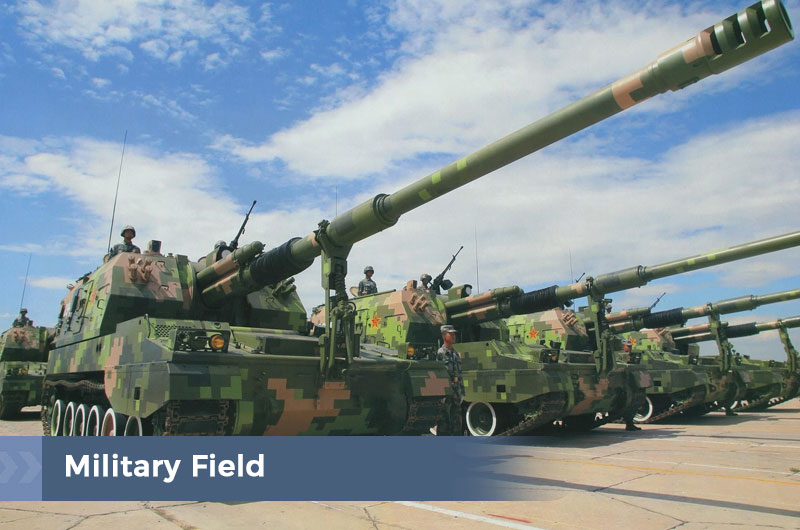
Military Field
Missile components, ammunition parts, fuze parts. High strength and high fatigue performance meet military reliability requirements.

Other Fields
Hydraulic equipment, medical devices, electronic structural parts, camera housings, etc.
Product Specifications and Supply Forms of 2024 Aluminum Plate
Worthwill can supply 2024 aluminum plate products in various specifications and tempers to meet the differentiated needs of customers across different industries.
Plates and Sheets
| Product Form | Common Thickness | Common Tempers | Execution Standards |
|---|---|---|---|
| Bare Plate | 0.25mm~125mm | O, T3, T351, T851 | AMS4037, ASTM B209 |
| Alclad Plate | 0.25mm~50mm | O, T3 | AMS4462, ASTM B209 |
| Phosphoric Acid Anodized Plate | Above 0.3mm | T3 | AMS4037 |
| Precision Ground Plate | Customized | T351 | Customized on demand |
Bars
| Cross-Section Shape | Common Tempers | Size Range | Standard |
|---|---|---|---|
| Round Bar | T351, T4 | 12mm~200mm | AMS4120, ASTM B211 |
| Hexagonal Bar | T351 | 12mm~50mm | Same as above |
| Square Bar | T351 | 12mm~100mm | Same as above |
| Flat Bar | T351, T4 | Multi-specification | Same as above |
Main Execution Standards
| Standard System | Standard Number |
|---|---|
| Chinese National Standard | GB/T 3880-2006 |
| American ASTM | B209 (Plates), B211 (Bars) |
| American AMS | 4037 (Bare Plate T3), 4462 (Alclad T3), 4120 (Bar T4) |
| American QQ | QQ-A-250/4 (Plates), QQ-A-250/5 (Alclad Plates) |
| International ISO | AlCu4Mg1 |
International Equivalent Grades
| Standard System | Grade |
|---|---|
| United States (UNS) | A92024 |
| China | 2A12 |
| Germany (DIN) | AlCuMg2 |
| France (NF) | A-U4G1 |
| International (ISO) | AlCu4Mg1 |
| United Kingdom (BS) | L97/L98 |
| Old Name | Duralumin 24ST |
Processing Precautions for 2024 Aluminum Plate
Machining
- Recommended to use K-series carbide milling cutters, with a rake angle of 12° and an edge inclination angle of 20°~25°.
- Rough machining: Large diameter fine-tooth tools, reducing the number of passes, improving removal efficiency.
- Finish machining: Control cutting heat, use loop cutting to improve machining stability.
Residual Stress Control
- Prioritize T351 or T851 tempers (aged after stretching and straightening) for the lowest residual stress.
- For thin plate parts, a bidirectional pre-stretching process (main stretching amount 2.0%) can be used to effectively reduce quenching residual stress.
Surface Treatment
- Anodizing (Sulfuric Acid/Phosphoric Acid): Improves corrosion resistance and surface hardness. Phosphoric acid anodizing (PAA) is the standard pretreatment for aviation adhesive bonding.
- High corrosion resistance demand: Prioritize Alclad plates, or an anodizing + organic coating composite protection.
2024 Aluminum Plate Selection Guide
| Demand Dimension | Condition | Recommended Temper |
|---|---|---|
| Strength Demand | Ultimate static strength | T851/T8 |
| High fatigue strength | T3/T4 | |
| Best formability | O Temper | |
| Corrosive Environment | Marine/High salt environment | T73 or Alclad plate |
| Indoor dry environment | Bare plate T3/T6 | |
| Processing Method | Bending, stamping forming | O temper or T3 |
| Precision mechanical machining | T351/T851 | |
| Working Temperature | ≤125℃ | All standard tempers are acceptable |
| 125~150℃ | 2024 is superior to 7075 | |
| >150℃ | Requires special evaluation |
Future Development Trends of 2024 Aluminum Plate
- New Energy Vehicles: Rapidly expanding lightweight demands for battery pack structural parts and body frames.
- Aviation and Aerospace: High-density launches and commercial aviation expansion are driving sustained incremental demand.
- Heat Treatment Innovation: RRA (Retrogression and Re-aging), ICME (Integrated Computational Materials Engineering) improving process accuracy.
- Additive Manufacturing: Development of 3D printing specific heat treatment specifications to solve anisotropy problems.
- Green Manufacturing: Energy-saving processes such as polymer quenchants and aerosol quenching replacing traditional water quenching.
Why Choose Worthwill's 2024 Aluminum Plate?
Henan Worthwill Industry Co., Ltd. is a professional enterprise focusing on the production and global supply of high-performance aluminum alloy materials. We have accumulated rich technical strength and delivery experience in the field of 2024 aluminum plates.
Worthwill's 2024 aluminum plate products strictly execute the GB/T 3880-2006 national standard as well as international standards such as AMS and ASTM. Every batch of products leaving the factory passes a dual quality control system of 100% electrical conductivity inspection and hardness sampling inspection to ensure that the heat treatment temper is accurate and performance indicators are stable and reliable.
We provide:
- Thickness range: 0.1mm~125mm, full series of tempers from O to T851
- Two surface forms: Bare plate and Alclad plate
- Customized dimension cutting, fast global delivery
For technical consultation, quotations, or samples, please feel free to contact the Worthwill professional team at any time.
Frequently Asked Questions (FAQ)
- Q: How much stronger is 2024 aluminum plate compared to 6061 aluminum plate?
- The yield strength of 2024-T4 is about 324 MPa, which is roughly 17% higher than the 276 MPa of 6061-T6, and the tensile strength is about 50% higher. In aviation applications requiring high fatigue resistance and strict specific strength, the advantages of 2024 are even more prominent.
- Q: Can 2024 aluminum plate be welded?
- Conventional fusion welding (TIG/MIG) is not recommended because the high copper content leads to a high risk of solidification cracking. Friction Stir Welding (FSW) is currently the most suitable welding method; in actual engineering, riveting is heavily used instead of welding, as it is safe and reliable.
- Q: At what maximum temperature can 2024 aluminum plate be used?
- 2024 aluminum plate can maintain stable mechanical properties below 150℃. Above 150℃, its strength drops sharply, so it is not recommended for long-term use at higher temperatures.
- Q: How to choose between 2024 aluminum plate and 7075 aluminum plate?
- If bearing repeated alternating loads, requiring high fatigue performance, or subsequent forming/processing → choose 2024; if pursuing the highest static strength and able to accept more stringent processing techniques → choose 7075. Both have their own strengths, and the core lies in the working condition requirements.