


2024 vs. 7075 Aluminum Plate
When selecting aluminum alloys, the 2024 aluminum plate and 7075 aluminum plate are two of the most common options encountered by engineers and procurement professionals.
While both belong to the high-strength aerospace-grade aluminum category, they exhibit distinctly different performance characteristics and application scenarios. Choosing the wrong material can lead to unnecessary cost overruns and, more importantly, compromise product safety.
This article provides a systematic comparison between 2024 and 7075 aluminum plates across multiple dimensions—including chemical composition, mechanical properties, processability, corrosion resistance, and cost—while including the 6061 aluminum plate as a reference baseline to help you make the optimal choice.
What is 2024 Aluminum Plate?
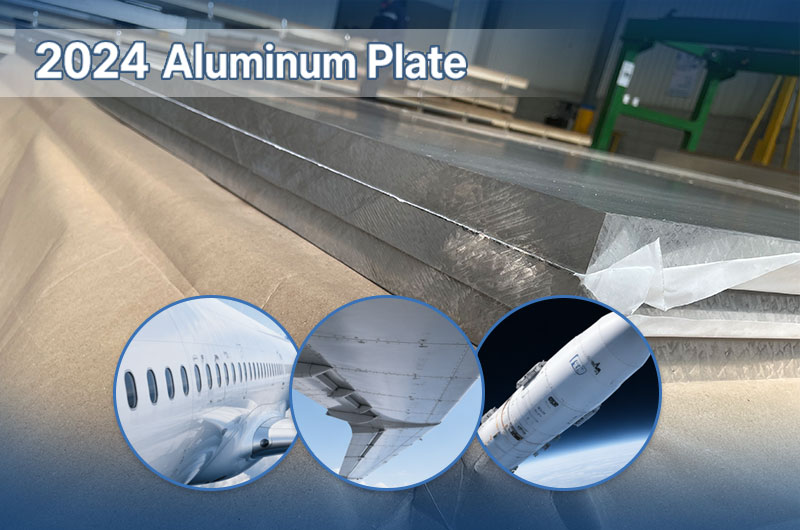
The 2024 aluminum alloy belongs to the 2000 series (Al-Cu-Mg system). With copper as its primary alloying element, it is commonly referred to as "Duralumin."
Officially registered in the United States in 1954, it is one of the most widely used hard aluminum alloys globally, boasting over 70 years of application history in aerospace, defense, and transportation.
The most prominent feature of the 2024 aluminum plate is its exceptional fatigue resistance and high specific strength, making it particularly suitable for structural parts subjected to cyclical stress, such as aircraft skins and lower wing panels.
Additionally, 2024 is one of the few aluminum alloys that retain good heat resistance; when temperatures exceed 125°C, its strength surpasses that of the 7075 alloy, making it viable for operating environments up to 150°C.
International Equivalent Grades:
- China GB: 2A12 (LY12)
- USA AA: 2024
- Europe EN: EN AW-2024 (AlCu4Mg1)
- Japan JIS: A2024
- Execution Standards: GB/T 3880.2-2024, ASTM B209-2020, AMS 4037
What is 7075 Aluminum Plate?
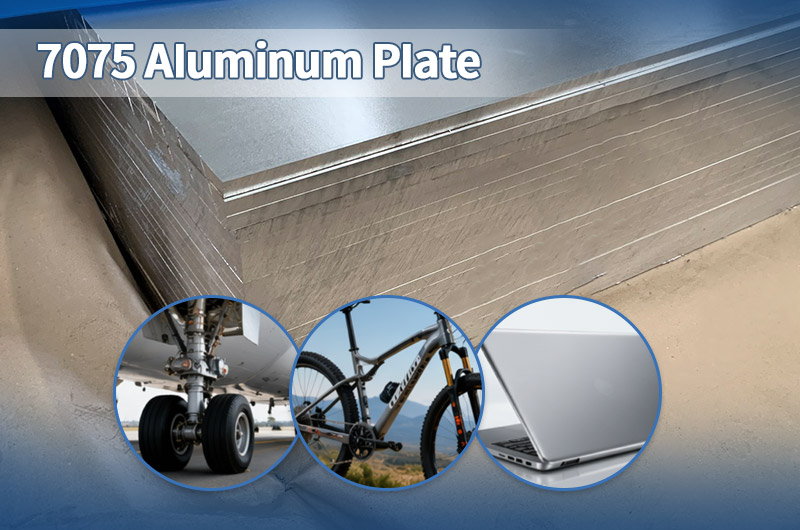
The 7075 aluminum alloy belongs to the 7000 series (Al-Zn-Mg-Cu system). With zinc as its primary alloying element, it is one of the highest-strength commercial aluminum alloys available, earning the title of "Super Duralumin."
First developed by Japan's Sumitomo Metals in 1935, it was reverse-engineered and popularized by Alcoa (USA) in 1943, and officially standardized for aerospace applications in 1945.
The greatest advantage of the 7075 aluminum plate is its extreme tensile strength and excellent fatigue performance. In the T6 temper, its tensile strength can reach 572 MPa (and over 590 MPa in certain tempers), rivaling the strength of medium carbon steel.
International Equivalent Grades:
- China GB: 7075
- USA AA: 7075 (UNS A97075)
- Europe EN: EN AW-7075 (AlZn5.5MgCu)
- Japan JIS: A7075
- Execution Standards: GB/T 3880.2-2020, ASTM B209-20, AMS-QQ-A-250/12
Quick Comparison Table: 2024 vs. 7075 vs. 6061
| Feature | 2024 Aluminum | 7075 Aluminum | 6061 Aluminum |
|---|---|---|---|
| Primary Alloy Element | Copper (Cu) | Zinc (Zn) | Magnesium + Silicon (Mg+Si) |
| Density (g/cm³) | 2.78 | 2.81 | 2.70 |
| Tensile Strength (MPa) | 469–483 (T3) | 560–572 (T6) | 290–310 (T6) |
| Yield Strength (MPa) | 324–345 (T3) | 480–503 (T6) | 240–276 (T6) |
| Elongation (%) | 15–18 | 7–11 | 10–16 |
| Hardness (HB) | 120 | 150–160 | 95 |
| Fatigue Resistance | 1st | 2nd | 3rd |
| Corrosion Resistance | Poor | Poor | Good |
| Weldability | Poor | Poor | Excellent |
| Formability | Good | Fair | Good |
| Machinability | Good | Good | Excellent |
| Max Operating Temp | 150°C | 120°C | 100°C |
| Overall Cost | Medium | High | Low |
Chemical Composition Comparison
Although both 2024 and 7075 are high-strength alloys, their strengthening mechanisms are completely different:
- 2024: Relies on Copper (Cu) and Magnesium (Mg) to form Al₂CuMg (S-phase) precipitation strengthening.
- 7075: Relies on Zinc (Zn) and Magnesium (Mg) to form MgZn₂ (η-phase) precipitation strengthening, with Copper acting as a secondary strengthener. This fundamental difference leads to significant variations in strength, corrosion resistance, and weldability.
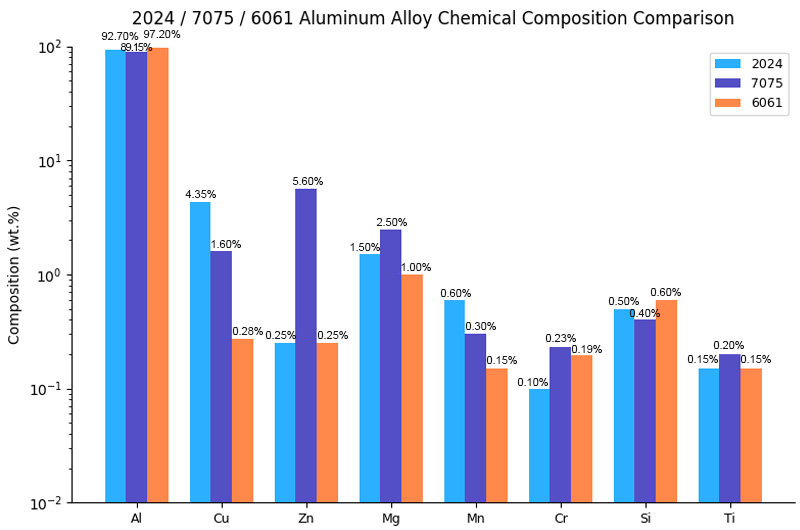
| Element | 2024 (wt.%) | 7075 (wt.%) | 6061 (wt.%) |
|---|---|---|---|
| Aluminum (Al) | 90.7–94.7 (Balance) | 86.9–91.4 (Balance) | 95.8–98.6 (Balance) |
| Copper (Cu) | 3.8–4.9 | 1.2–2.0 | 0.15–0.4 |
| Zinc (Zn) | ≤0.25 | 5.1–6.1 | ≤0.25 |
| Magnesium (Mg) | 1.2–1.8 | 2.1–2.9 | 0.8–1.2 |
| Manganese (Mn) | 0.3–0.9 | ≤0.3 | ≤0.15 |
| Chromium (Cr) | ≤0.10 | 0.18–0.28 | 0.04–0.35 |
| Silicon (Si) | ≤0.50 | ≤0.40 | 0.4–0.8 |
| Titanium (Ti) | ≤0.15 | ≤0.20 | ≤0.15 |
Key Takeaways:
- 7075's Zinc content (5.1–6.1%) is much higher than 2024 (≤0.25%), which is the core reason for 7075's superior strength.
- 2024's Copper content (3.8–4.9%) is much higher than 7075 (1.2–2.0%), granting 2024 superior fatigue resistance.
- 6061 relies on Mg+Si. While it has the lowest strength, it offers the best overall processability.
Mechanical Properties Comparison
Mechanical properties are the core criteria for material selection. The data below represents typical values in their standard heat-treated tempers.
Tensile & Yield Strength
| Property | 2024-T3 | 2024-T351 | 7075-T6 | 7075-T651 | 6061-T6 |
|---|---|---|---|---|---|
| Tensile Strength (MPa) | 470–483 | 440–470 | 560–572 | 550–570 | 290–310 |
| Yield Strength (MPa) | 325–345 | 290–325 | 480–503 | 460–500 | 240–276 |
| Elongation (%) | 15–18 | 13–15 | 7–11 | 8–11 | 10–16 |
| Hardness (HB) | 120 | 120 | 150–160 | 150 | 95 |
| Fatigue Strength (MPa) | 138–207 | 138 | 159–190 | 160 | 97 |
Key Performance Analysis
- Strength: The tensile strength of 7075-T6 (~572 MPa) is about 22% higher than 2024-T3 (~470 MPa), and its yield strength is about 46% higher. For applications requiring the bearing of extreme static loads (e.g., aircraft landing gear, high-stress structures), 7075 is the superior choice.
- Fatigue Performance: The fatigue crack growth rate of 2024 (da/dN = 3×10⁻⁵ mm/cycle) is noticeably lower than 7075 (5×10⁻⁵ mm/cycle). This means under repeated cyclic loading (like an aircraft fuselage enduring takeoff/landing stresses), 2024 has a longer service life and higher safety margins.
- Ductility: The elongation of 2024-T3 (15–18%) is significantly higher than 7075-T6 (7–11%), indicating better plasticity. This makes 2024 more suitable for forming operations and structures requiring a degree of deformation capability.
- High-Temperature Performance: At temperatures exceeding 125°C, 2024 retains its strength better than 7075. At 150°C, 2024 maintains about 85% of its room-temperature strength, whereas 7075 experiences a significant drop above 120°C, making it unsuitable for high-temperature applications.
Physical Properties Comparison
| Physical Parameter | 2024 | 7075 | 6061 |
|---|---|---|---|
| Density (g/cm³) | 2.78 | 2.81 | 2.70 |
| Melting Range (°C) | 502–638 | 477–635 | 582–652 |
| CTE (µm/m·K, 20–100°C) | 23.2 | 23.6 | 23.6 |
| Thermal Conductivity (W/m·K) | 121 | 130 | 167 |
| Electrical Conductivity (%IACS) | 30 | 33 | 43 |
| Elastic Modulus (GPa) | 73.1 | 71.7 | 68.9 |
| Poisson's Ratio | 0.33 | 0.33 | 0.33 |
Notes:
- The densities are very close (~2.8 g/cm³); weight differences are negligible. The difference in specific strength is primarily driven by their tensile strength values.
- 7075 has slightly better thermal conductivity, offering a minor edge in applications requiring heat dissipation.
- 2024 has a slightly higher elastic modulus, indicating marginally better resistance to elastic deformation in high-rigidity applications.
Processing Performance Comparison
Machinability
Both alloys have a "B-rating" (70% score per Aluminum Association standards) for machinability, which is considered good.
- 2024: Excels in the annealed temper. Due to its relatively lower hardness compared to 7075, tool wear is slower, making it ideal for high-volume precision machining.
- 7075: Harder material; requires carbide or diamond tooling. Recommended cutting speeds are 90–120 m/min with a feed rate of 0.1–0.2 mm/r.
Weldability
| Welding Method | 2024 | 7075 | 6061 |
|---|---|---|---|
| Fusion Welding | Poor (Hot-cracking prone) | Poor (Highly hot-cracking prone) | Good |
| Friction Stir Welding (FSW) | Viable (Joint efficiency ≥90%) | Viable (Joint efficiency ≥95%) | Excellent |
| Riveting | Recommended | Recommended | Optional |
| Spot/Seam Welding | Good | Fair | Good |
Note: Traditional fusion welding is not recommended for either 2024 or 7075. Aerospace structures typically use riveting, adhesive bonding, or FSW. If welding is a must, 6061 is the primary choice.
Formability
- 2024: Excellent formability in the annealed (O) or freshly quenched tempers due to high elongation. Suitable for bending, deep drawing, and complex forming.
- 7075: Relatively poor formability. Usually requires forming in the annealed temper, followed by heat treatment to reach the desired strength.
Heat Treatment
| Parameter | 2024 | 7075 |
|---|---|---|
| Solid Solution Temp (°C) | 490–505 | 465–480 |
| Artificial Aging Temp (°C) | 185–195 (T6/T62) | 120 (T6 single-stage) |
| Artificial Aging Time (h) | 8–14 | 24 |
| Typical Tempers | T3, T351, T851 | T6, T651, T7351 |
Corrosion Resistance Comparison
Corrosion resistance is a shared weakness for both alloys, but the mechanisms and severity differ.
| Corrosion Type | 2024 | 7075-T6 | 7075-T73 | 6061 |
|---|---|---|---|---|
| General Atmospheric | Poor | Poor | Fair | Good |
| Stress Corrosion Cracking (SCC) | Fair (T3/T351) | Sensitive (T6/T651) | Good (T73) | Excellent |
| Pitting (Chloride media) | Poor | Poor | Fair | Fair |
| Exfoliation Corrosion | Fair | Poor (T6) | Good (T76) | Good |
Crucial Note: 7075-T6 is highly sensitive to Stress Corrosion Cracking (SCC). It must be used with caution in humid or chloride-rich environments. For harsh environments, use the 7075-T73 or T7351 temper, which sacrifices 15–20% of strength for a massive improvement in corrosion resistance.
Common Protection Solutions:
- 2024: Alclad (coating with high-purity aluminum, standard for aerospace), Anodizing + Sealing, Chromate/Zirconate conversion coatings, Painting.
- 7075: Chromic acid anodizing (aerospace certified), Titanium plating, Hard anodizing (up to 50 µm), or utilizing the T73/T7351 temper.
Typical Application Scenarios
When to Choose 2024 Aluminum Plate
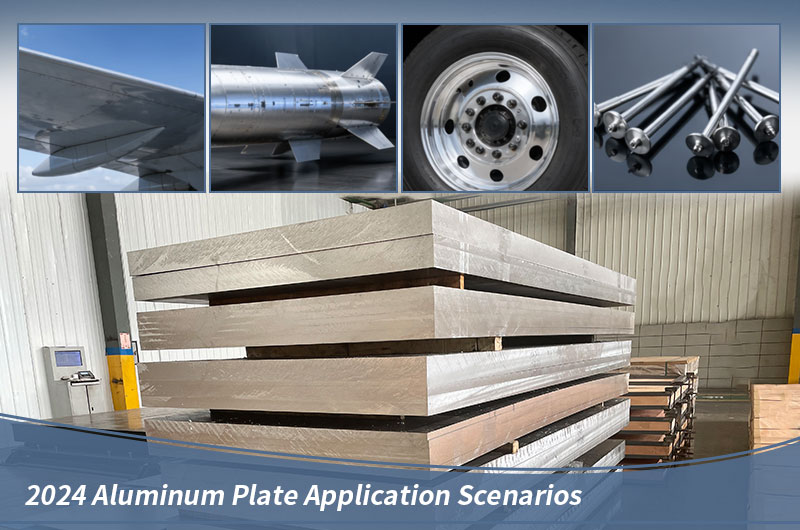
Thanks to its exceptional fatigue resistance and good formability, 2024 is ideal for:
- Aircraft skins and fuselages: High fatigue life required for takeoff/landing stress.
- Lower wing panels: Enduring tensile loads (2024 is the standard).
- Missile casings and aerospace structures: Balancing strength and damage tolerance.
- Truck hubs and propeller blades: Medium-to-high strength with ductility.
- Rivets: The plasticity of 2024 makes it the classic material for aluminum rivets.
- High-temp components (<150°C): Outperforms 7075 when temps exceed 125°C.
When to Choose 7075 Aluminum Plate
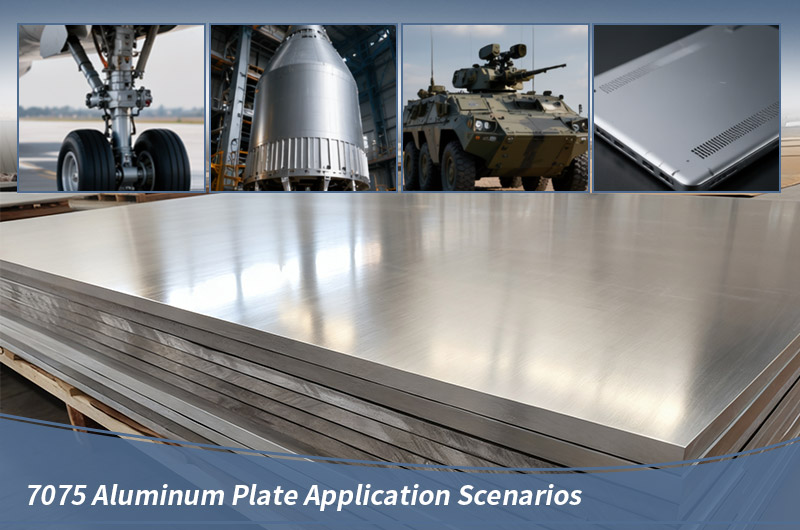
With its extreme strength and high strength-to-weight ratio, 7075 is ideal for:
- Aircraft landing gear, wing spars, bulkheads: Critical load-bearing parts enduring extreme static loads.
- Rocket fuel tanks: Lightweighting with high strength.
- Military & Defense: Armor plating, weapon components (e.g., M16 rifle receivers).
- Precision molds: Blow molds, ultrasonic welding molds (good thermal conductivity and forming efficiency).
- High-end sporting goods: Bicycle frames, carabiners, golf club heads.
- High-end electronics: Smartphone/laptop bodies (e.g., famously used in the OPPO N3).
Application Summary Table
| Application | 2024 | 7075 | 6061 |
|---|---|---|---|
| Aircraft Fuselage Skins | 1st Choice | Usable | Fair |
| Landing Gear / Wing Spars | Fair | 1st Choice | N/A |
| Missile/Space Structures | Suitable | Suitable | N/A |
| Precision Molds | Fair | 1st Choice | Fair |
| Sporting Goods | Fair | 1st Choice | Suitable |
| Welded Structures | Not Rec. | Not Rec. | 1st Choice |
| Architecture / Windows | Not Rec. | Not Rec. | 1st Choice |
| Automotive Structures | Suitable | High-end Only | 1st Choice |
| High Temp (>125°C) | 1st Choice | Unsuitable | Unsuitable |
Cost and Purchasing Advice
Price Reference
The general pricing hierarchy is: 6061 < 2024 < 7075
- 6061: Lowest price and machining cost. Highest cost-performance ratio for general structural applications.
- 2024: Medium price, good processability. Excellent value for aerospace and military applications.
- 7075: Highest price. The alloying elements (especially Zinc) and strict heat-treatment processes make both the raw material and machining costs the highest.
Note: Specific quotes vary greatly based on dimensions, tempers, certifications, and volume. Contact Worthwill (Henan Worthwill Industry Co., Ltd.) for customized quotes.
Inventory & Specification Reference (Worthwill)
| Product Form | 2024 Specifications | 7075 Specifications |
|---|---|---|
| Plate Thickness | 0.3–350 mm | 0.5–250 mm |
| Plate Width | 200–2000 mm | 1500–4000 mm (Ultra-wide) |
| Bar/Rod Diameter | Φ3–500 mm | Φ15–800 mm |
| Tube Outer Diameter | Φ20–500 mm | Φ8–300 mm |
| Wire Diameter | 0.1–20 mm | 0.1–20 mm |
Common Tempers Available: 2024 (T3/T351/T851/O), 7075 (O/T6/T651/T73/T7351)
How to Choose the Right Aluminum Plate?
Follow this 5-step decision guide:
- 1. Confirm Strength Requirements
-
- Need extreme strength (>500 MPa)? Choose 7075-T6/T651
- Need 400–500 MPa? Choose 2024-T3/T351 or 7075-T73
- 2. Evaluate Fatigue Loads
-
- Repeated cyclic stress (e.g., aircraft skins)? Choose 2024
- High static stress (e.g., landing gear, molds)? Choose 7075
- 3. Consider Operating Temperature
-
- Over 125°C? Choose 2024
- Under 120°C and strength is a priority? Choose 7075
- 4. Assess Processing Needs
-
- Requires fusion welding? Drop 2024/7075, choose 6061
- Requires complex forming? Choose 2024 (better ductility)
- Pure CNC machining? Both work; 2024 has lower tool wear
- 5. Review Budget
-
- Cost-sensitive project? Choose 2024 or 6061
- Performance-critical project? Choose 7075 (cost is secondary)
The Bottom Line:
- Choose 2024 = Fatigue life priority + Forming required + Medium-high temp environments.
- Choose 7075 = Extreme strength priority + Hardness/Wear resistance + High static stress at room temp.
- Choose 6061 = Welding required + General structures + Cost control.
About Worthwill
Henan Worthwill Industry Co., Ltd. is a professional supplier of premium aluminum alloy plates, offering 2024, 7075, 6061, and other series of aluminum plates, bars, and tubes. We support both standard inventory and custom sizes. With a comprehensive quality certification system, we provide material test certificates meeting ASTM, AMS, and GB/T standards.
For technical data sheets, samples, or to request a quote, please contact our professional team today!
Appendix: Comprehensive Data Tables for 2024, 7075, and 6061
A1. Chemical Composition (wt.%)
| Element | 2024 | 7075 | 6061 |
|---|---|---|---|
| Al | 90.7–94.7 (Bal) | 86.9–91.4 (Bal) | 95.8–98.6 (Bal) |
| Cu | 3.8–4.9 | 1.2–2.0 | 0.15–0.40 |
| Zn | ≤0.25 | 5.1–6.1 | ≤0.25 |
| Mg | 1.2–1.8 | 2.1–2.9 | 0.80–1.20 |
| Mn | 0.30–0.90 | ≤0.30 | ≤0.15 |
| Cr | ≤0.10 | 0.18–0.28 | 0.04–0.35 |
| Si | ≤0.50 | ≤0.40 | 0.40–0.80 |
| Fe | ≤0.50 | ≤0.50 | ≤0.70 |
| Ti | ≤0.15 | ≤0.20 | ≤0.15 |
A2. Mechanical Properties by Heat Treatment Temper
2024 Aluminum Alloy
| Temper | Tensile Strength (MPa) | Yield Strength (MPa) | Elongation (%) | Hardness (HB) | Fatigue Strength (MPa) |
|---|---|---|---|---|---|
| 2024-O | 186 (Typ) / ≤220 | 75.8 (Typ) / ≤96 | 20–22 | 47 | 90 |
| 2024-T3 | 469–483 | 324–345 | 15–18 | 120 | 138–207 |
| 2024-T351 | 440–470 | 290–325 | 13–15 | 120 | 138 |
| 2024-T4 | 469 | 324 | 16–19 | 120 | 138 |
| 2024-T6 | 427–476 | 345–393 | 5–10 | 125 | 124 |
| 2024-T851 | ≥455 | ≥400 | 4.9–5.0 | 140 | 117 |
7075 Aluminum Alloy
| Temper | Tensile Strength (MPa) | Yield Strength (MPa) | Elongation (%) | Hardness (HB) | Fatigue Strength (MPa) |
|---|---|---|---|---|---|
| 7075-O | 240 (Typ) / ≤280 | 120 (Typ) / ≤140 | 9–12 | 59 | 120 |
| 7075-T6 | 560 | 480 | 7.9 | 150 | 160 |
| 7075-T62 | 560 | 460 | 7.2 | 160 | 170 |
| 7075-T651 | 550–570 | 460–500 | 7–9 | 150 | 160 |
| 7075-T6510 | 590 | 510 | 5.7 | — | 180 |
| 7075-T73 | 500 | 410 | 7.1 | 140 | 160 |
| 7075-T7351 | 510 | 410 | 7.5 | 140 | 160 |
| 7075-T76 | 560 | 480 | 7.9 | 150 | 190 |
| 7075-T7651 | 550 | 470 | 7.3 | 150 | 190 |
A3. Physical Properties
| Parameter | 2024 | 7075 | 6061 |
|---|---|---|---|
| Density (g/cm³) | 2.78 | 2.81 | 2.70 |
| Melting Point (Solidus, °C) | 502 | 477 | 582 |
| Melting Point (Liquidus, °C) | 638 | 635 | 652 |
| CTE (µm/m·K, 20–100°C) | 23.2 | 23.6 | 23.6 |
| Thermal Conductivity (W/m·K) | 121 | 130 | 167 |
| Electrical Conductivity (%IACS) | 30 | 33 | 43 |
| Electrical Resistivity (µΩ·cm) | 5.82 | 5.15 | 3.99 |
| Elastic Modulus (GPa) | 73.1 | 71.7 | 68.9 |
| Shear Modulus (GPa) | 28.0 | 26.9 | 26.0 |
| Poisson's Ratio | 0.33 | 0.33 | 0.33 |
| Specific Heat Capacity (J/g·°C) | 0.875 | 0.96 | 0.90 |
A4. Overall Performance Rating
| Performance Dimension | 2024 | 7075 | 6061 |
|---|---|---|---|
| Strength | High | Extreme | Medium |
| Fatigue Resistance | Excellent | Good | Fair |
| Ductility/Formability | Good | Fair | Good |
| Weldability | Poor | Poor | Excellent |
| Corrosion Resistance | Poor | Poor (T6) / Fair (T73) | Good |
| Machinability | Good (70%) | Good (70%) | Good (70%+) |
| Heat Treat Response | Significant | Significant | Significant |
| High Temp Strength (>125°C) | Better than 7075 | Poor | Poor |
| Overall Cost | Medium | High | Low |
| Anodizing Results | Fair | Good | Excellent |
A5. Specific Strength & Advanced Metrics
| Metric | 2024-T3 | 7075-T651 | 6061-T6 |
|---|---|---|---|
| Specific Strength (MPa·cm³/g) | 170 | 192 | 120 |
| Damage Tolerance (da/dN, mm/cycle) | 3×10⁻⁵ | 5×10⁻⁵ | 8×10⁻⁵ |
| SCC Threshold KISCC (MPa√m) | 15 | 20 | High |
| High Temp Strength Retention (150°C) | 85% | 75% | 60% |
| Fatigue Limit (MPa, 10⁷ cycles) | 180 | 210 | — |