


3003 vs. 6061 Aluminum Alloy
In the world of aluminum alloys, there is no "best" material, only the "most suitable" choice.
3003 and 6061 are two of the most heavily consumed aluminum grades in the global market. They are both lightweight, corrosion-resistant, and highly weldable, yet they take completely different paths when it comes to strengthening mechanisms, processing performance, and application scenarios.
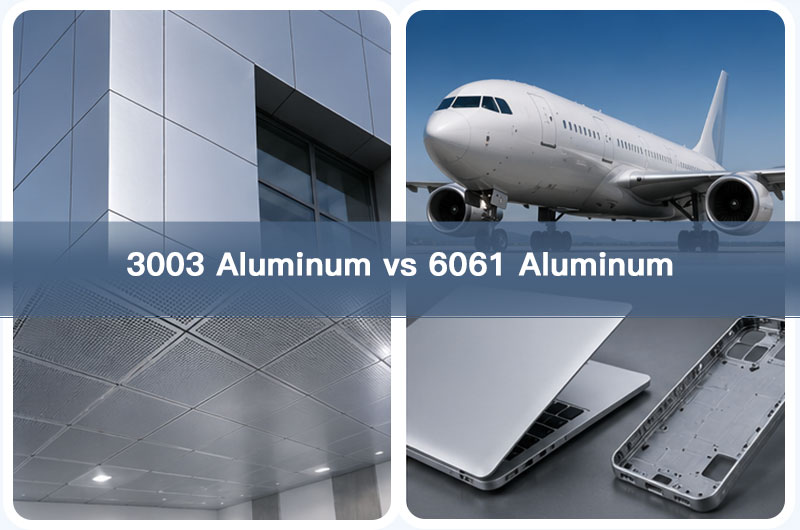
3003 vs. 6061 Aluminum: Brief Introductions
3003 Aluminum Alloy: The Representative of Al-Mn Rust-Proof Aluminum
3003 belongs to the 3000 series, with Manganese (Mn) as its primary alloying element (1.0–1.5%). It is the typical representative of Al-Mn rust-proof aluminum and is currently one of the most widely used rust-proof aluminum alloys globally.
The primary room-temperature phase composition of 3003 is α(Al) solid solution and MnAl₆. The electrode potential of MnAl₆ is almost identical to that of pure aluminum, which fundamentally ensures that 3003 possesses excellent corrosion resistance close to that of commercial pure aluminum.
In international standards, 3003 corresponds to ISO AlMn1Cu, EN AW-3003, JIS A3003, and UNS A93003. Its execution standards cover ASTM B209 and GB/T 3190-2020.
6061 Aluminum Alloy: The Engineering Benchmark of Al-Mg-Si Heat-Treatable Alloys
6061 belongs to the 6000 series, using Magnesium (Mg) and Silicon (Si) as its primary alloying elements. Through solution and aging treatments, it forms the Mg₂Si strengthening phase, achieving a significant precipitation hardening effect.
Developed in 1935 and originally named "Alloy 61S, " 6061 remains one of the most well-balanced structural aluminum varieties today. Common tempers include T4, T6, and T651, among which 6061-T6 is one of the most widely used engineering structural aluminums in the world.
In international standards, 6061 corresponds to EN AW-6061 (AlMg1SiCu), JIS A6061, and UNS A96061. Its execution standards cover ASTM B209/B210/B211/B221 and GB/T 3190-2020.
3003 vs. 6061 Aluminum: Chemical Composition Differences
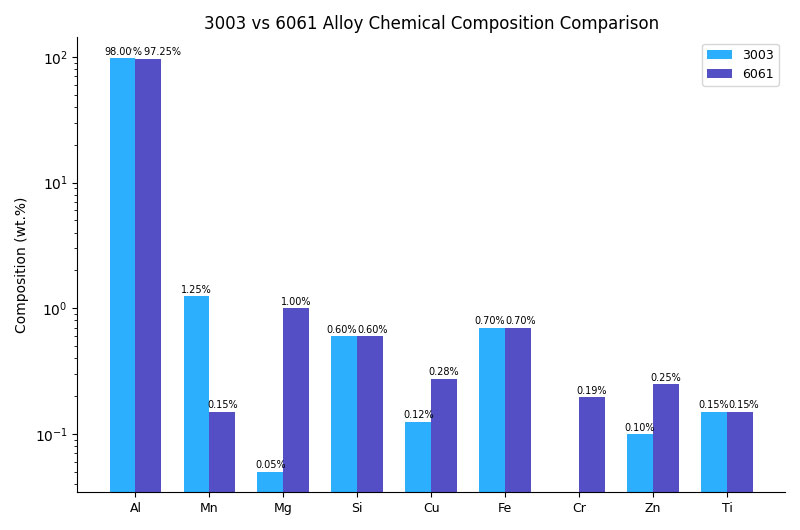
Chemical composition is the root cause of the performance differences between the two alloys and the starting point for understanding all subsequent discussions.
| Element | 3003 Aluminum Alloy | 6061 Aluminum Alloy |
|---|---|---|
| Aluminum (Al) | Remainder (approx. 97–99%) | Remainder (approx. 95.9–98.6%) |
| Manganese (Mn) | 1.0–1.5% (Primary) | ≤ 0.15% (Trace) |
| Magnesium (Mg) | ≤ 0.05% | 0.80–1.20% (Primary) |
| Silicon (Si) | ≤ 0.60% | 0.40–0.80% (Primary) |
| Copper (Cu) | 0.05–0.20% | 0.15–0.40% |
| Iron (Fe) | ≤ 0.70% | ≤ 0.70% |
| Chromium (Cr) | None | 0.04–0.35% |
| Zinc (Zn) | ≤ 0.10% | ≤ 0.25% |
| Titanium (Ti) | ≤ 0.15% (Added as needed) | ≤ 0.15% |
Key details regarding the synergy of elements in 3003:
- The Manganese content must be controlled at 1.0–1.5%, ideally in the middle range. Exceeding 1.5% leads to the formation of coarse, hard, and brittle MnAl₆phases, making the alloy prone to cracking during deformation and significantly reducing ductility.
- Iron plays a special role. Iron can dissolve into MnAl₆to form (FeMn)Al₆, effectively reducing the intragranular segregation of manganese and allowing the annealed sheet to achieve fine, uniform grains. However, too much (FeMn)Al₆will degrade mechanical properties. Production experience shows that Iron should be controlled at 0.4–0.6% and must remain higher than the Silicon content—a critical rule for controlling casting crack tendencies in 3003.
- Copper, when kept between 0.05–0.20%, can transform pitting corrosion into uniform corrosion while significantly increasing tensile strength, making it a beneficial element. Exceeding this range, however, will reduce corrosion resistance.
3003 vs. 6061 Aluminum: Strengthening Mechanisms
Understanding the strengthening mechanisms is the key to interpreting all performance differences.
3003's Mechanism: Cold Work Hardening (Strain Hardening)
3003 is a non-heat-treatable alloy. While the solid solubility of manganese in aluminum decreases as the temperature drops, the heat treatment strengthening effect is extremely weak. Therefore, strength improvements can only rely on cold working.
During plastic deformation like cold rolling or drawing, the dislocation density within the crystal lattice continuously increases. Dislocations entangle with each other, forming barriers that prevent further slip. Macroscopically, this presents as increased strength and hardness with a corresponding drop in elongation—this is known as "work hardening" or "strain hardening."
The deeper the cold working degree (from H12 to H18), the higher the strength, but plasticity is sacrificed. This trade-off between strength and plasticity is always the core consideration when selecting 3003.
6061's Mechanism: Solution and Aging Hardening (Precipitation Hardening)
6061's strengthening mechanism is built on the Mg₂Si precipitation hardening system, completed in three steps:
- Solution Treatment:Heating the alloy to 525–540°C and holding for 2–3 hours, allowing Mg and Si to fully dissolve into the aluminum matrix to form a supersaturated solid solution.
- Quenching:Rapid water cooling "freezes" the high-temperature uniform state, preventing Mg₂Si from precipitating prematurely.
- Artificial Aging:Holding at 160–180°C for 6–12 hours causes the fine, dispersed Mg₂Si strengthening phase to precipitate uniformly in the matrix. Strength and hardness surge, reaching peak aging (T6 temper).
These three steps boost 6061's yield strength from ≤110 MPa in the annealed state to ≥240 MPa in the T6 temper—an increase of over 100%. This ability to "precisely control performance via heat treatment" is something 3003 simply cannot achieve.
3003 vs. 6061 Aluminum: Mechanical Properties
Mechanical Properties of 3003 Tempers
| Temper | Tensile Strength (MPa) | Yield Strength (MPa) | Elongation (%) | Brinell Hardness (HB) |
|---|---|---|---|---|
| O (Annealed) | 110 | 40 | 28–30 | 28 |
| H12 (1/4 Hard) | 130 | 100 | 11 | 36 |
| H14 (1/2 Hard) | 160 | 130 | 8 | 42 |
| H16 (3/4 Hard) | 180 | 170 | 5 | 49 |
| H18 (Full Hard) | 210 | 180 | 4–5 | 56 |
Special Note:For aluminum-plastic composite pipes, special 3003G and 3003G1 alloys are used. By precisely controlling the ratios of Si, Fe, Cu, and Mn and adding trace Ti, after annealing at 430°C for 9 hours, 3003G achieves a tensile strength of 127 MPa and an astonishing elongation of 28.8–30.6%. This perfectly highlights the high-plasticity potential of the 3003 series.
Mechanical Properties of 6061 Tempers
| Temper | Tensile Strength (MPa) | Yield Strength (MPa) | Elongation (%) | Brinell Hardness (HB) |
|---|---|---|---|---|
| O (Annealed) | ≤ 150 | ≤ 110 | 16–25 | 33 |
| T4 (Solution + Natural Aging) | ≥ 210 | ≥ 110 | 16–18 | 63 |
| T6 (Solution + Artifical Aging) | ≥ 290 | ≥ 240 | ≥ 10 | 93–95 |
| T651 (T6 + Stress Relieved) | 310–320 | 270–276 | 10–12 | 93–95 |
The fatigue strength of 6061-T6 is about 97 MPa (at 5×10⁸cycles), suitable for structural parts bearing alternating loads. Its yield strength (≥240 MPa) exceeds that of some low-grade stainless steels, which is why it is heavily used in aerospace and transportation.
Tips:The strongest temper of 3003 (H18) has a tensile strength of about 210 MPa, while the minimum acceptable value for 6061-T6 is 290 MPa. The gap between the two is not "just a little stronger, " but a qualitative difference of engineering significance.
3003 vs. 6061 Aluminum: Physical Properties
| Parameter | 3003 | 6061-T6 | Notes |
|---|---|---|---|
| Density (g/cm³) | 2.73 | 2.70 | Almost identical; weight difference is negligible. |
| Thermal Conductivity (W/m·K) | 180–193 | 151–167 (Typical ~167) | 3003 has superior thermal conductivity. |
| Electrical Conductivity (% IACS) | 44 | 43 | Very similar. |
| Coefficient of Thermal Expansion (µm/m·K) | 23.2 | 23.6 | Minimal difference. |
| Elastic Modulus (GPa) | 68.9–70 | 68.9–69 | Almost identical. |
| Melting Point (°C) | 643–654 | Solidus 580, Liquidus 650 | 6061 has a wider crystallization range. |
Both have almost identical densities and elastic moduli, meaning that at the same volume and cross-section, there is no significant difference in weight or rigidity.
The gap inThermal Conductivityis a vital selection metric. 3003's thermal conductivity (180–193 W/m·K) is significantly better than 6061-T6's (~167 W/m·K). In heat management applications like radiators, heat exchangers, and AC tubes, this gap directly impacts heat transfer efficiency.
3003 vs. 6061 Aluminum: Production Processes
The Core Difficulty of 3003: Intragranular Segregation of Manganese
During casting, 3003 is highly prone to severe intragranular segregation of manganese—the grain center has low Mn, while the edges have high Mn. This segregation causes uneven recrystallization during annealing, resulting in uneven grain size, which directly degrades formability and mechanical properties.
In industrial production, four methods are used to control this: high-temperature homogenization annealing, high-temperature hot rolling (480–520°C), rapid high-temperature recrystallization annealing, and adding trace Titanium (Ti's segregation direction is opposite to Mn, partially offsetting it).
The Core of 6061: Heat Treatment Processes
6061's performance is highly dependent on heat treatment. The standard T6 process involves solution treatment (530–540°C), water quenching, and artificial aging (160–180°C). If softening is required, a rapid annealing process (350–410°C for 30–120 mins) can be used.
3003 vs. 6061 Aluminum: Welding Performance
3003: Excellent Weldability, Zero Post-Weld Worries
3003's weldability is universally rated as "Excellent." TIG, MIG, resistance welding, and brazing are all suitable. The weld quality is highly reliable, requires no post-weld heat treatment, and joint strength remains stable. This makes 3003 the first choice for fuel tanks, fluid containers, composite pipe joints, and chemical equipment.
6061: Weldable, But Beware of the Engineering Trap
6061 has good weldability (using 4043 or 5356 filler wire for TIG/MIG).
However, after welding, the strength in the Heat-Affected Zone (HAZ) drops significantly—usually falling close to the T4 temper, a loss of about 40% in strength. The Aluminum Association recommends that if full post-weld heat treatment is not performed, the allowable strength for the weld area in design should be taken as 165 MPa, not the 290 MPa of the T6 temper.
To recover the strength, the entire welded assembly must be re-solutioned and aged, which drastically increases cost and complexity.If your product has many welding nodes and post-weld heat treatment is impossible, choosing 3003 is far safer than 6061.
3003 vs. 6061 Aluminum: Forming & Machinability
3003: Ultimate Formability, Irreplaceable in Deep Drawing
In its annealed (O) temper, 3003 boasts an elongation of 28–30%, making it one of the most formable aluminum alloys. Deep drawing, spinning, bending, stamping, and roll forming are effortless. The minimum bending radius for thin gauges can reach 0t (completely folded flat). However, its machinability (cutting/CNC) in the soft state is poor, as it tends to stick to the tools.
6061: Excellent Machinability, But Formability Requires Caution
6061-T6 has outstanding machinability, yielding smooth finishes and tight dimensional tolerances, making it ideal for precision parts, fixtures, and molds.
Warning:6061 sheet in the T6 temper is highly prone to cracking during 90° bends. Bending must be done in the T4 temper, followed by heat treatment.
| Processing Method | 3003 | 6061 |
|---|---|---|
| Deep Drawing / Spinning | Excellent | Fair |
| Bending | Excellent | Good (T4), Prone to cracking (T6) |
| Machining (CNC) | Fair (Better in H tempers) | Excellent (T6 temper) |
| Extrusion | Good | Excellent |
| Forging | Rarely used | Good (Suitable for hot forging) |
3003 vs. 6061 Aluminum: Corrosion Resistance
3003: Corrosion Resistance Close to Pure Aluminum
3003's corrosion resistance is a core competitive advantage. It resists atmospheric, freshwater, seawater, food, organic acids, gasoline, and neutral salt environments. Its major alloying phase, MnAl₆, has an electrode potential matching pure aluminum, minimizing galvanic corrosion. (Note: Anodizing is generally not recommended for 3003 due to uneven coloration).
6061: Good Corrosion Resistance, Outstanding Anodizing
6061 has good general corrosion resistance, and the addition of Chromium improves its resistance to Stress Corrosion Cracking (SCC)—a feature 3003 lacks. Because of its higher Copper content, its basic corrosion resistance is slightly lower than 3003. However, 6061 excels at anodizing, producing a dense, uniform oxide film that can be dyed in various colors, making it perfect for consumer electronics and architectural facades.
3003 vs. 6061 Aluminum: Typical Application Scenarios
Core Applications of 3003
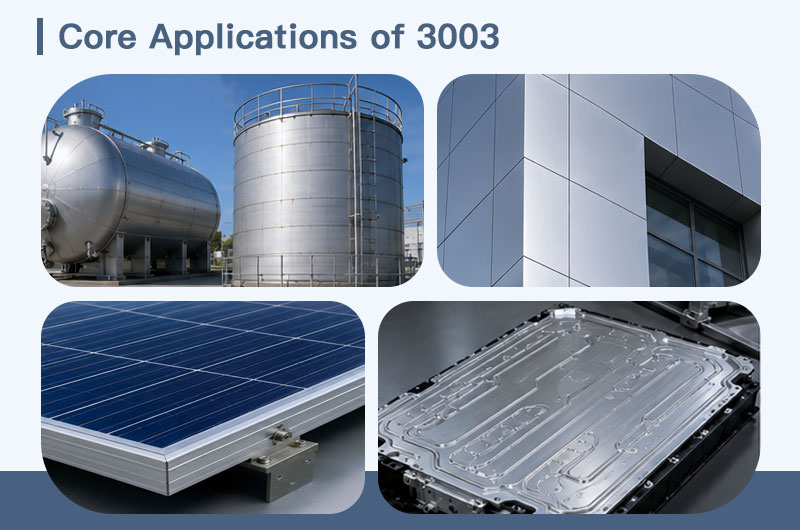
- HVAC & Thermal Management: Mainstream material for seamless AC tubes, replacing copper. Used extensively in EV battery cold plates and radiators due to its thermal conductivity (~193 W/m·K) and formability.
- Aluminum-Plastic Composite Pipes: Special 3003G/3003G1 foils are the core structural layers, utilizing 3003's high plasticity and excellent weldability.
- Packaging & Containers: Aluminum beverage cans, food/pharmaceutical foil, chemical storage tanks, and fuel tanks.
- Architecture & New Energy: Curtain wall panels, PVDF color-coated sheets, roofing, solar panel frames, and wind turbine components.
Core Applications of 6061
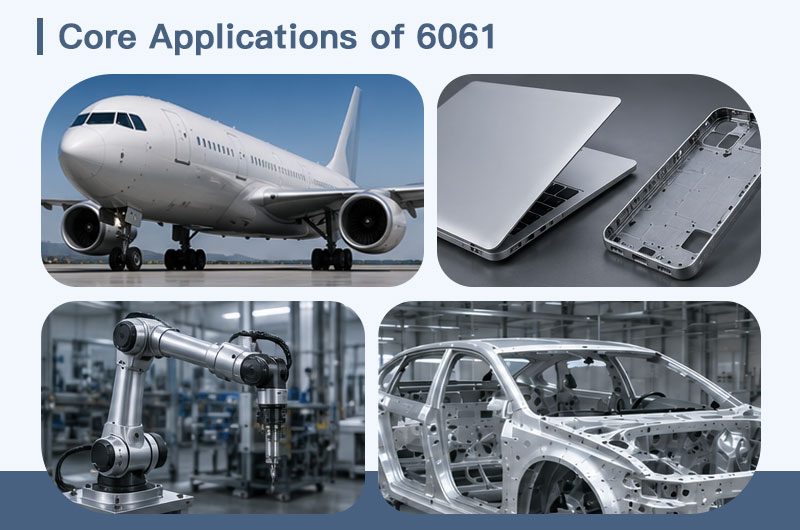
- Aerospace: Aircraft skins, fuselage frames, wing structures, and rocket forged rings, demanding extreme strength-to-weight ratios.
- Transportation: Truck frames, spun forged automotive wheels, bicycle frames, ship structures, and high-speed rail car bodies.
- Precision Manufacturing: CNC machined fixtures, mold base plates, semiconductor tooling, robot arms, and pneumatic cylinders.
- Consumer Electronics & Architecture: Laptop casings, smartphone mid-frames, drone skeletons, bridge structures, and load-bearing extrusions.
Comprehensive Summary Table
| Dimension | 3003 | 6061 | Who is better suited? |
|---|---|---|---|
| Alloy System | Al-Mn (3000 Series) | Al-Mg-Si (6000 Series) | — |
| Strengthening | Cold Work Hardening | Solution & Aging | — |
| Max Tensile Strength | ~210 MPa (H18) | ~310 MPa (T6) | 6061has higher absolute strength. |
| Max Yield Strength | ~180 MPa (H18) | ~276 MPa (T6) | 6061has superior load-bearing capacity. |
| Annealed Elongation | 28–30% | 20–25% | 3003has better plasticity. |
| Formability | Excellent | Fair (Temper sensitive) | 3003is much easier to form. |
| Post-Weld Strength | No loss | ~40% loss in HAZ | 3003is more stable post-weld. |
| Corrosion Resistance | Excellent | Good | 3003has superior baseline resistance. |
| Machinability (CNC) | Fair | Excellent | 6061is ideal for precision machining. |
| Anodizing Effect | Poor (Not recommended) | Excellent | 6061is much better for aesthetics. |
| Thermal Conductivity | 180–193 W/m·K | 151–167 W/m·K | 3003is better for heat transfer. |
| Material/Process Cost | Lower | Higher (Requires heat treatment) | 3003is more cost-effective. |
| Common Tempers | O, H12, H14, H16, H18, H24 | O, T4, T6, T651 | — |
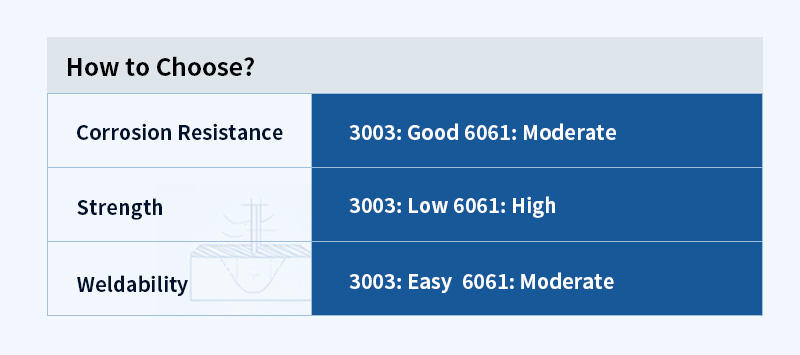
How to Choose?
When facing a specific project, answer these three questions to quickly find your material:
- 1. How much structural load must the product bear?
- If it’s a container, pipe, covering panel, or heat exchanger under low-to-medium loads, 3003 is perfectly capable and more cost-effective. If it’s a vehicle frame, aerospace component, or high-stress structural part, 6061’s strength is mandatory.
- 2. What is the primary manufacturing process?
- For processes dominated by deep drawing, bending, spinning, or continuous roll forming, prioritize 3003. For precision manufacturing requiring turning, milling, and grinding (CNC), prioritize 6061-T6.
- 3. Are there massive welding joints, and is post-weld heat treatment impossible?
- If the answer is "Yes, " 3003 is far safer than 6061, as you won't need to worry about strength degradation in the heat-affected zone.
Worthwill's Supply Capabilities
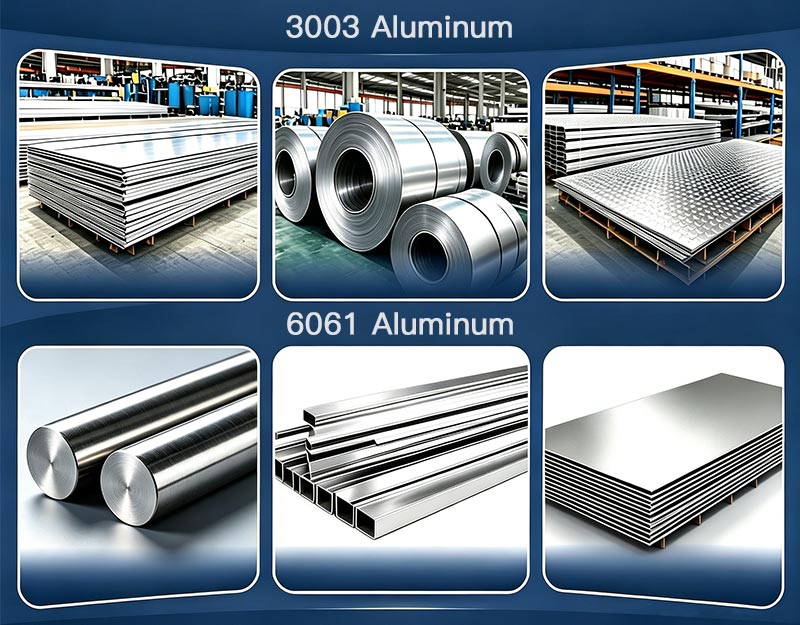
As a professional aluminum alloy supplier, Henan Worthwill Industry Co., Ltd. has extensive experience in supplying a full range of 3003 and 6061 products.
- For 3003: We supply cold-rolled sheets (O/H12/H14/H16/H18/H24), coils, embossed plates, color-coated coils (PVDF/PE), and bars. Maximum width reaches 2000 mm, slitting accuracy is ±0.05 mm, and our products support food-grade certifications (FDA/GB 4806.9).
- For 6061: We supply sheets, extruded bars, seamless tubes, and profiles in O/T4/T6/T651 tempers, covering a vast range from 0.3 mm thin sheets to 500 mm thick plates, meeting requirements from architectural structures to aerospace precision components.
Whether you need standard specification stock or customized small-batch orders, feel free to contact the Worthwill team for professional material selection advice and quotes.
Conclusion
3003 and 6061 are two aluminum alloys with entirely different "values."
3003 trades extreme strength for near-perfect plasticity and corrosion resistance. It plays along beautifully with various forming techniques, pushing the flexibility of aluminum to its absolute limit. 6061 took a different path, granting itself superior strength through precise heat-treatment systems, acting as the backbone for the most demanding engineering applications.
There is no "universal" material. Choosing the right material is the first step to project success.
If you have any questions regarding aluminum alloy selection, please feel free to contact the Worthwill technical team at any time. We are always happy to provide professional support.
Appendix: Quick Reference Guide for Performance
Appendix A: Physical Properties Comparison
| Performance Parameter | 3003 | 6061-T6 |
|---|---|---|
| Density (g/cm³) | 2.73 | 2.70 |
| Elastic Modulus (GPa) | 68.9–70 | 68.9–69 |
| Poisson's Ratio | 0.33 | 0.33 |
| Thermal Conductivity (W/m·K) | 180–193 | 151–167 |
| Electrical Conductivity (% IACS) | 44 | 43 |
| Coefficient of Thermal Expansion (µm/m·K, 20–100°C) | 23.2 | 23.6 |
| Melting Point / Solidus (°C) | 643–654 | Solidus 580, Liquidus 650 |
| Specific Heat Capacity (J/kg·K) | 900 | 900 |
Appendix B: Mechanical Properties of 3003 by Temper
| Temper | Tensile Strength (MPa) | Yield Strength (MPa) | Elongation (%) | Brinell Hardness (HB) |
|---|---|---|---|---|
| O (Annealed) | 110 | 40 | 28–30 | 28 |
| H12 (1/4 Hard) | 130 | 100 | 11 | 36 |
| H14 (Half Hard) | 160 | 130 | 8 | 42 |
| H16 (3/4 Hard) | 180 | 170 | 5 | 49 |
| H18 (Full Hard) | 210 | 180 | 4–5 | 56 |
| H19 (Extra Hard) | 240 | 210 | 1–2 | 65 |
| H22 | 140 | 94 | 7–8 | 37 |
| H24 | 160 | 130 | 6 | 45 |
| H26 | 180 | 160 | 3 | 53 |
Appendix C: Mechanical Properties of 6061 by Temper
| Temper | Tensile Strength (MPa) | Yield Strength (MPa) | Elongation (%) | Brinell Hardness (HB) |
|---|---|---|---|---|
| O (Annealed) | ≤ 150 | ≤ 110 | 16–25 | 33 |
| T4 (Solution Heat Treated + Naturally Aged) | ≥ 210 | ≥ 110 | 16–18 | 63 |
| T6 (Solution Heat Treated + Artificially Aged) | ≥ 290 | ≥ 240 | ≥ 10 | 93–95 |
| T651 (T6 + Stress Relieved by Stretching) | 310–320 | 270–276 | 10–12 | 93–95 |
| T42 (Solution Heat Treated by User + Naturally Aged) | 230 | 110 | 18 | 57 |
| T62 (Solution Heat Treated by User + Artificially Aged) | 320 | 270 | 8–9 | 88 |
Appendix D: Cross-Comparison of Key Mechanical Properties (Typical Common Tempers)
| Property Indicator | 3003-O | 3003-H14 | 3003-H18 | 6061-O | 6061-T4 | 6061-T6 |
|---|---|---|---|---|---|---|
| Tensile Strength (MPa) | 110 | 160 | 210 | ≤150 | ≥210 | ≥290 |
| Yield Strength (MPa) | 40 | 130 | 180 | ≤110 | ≥110 | ≥240 |
| Elongation (%) | 28–30 | 8 | 4–5 | 16–25 | 16–18 | ≥10 |
| Brinell Hardness (HB) | 28 | 42 | 56 | 33 | 63 | 93–95 |
| Shear Strength (MPa) | 75 | 96 | 110 | 84 | 170 | 210 |
| Fatigue Strength (MPa) | 50 | 60 | 70 | 61 | 96 | 97 |
Appendix E: Heat Treatment Process Parameters Comparison
| Process Parameter | 3003 | 6061 |
|---|---|---|
| Homogenization Annealing | 590–620°C | Approx. 590°C, hold for approx. 2h |
| Hot Rolling Temperature | 480–520°C (Optimum 500°C) | 260–372°C (Hot working) |
| Typical Annealing Temp. | 413°C, Air cool | 380–420°C |
| Solution Heat Treatment | N/A | 525–540°C, 2–3h, Water quench |
| Artificial Aging | N/A | 160–180°C, 6–12h |
| Max Operating Temp. | Approx. 180°C | Approx. 170°C |
Appendix F: International Alloy Designation Equivalents
| Standard System | 3003 Equivalent Designation | 6061 Equivalent Designation |
|---|---|---|
| China (GB) | 3003 | 6061 / LD30 |
| USA (AA/ASTM) | 3003 / A93003 | 6061 / A96061 |
| Europe (EN) | EN AW-3003 | EN AW-6061 |
| ISO | AlMn1Cu | AlMg1SiCu |
| Japan (JIS) | A3003 | A6061 |
| Germany (DIN) | AlMnCu / 3.0517 | AlMgSi1Cu / 3.3211 |
| UK (BS) | 3103 (N3) | H20 / N20 |