


3003 vs. 3004 Aluminum Alloy
Introduction: Understanding the Key Choice in Aluminum-Manganese Alloys
When selecting aluminum fabrication materials, purchasers often find themselves in a dilemma between 3003 and 3004 aluminum alloys. Although these two 3000-series aluminum-manganese alloys have similar chemical compositions, their performance differences dictate their distinct application areas.
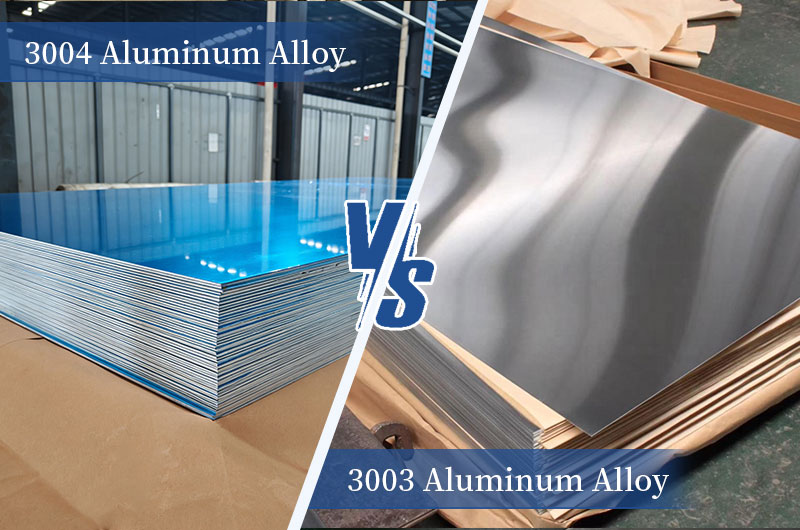
Here's the Core Difference:
- 3004 Aluminum Alloy is engineered for strength-priority applications—ideal for beverage can bodies, architectural roofing, pressure vessels, and automotive components.
- 3003 Aluminum Alloy is optimized for formability and versatility—perfect for kitchen equipment, heat exchangers, chemical storage tanks, and decorative sheets.
The Chemical Composition Reveals the Key: 3004 aluminum alloy has an addition of 0.8-1.3% magnesium, which increases its strength by 40-55% but reduces its elongation by 60-75%. In the H14 temper, 3003 has an elongation of 8.3%, while 3004 has only 2.8%—this difference solidifies 3003's advantage in applications requiring complex forming.
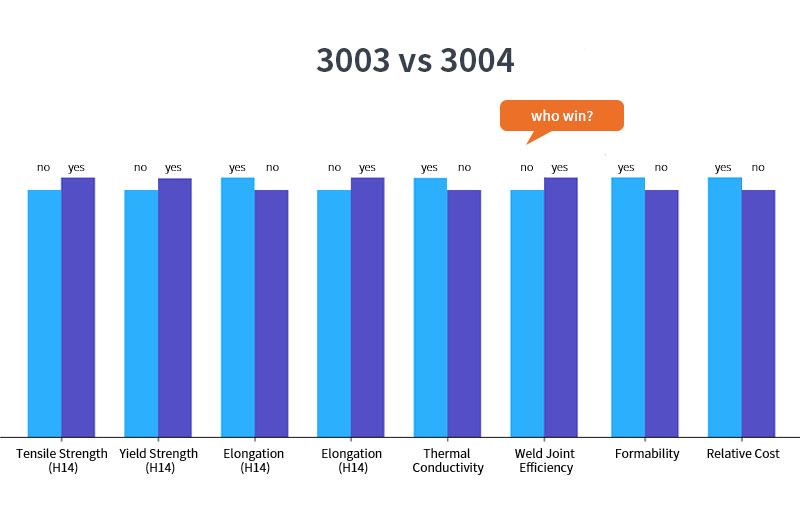
Quick Comparison at a Glance:
| Property | 3003 | 3004 | Advantage |
| Tensile Strength (H14) | 160 MPa | 240 MPa | 3004 (+50%) |
| Yield Strength (H14) | 130 MPa | 200 MPa | 3004 (+54%) |
| Elongation (H14) | 8.3% | 2.8% | 3003 (+196%) |
| Brinell Hardness (H14) | 42 HB | 67 HB | 3004 (+60%) |
| Thermal Conductivity | 180 W/m-K | 160 W/m-K | 3003 (+12%) |
| Weld Joint Efficiency | ~85% | ~94% | 3004 |
| Formability | Excellent | Good | 3003 |
| Relative Cost | Baseline | +5-10% | 3003 |
Chemical Composition: The Critical Role of Magnesium
The performance gap between these two alloys stems directly from differences in their chemical composition:
| Element | 3003 | 3004 | Impact |
| Magnesium (Mg) | 0% | 0.8-1.3% | Higher Mg = Significantly higher strength + Enhanced corrosion resistance |
| Manganese (Mn) | 1.0-1.5% | 1.0-1.5% | Mn improves corrosion resistance and strengthening response |
| Copper (Cu) | 0.05-0.2% | ≤0.25% | Cu enhances strength |
| Silicon (Si) | ≤0.6% | ≤0.3% | Controls casting properties |
| Iron (Fe) | ≤0.7% | ≤0.7% | Impurity element |
| Zinc (Zn) | ≤0.1% | ≤0.25% | Trace element |
| Aluminum (Al) | 96.8-99% | 95.6-98.2% | Base metal |
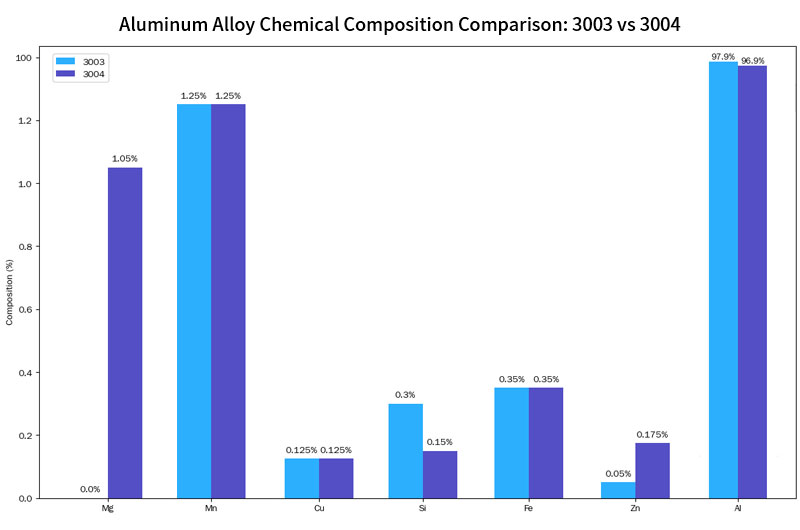
Technical Explanation: The approximately 1% magnesium content in 3004 works via a solid solution strengthening mechanism. When magnesium atoms dissolve into the aluminum matrix, they create lattice distortion, which impedes dislocation movement, thereby increasing the material's yield and tensile strength. This is precisely why 3004 was developed for the beverage can industry—higher strength allows for the use of thinner material (down-gauging by ~20%), saving material while maintaining structural integrity.
Mechanical Properties: The Strength vs. Ductility Trade-off
O Temper (Annealed - Softest State)
| Property | 3003-O | 3004-O | Difference |
| Ultimate Tensile Strength | 110 MPa | 170 MPa | 3004 is 55% stronger |
| Yield Strength | 40 MPa | 69 MPa | 3004 is 73% higher |
| Elongation | 28% | 19% | 3003 has 47% higher ductility |
| Brinell Hardness | 28 HB | 45 HB | 3004 is harder |
| Shear Strength | 75 MPa | 110 MPa | 3004 is 47% higher |
H14 Temper (Half-Hard - Most Common)
| Property | 3003-H14 | 3004-H14 | Difference |
| Ultimate Tensile Strength | 160 MPa | 240 MPa | 3004 is 50% stronger |
| Yield Strength | 130 MPa | 200 MPa | 3004 is 54% higher |
| Elongation | 8.3% | 2.8% | 3003 has 196% higher ductility |
| Brinell Hardness | 42 HB | 67 HB | 3004 is 60% harder |
| Fatigue Strength | 60 MPa | 97 MPa | 3004 is 62% higher |
H18 Temper (Full-Hard)
| Property | 3003-H18 | 3004-H18 | Difference |
| Ultimate Tensile Strength | 210 MPa | 300 MPa | 3004 is 43% stronger |
| Yield Strength | 180 MPa | 250 MPa | 3004 is 39% higher |
| Elongation | 4.5% | 1.1% | 3003 has 309% higher ductility |
| Brinell Hardness | 56 HB | 80 HB | 3004 is 43% harder |
Key Observation: 3004 exhibits significantly higher strength in all tempers, but at the cost of drastically reduced ductility. For parts that require deep drawing, tight bends, or spinning, the superior ductility of 3003 makes it the unequivocal choice. For structural components or applications that need to bear loads in thin gauges, the strength advantage of 3004 is irreplaceable.
Physical Properties Comparison
| Property | 3003 | 3004 |
| Density | 2.73 g/cm³ | 2.72 g/cm³ |
| Melting Range | 640-650°C | 630-650°C |
| Thermal Conductivity | 180 W/m·K | 160 W/m·K |
| Electrical Conductivity | 44% IACS | 42% IACS |
| Coefficient of Thermal Expansion | 23 µm/m·K | 24 µm/m·K |
| Modulus of Elasticity | 70 GPa | 70 GPa |
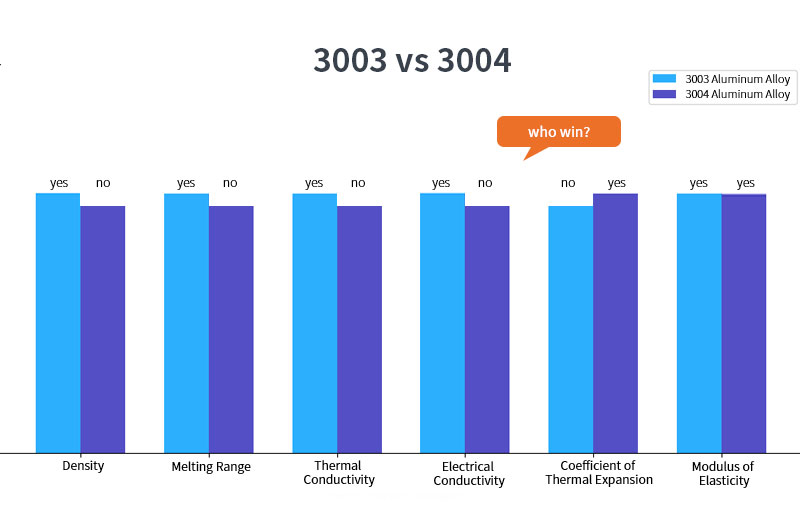
Practical Implications: The densities of both alloys are nearly identical, offering comparable weight-saving benefits. However, 3003's thermal conductivity is 12% higher than 3004's, making it better suited for applications like heat exchangers, heat sinks, and cookware.
Corrosion Resistance: A Slight Edge for 3004
Both alloys form a protective oxide film, but the magnesium content in 3004 makes it more resistant to corrosion in certain harsh environments:
| Environment | 3003 | 3004 | Advantage |
| Atmospheric Exposure | Excellent | Excellent | Comparable |
| Freshwater | Excellent | Excellent | Comparable |
| Seawater Immersion | Very Good | Excellent (≤0.03 mm/year) | 3004 |
| Industrial Chemicals | Good | Very Good | 3004 |
| Alkaline Solutions | Moderate | Moderate | Comparable |
| Chloride Environments | Very Good | Excellent | 3004 |
Why This Matters: For coastal architecture, marine components, and offshore platforms, the difference between "Very Good" and "Excellent" can mean decades of additional service life. 3004 has been specified by classification societies like Lloyd's Register and DNV for critical marine structures.
Weldability: Both are Excellent, 3004 Slightly Better
| Welding Method | 3003 | 3004 |
| TIG (GTAW) | Very Good | Excellent |
| MIG (GMAW) | Very Good | Excellent |
| Resistance Welding | Very Good | Excellent |
| Friction Stir Welding | Good | Excellent (≥95% joint efficiency) |
| Recommended Filler Wires | 5356, 5556 | 5356, 5556, 5754 |
| Hot Cracking Sensitivity | Low | Very Low |
| Post-Weld Strength Retention | ~85% | ~94% |
Engineering Tip: Neither alloy requires preheating or post-weld heat treatment. For 3004, using a matching 5754 filler wire in critical applications like pressure vessels and nuclear facilities can maximize the corrosion resistance continuity in the welded zone.
Formability: The Competitive Advantage of 3003
| Operation | 3003 | 3004 |
| Deep Drawing | Excellent | Good |
| Stretch Forming | Excellent | Good |
| Bending (Min. Radius) | 0-1t | 1-2t |
| Spinning | Excellent | Moderate |
| Stamping Complex Shapes | Superior | Acceptable |
| Work Hardening Rate | Lower | Higher |
| Springback | Less | More |
Practical Example: When forming automotive interior panels or appliance panels with complex curves, 3003-O aluminum allows for tighter bend radii without fracturing. 3004 aluminum requires more sophisticated tooling design, and complex parts often need an intermediate annealing step.
Application
| Industry | Best Uses for 3003 | Best Uses for 3004 |
| Packaging | Food containers, aluminum foil | Beverage can bodies, bottle caps |
| Architecture | Ceilings, decorative panels, gutters | Roofing panels, wall panels, curtain walls |
| Automotive | Radiators, interior trim | Fuel tanks, body panels, heat exchangers |
| Chemical | General storage tanks, piping | Pressure vessels, corrosive media tanks |
| HVAC | Heat exchangers, evaporators | Structural supports |
| Consumer Goods | Cookware, appliance casings | Industrial containers |
| Electrical | Cable conduits, enclosures | LED lamp heads, high-strength housings |
| Transportation | Trailer interiors, trim | Refrigerated truck bodies, fuel tankers |
Cost Considerations
| Factor | 3003 | 3004 |
| Base Material Cost | Baseline | +5-10% |
| Global Availability | Widely stocked | Common, slightly longer lead times in NA |
| Scrap Value | Standard aluminum scrap rate | Same |
| Lifecycle Cost (Marine Env.) | Higher (more maintenance) | Lower (longer service life) |
Procurement Insight: 3003 is a "workhorse alloy" stocked by nearly all aluminum distributors. While 3004 is increasingly popular, it may require longer lead times in North America. Since 2014, the adoption rate of 3004 in automotive OEMs has grown rapidly with the push for vehicle light-weighting initiatives.
Detailed Temper Performance Comparison
H1x Series (Strain-Hardened Only)
H12 (1/4 Hard)
| Property | 3003-H12 | 3004-H12 | Difference |
| Tensile Strength | 130 MPa | 160 MPa | 3004 +23% |
| Yield Strength | 100 MPa | 140 MPa | 3004 +40% |
| Elongation | 11% | 2.3% | 3003 +378% |
| Hardness | 36 HB | 46 HB | 3004 is harder |
H16 (3/4 Hard)
| Property | 3003-H16 | 3004-H16 | Difference |
| Tensile Strength | 180 MPa | 260 MPa | 3004 +44% |
| Yield Strength | 170 MPa | 220 MPa | 3004 +29% |
| Elongation | 5.2% | 2.8% | 3003 +86% |
| Hardness | 49 HB | 73 HB | 3004 is harder |
H2x Series (Strain-Hardened and Partially Annealed)
H22 (1/4 Hard)
| Property | 3003-H22 | 3004-H22 | Difference |
| Tensile Strength | 140 MPa | 210 MPa | 3004 +50% |
| Yield Strength | 94 MPa | 160 MPa | 3004 +70% |
| Elongation | 7.7% | 4.3% | 3003 +79% |
| Hardness | 37 HB | 58 HB | 3004 is harder |
H24 (1/2 Hard)
| Property | 3003-H24 | 3004-H24 | Difference |
| Tensile Strength | 160 MPa | 240 MPa | 3004 +50% |
| Yield Strength | 130 MPa | 190 MPa | 3004 +46% |
| Elongation | 6.0% | 3.4% | 3003 +76% |
| Hardness | 45 HB | 66 HB | 3004 is harder |
H26 (3/4 Hard)
| Property | 3003-H26 | 3004-H26 | Difference |
| Tensile Strength | 180 MPa | 260 MPa | 3004 +44% |
| Yield Strength | 160 MPa | 220 MPa | 3004 +38% |
| Elongation | 3.1% | 3.4% | Similar |
| Hardness | 53 HB | 72 HB | 3004 is harder |
H28 (Full Hard)
| Property | 3003-H28 | 3004-H28 | Difference |
| Tensile Strength | 210 MPa | 300 MPa | 3004 +43% |
| Yield Strength | 180 MPa | 240 MPa | 3004 +33% |
| Elongation | 1.7% | 1.4% | Similar |
| Hardness | 59 HB | 79 HB | 3004 is harder |
H3x Series (Strain-Hardened and Stabilized)
H32 (1/4 Hard)
| Property | 3003-H32 | 3004-H32 | Difference |
| Tensile Strength | 145 MPa | 210 MPa | 3004 +45% |
| Yield Strength | 110 MPa | 170 MPa | 3004 +55% |
| Elongation | 7.8% | 7.4% | Similar |
| Hardness | 39 HB | 54 HB | 3004 is harder |
H34 (1/2 Hard)
| Property | 3003-H34 | 3004-H34 | Difference |
| Tensile Strength | 165 MPa | 240 MPa | 3004 +45% |
| Yield Strength | 135 MPa | 200 MPa | 3004 +48% |
| Elongation | 6.4% | 5.8% | Similar |
| Hardness | 46 HB | 64 HB | 3004 is harder |
H36 (3/4 Hard)
| Property | 3003-H36 | 3004-H36 | Difference |
| Tensile Strength | 185 MPa | 260 MPa | 3004 +41% |
| Yield Strength | 155 MPa | 220 MPa | 3004 +42% |
| Elongation | 4.2% | 4.8% | Similar |
| Hardness | 51 HB | 71 HB | 3004 is harder |
H38 (Full Hard)
| Property | 3003-H38 | 3004-H38 | Difference |
| Tensile Strength | 205 MPa | 290 MPa | 3004 +41% |
| Yield Strength | 175 MPa | 250 MPa | 3004 +43% |
| Elongation | 2.8% | 2.5% | Similar |
| Hardness | 57 HB | 78 HB | 3004 is harder |
Bend Radius Comparison
Recommended Minimum Bend Radius (90-degree Cold Forming), Reference Test Method - ASTM E290, Thickness (t)
3003 Aluminum Alloy Bend Radius
| Temper | 1.6mm | 3.2mm | 4.8mm | 6.0mm | 10mm |
| O | 0t | 0t | 0.5t | 1t | 1t |
| H12 | 0t | 0.5t | 1t | 1t | 1.5t |
| H14 | 0.5t | 1t | 1t | 1.5t | 2.5t |
| H16 | 1t | 1.5t | 2.5t | 3t | 4t |
| H18 | 2.5t | 3t | 4t | 5t | 5.5t |
3004 Aluminum Alloy Bend Radius
| Temper | 1.6mm | 3.2mm | 4.8mm | 6.0mm | 10mm |
| O | 0t | 0.5t | 1t | 1t | 1t |
| H32 | 0.5t | 1t | 1t | 1.5t | 1.5t |
| H34 | 1t | 1.5t | 1.5t | 2.5t | 2.5t |
| H36 | 1.5t | 2.5t | 3t | 3.5t | 4t |
| H38 | 2.5t | 3t | 4t | 5t | 5.5t |
The listed bend radii are the minimum recommended values for bending the sheet without cracking. The application method is based on standard press brake cold forming using an air-bend die. Alternative types of bending operations may require larger or smaller radii. Tooling quality and design can affect radius outcomes.
3003 vs 3004: How to Choose
Choose 3003 Aluminum Alloy when:
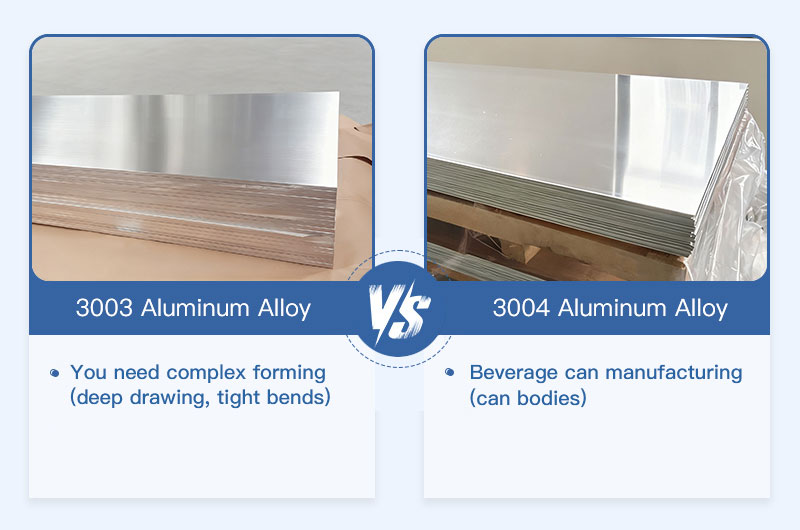
- You need complex forming (deep drawing, tight bends).
- Cost optimization is a priority.
- Manufacturing consumer goods (refrigerators, cookware, fan blades).
- Producing signage, lighting, and architectural trim.
- General sheet metal fabrication.
- Thermal conductivity is required for heat exchangers.
- Making chemical equipment (storage tanks, piping).
Choose 3004 Aluminum Alloy when:
- Beverage can manufacturing (can bodies).
- Architectural roofing systems (Al-Mg-Mn panels).
- Making pressure vessels and chemical storage tanks.
- Automotive applications (fuel tanks, body panels).
- High strength is needed in thin gauges.
- Used in coastal and marine environments.
- Fabricating traffic signs and road signs.
- Welded assemblies require maximum joint strength.
Frequently Asked Questions (FAQ)
What is the difference between 3003 and 3004?
These two general-purpose alloys are very similar. In terms of chemical composition, 3004 aluminum alloy has added magnesium, which gives this grade an advantage in strength.
Is 3003 aluminum used for cookware?
Yes, 3003 aluminum alloy is widely used in cookware manufacturing due to its excellent formability, good thermal conductivity, and food-safe properties.
What is 3004 aluminum used for?
3004 is primarily used for beverage can bodies, architectural roofing systems, pressure vessels, automotive fuel tanks, and structural applications requiring high strength.
What is the difference between 3003 and 3004?
3004 has added magnesium, making it stronger (by about 50%), while 3003 has better formability and thermal conductivity.
Conclusion
Both 3003 and 3004 aluminum alloys are exceptional materials—but they are optimized for different tasks. Each alloy performs outstandingly in its intended applications. The key is to match the material properties to your specific needs. Consulting with a materials engineer or a qualified supplier can help ensure the optimal alloy is selected for your project.