


What Is 5086 Aluminum?
5086 is an Al-Mg non-heat-treatable alloy with 3.5–4.5% magnesium, supplemented by manganese (0.2–0.7%) and chromium (0.05–0.25%). It achieves strength through cold working (strain hardening) rather than heat treatment, delivering an optimal balance between mechanical properties and seawater corrosion resistance.
| Key Advantage | Detail |
| Marine Certified | H116/H321 tempers meet ASTM B928; approved by DNV, ABS, LR, CCS |
| Seawater Resistance | Resists exfoliation and intergranular corrosion (ASTM G66 / G67 qualified in H116) |
| Lightweight | Density 2.66 g/cm³ — ~65% lighter than steel |
| Weldable | TIG/MIG/FSW joints reach ≥90% of O-temper base-metal strength |
| Cryogenic Tough | Retains ductility down to−196°C—suitable for cryogenic storage |
| Armor Capable | H131 temper per MIL-DTL-46027 for ballistic protection |
Industry reputation: Known as "marine-grade aluminum" in shipbuilding and "rustproof armor" in defense — 5086 bridges the gap between the formability of 5052 and the strength of 5083.
Equivalent Designations
| AA (USA) | EN (Europe) | W.Nr (Germany) | UNS | ISO | France (NF) |
| 5086 | AW-AlMg4 | 3.3545 | A95086 | AlMg4 | AG4MC |
Why Choose 5086?
Proven Seawater Performance
- H116 temper is thermally stabilized to resist stress-corrosion cracking (SCC) and exfoliation corrosion — the two primary failure modes in marine aluminum.
- Passes ASTM G66 (exfoliation ≤ PB) and ASTM G67 (NAMLT ≤15 mg/cm²).
- Outstanding bare corrosion resistance in seawater; below-waterline coatings and cathodic protection still recommended per class society rules.
Strength + Weldability
- H32 temper: UTS ≥275 MPa — ~20% stronger than 5052-H32 while maintaining good formability.
- Weld-zone strength: ≥90% of O-temper parent metal with ER5356 filler; ~70–75% of H32 parent strength (HAZ reverts to near-O condition).
Temperature Range
- Cryogenic: Retains full ductility to−196°C—suitable for liquid nitrogen and cryogenic storage.
- Service limit: Max sustained temperature ~65°C to avoid β-phase (Al₃Mg₂) sensitization.
Product Specifications
| Parameter | Details |
| Alloy | 5086 (UNS A95086 / EN AW-AlMg4 / 3.3545) |
| Tempers | O, H111, H112, H116, H321, H32, H34, H36 |
| Thickness | Sheet: 0.8–6 mm · Plate: 6–150 mm (thicker on request) |
| Width | 500–2650 mm |
| Length | Up to 6000 mm standard; custom cut available |
| Surface | Mill finish, polished, brushed, anodized, checkered (tread) |
| Standards | ASTM B928 (marine), ASTM B209, QQ-A-250/7, EN 485-2/573-3, MIL-DTL-46027 (armor) |
Temper Selection Guide
Quick Comparison
| Temper | Tensile (MPa) | Yield (MPa) | Elongation (%) | Corrosion Rating | Best For |
| O | 240–305 | ≥95 | ≥14 | ★★★★ Good | Deep drawing, formed heads, tanks |
| H111 | ≥240 | ≥95 | ≥12 | ★★★★ Good | Lightly worked structural parts |
| H32 | 275–325 | ≥195 | ≥8 | ★★★★ Good (general marine) | Truck bodies, trailer panels, industrial frames |
| H116 | ≥275 | ≥195 | ≥8 | ★★★★★ Marine certified | Hull plating, decks, offshore platforms |
| H321 | ≥275 | ≥195 | ≥8 | ★★★★★ Marine certified | Thick plate, heavy marine structure |
Temper Details
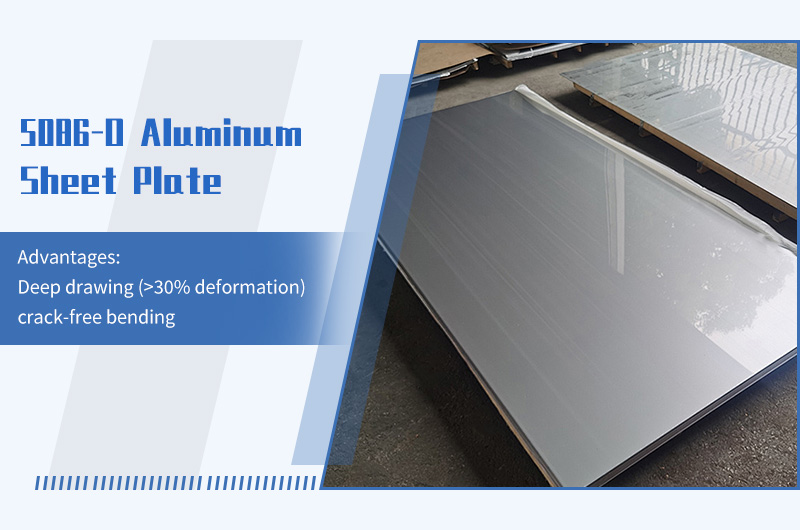
5086-O — Maximum Formability
- Deep-drawing capability with elongation ≥14%.
- Crack-free bending at tight radii (min. bend radius ≥1t).
- Popular sizes: 0.090" (2.3 mm) for drawn containers · 0.190" (4.8 mm) for complex curved forming.
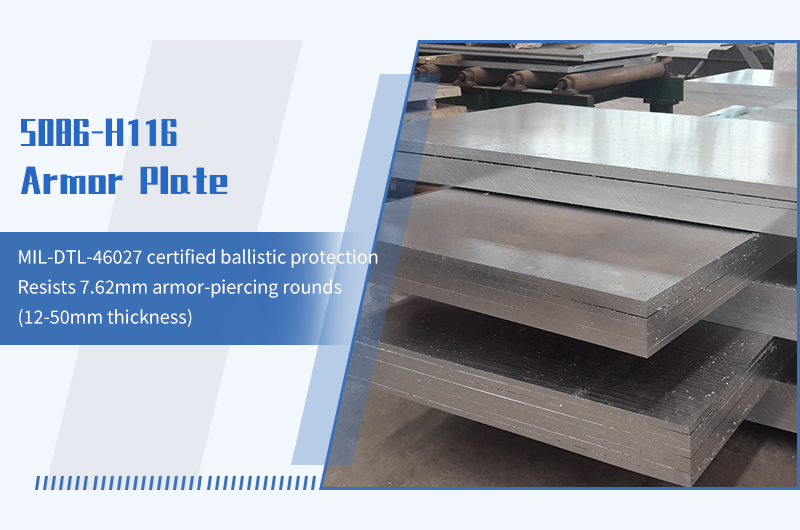
5086-H116 — The Marine Standard
- The only temper (along with H321) certified for seawater service per ASTM B928 and class societies (DNV, ABS, LR, CCS).
- 20+ year design life in marine environments.
- Popular sizes: 0.080" (2.0 mm) liner panels · 0.250" (6.35 mm) hull/deck plate · 0.500" (12.7 mm) pressure vessels · 1.000" (25.4 mm) platform supports.
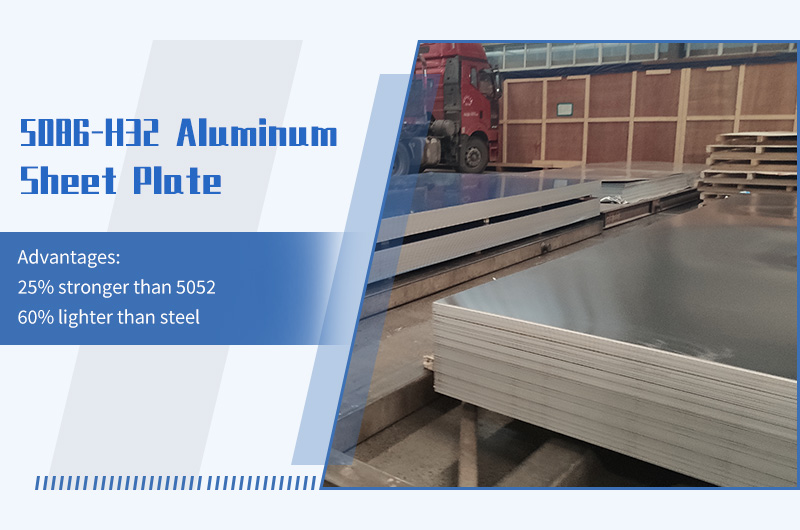
5086-H32 — Versatile Workhorse
- ~20% stronger than 5052-H32; good general corrosion resistance.
- Popular sizes: 0.063" (1.6 mm) automotive components · 0.125" (3.2 mm) trailer side panels · 0.500" (12.7 mm) industrial load-bearing frames.
5086-H131 — Armor Grade
- Ballistic-rated per MIL-DTL-46027 for light armored vehicles.
- Available in 12–50 mm thickness; impact and blast resistance testing on file.
Chemical Composition (per ASTM B209)
| Element | Range (%) | Role |
| Mg | 3.5–4.5 | Primary strengthener; drives seawater corrosion resistance |
| Mn | 0.20–0.70 | Grain refinement; neutralizes Fe impurity effects |
| Cr | 0.05–0.25 | Inhibits stress-corrosion cracking and exfoliation |
| Fe | ≤0.50 | Impurity — kept low for toughness |
| Si | ≤0.40 | Impurity |
| Cu | ≤0.10 | Strictly limited — elevated Cu promotes pitting in chloride environments |
| Zn | ≤0.25 | Impurity |
| Ti | ≤0.15 | Grain refiner |
| Al | Balance | Base metal (~93–95.5% typical) |
Physical Properties
| Property | Value | Unit |
| Density | 2.66 | g/cm³ |
| Melting Range | 585–640 | °C |
| Thermal Conductivity | 117 | W/m·K |
| Electrical Conductivity | 29 | % IACS |
| Specific Heat | 900 | J/kg·K |
| CTE (20–100°C) | 23.8 | μm/m·K |
Mechanical Properties
| Temper | Tensile (MPa) | Yield (MPa) | Elongation (%) | Hardness (HB) |
| O | 240–305 | ≥95 | ≥14 | ~55 |
| H111 | ≥240 | ≥95 | ≥12 | ~60 |
| H32 | 275–325 | ≥195 | ≥8 | ~72 |
| H34 | 290–340 | ≥225 | ≥5 | ~78 |
| H116 | ≥275 | ≥195 | ≥8 | ~72 |
| H321 | ≥275 | ≥195 | ≥8 | ~72 |
Additional data:
- Fatigue strength: ~140 MPa at 5 × 10⁸cycles (R =−1).
- Shear strength: ~165 MPa (H32).
- Weld-zone strength: ≥230 MPa tensile with ER5356 filler (≥90% of O-temper parent).
5086 vs. Other Marine Alloys
| Feature | 5086 | 5083 | 5052 |
| Mg Content | 3.5–4.5% | 4.0–4.9% | 2.2–2.8% |
| Tensile — H32 (MPa) | ≥275 | ≥275 | ≥228 |
| Tensile — H116 (MPa) | ≥275 | ≥303 | N/A |
| Elongation — O (%) | ≥14 | ≥14 | ≥18 |
| Seawater Rating | ★★★★★ | ★★★★★ | ★★★★ |
| Formability | Good | Moderate | Excellent |
| Weldability | Excellent | Excellent | Excellent |
| Cost Index | ●●●○ | ●●●○ | ●●○○ |
| Best For | Hull plate, armor, cryogenic | Structural hull, LNG tanks | Fuel tanks, interiors, sheet metal |
When to choose 5086 over 5083: 5086 offers slightly better formability and is preferred where bending and forming are dominant operations (e.g., complex hull shapes, boat molds). For maximum strength in straight plate applications (keels, large hull panels), 5083-H116 is the stronger choice.
Processing & Fabrication
Forming
| Operation | O | H32 / H116 | Notes |
| Min. Bend Radius | ≥1t | ≥2.5t | Bend ⊥ to rolling direction for best results |
| Deep Drawing | Good (draw ratio ~1.6) | Not recommended | Anneal between passes for multi-stage draws |
| Stretch Forming | Excellent | Moderate | Suitable for boat hull curvature |
Welding
| Parameter | Recommendation |
| Process | TIG (GTAW) · MIG (GMAW) · Friction Stir (FSW) |
| Filler | ER5356 (Al-5Mg) — primary recommendation |
| Shielding Gas | 100% Argon |
| Preheat | Not required <8 mm; 80–120°C for plate >8 mm |
| Interpass Temp | ≤120°C |
| Joint Strength | ≥90% of O-temper parent; ~70–75% of H32 parent |
Critical: Remove oxide with stainless-steel brush or chemical etch before welding. Never use carbon-steel wire wheels.
Cutting
- Thin sheet (≤6 mm): Shearing, laser, or waterjet.
- Thick plate (>6 mm): Plasma or waterjet; saw cutting for straight edges.
- CNC machining: Carbide tools, high speed, flood coolant. Note: 5086 work-hardens — keep tools sharp.
Stock Inventory
We maintain 5086 in H32, H116, H321, H111, and O tempers. All available cut-to-size. Contact us for current availability.
5086-H32 Sheet & Plate
| Thickness (in) | Width (in) | Length (in) | Standards |
| 0.032 | 48 | 96 | ASTM B209, EN 485-2 |
| 0.040 | 48 | 120 | ASTM B209, EN 485-2 |
| 0.063 | 60 | 120 | ASTM B209, EN 485-2 |
| 0.090 | 48 | 96 | ASTM B209 |
| 0.125 | 48 | 96 | ASTM B209 |
| 0.190 | 72 | 144 | ASTM B209 |
| 0.375 | 96 | 240 | ASTM B209 |
| 0.500 | 96 | 240 | ASTM B209 |
5086-H116 Sheet & Plate
| Thickness (in) | Width (in) | Length (in) | Standards |
| 0.080 | 48 | 96 | ASTM B928, DNV/GL |
| 0.100 | 60 | 120 | ASTM B928, LR/CCS |
| 0.160 | 72 | 144 | MIL-DTL-46027 |
| 0.250 | 96 | 240 | ASTM B928, DNV/GL/CCS |
| 0.375 | 96 | 240 | ASTM B928 |
| 0.500 | 96 | 240 | ASTM B928 |
| 1.000 | 96 | 240 | ASTM B928 |
| 2.000 | 98 | 236 | ASTM B928 |
5086-O / H111
| Temper | Thickness (in) | Width (in) | Length (in) | Standards |
| O | 0.090 | 48 | 96 | ASTM B209 |
| O | 0.190 | 60 | 120 | ASTM B209 |
| H111 | 0.063 | 48 | 96 | QQ-A-250/7 |
| H111 | 0.125 | 60 | 120 | QQ-A-250/7 |
| H111 | 0.375 | 96 | 240 | QQ-A-250/7 |
Specialty Products
| Product | Temper | Thickness (in) | Size (in) | Standards |
| Diamond Tread Plate | H116 | 0.118 | 96 × 432 | ASTM B632 |
| Marine Deck Plate | H116 | 0.250 | 96 × 240 | ASTM B928, LR |
Applications
Marine & Offshore
- Hulls & decks: H116 plate, 20+ year design life with proper coating system.
- Offshore platforms: Structural beams, helideck supports, walkway gratings.
- Port infrastructure: Mooring fittings, wave-break panels (suitable for C5-M corrosion environments per ISO 12944).
Transportation
- Truck & trailer: H32 body panels and floor plates — ~65% weight saving vs. steel.
- Rail: Interior panels, HVAC enclosures for high-speed trains.
- Automotive: Lightweight structural reinforcements and heat shields.
Defense & Armor
- Armored vehicles: H131 temper per MIL-DTL-46027 (12–50 mm) for ballistic protection.
- Naval systems: Radar pedestals, weapon mounts, deck structures.
Industrial & Cryogenic
- Pressure vessels: ASME Section VIII compliant; cryogenic storage (−196°C rated).
- Chemical tanks: Resistant to many alkaline and neutral solutions.
Packaging & Shipping
| Layer | Protection |
| Surface | PE film + interleaving paper (scratch prevention) |
| Moisture | VCI paper + desiccant (RH <50%) |
| Edges | Plastic corners + foam strips |
| Outer | ISPM-15 fumigated wooden pallets with steel straps (≤2 tons/pallet, stackable 3 high) |
| High-value / military | Sealed wooden crates (IPPC stamped) |
Shipping: Dry, clean 20'/40' containers; no co-loading with reactive chemicals or moisture sources. FOB / CIF / DDP available.
Why Choose Us for 5086?
| Differentiator | Detail |
| Certified Marine Stock | DNV, ABS, LR, CCS approved H116/H321; MIL-DTL-46027 armor plate on file |
| Ready to Ship | 5, 000+ tons across all tempers; standard lead time ~7 days |
| Processing | Laser cutting (±0.2 mm), waterjet, precision shearing, anodizing |
| Quality Control | OES spectrometry (per-heat composition verification) + ultrasonic testing (per ASTM B548) + salt spray and G66/G67 corrosion reports |
| Pricing | FOB = SMM ingot + fixed processing fee; transparent formula, multi-currency |
FAQ
What is the difference between 5086-H116 and 5086-H32?
Both share similar minimum strength (UTS ≥275 MPa, Yield ≥195 MPa). The critical difference is corrosion qualification: H116 is thermally stabilized and tested per ASTM B928 / G66 / G67 for resistance to exfoliation and intergranular corrosion in seawater. H116 (or H321) is mandatory for classified marine structures; H32 is suitable for general industrial and transport applications with moderate corrosion exposure.
5086 vs. 5083 — which should I choose?
5083-H116 offers ~10% higher tensile strength (≥303 MPa vs. ≥275 MPa) and is the industry standard for primary hull plating and LNG tanks. 5086 provides slightly better formability and is preferred for complex curved hull shapes, smaller vessels, and applications where bending/forming is dominant. Both are ASTM B928 marine-certified.
Can 5086 be used at cryogenic temperatures?
Yes — 5086 retains full ductility and toughness down to−196°C. It is used in cryogenic storage vessels and liquid-gas systems. For LNG primary containment, however, 5083-O remains the standard choice.
What filler wire for welding 5086?
ER5356 (Al-5Mg) is the primary recommendation. Joint strength reaches ≥90% of O-temper parent metal. Use 100% argon shielding; preheat to 80–120°C for plate >8 mm; interpass temperature ≤120°C.
What temper is used for armor plate?
5086-H131 per MIL-DTL-46027, not H116. H131 is specifically strain-hardened for ballistic resistance. H116 is the marine corrosion-resistant temper.
Is 5086 aluminum weldable to 5083?
Yes — 5086 and 5083 are routinely welded together in shipbuilding using ER5183 or ER5356 filler. The weld zone reverts to approximately O-temper strength for both alloys.