


What Is 5052 Aluminum?
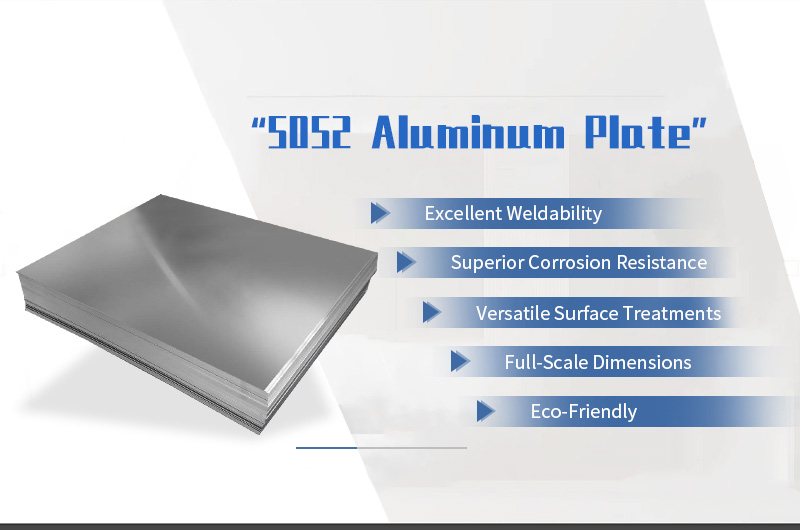
5052 is an Al-Mg (non-heat-treatable) alloy containing 2.2–2.8% magnesium and 0.15–0.35% chromium. It is the most widely used aluminum sheet alloy, prized for its:
| Advantage | Detail |
| Light Weight | Density 2.68 g/cm³ — roughly 1/3 the weight of steel |
| Corrosion Resistance | Resists marine atmosphere, salt water, and industrial chemicals; >500 hrs bare salt spray (ASTM B117) |
| Formability | Excellent deep drawing in O temper; good bending in H32/H34 |
| Weldability | TIG/MIG with ER5356 filler; ≥90% of O-temper base strength retained |
| Surface Versatility | Anodizing, brushing, polishing, embossing, powder coating |
| Sustainability | 100% recyclable; RoHS & REACH compliant |
Best suited for: fuel tanks, marine fittings, appliance housings, architectural panels, auto body panels, and general sheet-metal fabrication.
Specifications & Available Sizes
| Parameter | Details |
| Alloy | 5052 (UNS A95052 / EN AW-AlMg2.5 / 3.3523) |
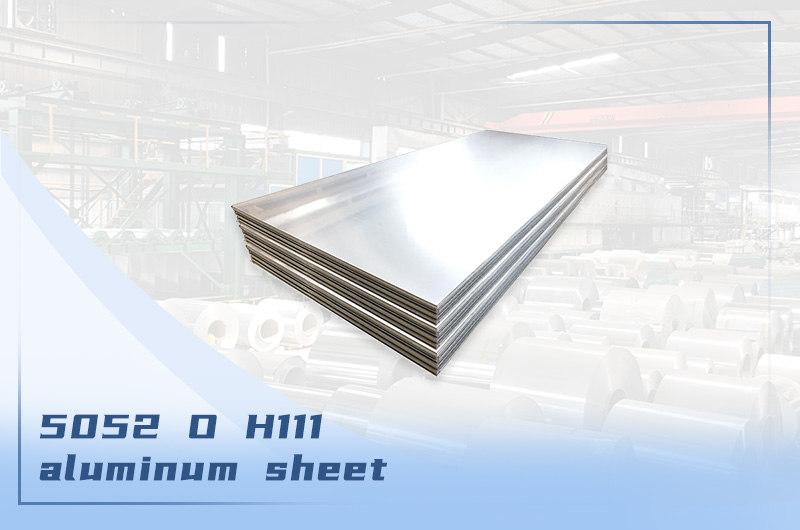
| Tempers | O, H32, H34, H36, H38 (H24 available on request) |
| Thickness | Sheet: 0.2–6.0 mm · Plate: 6–250 mm |
| Width | 900–2650 mm (up to 3100 mm on request) |
| Length | Up to 6000 mm standard; custom-cut available |
| Surface | Mill finish, bright, brushed, anodized, checkered/tread, embossed |
| Protection Film | Blue / transparent / B&W PE film (50 or 80 μm) |
| Standards | ASTM B209, AMS 4015 (O) / 4016 (H32) / 4017 (H34), AMS-QQ-A-250/8, EN 485, GB/T 3880 |
Temper Selection Guide
| Temper | Process | Tensile (MPa) | Yield (MPa) | Elongation | Hardness (HB) | Best For |
| O | Full anneal | 170–215 | 65–110 | 18–25% | ~47 | Deep drawing, spinning, complex forms |
| H32 | Strain-hardened + stabilized | 215–265 | 160–215 | 7–14% | ~60 | General sheet metal, fuel tanks, marine |
| H34 | Higher hardening | 235–285 | 180–240 | 5–10% | ~68 | Structural panels, truck bodies |
| H36 | Further hardened | 255–295 | 200–255 | 4–7% | ~73 | Stiffness-critical covers, enclosures |
| H38 | Full hard | 270–310 | 215–270 | 3–5% | ~77 | Can stock, spring clips |
Quick rule: O for maximum formability → H32 for balanced strength + formability → H34/H36 for rigidity → H38 for hardness.
Chemical Composition (per ASTM B209)
| Element | Content (%) | Role |
| Mg | 2.2–2.8 | Primary strengthener; enhances corrosion resistance |
| Cr | 0.15–0.35 | Grain-structure control; inhibits stress-corrosion cracking |
| Fe | ≤0.40 | Impurity — kept low to preserve formability |
| Si | ≤0.25 | Impurity |
| Cu | ≤0.10 | Strictly limited to prevent galvanic corrosion |
| Mn | ≤0.10 | Impurity |
| Zn | ≤0.10 | Impurity |
| Al | Balance | Base metal |
Physical Properties
| Property | Value | Unit |
| Density | 2.68 | g/cm³ |
| Melting Range | 607–649 | °C |
| Thermal Conductivity | 138 | W/m·K |
| Electrical Conductivity | 35 | % IACS |
| Specific Heat | 880 | J/kg·K |
| CTE (20–100°C) | 23.8 | μm/m·K |
Mechanical Properties
| Temper | Tensile Strength (MPa) | Yield Strength (MPa) | Elongation (%) | Brinell Hardness (HB) |
| O | 170–215 | 65–110 | 18–25 | 47 |
| H32 | 215–265 | 160–215 | 7–14 | 60 |
| H34 | 235–285 | 180–240 | 5–10 | 68 |
| H36 | 255–295 | 200–255 | 4–7 | 73 |
| H38 | 270–310 | 215–270 | 3–5 | 77 |
Additional data:
- Fatigue strength: ~117 MPa at 5 × 10⁸cycles—suitable for vibration-prone parts (e.g., vehicle panels, ship decks).
- Shear strength: ~138 MPa (H32). Use 5056 aluminum rivets or stainless fasteners with insulating bushings.
- Annealing: 343°C / 1 hr to fully restore O-temper ductility.
5052 vs. Other Alloys — When to Choose What
| Comparison | 5052 | Alternative | Verdict |
| 5052 vs 3003 | Higher strength (+40%), better corrosion resistance | 3003 is cheaper, easier to form | Choose 5052 when strength or corrosion matters; 3003 for low-cost general use |
| 5052 vs 5083 | More affordable, easier to form | 5083 is ~30% stronger, classified marine grade | Choose 5083 for structural hull plating; 5052 for fuel tanks, interiors, non-structural marine |
| 5052 vs 6061 | Better corrosion resistance, no heat treatment needed | 6061-T6 offers higher strength & machinability | Choose 6061 for machined structural parts; 5052 for formed sheet-metal parts |
| 5052 vs 5754 | Higher strength in H32/H34 tempers | 5754 has slightly better formability and weldability | Often interchangeable; 5754 preferred in European automotive |
Processing & Fabrication Guide
Forming
| Operation | Parameters | Notes |
| Deep Drawing | O temper; draw ratio up to 1.8–2.0 | Use draw lubricant; anneal between passes for multi-stage draws |
| Bending | Min. bend radius: 1.5t (O/H32); 2t (H34); 3t (H36+) | Bend perpendicular to rolling direction for best results |
| Stamping | O or H32; polished dies recommended | High-gloss tooling prevents surface galling |
Cutting & Machining
- Tooling: Carbide or diamond-coated (prevents built-up edge).
- Spindle speed: 3000–5000+ RPM; feed 0.1–0.3 mm/tooth.
- Coolant: Kerosene-based or water-soluble emulsion.
Tip: 5052 is softer than 6061-T6. Use sharp tools and high speeds to achieve clean cuts rather than smearing.
Welding
| Parameter | Recommendation |
| Process | TIG (GTAW) or MIG (GMAW) |
| Filler | ER5356 (Al-5Mg) |
| Shielding Gas | 100% Argon |
| Preheat | Not required for <8 mm; 80–120°C for thicker plate |
| Interpass Temp | ≤150°C |
| Joint Strength | ≥90% of O-temper base metal; ~75–80% of H32 base metal |
Important: Remove oxide with stainless-steel brush or chemical etch before welding. Never use steel-wire wheels (iron contamination causes corrosion).
Surface Treatment
| Method | Result | Best Temper |
| Anodizing (Type II/III) | 5–25 μm oxide; corrosion resistance ↑, decorative color | All tempers |
| Brushing / Polishing | Aesthetic finish for consumer products | H32, H34 |
| Powder Coating | Durable color coating; UV resistant | All tempers |
| Embossing / Stucco | Textured anti-slip or decorative surface | O, H32 |
Applications
Transportation
- Automotive: Fuel tanks (H32/H34), fender liners, heat shields
- Marine: Non-structural hull panels, yacht interiors, fuel tanks
- Rail: High-speed train interior panels, HVAC housings
Industrial & Energy
- Equipment: Chemical tanks (O temper), wind turbine nacelle covers (H32), GIS switchgear enclosures
- Pressure Vessels: ASME-coded tanks (unfired, <65°C service)
Architecture & Construction
- Facades: Anodized curtain wall panels, storm shutters, roof cladding
- Interior: Ceiling panels, signage, decorative trim
Electronics & Consumer
- Enclosures: Laptop housings (H32), LED heat sinks (thermal conductivity 138 W/m·K)
- Packaging: Closures, caps (H38)
Stock Inventory (Excerpt)
We maintain 80+ line items of 5052 sheet and plate in stock. Below is a representative selection — contact us for full availability and custom cutting.
5052-H32 Aluminum Sheet and Plate
| Thickness (in) | Width (in) | Lengths Available (in) |
| 0.020 | 48 | 96 |
| 0.025 | 36 / 48 | 96, 120 |
| 0.032 | 48 | 96, 120 |
| 0.040 | 48 | 96, 120, 144 |
| 0.050 | 48 / 60 | 120, 144 |
| 0.063 | 36 / 48 / 60 | 96, 120, 144 |
| 0.080 | 48 / 60 | 96, 120, 144 |
| 0.090 | 48 / 60 | 120, 144 |
| 0.100 | 48 | 96, 120, 144 |
| 0.125 | 36 / 48 / 60 / 72 | 96, 120, 144 |
| 0.160 | 48 | 144 |
| 0.190 | 36 / 48 / 60 | 96, 120, 144 |
| 0.249 | 48 / 60 | 96, 120, 144 |
5052-O Aluminum Sheet and Plate
| Thickness (in) | Width (in) | Lengths Available (in) |
| 0.025 | 48 | 144 |
| 0.032 | 48 | 96 |
| 0.040 | 48 | 144 |
| 0.050 | 48 | 144 |
| 0.063 | 48 | 144 |
| 0.090 | 48 | 144 |
| 0.1875 | 72 / 84 | 240 |
5052-H34 Aluminum Sheet and Plate
| Thickness (in) | Width (in) | Lengths Available (in) |
| 0.032 | 48 | 144 |
| 0.063 | 48 | 144 |
Standards: ASTM B209, AMS 4015 (O), AMS 4017 (H34), AMS-QQ-A-250/8. All material supplied with mill test reports.
Packaging & Shipping
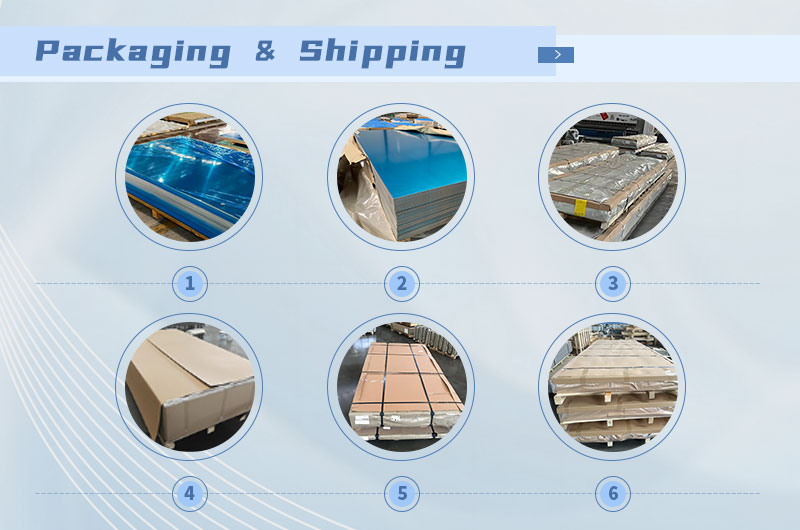
We ensure your materials arrive in pristine condition, regardless of the destination:
- Robust Packaging: Export-grade fumigated wooden pallets (≤2 tons/pallet). Wrapped in waterproof film with steel corner guards. Surface protection films (blue/clear/black & white 50μm-80μm) applied to prevent scratches.
- Safe Shipping: Loaded in dry, clean containers with strict weather protection and zero mixed-loading with reactive chemicals.
Why Choose Us?
- State-of-the-Art German Technology: Manufactured on an SMS Group 2800mm CVC cold mill (20, 000 kN force), ensuring an ultra-flat surface with a tolerance of ±0.005mm.
- Transparent, Factory-Direct Pricing: Enjoy prices consistently 10% below market average. (Formula: FOB Price = SMM/LME Al ingot price + fixed processing fee).
- Uncompromising Quality Control: Every batch undergoes triple testing: Compositional spectrometry (verifying 2.2-2.8% Mg), mechanical stress validation, and 120h+ salt spray certification.
- Fast Global Delivery: 1-week rapid FOB shipment with flexible payment terms (USD/EUR/CNY).
FAQ
What is the difference between 5052-H32 and 5052-H34?
H34 is strain-hardened to a higher level than H32, yielding ~10% more tensile and yield strength but ~30% less elongation. Use H32 for parts requiring moderate forming; H34 where rigidity and dent resistance are priorities.
Is 5052 aluminum suitable for marine use?
Yes — 5052 offers excellent resistance to seawater and marine atmospheres, making it ideal for fuel tanks, non-structural panels, and yacht interiors. For structural hull plating in classified vessels, 5083-H116 is typically required by class societies (DNV, ABS, CCS).
Can 5052 aluminum be anodized?
Yes. 5052 anodizes well and accepts color dyes. Type II anodizing (5–25 μm) is standard for decorative and mildly corrosive environments; Type III hard anodizing (25–75 μm) provides wear resistance.
What is the minimum bend radius for 5052?
O temper: 1.5× thickness. H32: 1.5–2× thickness. H34: 2× thickness. Always bend perpendicular to the rolling direction for best results.
5052 vs 6061 — which should I choose?
Choose 5052 for sheet-metal forming (bending, stamping, deep drawing) and corrosion resistance without coating. Choose 6061-T6 for machined structural parts requiring higher strength — but note that 6061 needs anodizing or coating in corrosive environments.
Is 5052 aluminum weldable?
Yes — it is one of the most weldable aluminum alloys. Use TIG or MIG with ER5356 filler and pure argon shielding. Weld-zone strength equals O-temper base metal (~170 MPa), so designs should account for this in H32/H34 parent material.