


What is 3005 Aluminum Alloy?
3005 aluminum alloy is a member of the 3000 series aluminum-manganese (Al-Mn) family, a non-heat-treatable, corrosion-resistant aluminum alloy. With manganese (Mn) as its primary alloying element (1.0-1.5%) and the addition of 0.2-0.6% magnesium (Mg), its strength is approximately 20% higher than that of 3003 aluminum alloy, while retaining excellent corrosion resistance and formability.
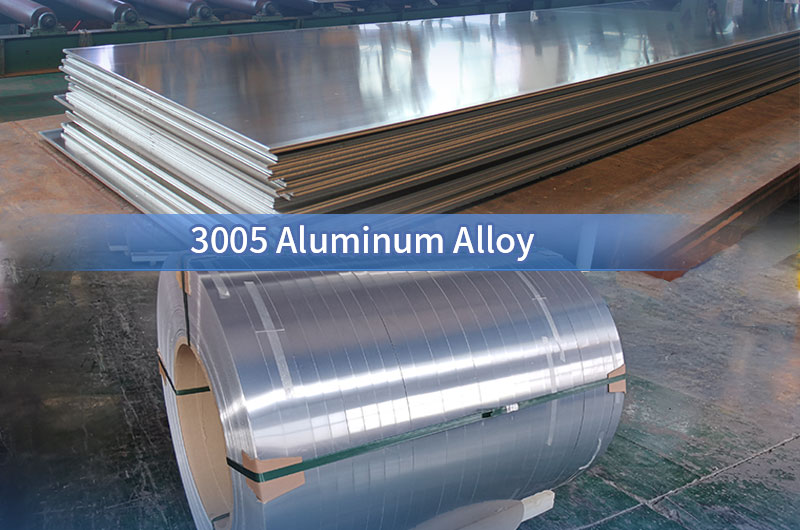
Worthwill specializes in manufacturing 3005 aluminum in various forms, including 3005 aluminum sheet, 3005 aluminum coil, and 3005 aluminum strip. These products are widely used in architectural decoration, transportation, electronics, packaging containers, and other fields.
Core Advantages of 3005 Aluminum Alloy
Outstanding Corrosion Resistance
- Reduces atmospheric corrosion rate by 50-70%.
- Excellent performance in marine environments.
- Naturally forms a dense, protective oxide film of 10-15 nm.
Excellent Formability
- Minimum bending radius of 1.5 times the sheet thickness.
- Supports processes like deep drawing, stretching, and roll forming.
- Ideal for fabricating curved and irregularly shaped components.
Good Weldability
- Compatible with TIG, MIG, and spot welding.
- Weld seam strength is close to that of the base material.
- Low tendency for hot cracking.
Significantly Increased Strength
- Approximately 20% stronger than 3003 alloy.
- Tensile strength reaches up to 250 MPa in the H18 temper.
Strong Adaptability for Surface Treatment
- Excellent performance in anodizing.
- Strong coating adhesion (Grade 0).
- Supports PVDF, PE, and powder coating applications.
3005 Aluminum Alloy Product Forms
Worthwill produces a full range of specifications with thicknesses from 0.1mm to 500mm, widths from 100mm to 2650mm, and lengths from 500mm to 16000mm. We adhere to national standards GB/T 3880-2006 and GB/T 3190-2008, as well as international standards such as ASTM B209, EN 573, and EN 485.
All products can be supplied with reports for chemical composition analysis, mechanical property testing, and surface quality & dimensional accuracy inspection.
3005 Aluminum Sheet/Plate
Specifications:
- Thickness Range: 0.5-500mm
- Standard Sizes: 1000×2000mm, 1220×2440mm, 1500×3000mm (customizable)
- Width Range: 100-2650mm
- Length Range: 500-16000mm
- Surface Types: Flat sheet, Embossed sheet, Stucco sheet
- Available Tempers: O, H12, H14, H16, H18, H19, H22, H24, H26, H28, H112
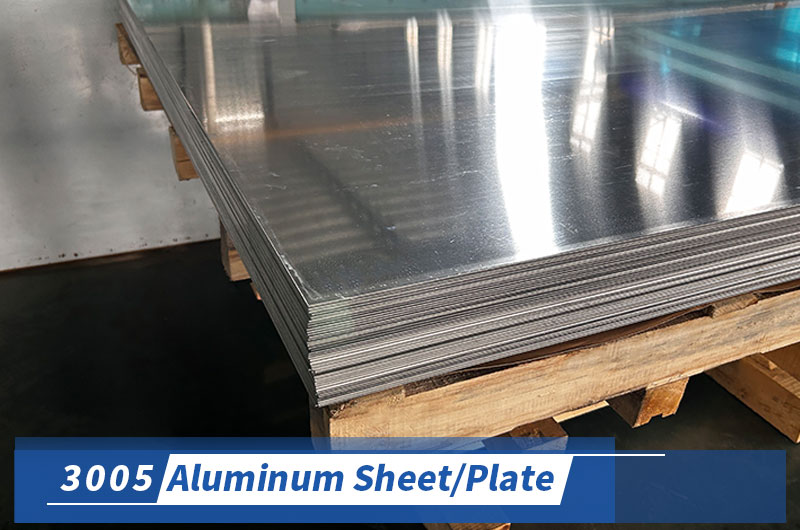
Applications: Architectural curtain walls, roofing panels, ceiling systems, signage panels, marine decorative panels.
Advantages: High flatness, excellent dimensional stability, suitable for large-area decorative and structural applications.
3005 Aluminum Coil
Specifications:
- Thickness Range: 0.2-6.0mm
- Width Range: 100-2650mm (custom slitting available)
- Inner Diameter (ID): 150mm, 300mm, 505mm
- Outer Diameter (OD): Determined by thickness and weight (up to 2000mm max)
- Available Tempers: O, H12, H14, H16, H18, H22, H24, H26, H28
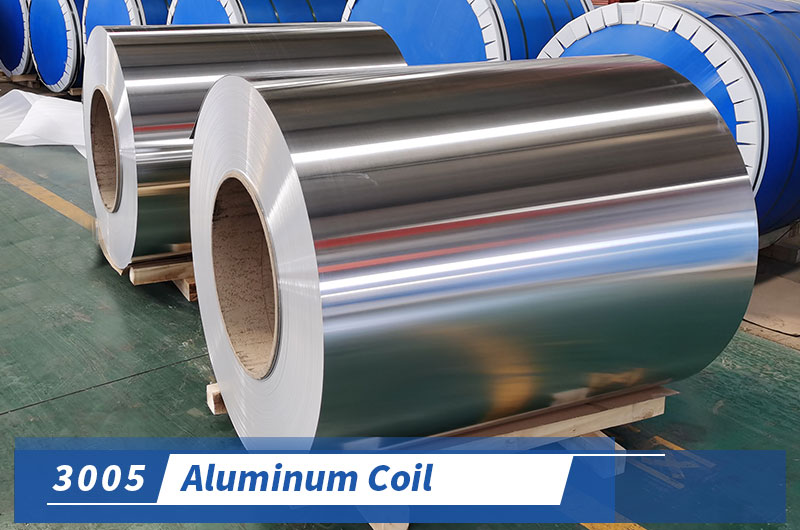
Applications: Continuous coil processing, color-coated aluminum substrates, material for blinds and louvers, roofing coils.
Advantages: Cost-effective, ideal for mass production and continuous processing lines, convenient for transportation and storage.
3005 Aluminum Strip
Specifications:
- Thickness Range: 0.1-3.0mm
- Width Range: 20-1600mm (precision slitting)
- Slitting Accuracy: ±0.2mm
- Edge Treatment: Mill edge or slit edge (optional)
- Available Tempers: O, H12, H14, H16, H18, H19, H22, H24
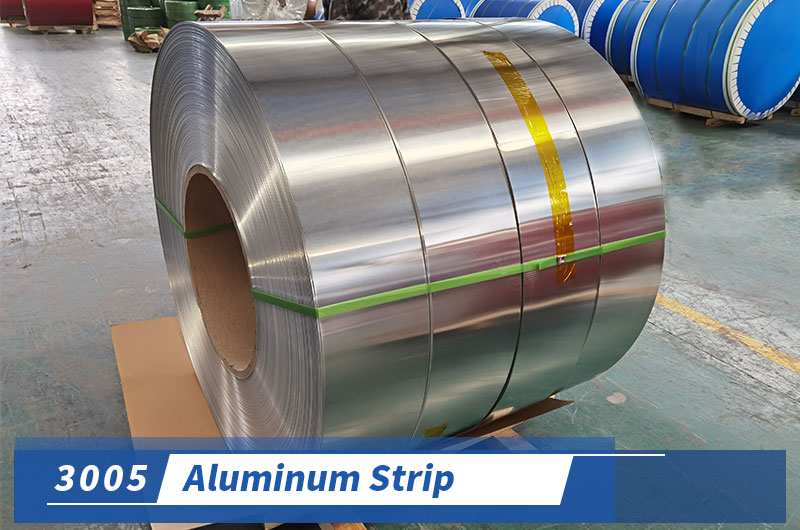
Applications: Radiator fins, cable sheathing, decorative trim, lamp caps, battery connector tabs.
Advantages: Flexible specifications, precise slitting, available in narrow widths, suitable for precision manufacturing and automated production.
3005 Aluminum Alloy Chemical Composition
| Element | Content (%) | Role |
|---|---|---|
| Aluminum (Al) | 95.7 - 98.8 | Base material |
| Manganese (Mn) | 1.0 - 1.5 | Primary strengthening element, improves strength and corrosion resistance |
| Magnesium (Mg) | 0.2 - 0.6 | Increases strength, enhances corrosion resistance in marine environments |
| Silicon (Si) | ≤ 0.6 | Impurity control |
| Iron (Fe) | ≤ 0.7 | Impurity control |
| Copper (Cu) | ≤ 0.3 | Low copper content ensures corrosion resistance |
| Zinc (Zn) | ≤ 0.25 | Impurity control |
| Chromium (Cr) | ≤ 0.1 | Controls grain recrystallization |
| Titanium (Ti) | ≤ 0.1 | Grain refiner |
| Conforms to GB/T 3880-2006, ASTM B209, EN 485 international standards |
3005 Aluminum Alloy Physical Properties
| Property | Value | Unit |
|---|---|---|
| Density | 2.73 | g/cm³ |
| Melting Range | 630-655 | °C |
| Thermal Conductivity (at room temp.) | 160 | W/m·K |
| Electrical Conductivity | 42 | % IACS |
| Coeff. of Thermal Expansion (20-100°C) | 23.9 | µm/m·°C |
| Specific Heat Capacity | 900 | J/kg·K |
| Modulus of Elasticity | 70 | GPa |
| Lightweight Advantage: With a density only 1/3 that of steel, it can significantly reduce the dead weight of building structures. |
3005 Aluminum Alloy Mechanical Properties
Quick Comparison of Mechanical Properties by Temper
| Temper | Tensile Strength (MPa) | Yield Strength (MPa) | Elongation (%) | Hardness (HB) | Characteristics |
|---|---|---|---|---|---|
| O (Annealed) | 140-150 | 51-80 | 20-30 | 33-45 | Softest, best formability |
| H12 | 160 | 140 | 12-20 | 46 | 1/4 Hard, balanced properties |
| H14 | 190 | 170 | 4-7 | 54 | 1/2 Hard, common temper |
| H16 | 210 | 190 | 3-6 | 61 | 3/4 Hard, high strength |
| H18 | 250 | 230 | 2-5 | 69 | Full Hard, highest strength |
| H22 | 160 | 130 | 4-8 | 45 | Strain-hardened then partially annealed |
| H24 | 190 | 150 | 3-6 | 52 | Moderate strength and formability |
3005 Aluminum Alloy Processing Performance
Plastic Working
- Hot Rolling: 300-500°C, improves microstructure.
- Cold Rolling: Room temperature processing, improves precision and surface finish.
- Extrusion: For producing complex profiles, such as door and window frames.
- Forging: Suitable for open-die and closed-die forging processes.
Machining
- Turning: High-precision machining of rotating parts.
- Milling: For processing flat surfaces, grooves, and complex shapes.
- Drilling: Good performance for hole-making.
- Machining Characteristics: Low cutting force, low temperature, slow tool wear.
Joining Processes
- TIG Welding: Precise control, suitable for thin materials.
- MIG Welding: Efficient and versatile.
- Spot/Seam Welding: Ideal for mass production.
- Riveting/Adhesive Bonding: Suitable for scenarios where welding is not feasible.
3005 Aluminum Alloy Surface Treatment
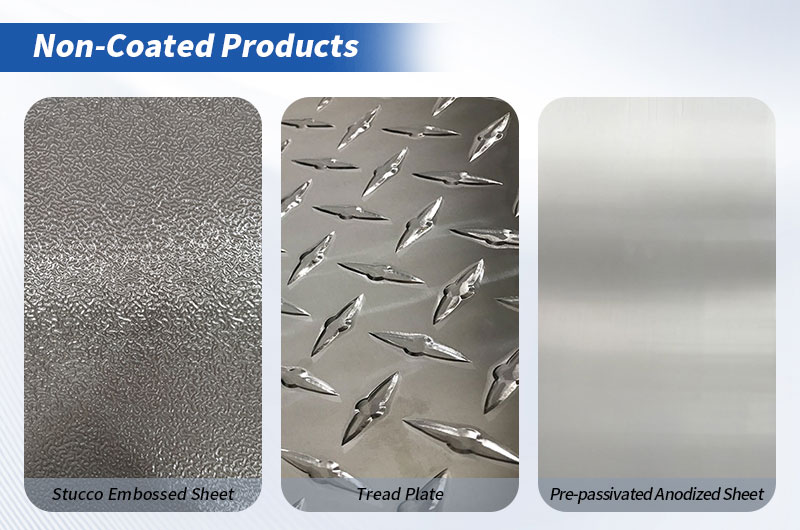
Non-Coated Products
- Stucco Embossed Aluminum: Irregular pattern, enhances aesthetics and rigidity.
- Tread Plate: Regular pattern, anti-slip and wear-resistant.
- Pre-passivated Anodized Sheet: Improves corrosion resistance, suitable for subsequent processing.
Coated Products
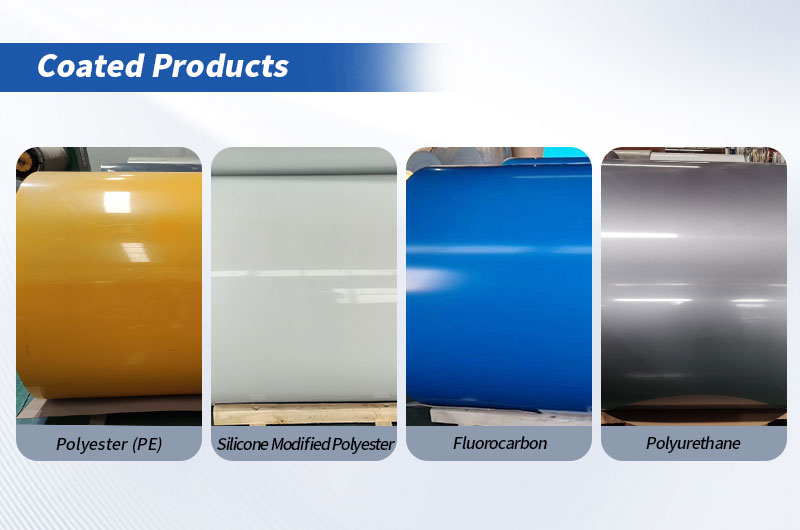
| Coating Type | Characteristics | Service Life | Applicable Environment |
|---|---|---|---|
| Polyester (PE) | Economical and practical | 8-12 years | Inland, dry regions |
| Silicone Modified Polyester (SMP) | UV resistant | 12-18 years | Rainy, high-sunlight regions |
| Fluorocarbon (PVDF) | Superior weather resistance | 20-25 years | Coastal / industrial pollution areas |
| Polyurethane (PU) | Strong chemical resistance | 10-15 years | Chemical environments |
Standard Coating Thickness:
- Primer: ≥5μm
- Topcoat: 20-40μm
- Backer Coat: 10-15μm
Performance Comparison of 3005 vs. Other Aluminum Alloys
This table helps you understand the positioning of 3005 alloy among common aluminum grades:
| Property | 1100 (Pure Al) | 3003 | 3005 | 3004 | 3105 | 5052 |
|---|---|---|---|---|---|---|
| Tensile Strength (MPa) | 90-130 | 130-180 | 140-250 | 170-260 | 140-220 | 210-280 |
| Yield Strength (MPa) | 35-120 | 50-165 | 51-240 | 70-205 | 55-185 | 90-240 |
| Elongation (%) | 20-35 | 8-30 | 2-30 | 5-25 | 8-28 | 12-25 |
| Corrosion Resistance | Good | Good | Excellent | Excellent | Good | Excellent |
| Formability | Excellent | Excellent | Good | Medium | Excellent | Medium |
| Weldability | Excellent | Excellent | Excellent | Good | Excellent | Good |
| Relative Cost Index | 100 | 105 | 110 | 115 | 108 | 130 |
3005 Aluminum Alloy Application Fields
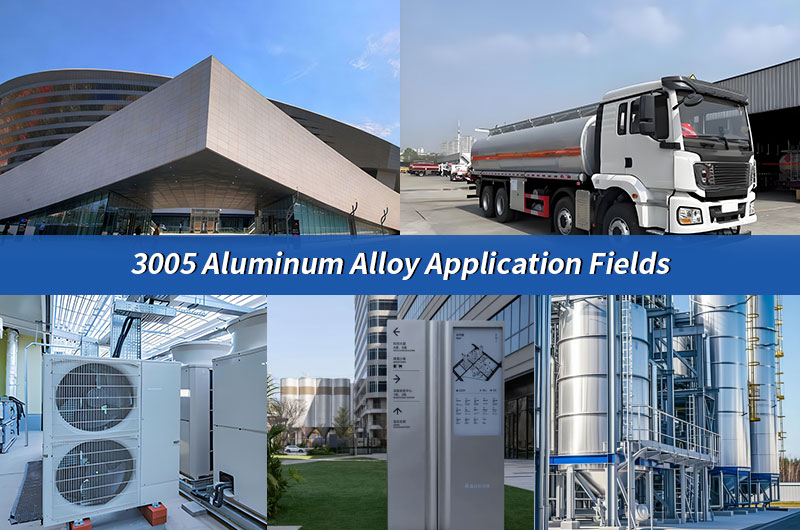
Architectural Decoration
Curtain walls, exterior cladding, roofing systems, metal roofs, suspended ceilings, aluminum ceiling tiles, gutters, downspouts, blinds and louvers, roller shutter doors, aluminum composite panel (ACP) substrates.
Transportation
Automotive body panels, underbody shields, radiators, fuel tanks, interior and exterior decorative panels for ships, container side panels, rail transit interiors.
Electronics and Appliances
Air conditioner casings and internal parts, refrigerator liners and back panels, heat sinks, heat exchangers, battery trays and housings, lamp caps and bases, photocopier drums.
Packaging and Containers
Food packaging containers, chemical storage tanks, pressure vessels, liquid product tanks, piping systems.
Other Fields
Furniture panels and profiles, prepainted aluminum substrates, signs and nameplates, decorative building materials.
Quick Selection Guide for 3005 Tempers by Application
| Application | Recommended Temper(s) | Thickness Range (mm) | Core Requirement |
|---|---|---|---|
| Deep Drawing | O, H12 | 0.3-1.5 | Elongation ≥15% |
| Color-Coating Substrate | H14, H24 | 0.4-1.0 | Flatness, adhesion |
| Architectural Curtain Wall | H14, H16, H24 | 0.8-2.0 | Strength, weather resistance |
| Roofing System | H16, H18, H26 | 1.0-1.5 | High strength, wind load resistance |
| Blinds and Louvers | H14, H24 | 0.5-1.2 | Formability, weather resistance |
| Automotive Underbody Shield | H16, H18 | 1.5-3.0 | Strength, corrosion resistance, lightweight |
| Marine Decoration | H14, H24 | 1.0-2.5 | Seawater corrosion resistance |
| Appliance Casing | H14, H22, H24 | 0.5-1.2 | Surface quality, paintability |
| Signage | H14, H16 | 0.8-2.0 | Flatness, surface treatability |
| Ceiling Panels | H14, H24 | 0.5-1.0 | Flatness, lightweight |
| Chemical Storage Tanks | O, H12, H22 | 2.0-6.0 | Corrosion resistance, weldability |
Additional Data for 3005 Aluminum Alloy (for your reference)
H1X Series (Strain-Hardened Only)
| Temper | Tensile Strength (MPa) | Yield Strength (MPa) | Elongation (%) | Brinell Hardness (HB) | Shear Strength (MPa) | Fatigue Strength (MPa) | Elastic Modulus (GPa) |
|---|---|---|---|---|---|---|---|
| 3005-O | 140 | 51 | 16-30 | 33 | 84 | 53 | 70 |
| 3005-H12 | 160 | 140 | 2.3-15 | 46 | 92 | 92 | 70 |
| 3005-H14 | 190 | 170 | 1.7-7 | 54 | 110 | 76 | 70 |
| 3005-H16 | 210 | 190 | 1.7-6 | 61 | 120 | 78 | 70 |
| 3005-H18 | 250 | 230 | 1.7-5 | 69 | 140 | 82 | 70 |
| 3005-H19 | 270 | 240 | 1.1-4 | 73 | 150 | 73 | 70 |
H2X Series (Strain-Hardened and Partially Annealed)
This series is strain-hardened and then partially annealed to achieve better formability and stability.
| Temper | Tensile Strength (MPa) | Yield Strength (MPa) | Elongation (%) | Brinell Hardness (HB) | Shear Strength (MPa) | Fatigue Strength (MPa) | Elastic Modulus (GPa) |
|---|---|---|---|---|---|---|---|
| 3005-H22 | 160 | 130 | 4.0-8 | 45 | 92 | 93 | 70 |
| 3005-H24 | 190 | 150 | 3.4-6 | 52 | 110 | 78 | 70 |
| 3005-H25 | 200 | 170 | 1.1-5 | 55 | 110 | 85 | 70 |
| 3005-H26 | 210 | 180 | 2.9-5 | 60 | 120 | 100 | 70 |
| 3005-H27 | 230 | 200 | 1.1-4 | 65 | 130 | 90 | 70 |
| 3005-H28 | 240 | 210 | 1.7-4 | 68 | 140 | 85 | 70 |
| 3005-H29 | 260 | 220 | 1.1-3 | 71 | 150 | 75 | 70 |
Thermal and Electrical Properties
Differences in thermal and electrical properties between tempers are minimal but can be relevant for specific applications.
| Property | O Temper | H14 Temper | H18 Temper | Unit |
|---|---|---|---|---|
| Thermal Properties | ||||
| Thermal Conductivity (25°C) | 160 | 160 | 160 | W/m·K |
| Specific Heat Capacity | 900 | 900 | 900 | J/kg·K |
| Coeff. of Thermal Expansion (20-100°C) | 23.9 | 23.9 | 23.9 | µm/m·°C |
| Thermal Diffusivity | 64 | 64 | 64 | mm²/s |
| Latent Heat of Fusion | 400 | 400 | 400 | J/g |
| Solidus Temperature | 640 | 640 | 640 | °C |
| Liquidus Temperature | 660 | 660 | 660 | °C |
| Maximum Service Temperature | 180 | 180 | 180 | °C |
| Electrical Properties | ||||
| Electrical Conductivity (by Volume) | 42 | 42 | 42 | % IACS |
| Electrical Conductivity (by Weight) | 140 | 140 | 140 | % IACS |
| Electrical Resistivity (20°C) | 4.1 | 4.1 | 4.1 | µΩ·cm |
Why Choose Worthwill?
Strong Manufacturing Capabilities
With over 20 years of experience in aluminum production and an annual capacity exceeding 50,000 tons, Worthwill is equipped with advanced machinery including cold rolling mills, hot rolling mills, slitting machines, and tension levelers to ensure full-process quality control from casting to finished product.
Reliable Product Quality
Certified with ISO 9001 and ISO 14001, we use precision testing equipment like spectrometers and tensile testers. Every batch of product is supplied with a material certificate and inspection report, strictly adhering to national and international standards.
Flexible Customization Services
We offer customization of thickness, width, length, temper (O to H29), and surface treatments (anodizing, coating, embossing, cutting, etc.) to meet your specific production requirements.
Efficient and Fast Delivery
Standard specifications are available in stock. Customized products are typically delivered in 15-25 days. We support nationwide delivery and export loading with a comprehensive logistics network.
Professional Technical Support
We provide expert advice on material selection, processing techniques, and technical support for welding and surface treatments. Our engineering team offers assistance throughout the entire process, with rapid after-sales response.
High Cost-Effectiveness
Our factory-direct sales model eliminates intermediaries, offering more competitive prices for larger volumes. Consistent quality leads to a lower total lifecycle cost. We have exported to over 60 countries and regions.
Frequently Asked Questions (FAQ)
Q1: What is the difference between 3005 and 3003 aluminum alloy?
A: 3005 has a higher manganese content (1.0-1.5%) and includes added magnesium (0.2-0.6%). This makes it about 20% stronger than 3003 and provides superior corrosion resistance, especially in humid and marine environments.
Q2: What is the difference between 3005 aluminum sheet, coil, and strip?
A: While they share the same chemical composition and properties, their main difference lies in form and application. Sheet is ideal for structural and decorative panels, coil is suited for continuous processing, and strip is used for precision stamping and deep-drawn parts.
Q3: Which temper should I choose?
A: For deep drawing, O or H14 tempers are recommended. For general architectural and appliance applications, H14 or H24 offer the best balance of strength and formability. For high-strength requirements, choose H16 or H18. Worthwill offers free selection advice based on your specific process.
Q4: What is the difference between H14 and H24 tempers?
A: Both have similar strength levels. However, H24 is strain-hardened and then partially annealed, resulting in lower internal stress and better formability for secondary processing. H14 has a slightly higher surface hardness and is better suited for direct stamping.
Q5: What is the minimum order quantity (MOQ) and lead time?
A: The MOQ for standard specifications is 1 ton, and for custom specifications, it is 3 tons. In-stock products ship within 3-7 business days, while custom orders take 15-25 business days. Expedited delivery can be arranged for urgent orders.
Q6: How do you guarantee product quality?
A: Worthwill implements quality control from raw material inspection and in-process monitoring to final product testing. We provide a full set of documentation, including chemical composition, mechanical property, and dimensional inspection reports, along with a Mill Certificate. We also support third-party inspection and on-site customer witnessing.