


3003 vs. 3005 vs 3105 Aluminum Alloys
Aluminum alloys 3003, 3005, and 3105 in the 3000 series, with manganese as the primary alloying element, occupy a crucial position in industrial manufacturing, architectural decoration, and consumer goods sectors due to their non-heat-treatable strengthening properties, excellent corrosion resistance, and balanced strength-to-weight ratio.
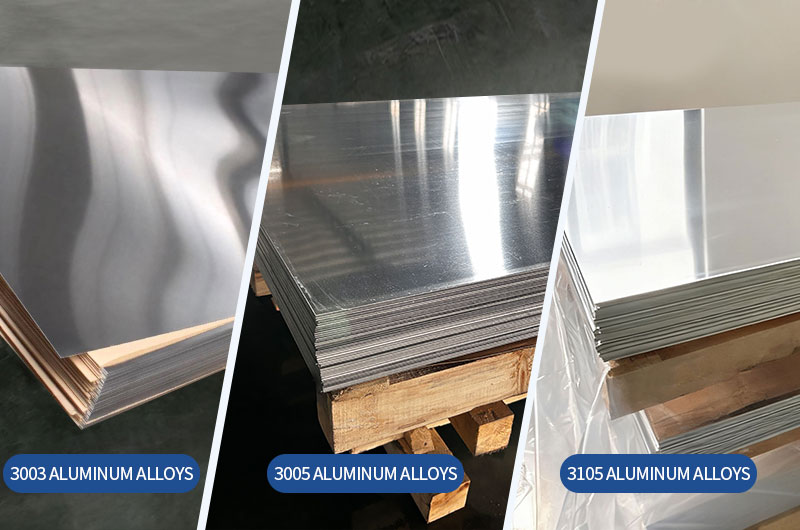
Despite belonging to the same series, subtle differences in their chemical compositions lead to significant variations in mechanical properties, processing characteristics, and application scenarios.
Based on ASTM international standards, Chinese national standards, and industry technical manuals, as well as data from websites including https://www.makeitfrom.com/, https://www.matweb.com/, and https://en.wikipedia.org/wiki/3003_aluminium_alloy, this paper systematically compares the chemical composition, mechanical properties under different states, physical and environmental characteristics, processing feasibility (welding, forming, machining), and application suitability of the three alloys. It provides selection recommendations supported by specific data and standard references, serving as a decision-making tool for engineers, designers, and procurement professionals.
Introduction
The core characteristic of 3000-series aluminum alloys is the use of manganese as the main strengthening element. Through the mechanism of solid solution strengthening, they enhance strength and corrosion resistance while retaining the good ductility of the aluminum matrix. Unlike heat-treatable strengthened alloys such as 6061 and 7075, the properties of this series are adjusted through cold working (tempering)—a feature that makes them particularly suitable for manufacturing precision components where subsequent heat treatment is not feasible.
Within the 3000 series, 3003, 3005, and 3105 form a complementary pattern due to their distinct functional orientations:
- 3003 Aluminum Alloy: Known in the industry as a "versatile workhorse alloy, " it achieves moderate strength improvement by adding trace copper while maintaining exceptional formability, making it the preferred material for components with complex shapes.
- 3005 Aluminum Alloy: Replaces some elements with magnesium, significantly increasing strength while maintaining corrosion resistance, targeting applications requiring medium strength.
- 3105 Aluminum Alloy: Adopts a low-manganese, high-magnesium composition design. Through the synergistic effect of elements, it balances strength and ductility, optimized for structural parts and applications in harsh environments.
This paper is based on authoritative standards such as ASTM B209 Standard Specification for Aluminum and Aluminum Alloy Sheet and Plate and GB/T 3880.2 Aluminum and Aluminum Alloy Sheet and Strip for General Industrial Use—Part 2: Mechanical Properties, combined with industry practical data, to analyze the mechanism by which compositional differences affect actual performance.
Chemical Composition: The Root Cause of Performance Differences
Chemical composition is the core factor determining the properties of aluminum alloys. 3003, 3005, and 3105 all use pure aluminum as the matrix, but the content ratios of manganese, magnesium, and copper form their unique performance foundations, with composition ranges strictly adhering to international and national standards.
| Element | 3003 Aluminum Alloy | 3005 Aluminum Alloy | 3105 Aluminum Alloy | Standard Reference |
| Aluminum (Al) | 96.8–99.0 | 95.7–98.8 | 96.0–99.5 | ASTM B209-21a |
| Manganese (Mn) | 1.0–1.5 | 1.0–1.5 | 0.3–0.8 | ASTM B209-21a |
| Copper (Cu) | 0.05–0.20 | 0–0.30 | 0–0.30 | ASTM B209-21a |
| Magnesium (Mg) | 0 | 0.2–0.6 | 0.2–0.8 | ASTM B209-21a |
| Iron (Fe) | 0–0.7 | 0–0.7 | 0–0.7 | ASTM B209-21a |
| Chromium (Cr) | 0 | 0–0.1 | 0–0.2 | ASTM B209-21a |
Key Conclusion: The compositional design determines the performance orientation of the three alloys—3003 achieves advantages in formability and welding through "copper element + high aluminum purity, " 3005 pursues strength improvement through "balanced manganese and magnesium, " and 3105 achieves a balance between strength and ductility through "high magnesium and low manganese." This difference will be further amplified in subsequent processing and applications.
Mechanical Properties: The Influence of Temper States
The mechanical properties of 3000-series aluminum alloys are highly dependent on tempering (degree of cold working). According to the latest GB/T 3880.2-2025 standard, the key performance indicators of the three alloys under typical states such as O (annealed), H14 (half-hard), and H18 (full-hard) show obvious gradient differences, providing quantitative basis for the selection of processing technologies.
| Temper State | Performance Indicator | 3003 Aluminum Alloy | 3005 Aluminum Alloy | 3105 Aluminum Alloy |
| O Temper | Ultimate Tensile Strength (UTS, MPa) | 110 | 140 | 120 |
| Yield Strength (MPa) | 40 | 51 | 48 | |
| Elongation at Break (%) | 28 | 16 | 20 | |
| Brinell Hardness | 28 | 33 | 29 | |
| Fatigue Strength (MPa) | 50 | 53 | 52 | |
| Shear Strength (MPa) | 75 | 84 | 84 | |
| H12 Temper | Ultimate Tensile Strength (UTS, MPa) | 130 | 160 | 150 |
| Yield Strength (MPa) | 100 | 140 | 120 | |
| Elongation at Break (%) | 11 | 2.3 | 4.5 | |
| Brinell Hardness | 36 | 46 | 41 | |
| Fatigue Strength (MPa) | 55 | 92 | 87 | |
| Shear Strength (MPa) | 84 | 92 | 96 | |
| H14 Temper | Ultimate Tensile Strength (UTS, MPa) | 160 | 190 | 170 |
| Yield Strength (MPa) | 130 | 170 | 150 | |
| Elongation at Break (%) | 8.3 | 1.7 | 2.7 | |
| Brinell Hardness | 42 | 54 | 48 | |
| Fatigue Strength (MPa) | 60 | 76 | 69 | |
| Shear Strength (MPa) | 96 | 110 | 110 | |
| H16 Temper | Ultimate Tensile Strength (UTS, MPa) | 180 | 210 | 190 |
| Yield Strength (MPa) | 170 | 190 | 170 | |
| Elongation at Break (%) | 5.2 | 1.7 | 2.4 | |
| Brinell Hardness | 49 | 61 | 56 | |
| Fatigue Strength (MPa) | 70 | 78 | 71 | |
| Shear Strength (MPa) | 110 | 120 | 110 | |
| H18 Temper | Ultimate Tensile Strength (UTS, MPa) | 210 | 250 | 220 |
| Yield Strength (MPa) | 180 | 230 | 190 | |
| Elongation at Break (%) | 4.5 | 1.7 | 3.9 | |
| Brinell Hardness | 56 | 69 | 62 | |
| Fatigue Strength (MPa) | 70 | 82 | 74 | |
| Shear Strength (MPa) | 110 | 140 | 120 | |
| H19 Temper | Ultimate Tensile Strength (UTS, MPa) | 240 | 270 | 240 |
| Yield Strength (MPa) | 210 | 240 | 220 | |
| Elongation at Break (%) | 1.1 | 1.1 | 1.1 | |
| Brinell Hardness | 65 | 73 | 67 | |
| Fatigue Strength (MPa) | 64 | 67 | 67 | |
| Shear Strength (MPa) | 130 | 150 | 140 | |
| H22 Temper | Ultimate Tensile Strength (UTS, MPa) | 140 | 160 | 150 |
| Yield Strength (MPa) | 94 | 130 | 120 | |
| Elongation at Break (%) | 7.7 | 4.0 | 7.4 | |
| Brinell Hardness | 37 | 45 | 41 | |
| Fatigue Strength (MPa) | 71 | 93 | 94 | |
| Shear Strength (MPa) | 81 | 92 | 95 | |
| H24 Temper | Ultimate Tensile Strength (UTS, MPa) | 160 | 190 | 170 |
| Yield Strength (MPa) | 130 | 150 | 140 | |
| Elongation at Break (%) | 6.0 | 3.4 | 5.6 | |
| Brinell Hardness | 45 | 52 | 47 | |
| Fatigue Strength (MPa) | 68 | 78 | 74 | |
| Shear Strength (MPa) | 93 | 110 | 110 | |
| H26 Temper | Ultimate Tensile Strength (UTS, MPa) | 180 | 210 | 200 |
| Yield Strength (MPa) | 160 | 180 | 170 | |
| Elongation at Break (%) | 3.1 | 2.9 | 4.3 | |
| Brinell Hardness | 53 | 60 | 55 | |
| Fatigue Strength (MPa) | 90 | 100 | 95 | |
| Shear Strength (MPa) | 110 | 120 | 110 | |
| H28 Temper | Ultimate Tensile Strength (UTS, MPa) | 210 | 240 | 220 |
| Yield Strength (MPa) | 180 | 210 | 190 | |
| Elongation at Break (%) | 1.7 | 1.7 | 3.2 | |
| Brinell Hardness | 59 | 68 | 61 | |
| Fatigue Strength (MPa) | 73 | 85 | 77 | |
| Shear Strength (MPa) | 120 | 140 | 120 |
Note: Data sources: https://www.makeitfrom.com/, https://www.matweb.com/
Key Patterns:
- As the temper degree deepens from O temper to H18 temper, all three alloys show a common trend of "strength increase and ductility decrease, " which is consistent with the mechanism of grain refinement and dislocation strengthening caused by cold working.
- 3005 maintains the leading position in strength and hardness under all states, confirming the effectiveness of the synergistic strengthening of manganese and magnesium.
- The ductility advantage of 3003 runs through all temper states, which is the core reason for its irreplaceability in the field of complex forming.
- 3105 achieves a balance between strength and ductility, making up for the insufficient strength of 3003 and the poor formability of 3005.
Physical and Environmental Characteristics: From Processing Adaptability to Sustainability
In addition to mechanical properties, thermal, electrical characteristics, and environmental impact are important considerations for material selection. Differences in these indicators directly affect the adaptability of materials in thermal management, conductive applications, and green manufacturing scenarios.
| Performance Indicator | 3003 Aluminum Alloy | 3005 Aluminum Alloy | 3105 Aluminum Alloy | Comparative Analysis and Industry Basis |
| Thermal Characteristics | ||||
| Thermal Conductivity (W/m·K) | 180 | 160 | 170 | 3003 has the optimal thermal conductivity (12.5% higher than 3005), making it an ideal material for heat exchangers, in line with industry application practices. |
| Melting Temperature Range (℃) | 640–650 | 640–660 | 640–660 | Magnesium increases the liquidus temperature of 3005/3105 by 10℃, requiring appropriate increase in heat input during welding. |
| Coefficient of Linear Expansion (μm/m·K) | 23 | 23 | 24 | 3105 has a slightly higher expansion coefficient, but the difference is negligible and does not affect assembly accuracy. |
| Maximum Service Temperature (℃) | 180 | 180 | 180 | All three are limited by the thermal stability of cold working strengthening; strength decreases significantly when exceeding 180℃. |
| Electrical Characteristics | ||||
| Electrical Conductivity (% IACS) | 44 | 42 | 44 | 3003 and 3105 have comparable electrical conductivity, suitable for low-current conductive components such as electrical enclosures. |
| Environmental and Economic Characteristics | ||||
| Carbon Footprint per Unit (kg CO₂/kg) | 8.1 | 8.2 | 8.2 | 3003 has a slightly lower carbon footprint due to its lower alloying element content, conforming to the trend of green manufacturing. |
| Energy Consumption per Unit (MJ/kg) | 150 | 150 | 150 | Energy consumption mainly comes from aluminum smelting; differences in the alloying stage are negligible. |
| 2025 Market Price (USD/ton) | 2100–2800 | 2300–3000 | 2200–2900 | 3003 has the lowest price, while 3005 has the highest price due to its performance advantages, with a price difference of approximately 10–15%. |
| Density (g/cm³) | 2.73 | 2.73 | 2.73 | Density is consistent; differences in strength-to-weight ratio are determined solely by strength. |
Key Insight: 3003 has advantages in functional components due to its superior thermal and electrical properties, while the performance premium of 3005 and 3105 matches their strength improvement. From a life-cycle perspective, the environmental impact differences among the three alloys are minimal, so performance adaptability should be prioritized during material selection.
Processing Feasibility: Comparison of Welding, Forming, and Machining Performance
Processing performance directly determines manufacturing efficiency and costs. Due to compositional differences, the three alloys show significant variations in welding, forming, and machining, which have been fully verified by AWS welding standards and industry processing manuals.
Welding Performance
The low alloy content of 3000-series aluminum alloys generally ensures good weldability, but there are significant differences in details:
- 3003 Aluminum Alloy: It has the best welding performance. Its copper element reduces the sensitivity to welding porosity and improves the ductility of the fusion zone. According to AWS C3.7M-2011 Standard for Aluminum Brazing, this alloy is compatible with various processes such as MIG, TIG, and resistance welding, with weld joint strength reaching 90–95% of the base metal, and no subsequent heat treatment is required. The welding reliability of 3003 has been long-term verified in the manufacturing of chemical storage tanks.
- 3005 and 3105 Aluminum Alloys: Their welding performance is slightly inferior to that of 3003. Magnesium increases the formation rate of oxide films; according to the Alcoa technical manual, strict surface treatment (such as degreasing and wire brushing) must be performed before welding to remove oxide layers, otherwise slag inclusion defects are likely to occur. The weld joint strength is usually 80–90% of the base metal, requiring caution in high-stress welded structures.
Conclusion: 3003 is the first choice for welding-intensive components (e.g., heat exchangers, pipelines), while 3005/3105 are only suitable for scenarios with low requirements for welding strength.
Forming Performance
Forming performance is directly related to ductility, and differences among the three alloys determine their adaptability in different forming processes:
- 3003 Aluminum Alloy: It has excellent forming performance. With an elongation at break of 28% in O temper, it can achieve complex processes such as deep drawing and spinning, with a minimum bend radius of 0× thickness (i.e., bending without fillets). In products such as kitchen utensils and HVAC ducts, the forming advantage of 3003 is irreplaceable.
- 3105 Aluminum Alloy: It has medium forming performance. In H14 temper, the bend radius needs to be controlled at 1–2× thickness, which can meet simple forming needs such as rolling and shallow drawing. It is widely used in architectural components such as siding and gutters, balancing strength and processability.
- 3005 Aluminum Alloy: It has the worst forming performance. The high magnesium content leads to a fast work hardening rate; it can hardly undergo bending in H18 temper. According to GB/T 3880.2-2025, it is only suitable for shallow stamping or shearing; for complex forming, O temper material must be used, sacrificing strength.
Conclusion: Forming complexity is a key criterion for selecting the three alloys—3003 for complex shapes, 3105 for simple shapes, and 3005 for non-formed components.
Machining Performance
Machining performance depends on the balance between material hardness and ductility:
- 3005 Aluminum Alloy: It has the best machining performance. Its high hardness (Brinell hardness of 69 in H18 temper) reduces tool adhesion, and low ductility makes chips easy to break. According to industry processing data, its milling speed can reach 300 m/min, and a smooth surface can be obtained without a large amount of coolant.
- 3105 Aluminum Alloy: It has medium machining performance. The balance between hardness and ductility makes it suitable for conventional processing such as drilling and turning, but tools need to be sharpened regularly to avoid chip accumulation.
- 3003 Aluminum Alloy: It has the worst machining performance. High ductility leads to continuous strip-shaped chips that easily wrap around tools, requiring reduced processing speed (150–200 m/min recommended) and high-pressure coolant; burrs are likely to occur after processing, requiring secondary deburring.
Conclusion: 3005 is the preferred choice for machined components, while 3003 requires additional processing costs.
Application Suitability: Precise Matching of Performance and Requirements
The performance differences of the three alloys lead to clear application divisions in various industries, as analyzed below with specific cases and industry reports.
Food and Household Appliances
- 3003 Aluminum Alloy Application Cases: Refrigerator liners, microwave oven enclosures, kitchen cookware
- 3005 Aluminum Alloy Application Cases: Household appliance decorative frames, beverage can lids, shallow stamped panels
- 3105 Aluminum Alloy Application Cases: Screw caps for carbonated beverage bottles, small appliance brackets
Selection Logic and Basis:
- 3003: Formability meets the needs of complex structures.
- 3005: Strength supports the durability of decorative parts.
- 3105: Corrosion resistance adapts to food contact scenarios.
Architectural Building Materials
- 3003 Aluminum Alloy Application Cases: HVAC ducts, ceiling panels, light fixture brackets
- 3005 Aluminum Alloy Application Cases: Decorative curtain wall panels, medium-pressure storage tanks, window frame profiles
- 3105 Aluminum Alloy Application Cases: Residential siding, roof panels, mobile home frames
Selection Logic and Basis:
- 3003: Ductility is suitable for duct bending.
- 3005: Strength and aesthetics adapt to curtain walls.
- 3105: Balanced performance is suitable for outdoor structures.
Chemical and Industrial Sectors
- 3003 Aluminum Alloy Application Cases: Chemical storage tanks, heat exchangers, process pipelines
- 3005 Aluminum Alloy Application Cases: Medium-pressure pump housings, conveyor components, wear-resistant liners
- 3105 Aluminum Alloy Application Cases: Heavy processing equipment frames, marine anti-corrosion components
Selection Logic and Basis:
- 3003: Weldability and thermal conductivity adapt to heat exchange equipment.
- 3005: Strength and wear resistance are suitable for mechanical parts.
- 3105: Corrosion resistance adapts to harsh environments.
Transportation
- 3003 Aluminum Alloy Application Cases: Light truck panels, trailer covers
- 3005 Aluminum Alloy Application Cases: Automotive decorative strips, bus interior panels
- 3105 Aluminum Alloy Application Cases: Automotive door inner panels, trailer siding
Selection Logic and Basis:
- 3003: Balances lightweight and formability.
- 3005: Aesthetics and strength adapt to decorative parts.
- 3105: Impact resistance is suitable for structural parts.
Application Trend Analysis
- The dominant position of 3003 in the field of precision forming cannot be replaced in the short term, especially with significant demand growth in the manufacturing of cooling plates for new energy vehicle thermal management systems.
- Due to the balance between aesthetics and strength, the application proportion of 3005 in the high-end architectural decoration field has increased year by year; 2024 industry data shows that its market share has reached 28% of the 3000 series.
- With cost advantages (5–8% lower than 3005), 3105 is gradually replacing some 5000-series alloys in the low-end architectural siding market.
Material Selection Decision Guide: Quick Judgment Based on Core Needs
Combined with the above analysis, the following material selection decision framework is established to help practitioners quickly identify the optimal alloy:
-
Core Need: Complex Forming (Deep Drawing, Spinning,
Small-Radius Bending)
- Conclusion: Must select 3003 Aluminum Alloy
- Basis: It maintains the highest ductility under all temper states and is the only grade that can meet complex forming requirements.
-
Core Need: High Strength (Ultimate Tensile Strength > 200
MPa) Without Complex Forming
- Conclusion: Prioritize 3005 Aluminum Alloy
- Basis: Its ultimate tensile strength can reach 250 MPa in H18 temper, the highest among the three, with excellent machining performance.
-
Core Need: Balanced Strength and Formability with Cost
Sensitivity
- Conclusion: Select 3105 Aluminum Alloy
- Basis: It has higher strength than 3003 and better formability than 3005, with a price between the two, showing outstanding cost-effectiveness.
-
Core Need: Welding-Intensive Structures (e.g., Storage Tanks,
Pipelines)
- Conclusion: Select 3003 Aluminum Alloy
- Basis: The copper element improves welding reliability, with minimal joint strength loss, meeting AWS welding standard requirements.
-
Core Need: Thermal Management or Conductive Components (e.g.,
Heat Sinks, Electrical Enclosures)
- Conclusion: Select 3003 Aluminum Alloy
- Basis: It has the optimal thermal and electrical conductivity, meeting functional needs.
Conclusion and Outlook
Although 3003, 3005, and 3105 aluminum alloys belong to the same 3000 series, their differentiated compositional designs lead to clear distinctions in performance and application scenarios:
- 3003 Aluminum Alloy takes "high ductility + excellent weldability + good thermal conductivity" as its core advantages, serving as a benchmark material for complex forming, welding-intensive, and functional components.
- 3005 Aluminum Alloy relies on "high strength + high hardness + excellent machining performance" to become the first choice for medium-strength, non-formed components.
- 3105 Aluminum Alloy forms unique competitiveness in the mid-end structural part field with "strength-formability balance + cost advantage."
In the future, with the upgrading of lightweight and green manufacturing needs, all three alloys face performance optimization directions: 3003 can further improve strength through micro-alloying (e.g., adding trace chromium), 3005 can improve formability through process modification, and 3105 is expected to enhance corrosion resistance through purity improvement. However, at the current technical level, the performance positioning of the three has formed a mature system, and precise matching of needs remains the core principle of material selection.