


6061 vs. 6063 Aluminum
Both 6061 and 6063 are 6xxx series aluminum-magnesium-silicon alloys, but they are engineered for distinctly different tasks. Understanding their differences can save you time, money, and potential headaches.
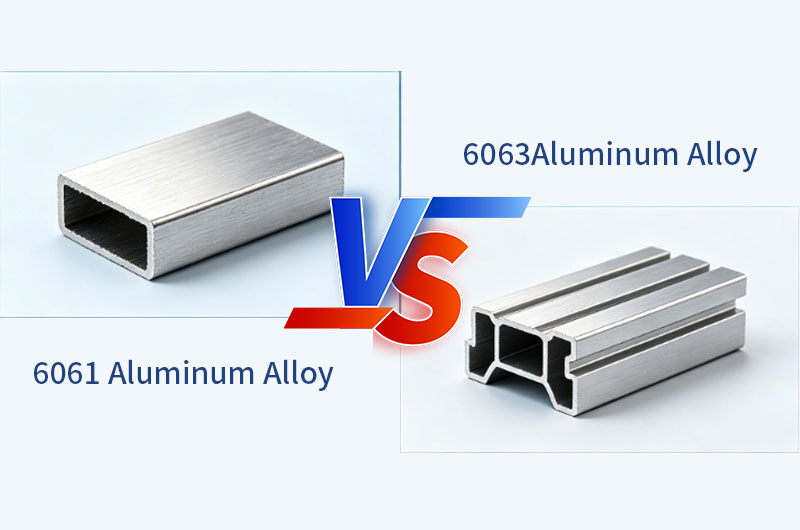
6061 vs. 6063 Aluminum: What Makes Them Different?
6061 achieves its higher strength through the addition of copper, while 6063 gains exceptional extrudability and surface finish through a simplified alloy composition.
6061: The Most Versatile Aluminum Alloy
- Positioning:A high-strength, multi-purpose structural material.
- Characteristics:Contains more magnesium and silicon, and adds copper to significantly increase strength.
- The Trade-off:The increase in strength comes at the cost of slightly reduced corrosion resistance and surface finish quality.
6063: The "Artist" of Architectural Aesthetics
- Positioning:The "architectural aluminum, " prioritizing appearance and formability.
- Characteristics:Has a lower alloy content and is virtually free of copper. This makes it "softer, " allowing it to be easily extruded into complex, thin-walled profiles with an excellent surface finish, making it ideal for anodizing.
6061 is the structural "workhorse" built for strength, while 6063 is the architectural "artist" designed for complex shapes and beautiful finishes.6063 is perfectly suited for the sleek window frames and decorative profiles of modern architecture.
Quick Comparison Chart
| Comparison Attribute | 6061 Aluminum Alloy | 6063 Aluminum Alloy |
| Positioning | Structural Alloy | Architectural Alloy |
| Key Advantages | High strength, good machinability | Excellent extrudability, superior surface finish |
| Tensile Strength (T6) | 290-310 MPa | 205-241 MPa |
| Yield Strength (T6) | 240-276 MPa | 160-214 MPa |
| Brinell Hardness (T6) | 93-95 HB | 73-75 HB |
| Copper Content | 0.15-0.4% | ≤0.10% |
| Corrosion Resistance | Good | Excellent |
| Extrudability | Moderate | Exceptional |
| Machinability | Excellent | Good |
| Anodizing Performance | Good | Exceptional (bright, uniform surface) |
| Weldability | Excellent | Excellent |
| Thermal Conductivity | 167 W/(m·K) | 201 W/(m·K) |
| Electrical Conductivity | 40-43% IACS | 53-58% IACS |
| Relative Cost | Higher | Lower (by 15-20%) |
| Typical Applications | Aircraft fittings, bicycle frames, machine parts, automotive chassis | Door & window frames, curtain walls, railings, heat sinks, decorative trim |
| Best Suited For | Load-bearing structural components, precision machined parts | Complex extruded profiles, architectural decoration |
6061 vs. 6063 Aluminum: Chemical Composition Comparison
The chemical composition of these alloys tells the story of their different properties. Here is a comparison of the actual makeup of each material:
Chemical Composition Comparison Table
| Element | 6061 Aluminum (%) | 6063 Aluminum (%) | Difference Explained |
| Aluminum (Al) | 95.85-98.56 (Balance) | 97.5-99.4 (Balance) | 6063 is purer. |
| Magnesium (Mg) | 0.8-1.2 | 0.45-0.9 | 6061 has a higher content for greater strength. |
| Silicon (Si) | 0.4-0.8 | 0.2-0.6 | Higher content in 6061. |
| Copper (Cu) | 0.15-0.4 | ≤0.10 | Key Difference:6061 has 3-4 times more copper. |
| Chromium (Cr) | 0.04-0.35 | ≤0.10 | Higher content in 6061. |
| Iron (Fe) | ≤0.7 | ≤0.35 | 6063 has stricter impurity control. |
| Zinc (Zn) | ≤0.25 | ≤0.10 | Stricter limits in 6063. |
| Manganese (Mn) | ≤0.15 | ≤0.10 | Content is low in both. |
| Titanium (Ti) | ≤0.15 | ≤0.10 | Used for grain refinement. |
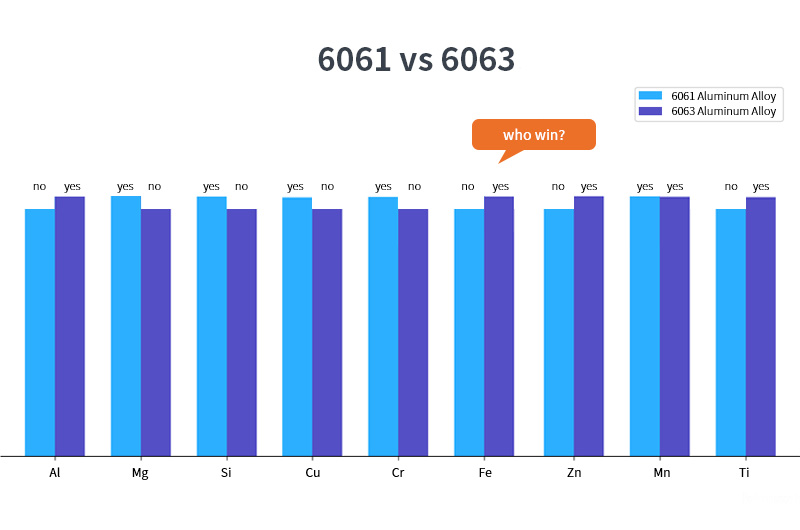
Analysis of Key Compositional Differences
- 6061: "More Heavily Alloyed"– It achieves superior mechanical strength by increasing alloying elements (especially copper), making it suitable for load-bearing beams, machine parts, etc.
- 6063: "Purer & More Refined"– Through strict control of impurities and the magnesium-silicon ratio, it obtains a perfect surface texture and excellent extrudability, making it ideal for doors, windows, curtain walls, heat sinks, and other decorative or complex profiles.
6061 vs. 6063 Aluminum: Mechanical Properties Comparison
When it comes to load-bearing capacity, the differences become very clear. Here is a detailed comparison in their most common heat-treated states:
T6 Temper Mechanical Properties Comparison (Most Common)
| Performance Metric | 6061-T6 | 6063-T6 | Performance Difference |
| Ultimate Tensile Strength | 290-310 MPa | 205-241 MPa | 6061 is 30-40% higher. |
| Yield Strength | 240-276 MPa | 160-214 MPa | 6061 is 35-40% higher. |
| Elongation | 8-12% | 10-12% | 6063 is slightly better. |
| Brinell Hardness | 93-95 HB | 73-75 HB | 6061 is 27% higher. |
| Shear Strength | 205-210 MPa | 150-152 MPa | 6061 is 37% higher. |
| Fatigue Strength (500M cycles) | 96-97 MPa | 68-70 MPa | 6061 is 38% higher. |
| Modulus of Elasticity | 68.9 GPa | 68.9 GPa | Identical. |
Comparison of 6063 in Different Tempers
| Performance Metric | 6063-O (Annealed) | 6063-T5 | 6063-T6 | Application Advice |
| Tensile Strength | ≤130 MPa | 160-185 MPa | 205-241 MPa | If T5 is sufficient, use it to save cost. |
| Yield Strength | ≤49 MPa | 110-145 MPa | 160-214 MPa | Choose T6 for structural parts. |
| Elongation | 18-21% | 8-12% | 10-12% | Choose O or T4 for parts requiring bending. |
| Brinell Hardness | 25 HB | 60-75 HB | 73-75 HB | Use T5 if high hardness is not required. |
| Processing State | Softest | Extruded + Artificially Aged | Solution Treated + Artificially Aged | T5 process is more economical. |
| Typical Use | Pre-deep processing | Architectural doors & windows | Load-bearing structures | 90% of architectural uses are T5. |
Comparison of Common 6061 Tempers
| Performance Metric | 6061-O (Annealed) | 6061-T4 | 6061-T6 | 6061-T651 |
| Tensile Strength | ≤150 MPa | 180-241 MPa | 290-310 MPa | 290-310 MPa |
| Yield Strength | ≤83 MPa | 110-145 MPa | 240-276 MPa | 240-276 MPa |
| Elongation | 25-30% | 16-22% | 8-12% | 10-12% |
| Brinell Hardness | 33 HB | 58-65 HB | 93-95 HB | 93-95 HB |
| Application Scenario | Requires deep drawing | Moderate strength + formability | Maximum strength | Precision structural parts |
| Typical Use | Pre-processing state | Formed then aged | Aerospace/Automotive | Aerospace/Molds (stress-relieved) |
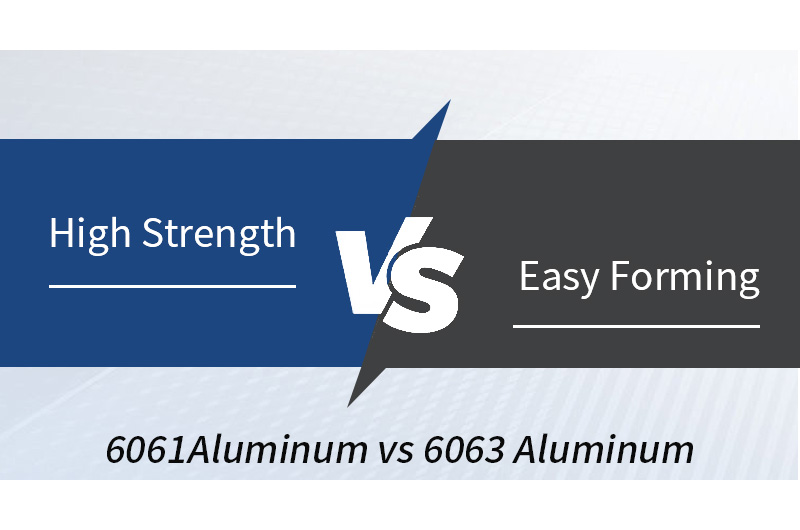
Interpreting the Performance Data: High Strength vs. Easy Forming
- Strength:6061-T6 is 30-40% stronger than 6063-T6, and 70-80% stronger than the mainstream 6063-T5. Under the same load, this allows for thinner cross-sections and a larger safety margin, making it a must-have for heavy-duty structural parts like aircraft fittings and automotive chassis.
- Hardness:Being 27% harder than 6063 gives 6061 better surface wear resistance and superior chip-breaking performance during machining (aids in cutting), but correspondingly increases the difficulty of forming.
- Ductility:6063 has slightly higher elongation, making it less prone to cracking during cold bending. This aligns perfectly with on-site bending adjustments and the extrusion of complex cross-sections.
The Fundamental Rule:6061 dominates heavy-duty structures with its absolute strength, while 6063 excels with flexibility, offering greater convenience in processing and forming.
6061 vs. 6063 Aluminum: Physical Properties Comparison
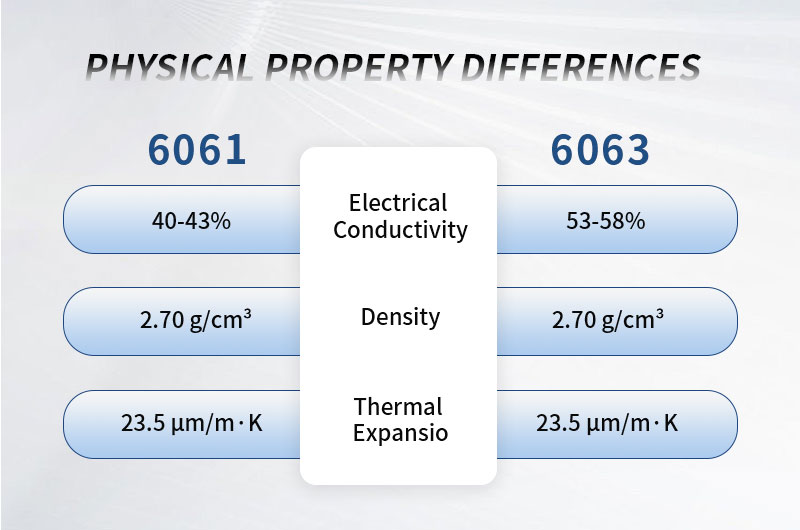
As aluminum-based materials, both alloys share many physical properties but have subtle, important differences:
Complete Physical Properties Comparison Table
| Physical Property | 6061-T6 | 6063-T6 | Practical Significance |
| Density | 2.70 g/cm3 | 2.70 g/cm3 | Identical, about 1/3 that of steel. |
| Melting Point (Solidus) | 580°C | 615°C | 6063 is slightly higher. |
| Melting Point (Liquidus) | 650°C | 655°C | Essentially the same. |
| Thermal Conductivity | 167-170 W/(m·K) | 200-201 W/(m·K) | 6063 is 18% higher, better for heat dissipation. |
| Coeff. of Thermal Expansion | 23.6×10??/K | 23.4×10??/K | Essentially the same. |
| Electrical Conductivity (IACS) | 40-43% | 53-58% | 6063 is 30% higher, better for conduction. |
| Electrical Resistivity | 39.2 nΩ·m | 32.5-33.2 nΩ·m | 6063 has lower resistance. |
| Specific Heat Capacity | 900 J/(kg·K) | 900 J/(kg·K) | Identical. |
| Modulus of Elasticity | 68.9 GPa | 68.9 GPa | Identical, same stiffness. |
| Poisson's Ratio | 0.33 | 0.33 | Identical. |
| Shear Modulus | 26 GPa | 25.8-26 GPa | Essentially the same. |
Physical Property Differences
- Thermal & Electrical Conductivity:6063's thermal conductivity is 18% better than 6061, and its electrical conductivity is 30% higher. This makes it the top choice for LED heat sinks, electronic enclosures, more compact heat exchangers, and busbars/conductive rails (for low loss).
- Density:Both are equal at ~2.70 g/cm3, sharing the lightweight advantage of aluminum alloys (only 1/3 the density of steel).
- Thermal Expansion:Both are equal with a coefficient of ~23.5 μm/m·K, behaving consistently in environments with temperature fluctuations.
6061 vs. 6063 Aluminum: Processing & Fabrication Comparison
Extrusion: 6063 is the Clear Winner
6063 is the champion of extrusion. Its optimized silicon-magnesium ratio gives the material excellent flow characteristics:
- Thinner Walls:Can be extruded as thin as 1mm.
- Complex Cross-sections:Can achieve sharp internal corners and multi-hollow structures.
- High Production Efficiency:Faster extrusion speeds and longer die life.
- Excellent Surface Quality:Achieves a high-quality surface directly from the die.
- Typical Application:Nearly all aluminum door/window frames and architectural decorative profiles.
Machining: 6061 is Superior
The high hardness of 6061-T6 becomes an advantage in machining:
- Clean Chips:Chips break cleanly without sticking to the tool.
- Better Surface Finish:Results in a smoother machined surface.
- Longer Tool Life:Less wear on cutting tools.
- Higher Dimensional Accuracy:Holds tolerances better.
- Note:While 6063-T6 can be machined, it is not as good as 6061-T6.
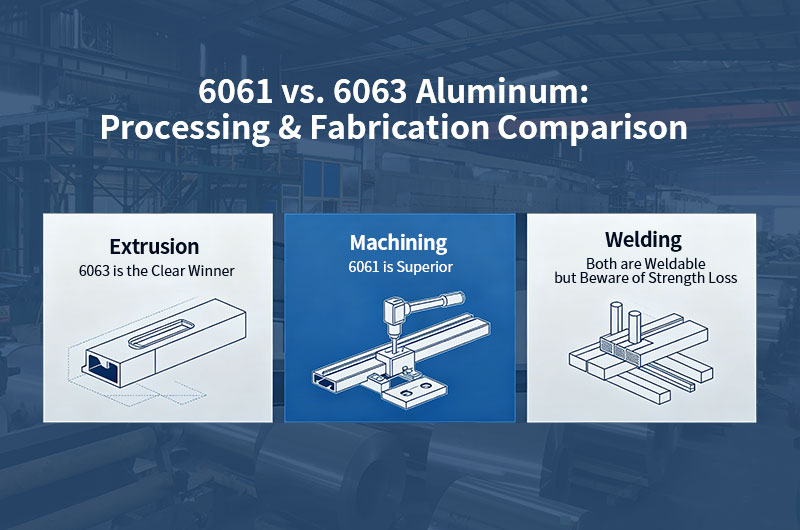
Welding: Both are Weldable, but Beware of Strength Loss
- Applicable Processes:TIG/MIG welding, commonly with 4043 or 5356 filler wire.
- Key Issue:The Heat-Affected Zone (HAZ) can lose up to 40% of its strength, with the weld area's properties degrading to a near-annealed state.
- Solutions:Post-weld heat treatment can restore strength (but is costly), or the strength reduction can be factored into the design.
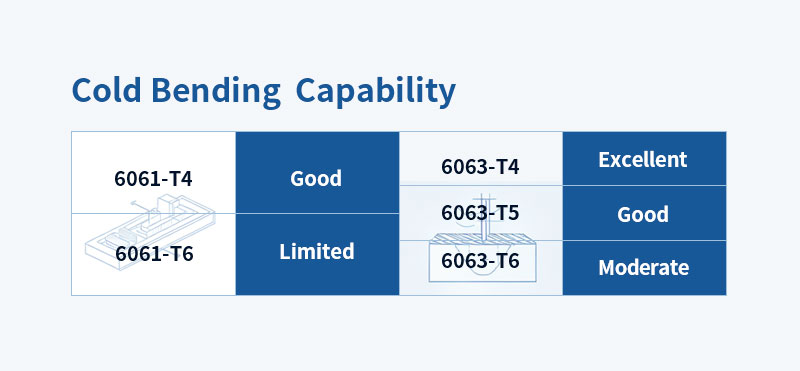
Cold Bending Capability
| Alloy & Temper | Formability | Minimum Bend Radius |
| 6061-T4 | Good | - |
| 6061-T6 | Limited | ≥4.5t |
| 6063-T4 | Excellent | - |
| 6063-T5 | Good | ≥3t |
| 6063-T6 | Moderate | - |
Process Tip:For complex bent parts, a two-step "Form in T4 → Age to T6" process can be used.
Corrosion Resistance: 6063 Has the Edge
The Core Reason: The Difference in Copper Content
- 6061 contains ≤0.4% copper, while 6063 contains only ≤0.10%.
- Copper can form galvanic cells, increasing the risk of corrosion.
6063 Aluminum's Advantages:
- Stronger resistance to pitting corrosion (especially in marine and industrial environments).
- Lower sensitivity to intergranular corrosion.
- Lower risk of stress corrosion cracking (SCC).
- Can provide decades of maintenance-free service in outdoor architectural applications.
Anodizing: 6063 is the Clear Winner
6063 Aluminum Performance:
- Produces a bright, uniform surface with consistent color.
- Allows for a thick (12-25μm) and durable oxide layer.
- Can be dyed to vibrant colors without blemishes.
6061 Aluminum Performance:
- Surface can appear slightly dull or greyish.
- May exhibit minor color variations.
- Dyes are not as vibrant.
- The oxide layer tends to be slightly thinner.
Application:For appearance-critical applications like building facades and decorative trim, 6063 is the preferred choice.
Cost Comparison: Look at the Total Cost of Ownership
6063's Cost Advantage (for Extruded Profiles):
- Raw material is cheaper.
- Faster extrusion speeds and longer die life reduce manufacturing costs.
- Excellent surface finish reduces the need for secondary processing.
6061's Cost Advantage (for Machined Parts):
- Higher strength allows for material savings (thinner, lighter parts).
- Higher machining efficiency and longer tool life reduce machining costs.
- Widely available in standard forms, making procurement easy.
6061 vs. 6063 Aluminum: How to Choose?
When choosing between 6061 and 6063 aluminum, consider these five core dimensions:
| Characteristic | 6061 (Structural Grade) | 6063 (Architectural Grade) |
| Strength | High, suitable for load-bearing structures. | Medium, suitable for decorative or light-load applications. |
| Fabrication | Easy to machine (CNC), used for precision parts. | Easy to extrude, used for complex, thin-walled profiles. |
| Surface | Good. | Exceptional, outstanding for anodizing, first choice for aesthetic parts. |
| Corrosion | Good. | Superior, especially for outdoor and coastal environments. |
| Application | Machine parts, industrial equipment, transportation. | Architectural doors & windows, curtain walls, railings, heat sinks. |
Decision Points:
- Consider Strength:Is it load-bearing?Choose 6061.
- Consider Appearance:Is a high-quality surface finish critical?Choose 6063.
- Consider Process:Is it a complex extrusion or CNC machining?Choose 6063 for extrusion, 6061 for machining.
- Consider Standards:Finally, always adhere to the industry specifications required for your project.
6061 vs. 6063 Aluminum: Common Misconceptions Debunked
Myth 1: 6063 is just a weaker version of 6061.
Fact: This is a difference in design philosophy. 6063 sacrifices some strength in exchange for superior extrudability, surface finish, and corrosion resistance.
Myth 2: 6063 can't be used for structural parts.
Fact: It absolutely can. With proper engineering design, the strength of 6063-T6 is sufficient for many structural applications, with architectural curtain walls being a prime example.
Myth 3: 6061 corrodes easily.
Fact: 6061 has good corrosion resistance on its own; it's just slightly less resistant than 6063. With anodizing or a coating, it performs excellently even in harsh environments.
Myth 4: The two alloys are interchangeable.
Fact: Absolutely not. Their mechanical properties, fabrication characteristics, and surface finishes are significantly different. Substituting one for the other without consideration can lead to design failure or subpar performance.
Conclusion: Each has its role, and neither is inherently "better." The key is to match the alloy to your specific needs, not to find a single "best" alloy.
6061 vs. 6063 Aluminum: Frequently Asked Questions (FAQ)
Which alloy is stronger, 6061 or 6063?
6061 is significantly stronger. In its common T6 temper, 6061 is about 30-40% stronger than 6063-T6. This superior strength makes it the go-to choice for load-bearing structural components like machine parts and bicycle frames.
If 6061 is stronger, why are window and door frames made from 6063?
Because 6063, the "architectural alloy, " prioritizes form and finish over raw strength. It offers:
- Exceptional Extrudability: Easily forms into complex, thin-walled profiles.
- Superior Surface Finish: Ideal for anodizing, creating a beautiful and uniform look.
- Better Corrosion Resistance: Crucial for outdoor applications.
Can 6063 be used for structural parts?
Yes, absolutely. While not as strong as 6061, 6063-T6 is strong enough for many structural uses, like architectural curtain walls and railings. The key is that the application must be properly engineered for the load it will carry.
Which alloy is better for CNC machining?
6061 is superior for machining. Its higher hardness allows for clean chip breaking, resulting in a better surface finish, higher dimensional accuracy, and longer tool life.
Which alloy has better corrosion resistance for outdoor use?
6063 has better corrosion resistance. This is primarily because it contains significantly less copper than 6061. The lower copper content makes 6063 the preferred choice for long-term outdoor, marine, or industrial applications.
Is 6063 always cheaper than 6061?
Not always—it depends on the application.
- For Extruded Profiles: 6063 is typically cheaper due to lower material cost and more efficient production.
- For Machined Parts: 6061 can be more cost-effective. Its higher strength may allow for a lighter design, and its superior machinability can reduce manufacturing costs.
Summary
There is no universal winner in the debate between 6061 and 6063 aluminum because these materials aren't really competing—they complement each other across the spectrum of aluminum applications.
Choose 6061 when strength, fatigue resistance, and machinability are at the top of your priority list. Its higher mechanical properties make it the go-to material for structural components, machine parts, and applications where load and stress are the driving design factors.
Choose 6063 when extrudability, surface finish, corrosion resistance, and thermal/electrical conductivity are paramount. Its unique properties make it the undisputed choice for architectural applications, decorative trim, heat sinks, and custom profiles where form and finish are as important as function.