


6061 vs. 7075 Aluminum
In the material selection of aluminum alloys, 6061 and 7075 are the two most frequently mentioned grades. They represent the typical products of the Al-Mg-Si series and Al-Zn-Mg-Cu series, respectively, playing vital roles in aerospace, automotive manufacturing, precision instruments, and other fields.
Basic Positioning
- 6061 Aluminum: Medium strength, easy to machine, good corrosion resistance. Suitable for general structural parts (e.g., bicycle frames, marine fittings, piping).
- 7075 Aluminum: Ultra-high strength, comparable to steel, but sensitive to stress corrosion cracking. Primarily used in aircraft and other applications where extreme strength is required.
6061 vs. 7075: Chemical Composition Comparison
Chemical Composition (wt.%)
| Element | 6061 | 7075 |
| Si(Silicon) | 0.40–0.80 | ≤ 0.40 |
| Mg(Magnesium) | 0.80–1.20 | 2.10–2.90 |
| Cu(Copper) | 0.15–0.40 | 1.20–2.00 |
| Zn(Zinc) | ≤ 0.25 | 5.10–6.10 |
| Cr(Chromium) | 0.04–0.35 | 0.18–0.28 |
| Mn(Manganese) | ≤ 0.15 | ≤ 0.30 |
| Fe(Iron) | ≤ 0.70 | ≤ 0.50 |
| Ti(Titanium) | ≤ 0.15 | ≤ 0.20 |
| Al(Aluminum) | Remainder (approx. 95–98%) | Remainder (approx. 87–91%) |
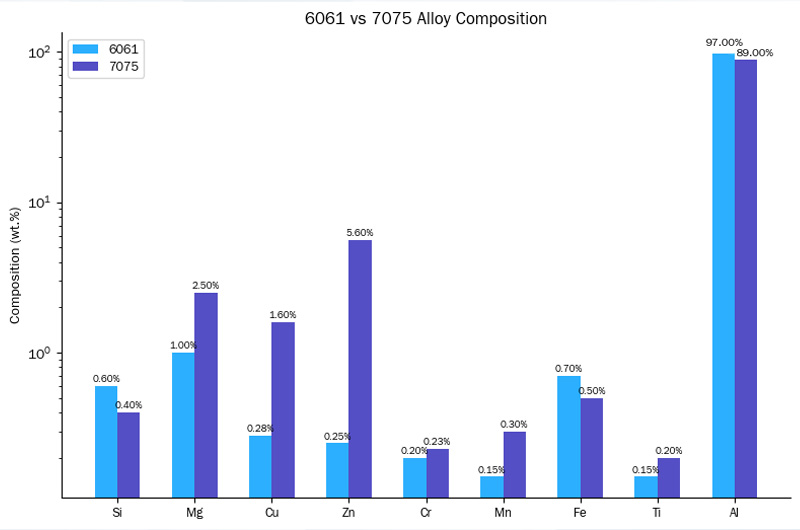
The Four Most Important Differences
- Zinc Content: 7075 contains a high amount of zinc, giving it extremely high strength. 6061 has almost no zinc and offers medium strength.
- Magnesium Content: 7075 contains more than twice the magnesium of 6061, further boosting its strength.
- The Role of Silicon: 6061 requires silicon to form its strengthening phase (Mg2Si). 7075 keeps silicon as low as possible to avoid interfering with its own strengthening mechanisms.
- Trade-off in Copper: 7075 has more copper than 6061, yielding higher strength but poorer corrosion resistance. 6061 has low copper, resulting in better corrosion resistance.
6061 vs. 7075: Common Tempers Comparison
Main Tempers and Properties of 6061
| Temper | Tensile Strength (MPa) | Yield Strength (MPa) | Elongation (%) | Hardness (HB) |
| 6061-O | 125 | 55 | 25-30 | 30 |
| 6061-F | 130-180 | 60-110 | 16-25 | 35-55 |
| 6061-T4 | 240 | 145 | 20-25 | 65 |
| 6061-T6 | 310 | 276 | 12 | 95 |
| 6061-T651 | 310 | 276 | 12 | 95 |
| 6061-T6511 | 290-310 | 250-276 | 10-12 | 95 |
6061 Temper Selection Guide:
- O Temper: Fully annealed; suitable for parts that will be formed and then heat-treated again.
- T4 Temper: Naturally aged; for applications requiring moderate strength but further cold forming.
- T6 Temper: The most common temper; optimal overall performance.
- T651 Temper: Stress-relieved by stretching; the first choice for heavy machining or precision parts.
- T6511 Temper: Standard temper for extruded profiles.
Main Tempers and Properties of 7075
| Temper | Tensile Strength (MPa) | Yield Strength (MPa) | Elongation (%) | Hardness (HB) | SCC Resistance |
| 7075-O | 230-280 | 105-170 | 14-17 | 60 | Good |
| 7075-T6 | 572 | 503 | 11 | 150 | Poor |
| 7075-T62 | 560 | 460 | 7.2 | 160 | Poor |
| 7075-T651 | 550 | 460 | 8.2 | 150 | Poor |
| 7075-T6510 | 590 | 510 | 5.7 | - | Poor |
| 7075-T6511 | 580 | 510 | 5.6 | - | Poor |
| 7075-T73 | 505 | 435 | 13 | 140 | Excellent |
| 7075-T7351 | 510 | 410-440 | 7.5 | 140 | Excellent |
| 7075-T7352 | 470 | 380 | 3.1 | 140 | Excellent |
| 7075-T76 | 560 | 480 | 7.9 | 150 | Good |
| 7075-T7651 | 550 | 470 | 7.3 | 150 | Good |
7075 Temper Selection Guide:
- T6 Series: Pursues maximum strength; suitable for dry, indoor environments.
- T651: Stress-relieved T6; mandatory for precision machining.
- T73 Series: Aviation structural standard; overaged to improve SCC (Stress Corrosion Cracking) resistance by 3-5 times.
- T7351: Mandatory requirement for main load-bearing structures in aircraft.
- T76 Series: Optimized for exfoliation corrosion resistance; often used in thick plates.
Common Tempers Comparison Matrix
| Dimension | 6061-T6 | 6061-T651 | 7075-T6 | 7075-T651 | 7075-T7351 |
| Tensile Strength (MPa) | 310 | 310 | 572 | 550 | 510 |
| Yield Strength (MPa) | 276 | 276 | 503 | 460 | 410-440 |
| Elongation (%) | 12 | 12 | 11 | 8.2 | 7.5 |
| Hardness (HB) | 95 | 95 | 150 | 150 | 140 |
| Specific Strength (MPa·cm³/g) | 115 | 115 | 203 | 196 | 181 |
| Fatigue Strength (MPa) | 96 | 96 | 160 | 160 | 160 |
| SCC Sensitivity | Low | Low | Extremely High | Extremely High | Low |
| Residual Stress Level | Medium (80-120MPa) | Low (<30MPa) | High (100-150MPa) | Low (<40MPa) | Low (<40MPa) |
| Machining Distortion Tendency | Medium | Low | High | Medium | Medium |
| Weldability | Good | Good | Poor | Poor | Poor |
| Relative Cost | 1.0 | 1.05 | 1.45 | 1.55 | 1.70 |
| Lead Time (Weeks) | 1-2 | 2-3 | 3-4 | 4-6 | 5-8 |
| Application Scenario | General structures | Precision parts | High-strength parts (indoor) | High-strength precision | Aerospace structures |
Key Insights:
- Strength Gap: 7075-T6 is 85% stronger than 6061-T6, but elongation only drops by 8%.
- Stress Relief Effect: T651/T7351 tempers reduce residual stress by 70-80%.
- Corrosion Reversal: The anti-SCC performance of 7075-T7351 is better than 7075-T6, closely rivaling 6061.
6061 vs. 7075: Mechanical Properties (Based on T6 Temper)
Engineering Significance of Strength
Tensile Strength (UTS):
- 6061-T6: 310 MPa
- 7075-T6: 572 MPa
- Gap: 7075 is 1.85 times stronger than 6061.
Example: For a plate with a cross-section of 10mm × 10mm = 100mm², the theoretical load-bearing capacity is:
- 6061-T6: F = 310 MPa × 100 mm² = 31, 000 N ≈ 3.1 tons of force
- 7075-T6: F = 572 MPa × 100 mm² = 57, 200 N ≈ 5.8 tons of force
In structural design, allowable stress is usually taken as 60-70% of the yield strength (Safety factor 1.5-1.67):
- 6061-T6 Allowable Design Stress: 276 × 0.67 = 185 MPa
- 7075-T6 Allowable Design Stress: 503 × 0.67 = 337 MPa
This means using 7075 allows you to reduce the cross-sectional area by about 45% under the same load, achieving significant weight reduction.
Yield-to-Tensile Ratio Analysis:
| Material Temper | Yield Strength | Tensile Strength | Ratio | Engineering Significance |
| 6061-T6 | 276 MPa | 310 MPa | 0.89 | Larger plastic reserve, good safety margin |
| 7075-T6 | 503 MPa | 572 MPa | 0.88 | Small plastic reserve, sensitive to stress concentration |
| 7075-T73 | 435 MPa | 505 MPa | 0.86 | Slightly improved plasticity |
Hardness & Wear Resistance
Brinell Hardness Comparison:
| Material | Hardness (HB) | Relative Wear Resistance | Relative Tool Life | Surface Finish |
| 6061-T6 | 95 | 1.0 | 1.5 | Excellent (Ra 0.4-0.8μm) |
| 7075-T6 | 150 | 1.6 | 1.0 | Good (Ra 0.8-1.6μm) |
The high hardness of 7075 makes it perform better in wear applications like friction pairs and guide rails, but it also causes:
- Increased tool wear (machining cost +30-50%).
- Cutting speeds must be reduced by 30-40%.
- Requires carbide or ceramic tools.
Fatigue Performance
Fatigue Strength (Rotational bending, 5×10^8 cycles):
| Temper | Fatigue Strength | Fatigue/Tensile Ratio | Cycle Life Advantage |
| 6061-T6 | 96 MPa | 0.31 | Baseline |
| 7075-T6 | 160 MPa | 0.28 | >100x longer (at same stress) |
S-N Curve Characteristics:
| Cycles | 6061-T6 Stress | 7075-T6 Stress | 7075 Advantage |
| 10^6 | 120 MPa | 200 MPa | +67% |
| 10^7 | 105 MPa | 170 MPa | +62% |
| 10^8 | 96 MPa | 160 MPa | +67% |
| 10^9 | 90 MPa | 150 MPa | +67% |
In cyclic loading applications, 7075 has a fatigue life advantage of over 100 times, which is critical for aircraft skins, landing gears, and bicycle frames subjected to repeated stress.
Fracture Toughness
Fracture Toughness KIC (MPa·m^0.5) in different directions:
| Temper | L-T Direction | T-L Direction | S-L Direction | Average |
| 6061-T6 | 29 | 26 | 24 | 26.3 |
| 7075-T6 | 29 | 25 | 20 | 24.7 |
| 7075-T73 | 38 | 34 | 30 | 34.0 |
Key Findings:
- The fracture toughness of 7075-T6 is slightly lower than 6061-T6.
- Through overaging (T73), 7075 improves its toughness by about 40%, surpassing 6061.
- Strong anisotropy: The S-L (short transverse) direction has the lowest toughness; designs should account for the weakest orientation.
Low-Temperature (Cryogenic) Toughness (-50℃):
| Material | Room Temp KIC | -50℃ KIC | Decrease |
| 6061-T6 | 29 | 26 | 10% |
| 7075-T6 | 25 | 18 | 28% |
| 7075-T73 | 34 | 27 | 21% |
6061 maintains a clearer toughness advantage at low temperatures, which is particularly important for high-altitude aircraft flights (below -50℃).
6061 vs. 7075: Physical Properties & Engineering Constants
Density & Lightweight Potential
Basic Data:
| Parameter | 6061-T6 | 7075-T6 | Difference |
| Density (g/cm³) | 2.70 | 2.81 | +4% (7075 is heavier) |
| Tensile Strength | 310 MPa | 572 MPa | +85% |
| Specific Strength | 115 | 203 | +77% |
Actual Weight Reduction Effect (Same Load Capacity):
| Design Condition | 6061 Cross-section | 7075 Cross-section | Weight Reduction |
| Tensile Load 10kN | 54 mm² | 30 mm² | -42% in volume |
| Density Adjusted Weight | Baseline (1.0x) | 0.62x | -38% in mass |
Thermophysical Properties
| Parameter | 6061-T6 | 7075-T6 | Engineering Impact |
| Thermal Conductivity | 167 W/m·K | 130 W/m·K | 6061 is 28% better at heat dissipation |
| Specific Heat | 896 J/kg·K | 960 J/kg·K | Similar |
| Thermal Expansion (CTE) | 23.6 µm/m·K | 23.6 µm/m·K | Identical |
| Melting Range | 582-652 ℃ | 477-635 ℃ | 7075 solidus is 105℃ lower |
Implications of Thermal Conductivity:
- Heatsinks: 6061 is superior; temperature gradient is 28% smaller.
- Welding: 7075 has a lower solidus, leading to a narrower welding window.
- Heat Treatment: 7075 requires stricter quench delay times (≤10s vs. ≤15s).
High-Temperature Strength Retention:
| Temperature | 6061-T6 Retention | 7075-T6 Retention |
| 100℃ | 95% | 93% |
| 150℃ | 75% | 65% |
| 200℃ | 45% | 35% |
| 250℃ | 25% | 20% |
Both materials soften rapidly above 150℃ and are not suitable for long-term high-temperature service.
Elastic Constants (Stiffness)
| Parameter | 6061-T6 | 7075-T6 | Compared to Steel |
| Modulus of Elasticity (E) | 68.9 GPa | 71.7 GPa | Approx. 1/3 of steel |
| Shear Modulus (G) | 26 GPa | 26.9 GPa | Approx. 1/3 of steel |
| Poisson's Ratio (ν) | 0.33 | 0.32 | Similar to steel |
Electrical Properties
| Parameter | 6061-T6 | 7075-T6 | Impact |
| Electrical Conductivity | 43% IACS | 33% IACS | 6061 is 30% higher |
| Electrical Resistivity | 0.040 Ω·mm²/m | 0.0515 Ω·mm²/m | 6061 is 29% lower |
| Thermal/Electrical Ratio | 3.88 | 3.94 | Basically consistent |
For applications requiring both strength and electrical conductivity (e.g., busbars, cable joints), 6061 has the advantage.
6061 vs. 7075 Aluminum: Processing Performance Comparison
Quantitative Machinability Comparison
Aluminum Association Machinability Rating:6061-T6 is ratedA (Excellent), while 7075-T6 is ratedB (Good).
CNC Machining Parameters Comparison Table:
| Machining Method | Parameter | 6061-T6 | 7075-T6 | Difference |
| Rough Milling | Cutting Speed (m/min) | 300-600 | 200-400 | -33% |
| Feed Rate (mm/tooth) | 0.15-0.30 | 0.10-0.20 | -33% | |
| Depth of Cut (mm) | 3-8 | 2-5 | -38% | |
| Finish Milling | Cutting Speed (m/min) | 400-800 | 250-500 | -37% |
| Surface Roughness Ra (μm) | 0.4-0.8 | 0.8-1.6 | +100% | |
| Drilling | Cutting Speed (m/min) | 100-150 | 80-120 | -27% |
| Hole Wall Quality | Excellent | Good | - | |
| Tool Life | Relative Life | 1.5-2.0 | 1.0 | -40% |
| Efficiency | Material Removal Rate | 1.5-2.0 | 1.0 | -40% |
Machining Cost Comparison (Based on removing 100cm³ of material):
| Cost Item | 6061-T6 | 7075-T6 | Difference |
| Tool Cost | 100 | 180 | +80% |
| Machining Time Cost | 100 | 150 | +50% |
| Total Machining Cost | 100 | 165 | +65% |
Welding Performance Comparison
Weldability Rating and Joint Efficiency:
| Material | Weldability Rating | Common Methods | Joint Efficiency | Post-Weld Strength (MPa) | Main Issues |
| 6061-T6 | Good | MIG/TIG | 0.65-0.75 | 200-230 | HAZ (Heat-Affected Zone) softening |
| 7075-T6 | Poor | Not recommended | 0.30-0.45 | 150-200 | Severe hot cracking + Low strength |
| 7075-T6 | Acceptable | FSW (Friction Stir Welding) | 0.65-0.75 | 350-420 | High equipment investment |
Forming Performance Comparison
Minimum Bend Radius Comparison (90° bend without cracking):
(Note: 't' = material thickness)
| Material Temper | Min. Bend Radius (R) | Forming Difficulty | Applicable Processes |
| 6061-O | 0.5t | Easy | Cold bending, deep drawing, stretching |
| 6061-T4 | 1.5t | Moderate | Cold bending, shallow drawing |
| 6061-T6 | 3t | Difficult | Cold bending requires caution |
| 7075-O | 2t | Difficult | Formable only in annealed state |
| 7075-T6 | 8-10t | Extremely Difficult | Cold forming is nearly impossible |
Deep Drawing Performance Comparison (Erichsen Cupping Test Values):
| Material | Erichsen Value (mm) | Draw Ratio | Applications |
| 6061-O | 11-13 | 1:2.5 | Deep drawn parts, complex curved surfaces |
| 7075-O | 7-9 | 1:1.8 | Shallow drawn parts |
Extrusion Performance Comparison:
| Parameter | 6061 | 7075 | Difference |
| Extrusion Speed (mm/s) | 15-25 | 5-10 | -60% |
| Extrudable Profile Complexity | High (thin-wall, hollow, multi-cavity) | Moderate | - |
| Relative Die Life | 1.5-2.0 | 1.0 | -40% |
| Relative Extrusion Cost | 1.0 | 1.4-1.6 | +40-60% |
Summary:6061 dominates in architectural profiles, decorative parts, and complex structural components, whereas 7075 is highly restricted by its poor formability.
Heat Treatment Comparison
Solutionizing + Aging Process Parameters Comparison:
| Process Stage | 6061-T6 | 7075-T6 | Differences & Requirements |
| Solution Temperature | 540±5℃ | 470±3℃ | Stricter temp control for 7075 |
| Soak Time | 1-2 hours | 1-2 hours | Similar |
| Quench Delay (Transfer Time) | ≤15 seconds | ≤10 seconds | 7075 is more sensitive |
| Quench Medium Temp | <40℃ | <40℃ | Same |
| Aging Temperature | 175±5℃ | 120±3℃ | Higher temp for 6061 |
| Aging Time | 8-10 hours | 24 hours | Longer time for 7075 |
| Peak Hardness Window | Wide (6-12h) | Narrow (20-28h) | Lower process tolerance/margin of error for 7075 |
Impact of Quench Delay (Transfer Time) on Strength:
| Transfer Time | 6061 Strength Retention Rate | 7075 Strength Retention Rate |
| 5 seconds | 100% | 100% |
| 10 seconds | 98% | 95% |
| 15 seconds | 95% | 85% |
| 20 seconds | 90% | 70% |
| 30 seconds | 80% | 50% |
Summary:7075 is extremely sensitive to the quench rate, which presents a major challenge when heat-treating large workpieces.
6061 vs. 7075 Aluminum: Corrosion Resistance Comparison
Atmospheric Corrosion Comparison
5-Year Outdoor Exposure Test Data:
| Environment Type | 6061-T6 Corrosion Depth | 7075-T6 Corrosion Depth | 7075-T73 Corrosion Depth |
| Industrial Atmosphere | <10 μm | 15-25 μm | 10-15 μm |
| Marine Atmosphere (800m) | 15-20 μm | 30-50 μm | 20-30 μm |
| Rural Atmosphere | <5 μm | 8-12 μm | 5-8 μm |
Stress Corrosion Cracking (SCC) Susceptibility Comparison
This is one of the most significant differences between the two materials.
SCC Performance Comparison Table:
| Material Temper | Susceptibility Rating | KISCC (MPa·m^0.5) | Safe Stress Level | Typical Time to Failure |
| 6061-T6 | A (Excellent) | >30 | 75% σy | No SCC records |
| 7075-T6 | D (Very Poor) | 15-20 | 30-40% σy | Months to years |
| 7075-T73 | B (Good) | 24 | 60% σy | Significantly prolonged |
| (Note: σy = Yield Strength) |
Intergranular Corrosion and Exfoliation Corrosion Comparison
ASTM G110 Test Results (6.0% NaCl + 0.5% H2O2):
| Material Temper | Exfoliation Corrosion Rating | Intergranular Corrosion Depth (24h) | Corrosion Resistance Evaluation |
| 6061-T6 | EA (No exfoliation) | <50 μm | Excellent |
| 7075-T6 | EC-ED (Severe) | 150-300 μm | Poor |
| 7075-T73 | EB (Slight) | 80-120 μm | Good |
| 7075-T76 | EA-EB | 60-100 μm | Good |
Surface Treatment Effects Comparison
Anodizing Performance Comparison:
| Material | Standard Anodic Film Thickness | Film Color | Hardness (HV) | Corrosion Resistance Improvement |
| 6061-T6 | 15-25 μm | Clear to golden | 350-400 | 3-5 times |
| 7075-T6 | 10-20 μm | Grey-brown | 300-380 | 2-3 times |
Hard Anodizing (Type III) Comparison:
| Material | Film Thickness | Hardness (HV) | Wear Resistance Improvement | Process Difficulty |
| 6061-T6 | 75-100 μm | 350-450 | 5-8 times | Moderate |
| 7075-T6 | 60-80 μm | 300-400 | 4-6 times | High |
Alclad Treatment (7075 Only):
- 7075-T6 Alclad:Surface clad with pure aluminum or 6061; thickness is 2.5-5% of the total thickness.
- Corrosion Resistance Improvement:3-5 times, approaching the level of 6061.
- Strength Loss:Approx. 5%.
- Cost Increase:15-20%.
6061 vs. 7075 Aluminum:Applications Comparison
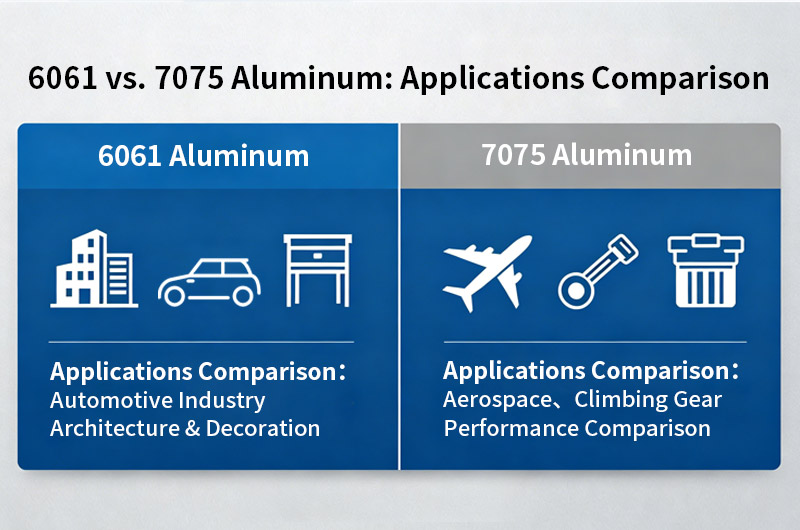
Aerospace
Aircraft Structural Material Distribution Comparison:
| Component | Primary Material | Alternative Material | Reason for Selection |
| Wing spars, stringers | 7075-T7351 | 7050-T7451 | Highest strength + SCC resistance |
| Fuselage frames | 7075-T7651 | 6061-T6 | High load-bearing strength |
| Skin (High stress areas) | 7075-T6 Alclad | 2024-T3 | Strength + fatigue + surface protection |
| Skin (Low stress areas) | 6061-T6 | 2024-T3 | Cost-effectiveness + corrosion resistance |
| Fuel systems | 6061-T6 | 5083-H116 | Weldability + corrosion resistance |
| Door frames | 6061-T6 | 7075-T73 | Welded structure + toughness |
| Landing gear | 7075-T73 Forgings | Titanium alloy | High strength + impact resistance |
Automotive Industry
Electric Vehicle (EV) Application Comparison:
| Component | 6061 Application | 7075 Application | Performance Comparison |
| Battery pack frames | Extruded profile welding | N/A | 6061 is weldable, cost is 30% lower |
| Subframes | T6 Casting/Forging | T6 Forging | 7075 has 15% higher stiffness, but 50% higher cost |
| Suspension control arms | T6 Forging | T6 Forging | 7075 has higher strength, reduces weight by 35% |
| Crash beams | T6 Extrusion | N/A | 6061 has superior energy absorption |
| Body structure/frames | T6 Extrusion welding | N/A | 6061 is the only choice (due to welding needs) |
Architecture & Decoration
Material Selection for Architectural Applications:
| Application Type | Material Selection | Reason | Market Share |
| Door & window frames | 6061-T5/T6 | Extrudability + weather resistance + cost | >95% |
| Curtain wall systems | 6061-T6 | Strength + weldability + anodizing | >90% |
| Decorative panels | 6061-T6 | Excellent surface treatment results | >85% |
| Steel structure connectors | 6061-T6 | Weldability is key | 100% |
| High-strength structures | 7075-T6 | Rarely used | <1% |
Consumer Electronics & Precision Instruments
Laptop Casing Material Comparison:
| Brand/Model | Material | Thickness | Weight | Deformation Resistance | Thermal Performance | Cost |
| MacBook Pro | 6061-T6 | 1.2-1.5mm | 1.4kg | Good | Excellent | Baseline |
| A Gaming Laptop | 7075-T6 | 0.8-1.0mm | 1.2kg | Excellent | Good | +30% |
| General Business Laptop | 6061-T6 | 1.5-2.0mm | 1.6kg | Moderate | Excellent | -20% |
Climbing Gear Performance Comparison:
| Equipment Type | 6061 Application | 7075 Application | Performance Difference |
| Carabiners | Strength 22kN, Weight 65g | Strength 25kN, Weight 50g | 7075 reduces weight by 23%, increases strength by 14% |
| Quickdraws | Rarely used | Mainstream choice | 7075 has better wear resistance |
| Trekking poles | Entry-level | High-end models | 7075 is lighter and stronger |
6061 vs. 7075 Aluminum:How to Choose?
For the vast majority of structural parts, 6061 is good enough and much cheaper. Unless you absolutely lack the required strength, there is no need to select 7075.
Selection Rules
- Choose6061if you need: Weldability, corrosion resistance, cost-efficiency, and complex forming.
- Choose7075if you need: Extreme strength, extreme weight reduction, no welding, and can accommodate strict corrosion protection.
Quick Decision Table
| If your primary priority is... | Choose | Because... |
| Maximum Strength(nearly double 6061) | 7075-T6 | Strength is the overriding priority. |
| Needs to be welded | 6061 | 7075 is virtually unweldable. |
| Needs bending, deep drawing, complex forming | 6061 | 7075 cracks easily. |
| Used in marine or highly humid environments | 6061 | 7075 is prone to stress corrosion cracking. |
| Precision machining with low tool cost | 6061 | Saves tool wear, higher MRR. |
| Lowest possible cost | 6061 | 7075 is at least 35% more expensive. |
| Extreme lightweighting(e.g., aircraft) | 7075 | Yields the highest specific strength. |
Appendix: Detailed Technical Parameters
6061 Aluminum Alloy Complete Data
Chemical Composition (wt%)
| Element | Content Range | Function/Role |
| Si(Silicon) | 0.40 - 0.80 | Forms Mg2Si strengthening phase |
| Fe(Iron) | ≤ 0.70 | Impurity control |
| Cu(Copper) | 0.15 - 0.40 | Auxiliary strengthening |
| Mn(Manganese) | ≤ 0.15 | Improves corrosion resistance |
| Mg(Magnesium) | 0.80 - 1.20 | Primary strengthening element |
| Cr(Chromium) | 0.04 - 0.35 | Grain refinement |
| Zn(Zinc) | ≤ 0.25 | Impurity control |
| Ti(Titanium) | ≤ 0.15 | Grain refinement |
| Others (Each) | ≤ 0.05 | - |
| Others (Total) | ≤ 0.15 | - |
| Al(Aluminum) | Remainder | Base element |
Mechanical Properties Summary by Temper
| Temper | Tensile Strength (MPa) | Yield Strength (MPa) | Elongation (%) | Hardness (HB) | Shear Strength (MPa) | Fatigue Strength (MPa) |
| O | 125 | 55 | 25-30 | 30 | 82 | 62 |
| F | 130-180 | 60-110 | 16-25 | 35-55 | 90-120 | 70 |
| T4 | 240 | 145 | 20-25 | 65 | 165 | 85 |
| T6 | 310 | 276 | 12 | 95 | 207 | 96 |
| T651 | 310 | 276 | 12 | 95 | 207 | 96 |
Physical Properties Complete Parameters
- Density: 2.70 g/cm³
- Melting Range: 582-652 ℃
- Solidus: 582 ℃
- Liquidus: 652 ℃
- Thermal Conductivity: 167 W/(m·K)
- Specific Heat Capacity: 896 J/(kg·K)
- Coefficient of Thermal Expansion (20-100℃): 23.6 × 10^-6 /K
- Electrical Conductivity: 43% IACS
- Electrical Resistivity: 0.040 Ω·mm²/m
- Modulus of Elasticity: 68.9 GPa
- Shear Modulus: 26 GPa
- Poisson's Ratio: 0.33
- Fracture Toughness KIC (L-T): 29 MPa·m^0.5
7075 Aluminum Alloy Complete Data
Chemical Composition (wt%)
| Element | Standard Grade | Aerospace Grade | Function/Role |
| Si(Silicon) | ≤ 0.40 | ≤ 0.30 | Strictly controlled |
| Fe(Iron) | ≤ 0.50 | ≤ 0.40 | Impurity control |
| Cu(Copper) | 1.2 - 2.0 | 1.4 - 1.8 | Increases strength |
| Mn(Manganese) | ≤ 0.30 | ≤ 0.25 | Improves corrosion resistance |
| Mg(Magnesium) | 2.1 - 2.9 | 2.3 - 2.7 | Synergistic strengthening |
| Cr(Chromium) | 0.18 - 0.28 | 0.20 - 0.25 | Grain control |
| Zn(Zinc) | 5.1 - 6.1 | 5.3 - 5.9 | Primary strengthening element |
| Ti(Titanium) | ≤ 0.20 | ≤ 0.15 | Grain refinement |
| Others (Each) | ≤ 0.05 | ≤ 0.03 | - |
| Others (Total) | ≤ 0.15 | ≤ 0.10 | - |
| Al(Aluminum) | Remainder | Remainder | Base element |
Mechanical Properties Summary by Temper
| Temper | Tensile Strength (MPa) | Yield Strength (MPa) | Elongation (%) | Hardness (HB) | Shear Strength (MPa) | Fatigue Strength (MPa) | Fracture Toughness (KIC) |
| O | 230-280 | 105-170 | 14-17 | 60 | 150 | 120 | - |
| T6 | 572 | 503 | 11 | 150 | 331 | 160 | 25 |
| T62 | 560 | 460 | 7.2 | 160 | 330 | 170 | 25 |
| T651 | 550 | 460 | 8.2 | 150 | 330 | 160 | 29 |
| T6510 | 590 | 510 | 5.7 | - | 340 | 180 | - |
| T6511 | 580 | 510 | 5.6 | - | 340 | 180 | - |
| T73 | 505 | 435 | 13 | 140 | 290 | 160 | 34-38 |
| T7351 | 510 | 410-440 | 7.5 | 140 | 300 | 160 | 34-38 |
| T76 | 560 | 480 | 7.9 | 150 | 320 | 190 | 30-34 |
| T7651 | 550 | 470 | 7.3 | 150 | 320 | 190 | 30-34 |
Physical Properties Complete Parameters
- Density: 2.81 g/cm³
- Melting Range: 477-635 ℃
- Solidus: 477 ℃
- Liquidus: 635 ℃
- Thermal Conductivity: 130 W/(m·K)
- Specific Heat Capacity: 960 J/(kg·K)
- Coefficient of Thermal Expansion (20-100℃): 23.6 × 10^-6 /K
- Electrical Conductivity: 33% IACS
- Electrical Resistivity: 0.0515 Ω·mm²/m
- Modulus of Elasticity: 71.7 GPa
- Shear Modulus: 26.9 GPa
- Poisson's Ratio: 0.32
6061 vs. 7075 Performance Quick Reference Comparison Table
| Performance Indicator | 6061-T6 | 7075-T6 | 7075-T7351 | 7075 Advantage (vs 6061) |
| Tensile Strength (MPa) | 310 | 572 | 510 | +85% / +65% |
| Yield Strength (MPa) | 276 | 503 | 420 | +82% / +52% |
| Elongation (%) | 12 | 11 | 7.5 | -8% / -38% |
| Hardness (HB) | 95 | 150 | 140 | +58% / +47% |
| Fatigue Strength (MPa) | 96 | 160 | 160 | +67% |
| Fracture Toughness (MPa·m^0.5) | 29 | 25 | 35 | -14% / +21% |
| Density (g/cm³) | 2.70 | 2.81 | 2.81 | +4% |
| Specific Strength (MPa·cm³/g) | 115 | 203 | 181 | +77% / +57% |
| Thermal Conductivity (W/m·K) | 167 | 130 | 130 | -22% |
| Electrical Conductivity (% IACS) | 43 | 33 | 33 | -23% |
| SCC Resistance | Excellent | Poor | Excellent | - |
| Weldability | Good | Poor | Poor | - |
| Machinability Rating | A | B | B | - |
| Relative Cost | 1.0 | 1.45 | 1.70 | +45% / +70% |
International Equivalent Grades Table
6061 Aluminum Alloy
| Standard System | Grade | Standard Number |
| China (GB) | 6061 / LD30 | GB/T 3190-2020 |
| USA (AA) | 6061 | ASTM B209, B221 |
| Europe (EN) | EN AW-6061 / AlMg1SiCu | EN 573-3 |
| Germany (DIN) | AlMgSi1Cu / 3.3211 | DIN Standard |
| Japan (JIS) | A6061 | JIS H4000, H4040 |
| UK (BS) | 6061 / N20 / H20 | BS 1470 |
| International (ISO) | AlMg1SiCu | ISO 209.1 |
7075 Aluminum Alloy
| Standard System | Grade | Standard Number |
| China (GB) | 7075 / 7A09 | GB/T 3190-2020 |
| USA (AA) | 7075 | ASTM B209 |
| USA (AMS) | AMS 4045 (T6), AMS 4078 (T7351) | Aerospace Material Specifications |
| Europe (EN) | EN AW-7075 / AlZn5.5MgCu | EN 573-3 |
| Germany (DIN) | AlZnMgCu1.5 / 3.4365 | DIN Standard |
| Japan (JIS) | A7075 | JIS H4000, H4080 |
| UK (BS) | 7075 / C77S | BS 1470 |
| Russia (GOST) | В95 (B95) | ГОСТ 4784 |
| International (ISO) | AlZn5.5MgCu | ISO 209 |
Conclusion
6061 and 7075 represent two distinct design philosophies:6061pursues balance and versatility, striking an optimal compromise among strength, machinability, corrosion resistance, and cost;7075pursues extreme strength, making it suitable for applications with exceptionally high lightweighting requirements where the higher costs and process limitations are acceptable.
Key Comparisons:
- Strength: 7075-T6 is approximately 85% stronger than 6061-T6.
- Cost: 7075 material and machining costs are roughly 45% higher.
- Environment: 6061 is naturally resistant to stress corrosion cracking (SCC); 7075 requires special treatments or strict surface protection.
- Processing: 6061 offers superior welding and forming properties, leading to broader applications.
Final Verdict: For the vast majority of structural components, selecting6061is far more cost-effective.7075is only necessary when strength overrides all other factors and you are willing to bear the higher costs associated with it.