


What Is 5083 Aluminum?
5083 is a high-magnesium Al-Mg (non-heat-treatable) alloy containing 4.0–4.9% Mg and 0.4–1.0% Mn. The elevated magnesium content produces a dense, self-healing oxide film that gives 5083 the best seawater corrosion resistance of any common structural aluminum alloy.
| Key Advantage | Detail |
| Marine Corrosion Resistance | H116 temper passes ASTM G66 (exfoliation) & G67 (intergranular corrosion ≤15 mg/cm²) |
| Lightweight | Density 2.66 g/cm³ — ~65% lighter than steel |
| Cryogenic Toughness | Retains full ductility and toughness down to−196°C; primary choice for LNG containment |
| Weld Strength | TIG/MIG joints reach ≥90% of O-temper base-metal strength with ER5183/ER5356 filler |
| Class Society Approved | DNV, ABS, LR, CCS, BV, NK, KR certified (H116/H321 per ASTM B928) |
In short: 5083 is the industry-standard alloy for structural hull plating, offshore platforms, and cryogenic pressure vessels wherever strength, weldability, and seawater resistance must coexist.
Product Specifications
| Parameter | Details |
| Alloy | 5083 (UNS A95083 / EN AW-5083 / AlMg4.5Mn0.7) |
| Tempers | O, H32, H34, H111, H112, H116, H321 |
| Thickness | Sheet: 1.5–6 mm · Plate: 6–250 mm |
| Width | 900–2650 mm (up to 3100 mm on request) |
| Length | Up to 6000 mm standard; 12 m available on request |
| Surface | Mill finish, bright, brushed, anodized, checkered, embossed |
| Protection Film | Blue / transparent / B&W PE film (50 or 80 μm) |
| Standards | ASTM B209, ASTM B928 (marine), AMS 4056, QQ-A-250/6, EN 485, GB/T 3880 |
Temper Selection Guide
Quick Comparison
| Temper | Tensile (MPa) | Yield (MPa) | Elongation (%) | Key Feature | Primary Use |
| H116 | ≥303 | ≥215 | ≥10 | Anti-exfoliation (ASTM B928 mandatory) | Hull plating, polar vessels, offshore |
| H321 | ≥303 | ≥215 | ≥10 | Thermally stabilized; thick-plate availability | Naval armor, heavy transport, pressure hulls |
| H112 | ≥275 | ≥125 | ≥12 | As-fabricated; cost-effective | Tanker shells, pipelines, general structural |
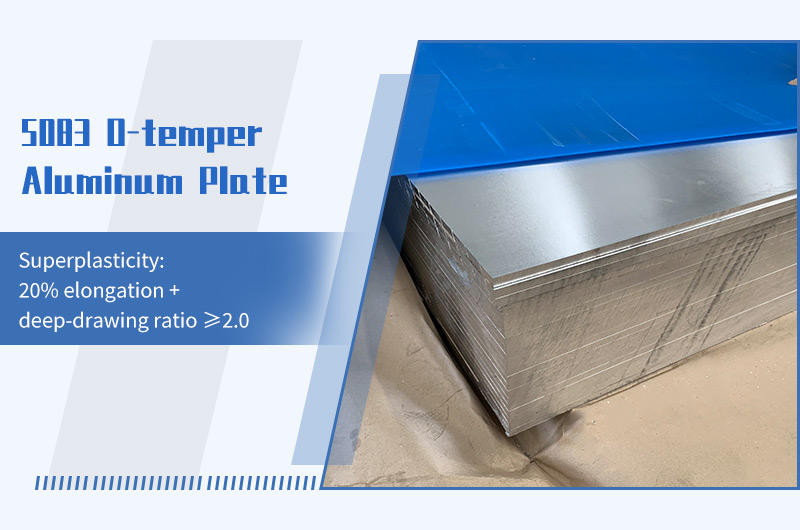
| O | 270–345 | ≥115 | ≥14 | Maximum formability & cryogenic ductility | LNG tanks, pressure vessels, formed heads |
Detailed Temper Profiles
5083-H116 — The Marine Standard
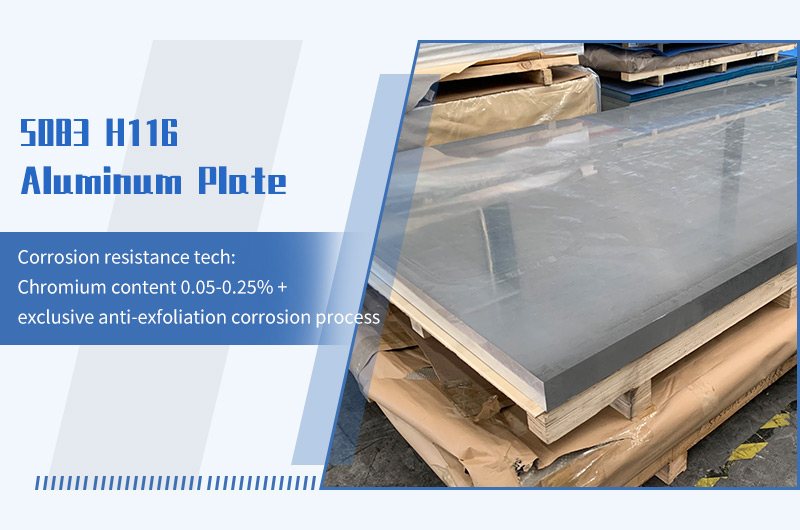
- Why it matters: H116 is the only temper mandated by ASTM B928 for marine hull plate exposed to seawater. Its controlled thermomechanical processing ensures resistance to both exfoliation corrosion (ASTM G66 ≤ PB) and intergranular corrosion (ASTM G67 NAMLT ≤15 mg/cm²).
- Certifications: DNV·GL, ABS, LR, CCS full classification society approval.
- Applications: Ship keels, hull shells, polar icebreaker plating, offshore platform decks.
5083-H321 — Heavy Plate & High Impact
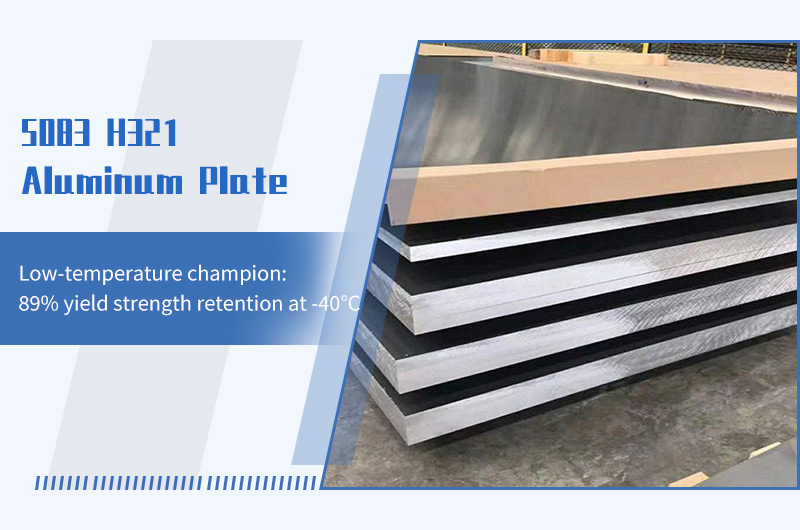
- Edge: Available in thicknesses up to 250 mm; stabilized at higher temperatures for thick-section performance.
- Applications: Coal/ore carrier floors, military armor plate, manned submersible pressure hulls.
5083-H112 — Cost-Effective Structural
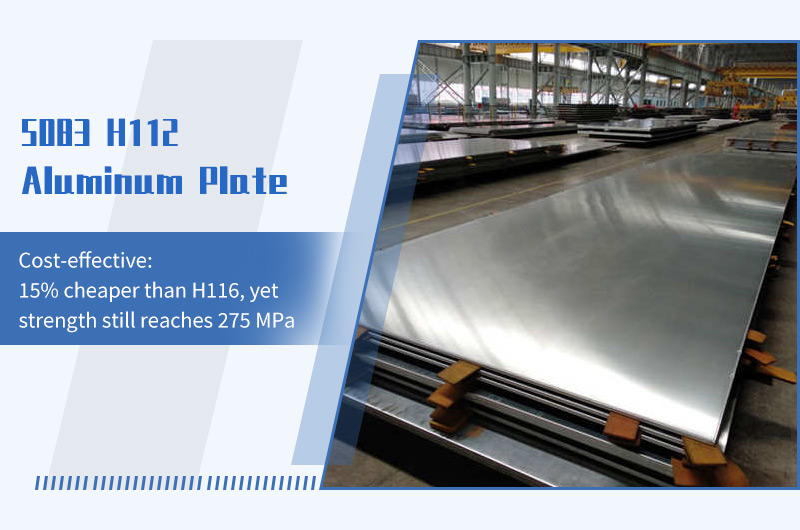
- Edge: ~15% lower processing cost than H116 while delivering UTS ≥275 MPa and Yield ≥125 MPa.
- Applications: Oil/chemical tanker shells, industrial piping, non-classified marine structures.
5083-O — Formability & Cryogenics
- Edge: Elongation ≥14%; excellent cold formability for dished heads and deep-drawn shapes.
- Applications: LNG tank components (−162°C service), cryogenic pressure vessels, spun/formed parts.
Chemical Composition (per ASTM B209 / B928)
| Element | Range (%) | Function |
| Mg | 4.0–4.9 | Primary strengthener; drives seawater corrosion resistance |
| Mn | 0.40–1.0 | Refines grain structure; offsets Fe impurity effects |
| Cr | 0.05–0.25 | Inhibits stress-corrosion & exfoliation pathways |
| Fe | ≤0.40 | Impurity — kept low to preserve toughness |
| Si | ≤0.40 | Impurity |
| Cu | ≤0.10 | Strictly limited — elevated Cu promotes pitting in chloride environments |
| Zn | ≤0.25 | Impurity |
| Ti | ≤0.15 | Grain refiner |
| Al | Balance | Base metal |
Critical note: Mg content above 3% makes the alloy susceptible to sensitization (β-phase Al₃Mg₂precipitation at grain boundaries). The H116 and H321 tempers incorporate thermal stabilization (200–250°C) to distribute precipitates uniformly and prevent this failure mode. Verify with ASTM G67 on every production lot.
Physical Properties
| Property | Value | Unit |
| Density | 2.66 | g/cm³ |
| Melting Range | 574–638 | °C |
| Thermal Conductivity | 117 | W/m·K |
| Electrical Conductivity | 29 | % IACS |
| Specific Heat | 900 | J/kg·K |
| CTE (20–100°C) | 23.8 | μm/m·K |
Mechanical Properties
| Temper | Tensile (MPa) | Yield (MPa) | Elongation (%) | Hardness (HB) |
| O | 270–345 | 115–165 | 14–22 | ~65 |
| H112 | ≥275 | ≥125 | ≥12 | ~70 |
| H116 | ≥303 | ≥215 | ≥10 | ~80 |
| H321 | ≥303 | ≥215 | ≥10 | ~80 |
| H32 | 275–345 | ≥215 | ≥8 | ~75 |
Additional data:
- Fatigue strength: ~160 MPa at 5 × 10⁸cycles (R =−1).
- Shear strength: ~175 MPa (H116).
- Weld-zone strength: ≥275 MPa tensile with ER5183 filler (≥90% of O-temper parent).
Processing & Fabrication
Forming
| Operation | H116 / H321 | O Temper | Notes |
| Min. Bend Radius | ≥3t | ≥1t | H116: preheat to 80–120°C for plate >8 mm |
| Deep Drawing | Not recommended | Draw ratio ~1.5–1.8 | 5083 is stiffer than 5052; use adequate die radii |
| Stretch Forming | Moderate | Good | Best results with progressive tooling |
Welding
| Parameter | Recommendation |
| Process | TIG (GTAW) or MIG (GMAW) |
| Filler | ER5183 (preferred for strength) or ER5356 |
| Shielding Gas | 100% Argon (TIG) · Ar/He mix (MIG thick plate) |
| Preheat | Not required <8 mm; 80–120°C for plate >8 mm |
| Interpass Temp | ≤120°C |
| Post-Weld | No PWHT required; HAZ reverts to ~O-temper strength |
Surface prep: Remove oxide layer with stainless-steel brush or chemical etch before welding. Never use carbon-steel wire wheels — iron contamination creates corrosion initiation sites.
Cutting & Machining
- Sawing/shearing: Standard for plate ≤25 mm; plasma or waterjet for thicker sections.
- CNC machining: Carbide tooling, high spindle speed (2000–4000 RPM), flood coolant.
- Note: 5083 work-hardens during machining — use sharp tools and avoid dwelling.
5083 vs. Other Marine Alloys
| Feature | 5083 | 5059 | 5754 | 5052 |
| Mg Content | 4.0–4.9% | 5.0–6.0% | 2.6–3.6% | 2.2–2.8% |
| Tensile (MPa) | 270–350 | 370–400 | 190–265 | 170–285 |
| Yield (MPa) | 115–215 | ≥280 | 80–160 | 65–240 |
| Elongation | 10–22% | 10–15% | 14–22% | 5–25% |
| Seawater Rating | ★★★★★ | ★★★★★+ | ★★★★ | ★★★★ |
| Weldability | Excellent | Excellent (hot-crack sensitive) | Superior | Excellent |
| Cost Index | ●●●○ | ●●●●● | ●●○○ | ●●○○ |
| Best For | Hull plating, LNG tanks | Next-gen naval, submarines | Ship interiors, auto panels | Fuel tanks, bulkheads |
When to upgrade from 5052 → 5083: Any structural marine component exposed to direct seawater, requiring class society certification, or serving at cryogenic temperatures.
Stock Inventory
We stock 5083 plate in O, H116, and H321 tempers across a full range of thicknesses. All cut-to-size. Contact us for current availability.
5083-O Aluminum Sheet and Plate in Stock
| Thickness (in) | Available Widths (in) | Available Lengths (in) |
| 0.250 | 48 · 60 · 72 · 96 · 120 | 96, 144, 190, 240, 288 |
| 0.375 | 48 · 60 · 72 · 96 · 120 | 96, 144, 190, 240, 288 |
| 0.625 | 48 · 60 · 72 · 96 · 120 | 96, 144, 190, 240, 288 |
| 0.750 | 48 · 60 · 72 · 96 · 120 | 96, 144, 190, 240, 288 |
| 1.000 | 48 · 60 · 72 · 96 · 120 | 96, 144, 190, 240, 288 |
| 1.250 | 48 · 60 · 72 · 96 · 120 | 96, 144, 190, 240, 288 |
| 1.500 | 48 · 60 · 72 · 96 · 120 | 96, 144, 190, 240, 288 |
| 1.750 | 48 · 60 · 72 · 96 · 120 | 96, 144, 190, 240, 288 |
| 2.000 | 48 · 60 · 72 · 96 · 120 | 96, 144, 190, 240, 288 |
Standards: ASTM B209, ASME SB209. All supplied with mill test reports.
5083-H116 Aluminum Sheet and Plate in Stock
| Thickness (in) | Standards |
| 0.125 · 0.160 | ASTM B928 |
| 0.190 · 0.197 · 0.236 | ASTM B209 / B928 |
| 0.250 · 0.313 · 0.375 | ASTM B928 / AMS 4056 / QQ-A-250/6 |
| 0.394 · 0.472 · 0.500 | AMS 4056 / QQ-A-250/6 |
| 0.625 · 0.750 · 1.000 | AMS 4056 / QQ-A-250/6 / ASTM B928 |
| 1.375 | ASTM B209 / B928 |
All sizes cut to order. Width and length per customer specification.
5083-H321 Aluminum Sheet and Plate in Stock
| Thickness (in) | Standards |
| 0.125 · 0.250 | ASTM B209 / B928 |
| 0.375 · 0.500 · 0.625 | AMS 4056 / QQ-A-250/6 / ASTM B928 |
| 0.750 · 1.000 · 1.250 | AMS 4056 / QQ-A-250/6 / ASTM B928 |
| 1.500 · 2.000 · 2.250 | AMS 4056 / QQ-A-250/6 / ASTM B928 |
| 2.500 · 3.000 · 3.250 | AMS 4056 / QQ-A-250/6 / ASTM B928 |
| 3.500 · 4.250 | AMS 4056 / QQ-A-250/6 / ASTM B928 |
Packaging & Shipping
| Item | Detail |
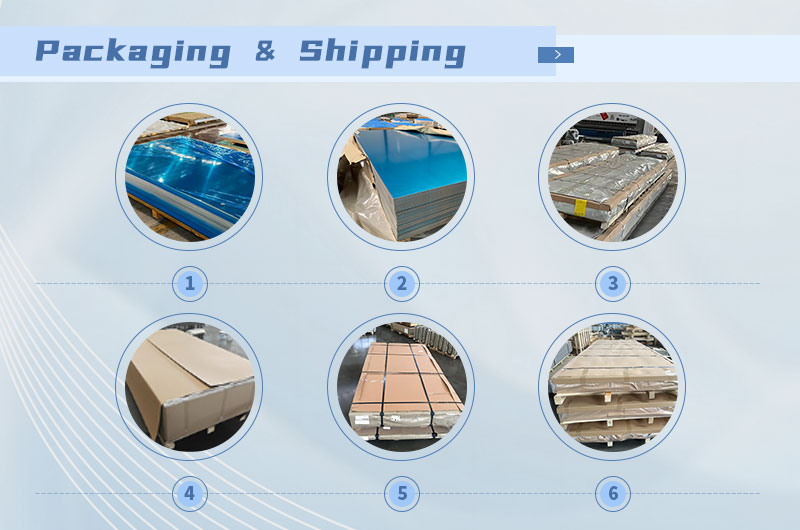
| Packing | Fumigated wooden pallets (ISPM-15 certified); ≤2 tons each; stackable 3 high |
| Protection | Waterproof PVC film + VCI paper + steel corner guards (50G drop-test rated) |
| Container | Dry, clean 20'/40' GP or flat rack; no co-loading with chemicals or moisture sources |
| Delivery | FOB / CIF / DDP; standard lead time ~7 days for stock items; 72-hour rush available |
Pricing
FOB Price = SMM A00 Aluminum Ingot Price + Processing Fee
| Advantage | Detail |
| Mill-direct processing | Processing fees ~15% below market average |
| Transparent formula | Published ingot index + fixed fee; quoted in USD / EUR / CNY |
| Rush delivery | 72-hour expedite surcharge only 5% |
FAQ
What is the difference between 5083-H116 and 5083-H321?
Both deliver ≥303 MPa tensile and ≥215 MPa yield. The key difference is corrosion qualification: H116 is specifically tested to ASTM B928 for exfoliation and intergranular corrosion resistance and is mandatory for classified marine hull plate. H321 is thermally stabilized at a higher temperature and is more common in thick plate for armor and heavy structural applications. For shipbuilding, always specify H116.
Can 5083 be used for LNG tanks?
Yes — 5083-O is the primary alloy for LNG containment systems (−162°C). It retains excellent ductility and fracture toughness at cryogenic temperatures, certified per EN 13445 and ASME Section VIII.
What filler wire should I use to weld 5083?
ER5183 (Al-4.5Mg-0.7Mn) is preferred for maximum joint strength (~275 MPa). ER5356 (Al-5Mg) is also acceptable and more widely available. Always use 100% argon shielding and clean joints within 4 hours of welding.
Is 5083 better than 5052 for marine use?
For structural components exposed to seawater — yes. 5083 offers ~30% higher strength and superior exfoliation corrosion resistance (H116 temper). However, 5052 is more formable, ~30% cheaper, and perfectly adequate for non-structural marine parts like fuel tanks, interiors, and ductwork.
What class society certifications does your 5083 carry?
Our 5083-H116 and H321 plates are certified by DNV·GL, ABS, Lloyd's Register (LR), CCS, BV, NK, and KR. All plates ship with original mill test reports plus third-party verification on request.
Does 5083 require surface coating in seawater?
Bare 5083-H116 resists seawater corrosion without coating. However, for below-waterline hull surfaces, most classification rules require an epoxy anti-fouling coating system plus cathodic protection (Zn-Al anodes) as supplementary protection to maximize service life.