


Why Choose 1070 Aluminum Busbar
1070 aluminum busbar offers the highest electrical conductivity among all aluminum busbars, reaching 62-63% IACS. While 1060 is sufficient for general applications, 1070 is the optimal choice for high energy consumption and heat-sensitive heavy users (electrolysis, metallurgy, data centers, high-voltage power transmission). The electricity savings far exceed the material price difference.
- Highest electrical conductivity
- Lowest resistance
- Minimal temperature rise
- Greater long-term energy savings
Not sure if you need 1070?
If your current load is <2000A and not continuous operation, 1060 Aluminum Busbar offers better value.
If you need export certification, 1350 Aluminum Busbar is more suitable.
Technical Specifications
Basic Parameters
| Item | Data | Compared to 1060 |
| Alloy Grade | 1070 (High-Purity Aluminum) | — |
| Aluminum Content | ≥ 99.70% | +0.1% |
| Electrical Conductivity | ≥ 62% IACS (O-temper can reach 63%) | +1-2% |
| Resistivity | ≤ 0.0275 μΩ·m | -3% |
| Density | 2.7 g/cm³ | Same |
| Thermal Conductivity | 236 W/(m·K) | +1% |
| Standards | GB/T 3190, ASTM B209 | — |
Available Tempers & Properties
| Temper | Conductivity (IACS) | Tensile Strength (MPa) | Elongation (%) | Recommended Use |
| O-temper | 63% | 55-70 | ≥25 | Ultimate conductivity requirements |
| H112 | 62% | 55-85 | ≥12 | General high-current busbars |
| H14 | 62% | 85-110 | ≥5 | Applications requiring some strength |
O-temper offers the highest conductivity (63%), recommended for applications with extreme conductivity requirements.
Chemical Composition (Compared to 1060)
| Element | 1070 | 1060 | Control Difference |
| Al | ≥99.70% | ≥99.60% | Higher |
| Si | ≤0.20% | ≤0.25% | 20% stricter |
| Fe | ≤0.25% | ≤0.35% | 29% stricter |
| Cu | ≤0.04% | ≤0.05% | 20% stricter |
| Mn | ≤0.03% | ≤0.03% | Same |
| Zn | ≤0.04% | ≤0.05% | 20% stricter |
1070's control on Fe (Iron) is nearly 30% stricter than 1060—this is one of the key factors for its higher conductivity.
Dimension Range
| Item | Standard Range | Notes |
| Thickness | 3 - 50mm | Customizable up to 80mm |
| Width | 20 - 200mm | Customizable up to 400mm |
| Length | 1000 - 6000mm | Up to 12000mm max |
Conductivity Advantage Quantitative Analysis
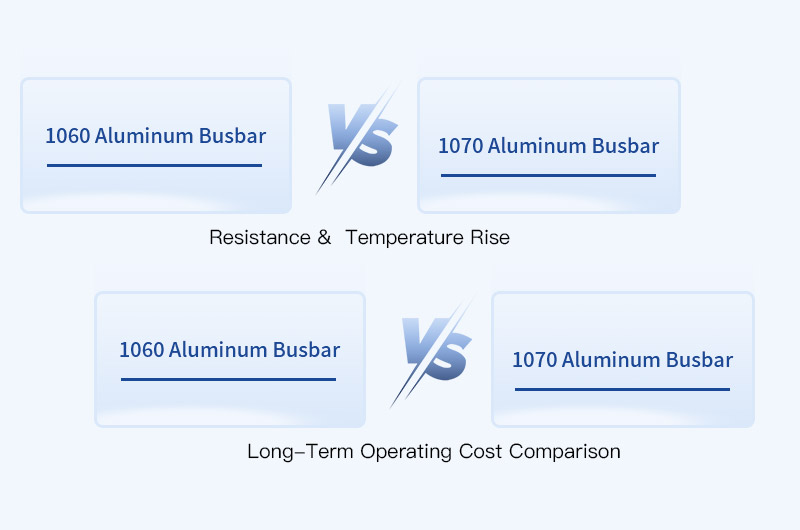
Resistance & Temperature Rise Comparison
Test Conditions: 10×100mm cross-section, 3000A current load
| Metric | 1060 | 1070 | Difference |
| Unit Resistance (mΩ/m) | 0.0472 | 0.0458 | -3% |
| Steady-State Temperature Rise | ~45K | ~42K | -7% |
| Current Capacity (same temp rise) | Baseline | +3.5% | — |
Long-Term Operating Cost Comparison
Assumptions: 100-meter busbar, 3000A, 8000 hours/year operation, electricity rate 0.8 CNY/kWh
| Item | 1060 | 1070 |
| Annual Energy Loss | 340,000 kWh | 330,000 kWh |
| Annual Electricity Cost | 272,000 CNY | 264,000 CNY |
| Annual Savings | — | 8,000 CNY |
| 10-Year Savings | — | 80,000 CNY |
Investment Return Analysis
| Item | Data |
| 1070 vs 1060 Material Price Difference | Approximately 5-10% |
| 100-meter Busbar Material Difference | Approximately 5,000-10,000 CNY |
| Annual Electricity Savings | Approximately 8,000 CNY |
| Payback Period | Approximately 1 year |
Conclusion: For high-current, long-term operation scenarios, 1070's total cost of ownership is actually lower.
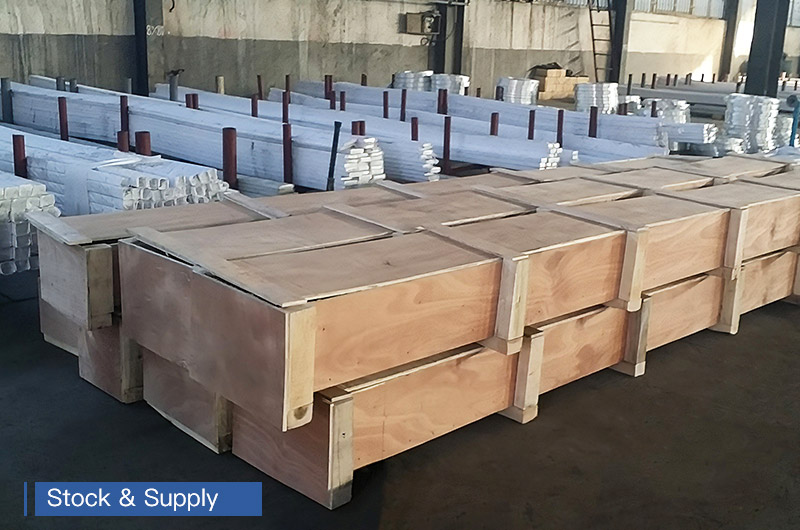
Stock & Supply
| Specification Range | Supply Status | Lead Time |
| 6-12mm thick × 60-100mm wide | In Stock | 3-5 days |
| 15-20mm thick × 100-150mm wide | Regular Stock | 7-10 days |
| Other specifications | Custom | 15-20 days |
Regular Stock Specifications:
| Thickness | Width (mm) |
| 6mm | 60, 80, 100 |
| 8mm | 60, 80, 100, 120 |
| 10mm | 80, 100, 120, 150 |
| 12mm | 100, 120, 150 |
Minimum order quantity for 1070 custom orders is 500kg. Please inquire about specific specification lead times.
Industry Solutions
Solution 1: Aluminum Electrolysis Plant Conductive Rods
Industry Pain Points:
- Extremely high current (tens of thousands of amperes)
- 24/7 continuous operation
- Electricity costs account for high proportion of production costs
Worthwill Solution:
| Item | Solution |
| Recommended Grade | 1070-O temper (63% IACS) |
| Recommended Cross-Section | Calculated by current density, typically large cross-section |
| Supply Form | Cut-to-length, extra-long available (>6m) |
| Quality Assurance | Individual conductivity testing with reports |
Expected Benefits:
- Compared to 1060, annual electricity savings can reach 6 figures
- Payback period typically <1 year
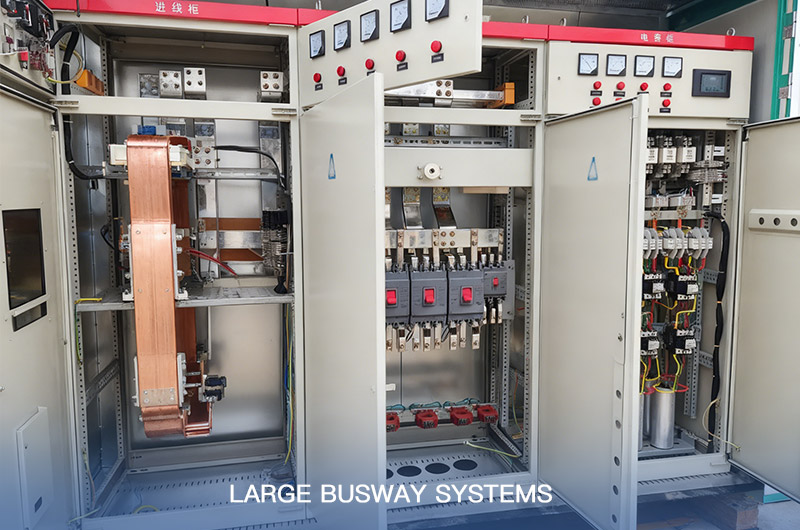
Solution 2: Large Busway Systems
Industry Pain Points:
- High current capacity (3000A+)
- Limited heat dissipation in enclosed structure
- Strict temperature rise standards
Worthwill Solution:
| Item | Solution |
| Recommended Grade | 1070-H112 (balancing conductivity and strength) |
| Recommended Specifications | 10×100, 12×120 and other large cross-sections |
| Process | Extruded rounded corners (prevents corona discharge) |
| Surface | Tin plating available (contact areas) |
Expected Benefits:
- Temperature rise reduced by approximately 7%
- Increased current capacity under same temperature rise limits
Solution 3: High-Voltage Switchgear (35kV+)
Industry Pain Points:
- High-voltage environment demands premium materials
- Partial discharge sensitivity
- Long-term reliability requirements
Worthwill Solution:
| Item | Solution |
| Recommended Grade | 1070-H112 |
| Process | Must have extruded rounded corners (R≥2mm) |
| Surface | Silver plating available (ultra-low contact resistance) |
| Testing | Complete quality documentation provided |
Production Process and Processing Services
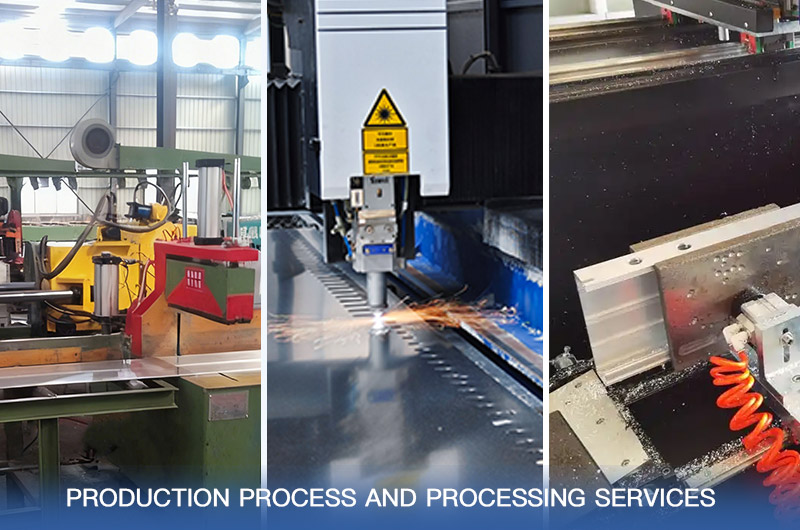
1070 can be produced using the following processes:
| Process | Edge Type | Advantages | Recommended Applications |
| Extrusion | Rounded (R-corner) | Eliminates corona discharge | HV distribution cabinets, switchgear |
| Hot Rolling | Square | Large cross-section, uniform thickness | Electrolysis cell conductive rods |
| Cast & Saw | Square | Extra-large cross-section (100mm+) | Ultra-high current applications |
1070 can undergo the same full range of processing as 1060:
| Processing Type | Options |
| Surface Treatment | Tin plating, nickel plating, silver plating |
| Machining | Punching, tapping (M6-M20), slot milling |
| Bending | Flat bend, edge bend, Z-bend (O-temper R≥0.5t) |
| Insulation | Heat shrink tubing, dip coating |
| Chamfering | Standard/high-precision grade |
Quality Assurance
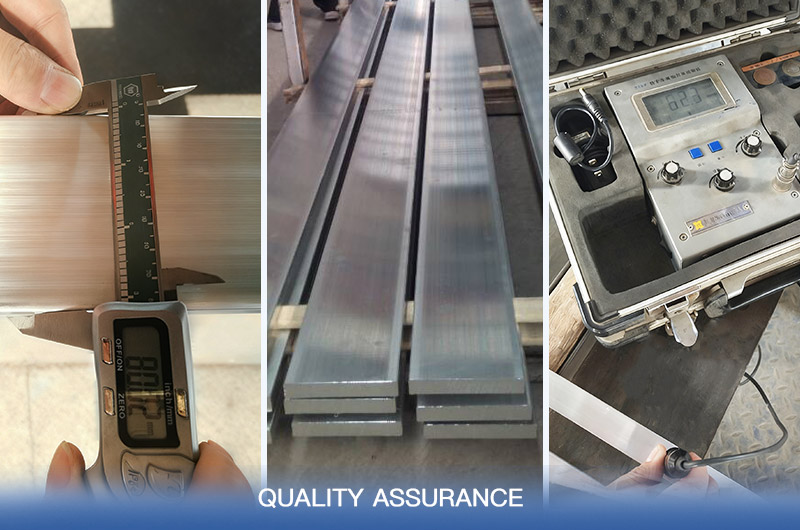
1070 requires higher purity, and Worthwill's quality control is more stringent:
| Stage | Control Measures |
| Raw Materials | Dedicated high-purity aluminum ingot batches, stored separately |
| Melting & Casting | Independent furnace runs, avoiding cross-contamination |
| Composition Testing | Spectrometer testing per batch, focus on Fe and Si |
| Conductivity Testing | 100% eddy current testing, ensuring ≥62% |
| Shipping Documents | MTC + Composition report + Conductivity report |
Frequently Asked Questions (FAQ)
Q: Is there any visual difference between 1070 and 1060? How to verify upon receipt?
A: There is no visual difference. Verification methods:
- Check the Material Test Certificate (MTC) to confirm grade is 1070
- Use an eddy current conductivity meter to measure—1070 should be ≥62% IACS
- Send to third-party laboratory for chemical composition analysis
Q: How much more expensive is 1070 compared to 1060?
A: Typically 5-10% higher, depending on:
- Specifications (standard sizes have smaller price differences)
- Order quantity (volume discounts available)
- Market aluminum price fluctuations
Q: Is 1070 suitable for transformer windings?
A: Yes, but generally not recommended:
- Transformer winding current density is relatively low
- 1060 already meets the requirements
- 1070 is better suited for "main busbars" and other high-current critical components
Recommendation: Use 1060 for windings, 1070 for main busbars—optimal total cost.
Q: Is 1070's bending performance the same as 1060?
A: Exactly the same. Both are pure aluminum with identical processing characteristics:
- O-temper: 90° bend without cracking
- Minimum bend radius: 0.5t (t = thickness)
Q: Can you provide extra-long specifications for 1070?
A: Yes.
- Standard length: 1000-6000mm
- Custom length: Up to 12000mm maximum
- Extra-long specifications require confirmation of shipping method
Q: What certification documents are needed for the electrolysis industry?
A: Typically required:
- Material Test Certificate (MTC)
- Chemical composition test report
- Electrical conductivity test report
- Third-party SGS report when necessary
Worthwill can provide all of the above documents.