


1050 vs. 1060 Aluminum
What are 1050 and 1060 Aluminum?
Both 1050 and 1060 belong to the 1000 series of commercially pure aluminum. They feature simple compositions and are known for their excellent electrical conductivity, thermal conductivity, and corrosion resistance. Both have universally recognized equivalent grades internationally (such as US and European standards). The core differences between the two are as follows:
- 1050 Aluminum:Aluminum content ≥ 99.5%, iron impurity ≤ 0.40%. The common supply temper is H14 (half-hard).
- 1060 Aluminum:Higher purity, with aluminum content ≥ 99.6%, and stricter limits on impurities like iron (≤ 0.35%). Therefore, its electrical conductivity and corrosion resistance are slightly superior to 1050.
1050 vs. 1060 Aluminum:Quick Comparison Overview
| Comparison Item | 1050 Aluminum Alloy | 1060 Aluminum Alloy |
|---|---|---|
| Aluminum Content | ≥ 99.5% | ≥ 99.6% |
| Density | 2.71 g/cm³ | 2.71 g/cm³ |
| Melting Point | 646 - 657°C | 646 - 657°C |
| Thermal Conductivity | 222 W/m·K | 234 W/m·K |
| Electrical Conductivity | 61% IACS | 62% IACS |
| Tensile Strength (O Temper) | 76 MPa | 72 MPa |
| Tensile Strength (H18 Temper) | 140 MPa | 130 MPa |
| Yield Strength (H18 Temper) | 120 MPa | 110 MPa |
| Elongation (O Temper) | 37% | 30% |
| Brinell Hardness (H18 Temper) | 43 HB | 35 HB |
| Heat Treatable | No | No |
| Cold Work Hardening | Yes | Yes |
| Weldability | Excellent | Excellent |
| Corrosion Resistance | Excellent | Excellent |
1050 vs. 1060 Aluminum:Chemical Composition Comparison
Chemical composition is the fundamental reason for the performance differences between the two. The table below lists the comparison of key elements:
| Element | 1050 (Maximum) | 1060 (Maximum) |
|---|---|---|
| Aluminum (Al) | ≥ 99.5% | ≥ 99.6% |
| Iron (Fe) | ≤ 0.40% | ≤ 0.35% |
| Silicon (Si) | ≤ 0.25% | ≤ 0.25% |
| Copper (Cu) | ≤ 0.05% | ≤ 0.05% |
| Manganese (Mn) | ≤ 0.05% | ≤ 0.03% |
| Magnesium (Mg) | ≤ 0.05% | ≤ 0.03% |
| Zinc (Zn) | ≤ 0.05% | ≤ 0.05% |
| Titanium (Ti) | ≤ 0.03% | ≤ 0.03% |
| Vanadium (V) | ≤ 0.05% | ≤ 0.05% |
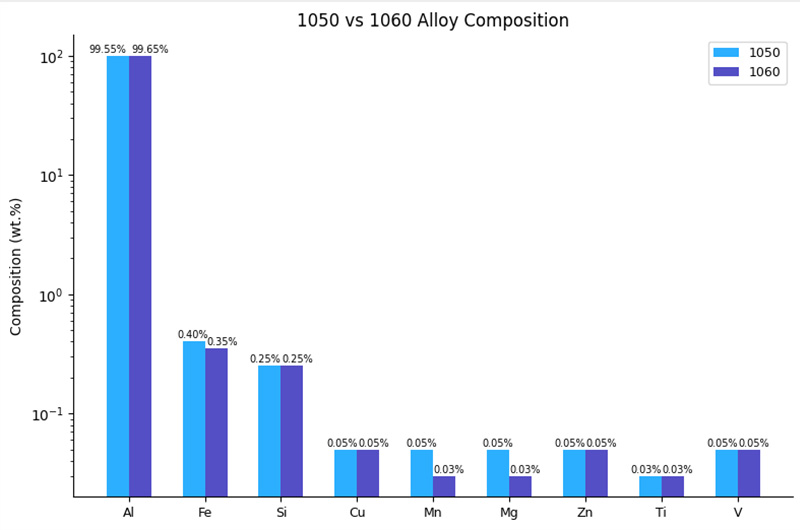
Looking at the data, the aluminum purity of
1060 is 0.1% higher, and the upper limits for impurity elements are strictly
controlled. This is the core reason for the performance differences between the
two.
It is worth noting that both contain trace amounts of vanadium (V), which
serves to refine grains and increase the recrystallization temperature, thereby
improving the overall performance of the material.
1050 vs. 1060 Aluminum:Physical Properties Comparison
In basic physical parameters such as density and melting point, 1050 and 1060 are almost exactly the same.
| Physical Property | 1050 | 1060 |
| Density | 2.71 g/cm³ | 2.71 g/cm³ |
| Melting Range | 646 - 657°C | 646 - 657°C |
| Thermal Expansion Coefficient (20-100°C) | 24 × 10⁻⁶/K | 23.6 × 10⁻⁶/K |
| Specific Heat Capacity | 900 J/kg·K | 900 J/kg·K |
| Elastic Modulus | 68 - 71 GPa | 68 - 70 GPa |
| Poisson's Ratio | 0.33 | 0.33 |
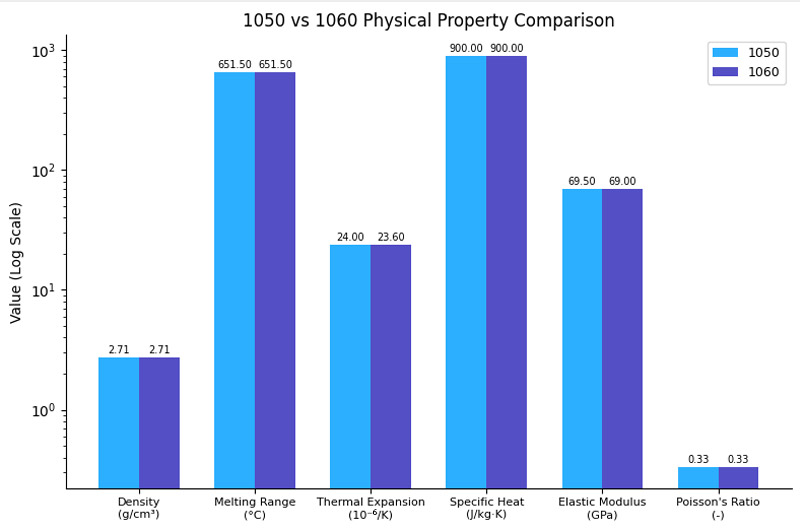
The most obvious physical property differences lie in thermal and electrical conductivity:
- Thermal Conductivity:1060 has a thermal conductivity of 234 W/m·K, higher than 1050's 222 W/m·K, a difference of about 5.4%. This gives 1060 a slight advantage in applications requiring efficient heat dissipation (e.g., heat exchangers, heat sinks).
- Electrical Conductivity:The electrical conductivity of 1060 is 62% IACS, while 1050 is 61% IACS. Though the gap is small, it has practical significance in large-scale electrical applications. The electrical resistivity of 1060 is 0.0278 × 10⁻⁶Ω·m, slightly lower than 1050's 0.0282×10⁻⁶Ω·m.
1050 vs. 1060 Aluminum:Mechanical Properties Comparison
Mechanical properties are the most direct reference for material selection. Since both are pure aluminum and cannot be strengthened by heat treatment, improvements in mechanical properties can only be achieved through cold working (strain hardening).
Annealed State (O Temper) Properties Comparison
The O temper is the softest state after full annealing, offering the highest ductility, suitable for manufacturing processes requiring extensive forming.
| Performance Indicator | 1050-O | 1060-O |
|---|---|---|
| Tensile Strength (UTS) | 76 MPa | 72 MPa |
| Yield Strength | 25 MPa | 21 MPa |
| Elongation | 37% | 30% |
| Brinell Hardness | — | 19 HB |
| Shear Strength | 62 MPa | 49 MPa |
| Fatigue Strength | 31 MPa | 20 MPa |
In the O temper, the overall mechanical properties of 1050 are slightly superior to 1060, with tensile strength about 5% higher, elongation 7 percentage points higher, and higher fatigue strength.
Work-Hardened States (H Tempers) Properties Comparison
As the degree of cold working increases, the strength of the material gradually increases, while ductility decreases accordingly.
| Temper | 1050 Tensile Strength | 1060 Tensile Strength | 1050 Elongation | 1060 Elongation |
|---|---|---|---|---|
| H12 | 96 MPa | 85 MPa | 10% | 12% |
| H14 | 110 MPa | 98 MPa | 8.4% | 7.7% |
| H16 | 130 MPa | 110 MPa | 6.3% | 5.3% |
| H18 | 140 MPa | 130 MPa | 4.6% | 4.0% |
Key finding:In all work-hardened states, the tensile strength of 1050 is higher than that of 1060, with a gap of about 7% to 18%. This means if a project requires a certain level of material strength, 1050 is the better choice.
Full Comparison in H18 Temper (Maximum Cold Work Strength)
H18 is the highest strength state achievable through pure cold working. Below is a detailed comparison:
| Performance Indicator | 1050-H18 | 1060-H18 |
|---|---|---|
| Tensile Strength | 140 MPa | 130 MPa |
| Yield Strength | 120 MPa | 110 MPa |
| Elongation | 4.6% | 4.0% |
| Brinell Hardness | 43 HB | 35 HB |
| Shear Strength | 81 MPa | 75 MPa |
| Fatigue Strength | 48 MPa | 45 MPa |
1050 vs. 1060 Aluminum:Processing Properties Comparison
The processing properties of the two are very similar, which is an important reason why they are often used interchangeably.
| Processing Property | 1050 | 1060 |
|---|---|---|
| Cold Working | Excellent | Excellent |
| Hot Working | Excellent | Excellent |
| Weldability | Excellent | Excellent |
| Formability | Excellent | Excellent |
| Corrosion Resistance | Excellent | Excellent |
| Machinability | Poor | Poor (especially in soft tempers) |
| Heat Treatable | No | No |
| Anodizing Capability | Excellent | Excellent |
| Brazability | Excellent | Excellent |
- Cold Working:Both can be strengthened to varying degrees through tempers like H12, H14, H16, and H18. The H temper series of 1060 also includes partially annealed states like H22, H24, H26, and H28, offering more flexible choices.
- Welding:For 1050, 1100 filler wire is recommended; when welding to 5083, 5086, or 7xxx series, 5356 wire is recommended; for other cases, use 4043 wire. For 1060, using filler wire of the same material is recommended.
- Machinability:Both have poor machinability in the soft state; using carbide or high-speed steel tools with lubricants is recommended. Machinability improves in harder tempers like H16 and H18.
- Annealing Process:The annealing processes for both are basically the same. Rapid annealing temperature is 350-410°C, high-temperature annealing is 350-500°C, and low-temperature annealing is 150-250°C. Air cooling or water cooling can be used.
1050 vs. 1060 Aluminum:Application Fields Comparison
The application fields of both highly overlap, but each has its specific focus.
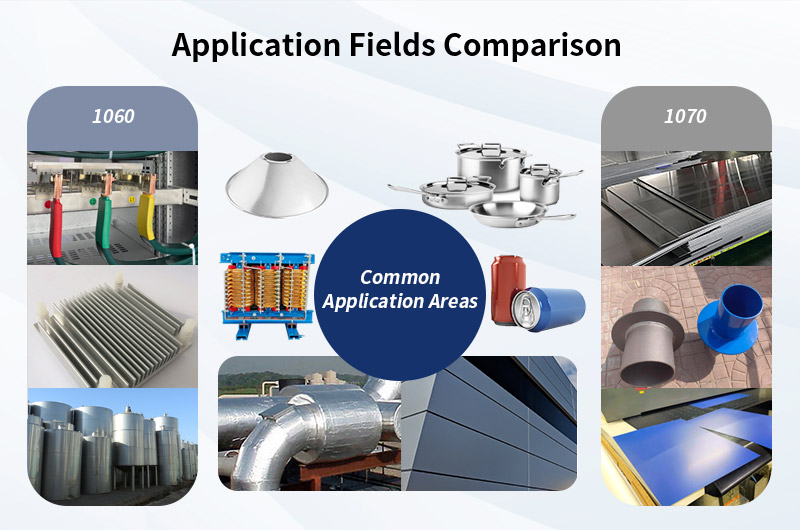
Common Application Areas
- Chemical Equipment:Storage tanks, pipelines, heat exchangers, reaction vessels, etc. (corrosion resistance is key).
- Architectural Decoration:Curtain walls, reflectors, signboards, billboards, building facade decorations.
- Food Industry:Food containers, kitchenware, packaging materials (both meet food safety requirements).
- Electrical Industry:Busbars, conductors, cable sheathing, transformer windings.
- Lighting Industry:Lampshades, reflectors, luminaire housings.
Advantageous Applications for 1060
Because of its higher aluminum purity and electrical conductivity, 1060 is more competitive in the following fields:
- Electrical & Electronics:The electrical conductivity of 1060 (62% IACS) is slightly higher than 1050, making it the preferred choice for transformer windings, busbars, and switchgears. Its lower resistance reduces energy loss in long-distance power transmission or high-current applications.
- Thermal Management:1060's thermal conductivity reaches 234 W/m·K, higher than 1050's 222 W/m·K. It is more suitable for applications requiring high heat transfer, such as heat sinks, heat exchangers, and air conditioner condenser fins.
- Chemical Storage:The high purity of 1060 gives it slightly better corrosion resistance in corrosive environments, making it more suitable for long-term contact with corrosive media like railway tank cars and chemical storage tanks.
- Precision Machined Parts:1060 is widely used in thin gauge products like electronic labels and aluminum foil, with minimum thicknesses reaching down to 0.02mm.
Advantageous Applications for 1050
Due to its slightly higher strength and toughness, 1050 maintains an advantage in the following fields:
- Structural Sheet Metal Parts:In applications requiring a certain degree of strength while maintaining good formability, 1050 in the H14 temper (Tensile strength 110 MPa, Yield strength 94 MPa) is superior to 1060 in the equivalent temper.
- Architectural Flashing & Cable Sheathing:1050 is the traditional material for these applications, particularly common in the European market.
- PCB Aluminum Base Boards:1050 aluminum sheets in H18 and H19 tempers are widely used for PCB drilling entry/backup boards due to their excellent dimensional stability.
- Printing Base Plates:1050 aluminum plates in H16 and H18 tempers are the mainstream substrates for PS (Presensitized) and CTP (Computer-to-Plate) plates, featuring excellent flatness and coating adhesion.
1050 vs. 1060 Aluminum:Specifications and Supply Forms Comparison
Both can be supplied in various product forms covering a wide range of specifications.
| Product Form | 1050 Specification Range | 1060 Specification Range |
|---|---|---|
| Aluminum Plate (Thickness) | 0.1 - 260 mm | 0.5 - 600 mm |
| Aluminum Plate (Width) | 500 - 2650 mm | 100 - 2650 mm |
| Aluminum Coil (Thickness) | 0.2 - 6 mm | 0.2 - 6 mm |
| Aluminum Strip (Thickness) | 0.02 - 1.5 mm | 0.2 - 3 mm |
| Aluminum Foil (Thickness) | 0.008 - 0.02 mm | 0.01 - 0.2 mm |
| Aluminum Bar (Diameter) | 5 - 500 mm | 6 - 400 mm |
| Aluminum Tube (Outer Dia.) | 0.25 - 25.4 mm | 3 - 300 mm |
- Common Tempers:Both offer a variety of tempers including O, H12, H14, H16, H18, H22, H24, H26, H28, and H112 to meet different strength and formability requirements.
- Execution Standards:Both comply with international standards such as ASTM B209 (Plate/Sheet), ASTM B210 (Tube), ASTM B211 (Bar), ISO 6361, as well as Chinese national standards like GB/T 3880.
1050 vs. 1060 Aluminum:Price Comparison
In terms of price, both belong to the 1000 series commercially pure aluminum. The overall price levels are similar, but slight differences exist.
- Pricing Formula:Aluminum Material Price = Daily Aluminum Ingot Price + Processing Fee
- Factors for Price Differences:
- 1060 has higher aluminum content (99.6% vs 99.5%), resulting in slightly higher raw material costs.
- 1060 has stricter impurity control, leading to slightly higher smelting costs.
- 1050 has a more mature production process, so its price may be slightly lower in certain markets.
- The price difference between the two is typically between 3% and 8%, depending on specifications and market conditions.
- From a practical procurement perspective, the price gap is negligible; material selection should be primarily based on performance requirements.
How to Choose: 1050 or 1060?
Before making a choice, the following points can help you quickly determine the appropriate material:
Choose 1060 if you need:
- Higher electrical conductivity (for transformers, busbars, electrical equipment).
- Better thermal conductivity (for heat sinks, heat exchangers).
- Higher aluminum purity (for highly corrosive chemical environments).
- To align with most current suppliers (1060 is the current mainstream choice in the market).
Choose 1050 if you need:
- Slightly higher strength and hardness (H18 temper tensile strength 140 MPa vs. 130 MPa).
- Better ductility (O temper elongation 37% vs. 30%).
- Products compliant with European standards for architectural flashing and cable sheathing.
- Products requiring high dimensional stability, such as PCB aluminum base boards and printing base plates.
Either is fine (prioritize supply convenience) if:
- Used for general architectural decoration, signage, kitchenware, etc., where performance requirements are not strict.
- Used for general industrial purposes like formed parts or welded components.
It should be specially noted that, based on current market trends, 1050 is gradually being replaced by 1060 in many applications. When selecting materials, it is recommended to first confirm the supplier's inventory status and delivery lead times.
Summary
1050 and 1060 both belong to the commercially pure aluminum category. They feature excellent corrosion resistance, formability, and weldability, making them highly cost-effective choices for low-strength applications, and they are interchangeable in most scenarios. The core difference lies in the 0.1% purity variation:
- 1060 (Current Market Mainstream):Better electrical and thermal conductivity, making it the preferred choice in electrical and thermal management fields, and it is gradually replacing 1050.
-
1050 (Specific Structural Applications):Slightly higher strength and ductility.
Regardless of which one is chosen, both offer excellent corrosion resistance, formability, and weldability, representing one of the most cost-effective aluminum alloys for industrial applications without high-strength requirements.
Appendix: Comprehensive Data Reference Tables
Appendix I: Complete Chemical Composition Table (%)
| Element | 1050 | 1050A (EN Standard) | 1060 |
|---|---|---|---|
| Al | ≥ 99.5 | ≥ 99.5 | ≥ 99.6 |
| Si | ≤ 0.25 | ≤ 0.25 | ≤ 0.25 |
| Fe | ≤ 0.40 | ≤ 0.40 | ≤ 0.35 |
| Cu | ≤ 0.05 | ≤ 0.05 | ≤ 0.05 |
| Mn | ≤ 0.05 | ≤ 0.05 | ≤ 0.03 |
| Mg | ≤ 0.05 | ≤ 0.05 | ≤ 0.03 |
| Zn | ≤ 0.05 | ≤ 0.07 | ≤ 0.05 |
| Ti | ≤ 0.03 | ≤ 0.05 | ≤ 0.03 |
| V | ≤ 0.05 | — | ≤ 0.05 |
| Others (Each) | ≤ 0.03 | ≤ 0.03 | ≤ 0.03 |
Appendix II: Complete Mechanical Properties Table for 1050 Tempers
| Temper | Tensile Strength (MPa) | Yield Strength (MPa) | Elongation (%) | Fatigue Strength (MPa) | Shear Strength (MPa) |
|---|---|---|---|---|---|
| O | 76 | 25 | 37 | 31 | 62 |
| H112 | 83 | 34 | 20 | 31 | 52 |
| H12 | 96 | 73 | 10 | 56 | 57 |
| H14 | 110 | 94 | 8.4 | 49 | 69 |
| H16 | 130 | 110 | 6.3 | 50 | 76 |
| H18 | 140 | 120 | 4.6 | 48 | 81 |
| H22 | 96 | 73 | 10 | 57 | 57 |
| H24 | 110 | 84 | 6.8 | 45 | 63 |
| H26 | 130 | 95 | 4.6 | 54 | 75 |
Appendix III: Complete Mechanical Properties Table for 1060 Tempers
| Temper | Tensile Strength (MPa) | Yield Strength (MPa) | Elongation (%) | Fatigue Strength (MPa) | Shear Strength (MPa) | Brinell Hardness (HB) |
|---|---|---|---|---|---|---|
| O | 72 | 21 | 30 | 20 | 49 | 19 |
| H112 | 68 | 17 | 18 | 15 | 42 | — |
| H113 | 67 | 17 | — | — | — | — |
| H12 | 85 | 61 | 12 | 29 | 55 | 23 |
| H14 | 98 | 83 | 7.7 | 35 | 61 | 26 |
| H16 | 110 | 97 | 5.3 | 45 | 70 | 30 |
| H18 | 130 | 110 | 4.0 | 45 | 75 | 35 |
| H22 | 89 | 67 | 6.8 | 50 | 52 | — |
| H24 | 99 | 78 | 1.1 | 38 | 56 | — |
| H26 | 110 | 84 | 1.1 | 45 | 62 | — |
| H28 | 130 | 95 | 1.1 | 37 | 71 | — |
Appendix IV: Complete Physical Properties Table
| Physical Property | 1050 | 1060 | Unit |
|---|---|---|---|
| Density | 2.71 | 2.71 | g/cm³ |
| Melting Point (Solidus) | 646 | 646 | °C |
| Melting Point (Liquidus) | 657 | 657 | °C |
| Elastic Modulus | 68 - 71 | 68 - 70 | GPa |
| Shear Modulus | 26 | 26 | GPa |
| Poisson's Ratio | 0.33 | 0.33 | — |
| Thermal Expansion Coeff. (20-100°C) | 24 | 23.6 | × 10⁻⁶/K |
| Thermal Conductivity | 222 - 230 | 234 | W/m·K |
| Specific Heat Capacity | 900 | 900 | J/kg·K |
| Electrical Conductivity | 61 | 62 | % IACS |
| Electrical Resistivity | 0.0282 | 0.0278 | × 10⁻⁶Ω·m |
| Thermal Diffusivity | 94 | 96 | mm²/s |
| Max Operating Temp (Mechanical) | 170 | 170 | °C |
Appendix V: International Grade Equivalents Table
| Standard System | 1050 Equivalent Grade | 1060 Equivalent Grade |
|---|---|---|
| China GB | 1050 / 1050A | 1060 |
| US AA/ASTM | A91050 | A91060 |
| Europe EN | EN AW-1050A | EN AW-1060 |
| International ISO | Al99.5 | Al99.6 |
| Japan JIS | A1050 | A1060 |
| Germany DIN | Al99.5 / 3.0255 | — |
Appendix VI: Processing Properties Comparison Table
| Processing Property | 1050 | 1060 |
|---|---|---|
| Cold Working | Excellent | Excellent |
| Hot Working Range | 260 - 510°C | 260 - 510°C |
| Gas Welding | Excellent | Excellent |
| TIG/MIG Welding (Argon Arc) | Excellent | Excellent |
| Contact Welding | Excellent | Excellent |
| Brazability | Excellent | Excellent |
| Soldering | Excellent | Excellent |
| Formability | Excellent | Excellent |
| Machinability | Poor | Poor |
| Anodizing Capability | Excellent | Excellent |
| Heat Treatment Strengthening | Not possible | Not possible |
| Cold Work Hardening | Possible | Possible |