


1060 vs. 1070 vs. 1350 Aluminum Busbars
Why Are These Three Pure Aluminum Bus Bars So Hard to Choose Between?
In the electrical equipment industry, "aluminum replacing copper" has become the mainstream forcost reduction and efficiency improvement. With the following core advantages, 1-series pure aluminum busbars are largely replacing traditional copper busbars(Copper vs. Aluminum Busbars):
| Advantage | Specific Performance |
| Lower Cost | 40-50% material cost reduction at equivalent current |
| Lighter Weight | Aluminum density (2.7g/cm³) is 1/3 that of copper (8.9g/cm³) |
| Good Conductivity | 1000-series pure aluminum: 61-63% IACS conductivity |
| Excellent Machinability | High ductility; easy to bend, punch and weld |
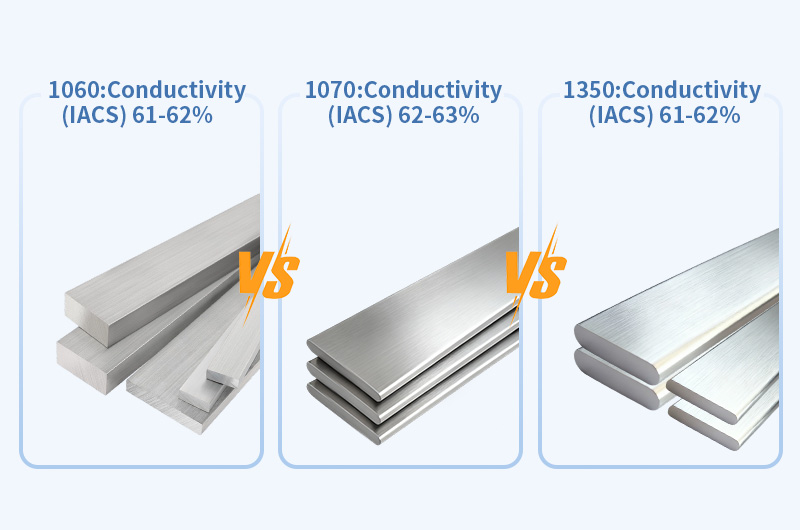
However, when facing the three common models on the market—1060, 1070, and 1350—buyers often have these questions:
- "1070 is only 1% higher in conductivity than 1060. Is it worth paying more?"
- "1350 has lower aluminum content than 1060. Why is it called electrical grade aluminum?"
- "Which one should I use for export equipment?"
This article will provide thorough answers from a professional perspective.
Quick Overview of Key Differences
Comparison Table
| Comparison Item | 1060 Bus Bar | 1070 Bus Bar | 1350 Bus Bar |
| Aluminum Content | ≥99.60% | ≥99.70% | ≥99.50% |
| Conductivity (IACS) | 61-62% | 62-63% | 61-62% |
| Core Positioning | Best Value | Ultimate Conductivity | International Electrical Standard |
| Applicable Standards | GB/T 3190, ASTM B209 | GB/T 3190, ASTM B209 | ASTM B233 |
| International Recognition | General | General | Highest |
| Price Reference | Baseline | 5-10% Higher | 3-5% Higher |
| Typical Applications | Distribution cabinets, transformers | High-current busbars, electrolysis industry | Export equipment, cable connections |
Tips: 1070 has the highest aluminum content (99.7%), but the international electrical standard specifies 1350—because 1350 has the strictest control over impurity elements that affect conductivity.
One-Sentence Summary
- 1060 busbar: Meets the vast majority of requirements, best value for money
- 1070 busbar: For ultimate conductivity, first choice for high-current applications
- 1350 busbar: Essential for export equipment, worry-free international certification
In-Depth Chemical Composition Comparison
All three models are "pure aluminum, " but they differ in impurity element control standards, which directly affects the stability of electrical conductivity.
Chemical Composition Comparison Table
| Element | 1060 | 1070 | 1350 |
| Al (Aluminum) | ≥99.60% | ≥99.70% | ≥99.50% |
| Si (Silicon) | ≤0.25% | ≤0.20% | ≤0.10% |
| Fe (Iron) | ≤0.35% | ≤0.25% | ≤0.40% |
| Cu (Copper) | ≤0.05% | ≤0.04% | ≤0.05% |
| Mn (Manganese) | ≤0.03% | ≤0.03% | ≤0.01% |
| Mg (Magnesium) | ≤0.03% | ≤0.03% | — |
| Zn (Zinc) | ≤0.05% | ≤0.04% | ≤0.05% |
| B (Boron) | — | — | ≤0.05% |
| Cr+Mn+Ti+V | — | — | ≤0.03% |
Professional Analysis
Why does 1350, with lower aluminum content, qualify as the electrical standard grade? Because what affects conductivity is not "how much aluminum there is, " but "how much impurity there is."
- Silicon (Si): Every 0.1% increase reduces conductivity by approximately 1% IACS
- Manganese (Mn): Every 0.1% increase reduces conductivity by approximately 3% IACS
1350 limits Si to ≤0.10% (2.5 times stricter than 1060) and Mn to ≤0.01% (3 times stricter than 1060), resulting in more stable and consistent conductivity performance.
Conductivity Comparison
Conductivity is the primary criterion for selecting aluminum bus bars. The International Annealed Copper Standard (IACS) defines pure copper conductivity as 100%.
Conductivity Comparison by Temper
| Model | O Temper (Soft) | H112 Temper | H14 Temper |
| 1060 | 62% | 61% | 61% |
| 1070 | 63% | 62% | 62% |
| 1350 | 62% | 61.8% | 61.5% |
Practical Significance of Conductivity Differences
Is the 1-2% higher conductivity of 1070 compared to 1060 significant? It mainly depends on the application scenario:
| Scenario | Impact Level | Recommendation |
| Current <1000A | Almost imperceptible | Choose 1060 |
| Current 1000-2000A | Slight difference | Choose based on budget |
| Current >2000A | Significant difference | Choose 1070 |
| Annual operation >6000h | Large cumulative difference | Choose 1070 |
Energy Savings Calculation Example:
Assumptions:
- Bus bar specification: 10×100mm, length 100m
- Current capacity: 3000A
- Annual operation: 8000 hours
- Electricity price: $0.11/kWh
| Item | 1060 | 1070 |
| Resistivity (μΩ·m) | 0.0283 | 0.0275 |
| Annual Energy Loss | Approx. 340, 000 kWh | Approx. 330, 000 kWh |
| Annual Electricity Cost | Approx. $37, 400 | Approx. $36, 300 |
| Annual Savings | — | Approx. $1, 100 |
Conclusion: In high-current, long-cycle operation scenarios, the energy savings from 1070 can exceed the material price difference within 3-5 years.
Detailed Analysis
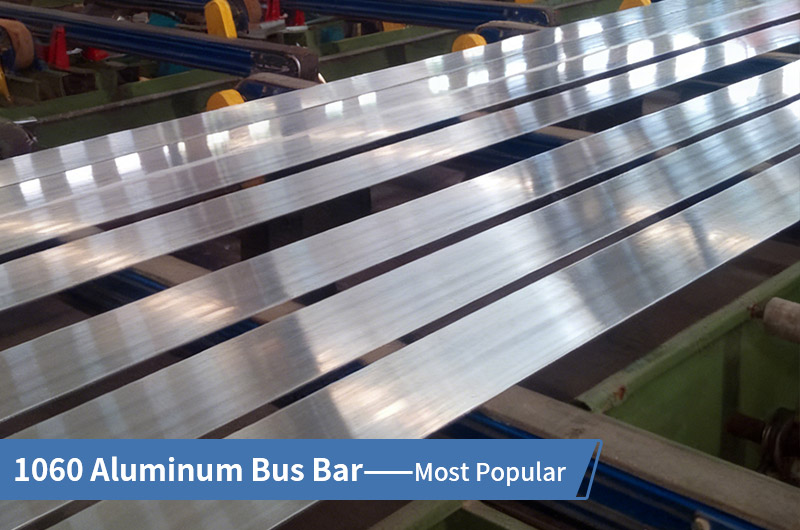
1060 Aluminum Bus Bar — Most Popular
Core Advantages:
| Advantage | Description |
| Most Abundant Supply | Produced by all aluminum manufacturers, complete range of specifications |
| Most Affordable Price | Significant economies of scale, mature processing |
| Adequate Performance | 61-62% IACS meets 90% of applications |
| Excellent Machinability | O temper allows 90° bending without cracking |
Suitable Applications:
- Low-voltage distribution cabinets (≤1000V)
- Switchgear busbars
- Dry-type transformer windings
- Power battery flexible connections
- Busway systems
Limitations:
- Conductivity not optimal
- Not an international electrical standard grade
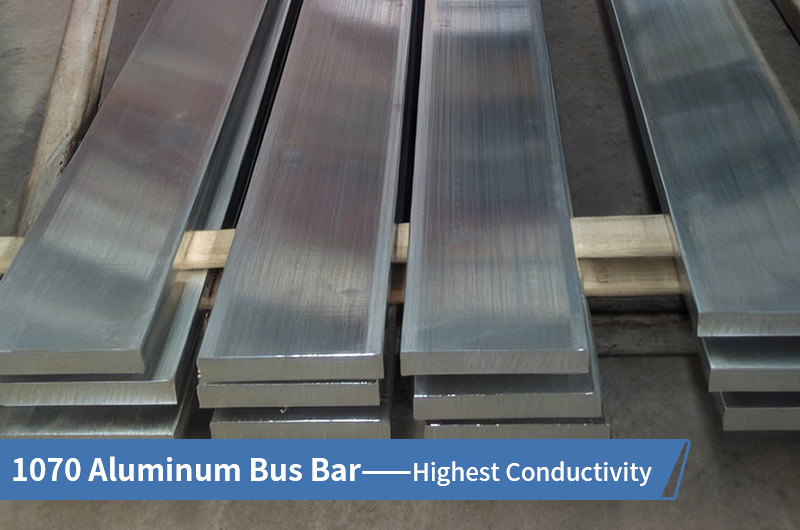
1070 Aluminum Bus Bar — Highest Conductivity
Core Positioning: The highest conductivity model in the 1000 series pure aluminum
Core Advantages:
| Advantage | Description |
| Highest Conductivity | 62-63% IACS, industry-leading |
| Lowest Resistance | Approximately 3% lower than 1060 |
| Lowest Temperature Rise | Less heat generation during high-current operation |
| Long-term Energy Savings | Lower operating costs |
Suitable Applications:
- High-voltage transmission systems (35kV and above)
- High-current busway systems (>2000A)
- Conductor bars for aluminum electrolysis/electroplating industry
- Conductor arms for metallurgical arc furnaces
- Precision equipment sensitive to temperature rise
Cost Analysis:
Material cost is 5-10% higher, but for high-current long-term operation, energy savings can cover the price difference. Overall, 1070 may be more economical.
Limitations:
- Slightly higher price
- Some specifications require customization
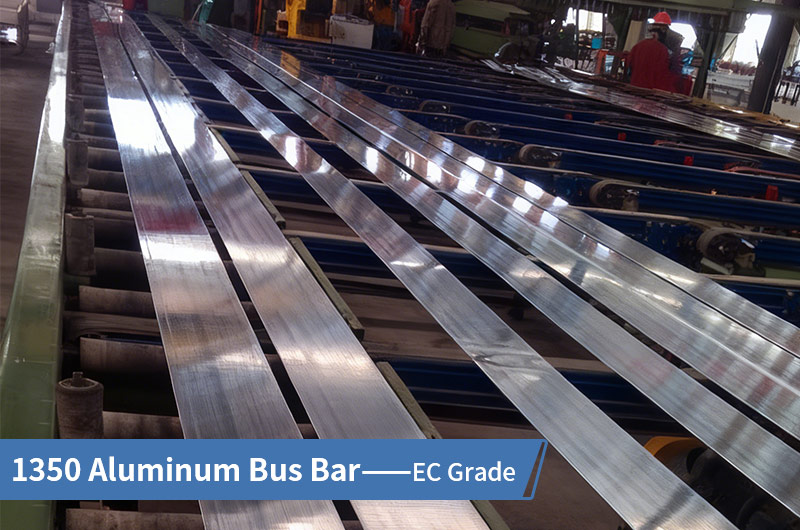
1350 Aluminum Bus Bar — EC Grade
Core Positioning: Internationally recognized electrical-grade pure aluminum (EC Grade)
Core Advantages:
| Advantage | Description |
| International Standard | Compliant with ASTM B233 |
| Certification Convenience | UL/CE/IEC certification materials pass directly |
| Strictest Impurity Control | Best consistency in conductivity performance |
| Cable Compatibility | Same material as international aluminum core cable conductors |
Suitable Applications:
- Export-oriented distribution equipment
- Cable connection terminals and connectors
- International projects in Europe, Americas, and Middle East
- UL/CE certified equipment
- Applications requiring extremely high quality consistency
Key Difference from 1060:
Conductivity is almost identical, but 1350 is the international electrical standard grade. For export equipment, choosing 1350 means material review passes directly during certification—no additional explanation needed.
Limitations:
- Less cost-effective than 1060 for domestic projects
- Slightly higher price
How to Choose?
Quick Selection
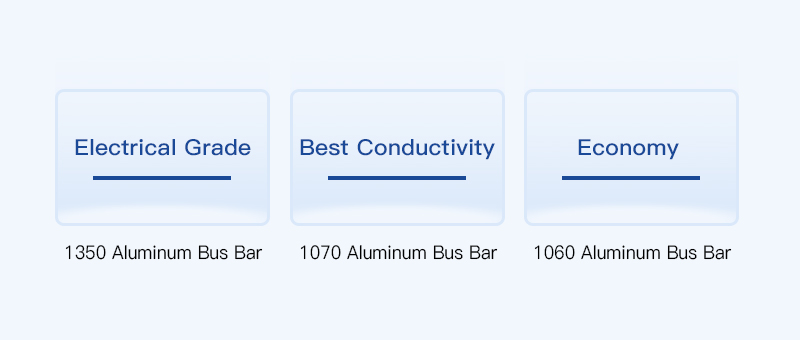
1350 Aluminum Bus Bar (Electrical Grade)
Designed specifically to meet international standards such as ASTM and IEC.
Choose this for projects with strict certification requirements.
1070 Aluminum Bus Bar (Best
Conductivity)
Suitable for demanding environments with >35kV high voltage or >2000A
high current, providing optimal conductivity.
1060 Aluminum Bus Bar (Economy)
Suitable for general-purpose projects, offering the most competitive price
while meeting performance requirements.
Application Scenario Quick Reference Table
| Your Application Scenario | Recommended Model | Reason |
| Domestic low-voltage distribution cabinet | 1060 | Abundant supply, low price, fully adequate |
| Domestic transformer winding | 1060 | Easy to bend, high value |
| Power battery flexible connection | 1060 | Good ductility, controllable cost |
| High-current busway (>2000A) | 1070 | High conductivity, low temperature rise |
| High-voltage switchgear (35kV+) | 1070 | Low resistance, minimal loss |
| Aluminum electrolysis conductor bar | 1070 | Ultimate conductivity, long-term energy savings |
| Export distribution equipment | 1350 | International standard, easy certification |
| Cable connection terminals | 1350 | Same material as cables |
| International EPC projects | 1350 | Meets international specifications |
| Uncertain which to choose | 1060 | Most versatile, covers 80% of scenarios |
Production Process Comparison
All three models can be produced using the following processes. The choice depends on application requirements:
Process Comparison Table
| Process | Edge Shape | Surface Characteristics | Thickness Range | Recommended Application |
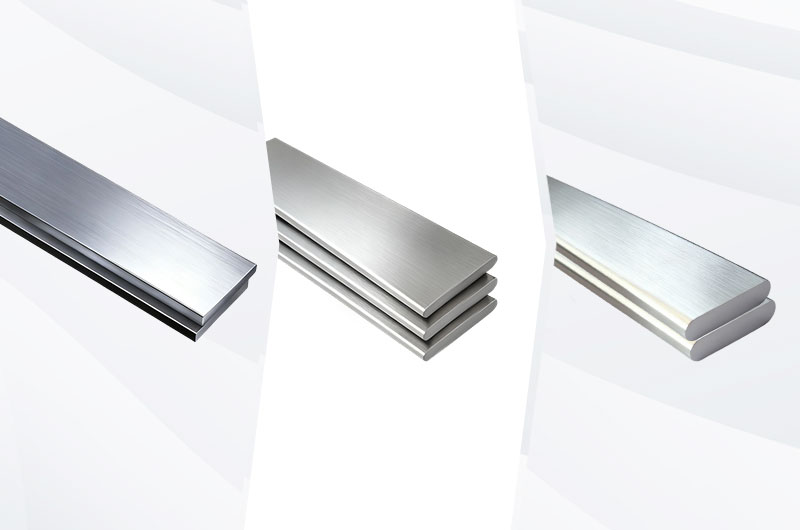
| Extrusion | Rounded corners (R-corners) | Smooth, longitudinal texture | 3-50mm | High-voltage distribution cabinets, switchgear |
| Hot Rolling | Square corners | Uniform and dense | 3-50mm | Busway, bus bars |
| Cold Rolling & Slitting | Square corners, with burrs | Precision bright finish | 0.3-5mm | Transformer windings, flexible connections |
How to Quickly Identify the Process?
After receiving the aluminum bus bar, simply look at the edges to determine:
| Edge Characteristics | Process |
| Smooth, rounded edges | Extrusion process |
| Sharp edges or cutting marks | Rolling/slitting process |
For high-voltage distribution, rounded corners (extrusion process) are recommended to prevent corona discharge.
1000 Series vs. 6000 Series Aluminum
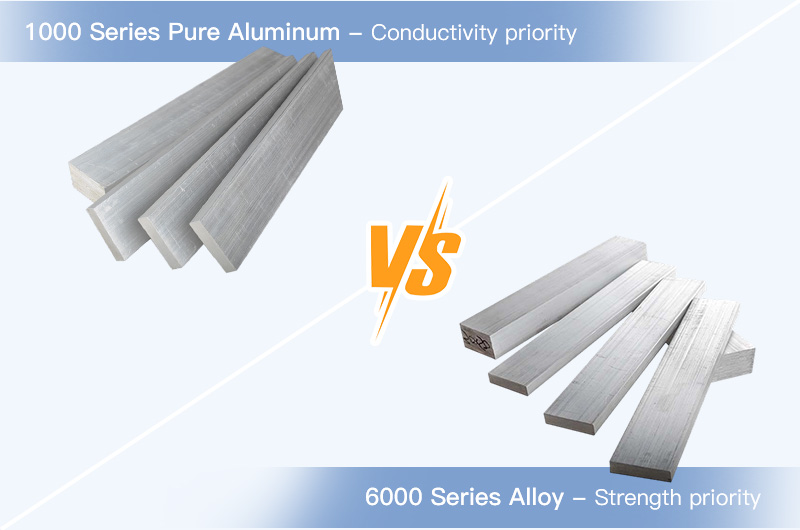
Pure aluminum bus bars are not universal. Consider 6000 series aluminum alloy in the following situations:
| Requirement | Recommended Material | Conductivity | Strength |
| Conductivity Priority | 1060/1070/1350 busbar | 61-63% | Low |
| Balance of Strength + Conductivity | 6101-T6 busbar | 55-59% | Medium-High |
| Structural Load-bearing Priority | 6061-T6 busbar | 40-43% | High |
Simple Memory:
- 1000 series = Conductivity priority (soft aluminum bus bar)
- 6000 series = Strength priority (hard aluminum bus bar)
Frequently Asked Questions (FAQ)
Q1: How much more expensive is 1070 than 1060? Is it worth upgrading?
A: Usually 5-10% more expensive. Whether it's worth it depends on the scenario:
| Scenario | Recommendation |
| Current <1000A, annual operation <4000h | Choose 1060, difference negligible |
| Current >2000A, annual operation >6000h | Choose 1070, significant energy savings |
| Strict temperature rise control required | Choose 1070, lower resistance means less heat |
Q2: 1350 and 1060 have similar conductivity. Why choose 1350?
A: Although 1350 and 1060 have similar conductivity, 1350 is the grade specified by the international electrical standard (ASTM B233), offering clear advantages for export:
- Material review passes directly in North American and European markets
- Same material as international cable conductors, more stable contact resistance
- Stricter impurity control, better batch consistency
Q3: Is there a difference in bending performance among the three models?
A: Almost none. All three are 1000 series pure aluminum with excellent ductility:
- O temper: Minimum bending radius 0.5t (t = thickness)
- 90° bending guaranteed without cracking or orange peel effect
Q4: Can the three models be distinguished by appearance?
A: They cannot be distinguished by appearance; all are silver-white aluminum materials. Identification methods:
- Check the Mill Test Certificate
- Use an eddy current conductivity meter to measure
Q5: Which model has the fastest delivery time?
A: 1060 > 1350 > 1070
- 1060: Most abundant stock, standard specifications can ship same day
- 1350: Most specifications in stock
- 1070: Common specifications in stock, special specifications require customization (approximately 15-20 days)
Q6: Are rounded or square corners better for aluminum bus bars?
A: It depends on the application:
| Type | Advantage | Recommended Application |
| Rounded (R-corners) | Eliminates corona discharge | High-voltage distribution cabinets (10kV+) |
| Square corners | Larger contact area | Low-voltage equipment, transformer windings |
Summary
| Your Priority | Best Choice |
| Cost Priority | 1060 |
| Conductivity Priority | 1070 |
| Compliance Priority | 1350 |
| Uncertain | 1060 (covers 80% of scenarios) |
Worthwill offers all three models:
- Produced from A00 primary aluminum ingots, no recycled aluminum
- 100% factory inspection, conductivity guaranteed
- Multiple processes available: extrusion/rolling
- One-stop processing: tin plating, punching, bending