


Copper vs. Aluminum Busbars
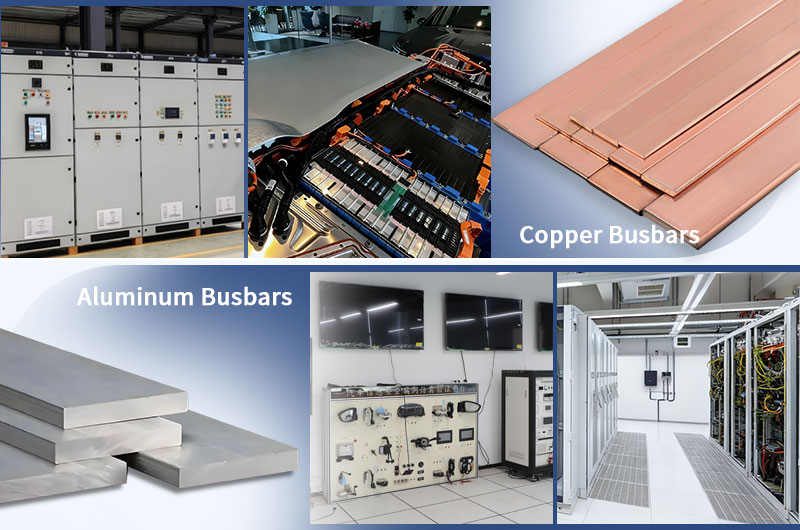
In power distribution systems, selecting the right busbar material—typically copper or aluminum busbar—directly impacts efficiency, safety, and lifecycle costs. According to IEEE 605, optimal selection can reduce total project costs by 30–45% without compromising safety or performance.
Core Parameters Comparison: Copper vs. Aluminum Busbar
| Comparison Item | Copper Busbar (C11000/T2) | Aluminum Busbar (1350/1060/6101) |
|---|---|---|
| Electrical Conductivity | 100% IACS | Approx. 61% IACS |
| Cross-sectional Area Required for Same Ampacity | Baseline | Approx. 1.6 times |
| Weight at Same Ampacity | Baseline | Approx. 50% lighter |
| Coefficient of Thermal Expansion (CTE) | 17 μm/m·°C | 23–23.6 μm/m·°C |
| Melting Point | 1085°C | 660°C |
| Creep Tendency | Low | High (approx. 25 times that of copper) |
| Oxidation Resistance | Good | Poor (Oxide layer is an insulator) |
| Material Cost | High (Approx. 3–4 times that of aluminum) | Low |
| Maintenance Requirement | Low | Medium (Requires regular bolt inspection) |
What is a Busbar?
A busbar is a metallic conductor (commonly flat, tubular, or flexible) that collects and distributes current in power systems. It transfers energy from power sources to loads and acts as the central hub for circuit breakers and fuses. Material choice is the crucial first step, directly dictating system efficiency, safety, weight, and cost.
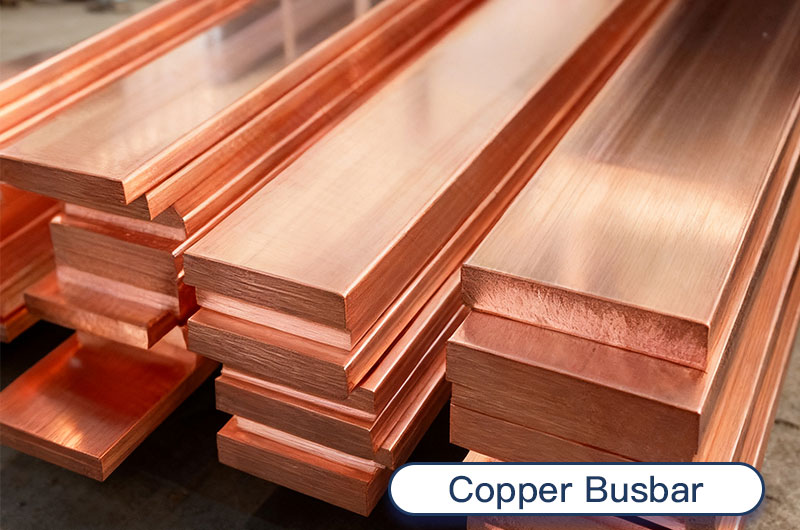
Core Characteristics of Copper Busbars
Ultimate Conductivity & Space Efficiency
As the industry benchmark (100% IACS), copper offers the highest conductivity. For a given ampacity, copper busbars require the smallest cross-section and generate the lowest thermal loss, making them the absolute top choice for compact and space-constrained distribution designs.
Superior Heat Dissipation & System Longevity
Copper's thermal conductivity (~390 W/m·K) is about 75% higher than aluminum's, enabling rapid heat dissipation at connection points to prevent hotspots. Since insulation lifespan doubles for every 8–10°C drop in temperature, copper busbars significantly extend the system's overall operational life.
Mechanical Strength
| Mechanical Parameter | C110 Copper Busbar | 6101-T6 Aluminum Busbar |
|---|---|---|
| Tensile Strength | 220–250 MPa | 150–180 MPa |
| Yield Strength | 70–120 MPa | 145–165 MPa |
| Elongation | 30–45% | 10–15% |
| Elastic Modulus | 110 GPa | 70 GPa |
Data Source: ASTM B187 (Copper) and ASTM B236 (Aluminum) standards.
Surface Treatment Options
According to the IEC 60947 standard, different surface treatments correspond to different permissible temperature rises:
| Surface Treatment | Permissible Temp Rise | Primary Advantages |
|---|---|---|
| Bare Copper | 60K | Best conductivity, lowest cost |
| Tin-plated | 65K | Prevents oxidation, easy to solder/weld |
| Silver-plated | 70K | Lowest contact resistance, suitable for high frequencies |
| Nickel-plated | 70K | Wear-resistant, suitable for harsh environments |
Note: All busbars and accessories within the same system must use the identical surface treatment to avoid galvanic corrosion caused by the contact of dissimilar metals.
Copper Busbar Ampacity Reference Table
Applicable conditions: 40°C ambient temperature, 50°C temperature rise, natural convection cooling, vertical orientation. Data complies with UL 857 and NEMA BU 1.2 testing protocols.
| Dimensions (Width × Thickness, mm) | Cross-sectional Area (mm²) | Ampacity (A) |
|---|---|---|
| 25×3 | 75 | 276 |
| 40×4 | 160 | 506 |
| 50×5 | 250 | 697 |
| 60×6 | 360 | 912 |
| 80×8 | 640 | 1370 |
| 100×10 | 1000 | 1870 |
| 125×10 | 1250 | 2150 |
Quick Estimation: Estimate base ampacity by multiplying busbar width (mm) by a thickness coefficient. For complex setups, adjust this value by multiplying by ~1.57 for two layers or 2.0 for three layers, and add 10–15% if installed vertically.
Core Characteristics of Aluminum Busbars
Conductivity & Alloy Grades
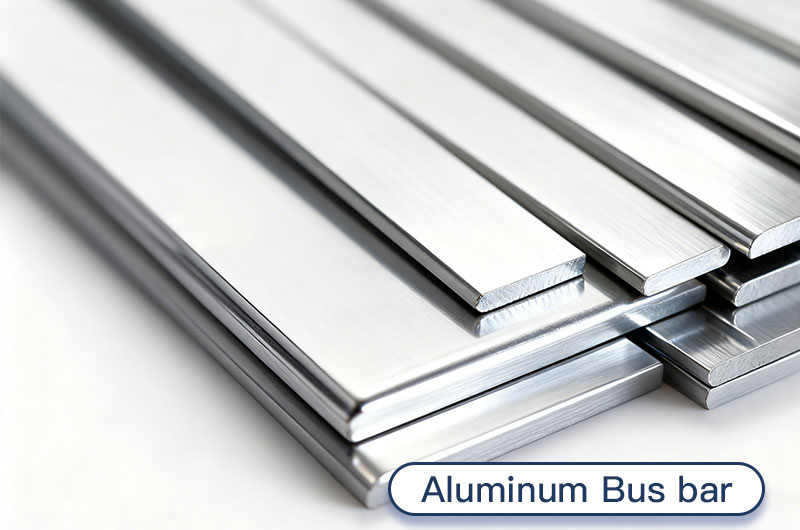
The electrical conductivity of aluminum is approximately 61% that of copper. To meet the same current requirements, aluminum busbars need about 1.6 times the cross-sectional area of copper. Different alloy grades are suitable for specific applications:
Weight & Cost Reduction Advantages
Even though the cross-sectional area must be increased by 1.6 times, an aluminum busbar is still approximately 50% lighter than a copper busbar for the same ampacity.
| Alloy Grade | Conductivity (IACS) | Key Characteristics |
|---|---|---|
| 1350 | 61–62% | Complies with ASTM B233, top choice for export certifications |
| 1060 | 61–62% | Standard in China, highest cost-effectiveness |
| 1070 | 62–63% | Highest conductivity, ideal for high-current electrolytic industries |
| 6101-T61 | Approx. 59% | Balance of strength and conductivity, ideal for busway ducts |
| 6101-T6 | 55–57% | Highest strength, suitable for structural requirements |
Three Major Engineering Challenges of Aluminum Busbars
To utilize aluminum busbars successfully, the following three issues must be strictly prevented:
- Oxidation Insulation Heating: The moment bare aluminum contacts air, it instantly forms an insulating oxide film, which easily leads to overheating and burning at connection points. Therefore, overlapping joints must be abraded and coated with conductive electrical joint compound (paste) during installation.
- Loosening due to Creep: Aluminum slowly deforms under constant pressure (its creep rate is significantly higher than copper's), causing bolted connections to loosen over time. Belleville spring washers are mandatory, along with regular inspection and retightening.
- Bi-metallic Corrosion: Direct contact between pure copper and pure aluminum, in the presence of moisture, will cause severe galvanic corrosion. Dedicated "bi-metallic connectors/transition plates" must be used at transition joints.
Aluminum Busbar Ampacity Reference Table
Applicable conditions: 40°C ambient temp, 50°C temp rise, natural convection cooling, vertical orientation (6101-T61).
| Dimensions (Width × Thickness, mm) | Cross-sectional Area (mm²) | Ampacity (A) |
|---|---|---|
| 25×3 | 75 | 215 |
| 40×4 | 160 | 389 |
| 50×5 | 250 | 539 |
| 60×6 | 360 | 705 |
| 80×8 | 640 | 1070 |
| 100×10 | 1000 | 1475 |
| 125×10 | 1250 | 1747 |
Quick Conversion Formula: Aluminum Busbar Ampacity (40°C) = Copper Busbar Ampacity ÷ 1.3
For a full side-by-side reference across all standard sizes, see our Aluminum vs Copper Busbar Ampacity comparison chart (PDF).
In-Depth Comparison: Copper vs. Aluminum Busbar
Conductivity & Space Efficiency
Taking a 2000A distribution requirement as an example: A copper busbar requires a 1/4"×4" cross-section, whereas an aluminum busbar requires a 1/2"×5" cross-section to achieve the same capacity. This difference in cross-section directly affects enclosure sizing, internal wiring complexity, and overall installation costs.
Copper/Aluminum Substitution Comparison Across Current Scales (C11000 Cu / 6101-T61 Al, 40°C ambient, 50°C rise):
Small Applications (Under 500A):
| Copper Busbar Dimensions | Copper Busbar Ampacity | Aluminum Busbar Dimensions | Aluminum Busbar Ampacity | Weight Savings at Same Ampacity |
|---|---|---|---|---|
| 1/4"×1" | 530A | 1/4"×2" | 526A | Approx. 50% |
| 1/4"×2" | 940A | — | — | — |
Medium Applications (500–1500A):
| Copper Busbar Dimensions | Copper Busbar Ampacity | Aluminum Busbar Dimensions | Aluminum Busbar Ampacity | Weight Savings at Same Ampacity |
|---|---|---|---|---|
| 1/4"×2" | 940A | 1/2"×2" | 756A | Approx. 50% |
| 1/4"×3" | 1300A | 1/2"×3" | 1036A | Approx. 50% |
Large Applications (1500–3000A):
| Copper Busbar Dimensions | Copper Busbar Ampacity | Aluminum Busbar Dimensions | Aluminum Busbar Ampacity | Weight Savings at Same Ampacity |
|---|---|---|---|---|
| 3/8"×4" | 2000A | 1/2"×6" | 1764A | Approx. 50% |
| 1/2"×5" | 2750A | 1/2"×8" | 2240A | Approx. 50% |
Note: The ampacity ratio remains consistently between 1.78–1.79:1 across these specifications. The ~50% weight saving represents the actual savings at the same ampacity (accounting for the increased cross-section). For the exact same cross-sectional area, aluminum is about 70% lighter.
Voltage Drop Performance (Using a 30m / 1000A System as an example)
- Copper Busbar (1/4"×2"): Voltage Drop 0.34% (1.65V)
- Equivalent Aluminum Busbar (1/2"×2"): Voltage Drop 0.31% (1.50V)
Mechanical Strength & Deformation Resistance
- Physical Dominance: Copper's elastic modulus (110 GPa) and elongation vastly outperform aluminum.
- Copper's Home Turf: In harsh conditions featuring high-frequency vibrations, intense short-circuit impacts, long unsupported spans, and frequent thermal cycling, copper busbars hold an absolute reliability advantage.
- Aluminum Countermeasures: While not as deformation-resistant as copper, aluminum busbars can meet the mechanical requirements of most standard distribution scenarios by simply shortening the support spacing during the design phase.
Thermal Performance & Safety
| Thermal Parameter | Copper Busbar | Aluminum Busbar |
|---|---|---|
| Thermal Conductivity | 385–391 W/(m·K) | 218–230 W/(m·K) |
| Coefficient of Thermal Expansion (CTE) | 16.5×10⁻⁶/°C | 23.6×10⁻⁶/°C |
| Melting Point | 1085°C | 660°C |
Aluminum's high thermal expansion requires spring washers at joints to prevent loosening. Additionally, its low melting point (660°C) poses arc flash risks during short circuits, demanding caution in critical safety applications.
Corrosion Resistance Comparison
Copper's Corrosion Behavior: Copper forms cuprous oxide (Cu₂O, reddish-brown) in the atmosphere, eventually forming copper carbonate over long-term exposure. Crucially, the copper oxide layer retains 10–30% of its conductivity, allowing joints to maintain their electrical function. This is a core advantage of copper busbars.
Aluminum's Corrosion Behavior: The conductivity of the aluminum oxide layer is virtually zero, which directly leads to joint failure.
Environmental Suitability:
| Environment Type | Copper Busbar | Aluminum Busbar |
|---|---|---|
| Marine/Coastal Environments | Top Choice | Requires strict protection |
| Chemical, Oil & Gas Facilities | Top Choice | Requires strict protection |
| Wastewater Treatment Plants | Top Choice | Not Recommended |
| Indoor Controlled Environments | Suitable | Suitable |
| Data Centers | Suitable | Suitable (requires protection) |
| Well-sealed Outdoor Enclosures | Suitable | Suitable |
Reference Standard: ASTM B117 Salt Spray Test Standard.
Total Lifecycle Cost (TCO) Analysis
| Cost Dimension | Copper Busbar | Aluminum Busbar |
|---|---|---|
| Initial Material Cost | High | Low |
| Installation Labor Cost | Standard | Lightweight design reduces physical labor, but requires special connectors |
| Inspection Frequency | Once a year | Once every six months |
| Bolt Retightening | Rarely needed | Once every 3–5 years |
| Design Lifespan | 30–50 years | 25–40 years |
| Maintenance Cost | Low | Higher |
Environmental & Sustainability
Both materials are 100% recyclable. Aluminum strongly supports ESG goals: its recycling uses only 5% of primary production energy, with 75% of all historical aluminum still in use. Copper recycling requires 15% of primary energy, with 65% still in use.
Copper-Clad Aluminum (CCA) Busbars: The Third Option
Product Definition & Core Parameters
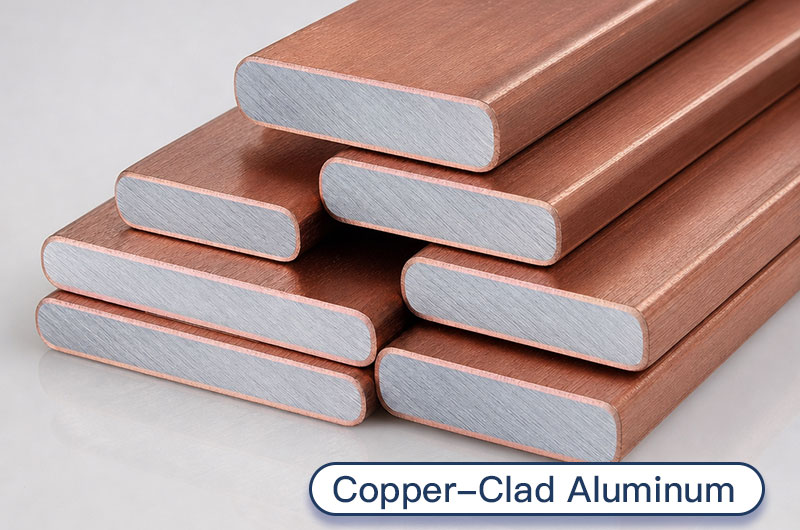
Copper-clad aluminum (CCA) busbars consist of an aluminum core clad with an outer layer of copper through a metallurgical process (the copper layer accounts for about 30% of the total thickness). The two metals form a permanent bond at the atomic level.
Core Advantages & Reliability Verification
- Compared to Copper (Massive cost and weight reduction): Costs drop straight by 35–45%, and weight is reduced by about 60%.
- Compared to Aluminum (Cures aluminum pain points): The pure copper surface cladding perfectly resolves the fatal flaws of pure aluminum, such as rapid oxidation, high creep deformation, and short joint lifespan.
- High-Frequency Application Bonus: Due to the "Skin Effect, " high-frequency currents are conducted entirely through the surface copper layer, making its high-frequency current-carrying performance rival that of pure copper.
- Endorsed by Industry Giants: Long-term reliability has been proven, and CCA has successfully entered the global supply chains of giants like Schneider and ABB.
| Parameter | Value |
|---|---|
| Copper Volume Ratio | 15–20% |
| Density | 3.63–3.96 g/cm³ (Approx. 42–44% that of pure copper) |
| Conductivity | 85–92% of pure copper (Approx. 69% IACS) |
| Cost | 35–45% lower than pure copper |
Three-Material Comprehensive Comparison
| Performance Metric | T2 Copper Busbar | Aluminum Busbar (1060) | CCA Busbar |
|---|---|---|---|
| Conductivity | 97% IACS | 59.5% IACS | 69% IACS |
| Relative Ampacity | 100 | 78 | 86 |
| Density (g/cm³) | 8.89 | 2.70 | 3.94 |
| Oxidation Resistance | Good | Poor | Same as copper |
| Creep | Low | High | Low |
| Electrical Lifespan | Long | Relatively short | Long |
| Positioning | Performance Priority | Cost Priority | Best Cost-Performance |
Core Installation Craftsmanship & Maintenance Red Lines
Copper Busbars: High Tolerance, Simplified Installation
- Hardware Requirements: Standard hardware is sufficient; high torque tolerance. Conductive paste is only required in humid/corrosive environments.
- Acceptance Criteria: Use a 0.03mm feeler gauge to verify contact flushness; joint voltage drop ≤7mV; operating temperature ≤70°C.
Aluminum Busbars: "Fail-Safe" Rules That Must Be Strictly Enforced
- Critical Hardware (Anti-loosening): Belleville spring washers (to counteract thermal cycling and creep) and Grade 8.8 or higher bolts are mandatory.
- Connection Red Lines (Anti-corrosion): Copper-aluminum connections must utilize dedicated bi-metallic transition joints; direct contact between bare copper and bare aluminum is strictly prohibited.
- The 3-Step Process (Anti-oxidation): Abrade to remove the oxide layer → Immediately apply zinc-loaded conductive paste → Complete tightening within 10 minutes.
- Layout Suggestion: Aluminum busbars should ideally be installed vertically (wide face vertical) to boost ampacity by 10–15%.
Inspection & Maintenance Differences
- Temperature Red Lines: Use infrared thermography. A temperature difference exceeding 10K at a joint indicates an anomaly; absolute temperature must not exceed 70°C.
- Maintenance Cost Differences: Copper connections are highly stable, requiring only one standard inspection annually. Aluminum connections are prone to torque decay early on, requiring a follow-up inspection and retightening every six months during the critical initial operation phase.
Application Scenario Selection Guide
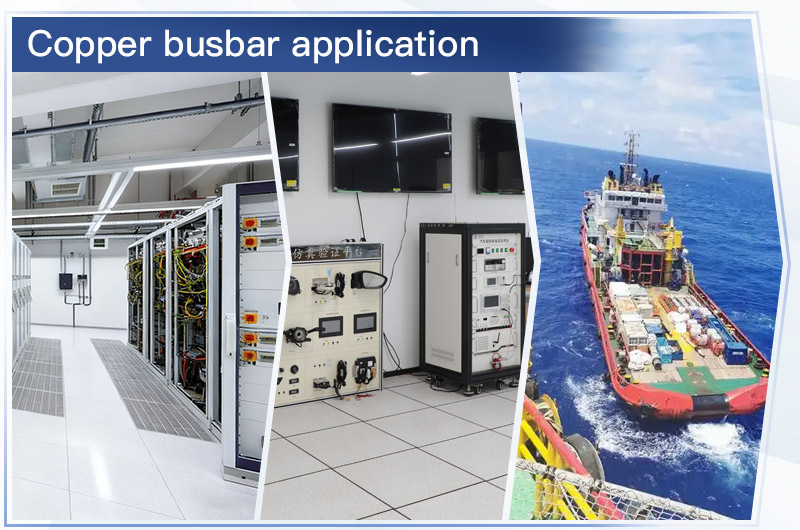
Scenarios Preferring Copper Busbars
- Data Centers & Critical Facilities: Space is tight, and downtime is extremely costly. Copper's high current density and low maintenance make it the optimal choice. Complies with ANSI/TIA-942 recommendations.
- Marine & Offshore Applications: In salt spray environments, copper's corrosion resistance is irreplaceable. Complies with IEC 60092-352 marine standards.
- Industrial Oil & Gas, Chemical, Wastewater Facilities: Highly corrosive environments where copper requires no complex additional treatments.
- High Vibration Environments: Copper's higher elongation and fatigue strength make it more reliable in motor control centers and seismic zones.
- Hard-to-Access Locations: Remote or underground facilities benefit from copper's low maintenance needs, reducing O&M difficulty and costs.
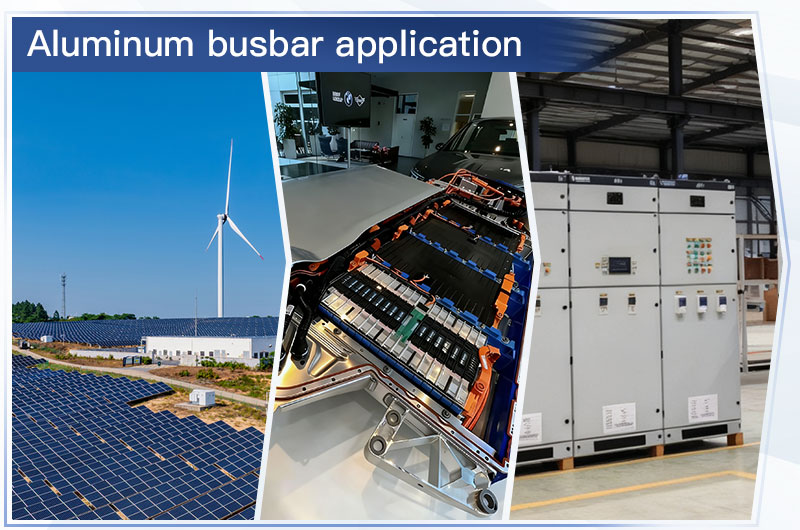
Scenarios Preferring Aluminum Busbars
- Utility-Scale Renewable Energy Projects: Large solar and wind power plants require massive amounts of busbars. Aluminum's material cost advantage is highly significant, and its lighter weight reduces structural support needs. Complies with IEEE 1547 grid integration standards.
- Large Building Electrical Shafts & Long-Distance Busway Ducts: Reduced weight lowers building structural loads. Commonly used in UL 857 certified busways.
- Budget-Constrained Projects with Bus Runs Exceeding 50 Feet (approx. 15 meters): Currents over 800A, indoor controlled environments, and where normal maintenance is viable.
- Aerospace & Automotive Applications: Weight-sensitive environments where properly engineered aluminum busbar systems offer distinct advantages.
Scenarios Preferring Copper-Clad Aluminum (CCA) Busbars
Applications requiring material cost reductions as an alternative to pure copper, but where the reliability trade-offs of pure aluminum are unacceptable; New energy equipment (wind converters, Energy Storage Systems (ESS), EV high-voltage connections); Battery interconnects and inverter connections where high frequencies are present; Low-voltage switchgear and power busways demanding high cost-performance.
Selection Decision Matrix
| Evaluation Dimension | Key Question | Recommended Material |
|---|---|---|
| Current Density | Is space restricted? | Restricted: Copper; Ample space: Aluminum viable |
| Installation Env. | Are there corrosive/high humidity conditions? | Harsh: Copper; Normal env: Aluminum viable |
| Project Scale | Is the busbar usage massive? | Large projects: Aluminum offers clear advantages |
| Weight Constraints | Is the structural load sensitive? | Sensitive: Aluminum; Insensitive: Copper |
| Maintenance Capability | Can regular torque inspections be performed? | Difficult: Copper; Convenient: Aluminum viable |
| Reliability Req. | Is the cost of downtime excessively high? | High: Copper; Low: Aluminum viable |
Relevant Standards & Compliance
| Standard Number | Scope | Region |
|---|---|---|
| IEC 61439 | Low-voltage switchgear and controlgear assemblies | International |
| IEC 60947 | Low-voltage switchgear (includes temp rise standards) | International |
| UL 857 / UL 891 | Busways and Switchboards | North America |
| NEMA BU 1.2 | Aluminum busway installation standard | USA |
| NEC 110.14 | Copper-aluminum connection requirements | USA |
| GB/T 5585 | Copper and aluminum/alloy busbars for electrical purposes | China |
| ASTM B236 | Standard specification for aluminum busbars | USA |
| ASTM B187 | Standard specification for copper busbars | USA |
| IEEE 605 | Guide for bus design | International |
Worthwill Copper & Aluminum Busbar Products
Henan Worthwill Industry Co., Ltd. specializes in manufacturing electrical-grade copper and aluminum busbars. Our products are supplied to renowned global electrical manufacturers such as Hitachi, ABB, Siemens, and Toshiba, and are exported to over 80 countries and regions worldwide.
Aluminum Busbar Product Series
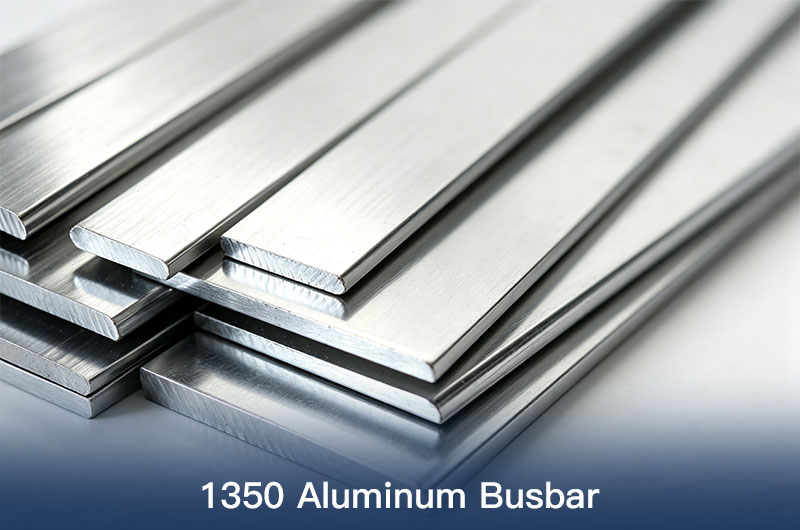
1350 Aluminum Busbar
- Conductivity: 61.8–62% IACS
- Purity: ≥99.5%
- Applications: Export distribution equipment, ideal for UL/CE certified projects.
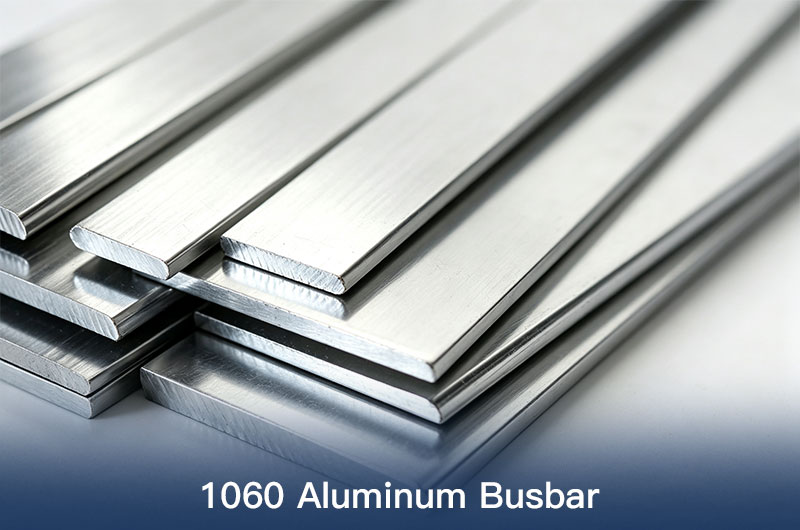
1060 Aluminum Busbar
- Conductivity: About 61–62% IACS
- Purity: ≥99.6%
- Applications: Domestic distribution systems, transformers, new energy.
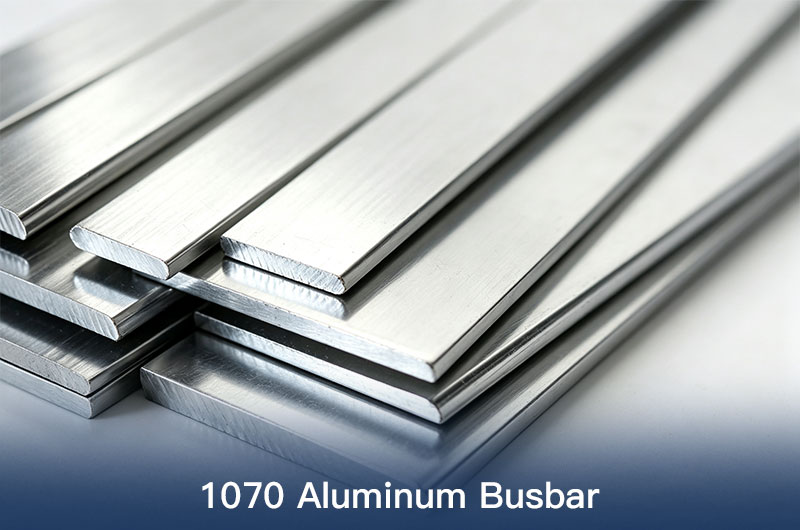
1070 Aluminum Busbar
- Conductivity: About 62–63% IACS
- Purity: ≥99.7%
- Applications: Highest conductivity in the series, built for high-current industrial environments.
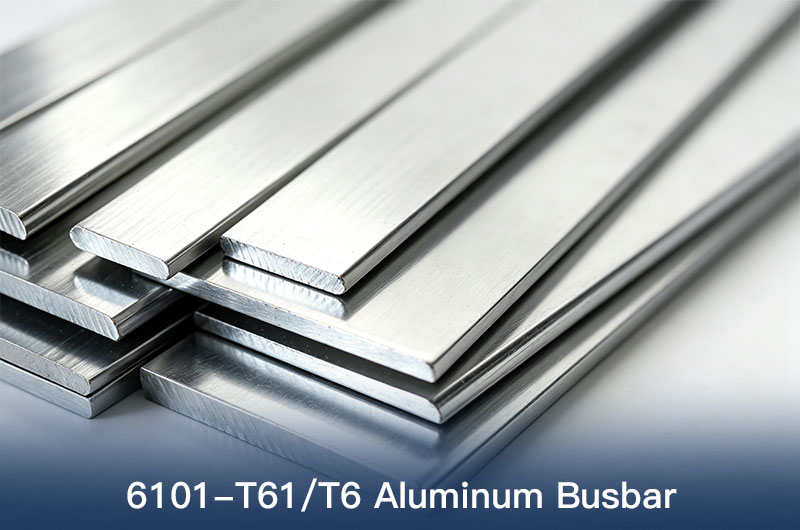
6101 Aluminum Busbar
- Conductivity: About 55–60% IACS
- Temper: T61 / T6
- Applications: Alloy busbar with enhanced mechanical strength for large-scale electrical distribution.
Product Specifications & Processing
| Product Type | Thickness / Outer Diameter Range | Width / Wall Thickness Range | Length Range |
|---|---|---|---|
| Flat Rectangular Busbar | Thickness 2–250 mm | Width 5–300 mm | Up to 6 meters (Customizable) |
| Tubular Aluminum Busbar | Outer Diameter 3–250 mm | Wall Thickness 1–15 mm | Up to 18 meters |
| Round Bar | Diameter Φ6–Φ60 mm | — | Customizable |
Worthwill offers comprehensive one-stop services for busbars:
- Deep Processing: Custom cutting, punching, bending, plating (tin/silver/nickel), anodizing, and heat-shrink insulation.
- Global Standards: Fully compliant with ASTM B317, IEC 60105, DIN EN 755, and GB/T 3190.
- Certified Quality: Every batch includes an MTC, chemical/conductivity reports, and SGS/BV third-party inspection certifications.
Frequently Asked Questions (FAQ)
- Can aluminum busbars completely replace copper?
- Yes, in most low-voltage applications, provided you increase the cross-section by ~1.6 times and use dedicated Al connectors. However, copper remains irreplaceable in heavily space-constrained or highly corrosive environments.
- Can I directly connect or mix copper and aluminum busbar?
- No. Direct contact causes galvanic corrosion and joint failure. You must always use tin-plated dual-rated (Cu/Al) connectors or dedicated bi-metallic transition plates (per NEC 110.14 & UL 486) with conductive paste.
- Tin-plated vs. bare copper busbars: Which is better?
- Bare copper is fine for dry indoors. However, tin-plated is highly recommended for most projects: it resists corrosion, allows a higher temperature rise (65K vs. 60K per IEC 60947), and only adds 8–12% to the cost.
- How often should aluminum busbars be inspected?
- Annually for standard installations, and every 6 months for critical applications. Using infrared thermal imaging is highly recommended to detect hotspots early.
- Can I mix copper and aluminum within the same system?
- Yes, but you must use appropriate bi-metallic connectors or transition plates. Direct contact between copper and aluminum will cause galvanic corrosion. Please use tin-plated connectors rated for both materials or dedicated bi-metallic transition plates.
Conclusion: Which Material to Choose?
The optimal choice depends on your project parameters:
- Choose Copper Busbar: When space is tight, environments are harsh, or maximum reliability/low-maintenance is critical. The price premium is justified.
- Choose Aluminum Busbar: For budget-conscious, weight-sensitive, or large-scale projects. Modern alloys (like 6101-T6) offer unbeatable cost-performance.
- The Hybrid Solution: The most practical approach for many systems—use copper inside compact equipment, aluminum for long-distance busways, and link them safely with bi-metallic connectors.