


Temper Designation for Aluminum Alloys
For the same aluminum alloy, a different temper designation can mean the difference between a material that "bends beautifully" and one that "cracks upon bending, " or change it from "lacking strength" to "warping as soon as it's machined." Understanding temper designations for aluminum alloys is the key to reducing material selection errors and avoiding quality disputes.
This guide, an "aluminum tempers explained, " will clarify the common F/O/H/W/T tempers, Hxx, Txx, T651/T7351, and more, all in one place.
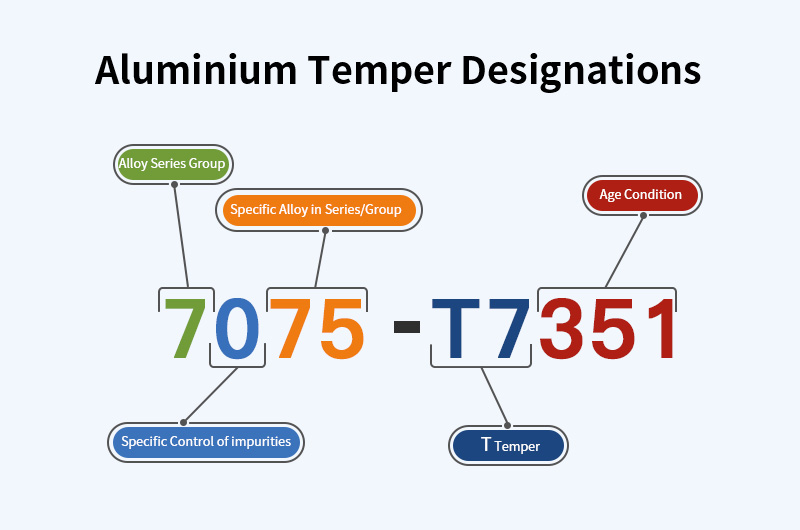
After mastering this "aluminum tempers explained" guide, you will be able to:
- Quickly interpret Temper Designations for Aluminum Alloys.
- Instantly judge if a temper is appropriate for a given alloy series.
- Clearly distinguish between the five basic tempers: F, O, H, W, and T.
- Understand the meaning of the two and three-digit codes in H tempers.
- Master the processing routes for T1–T10 tempers.
- Comprehend the significance of stress-relieved tempers like T651, T6511, and TX52.
- Learn the use of corrosion-resistant tempers like T73, T76, and T74 in the 7000 series.
- Recognize the differences in temper usage between wrought and cast aluminum.
- Accurately write complete specifications when inquiring, ordering, and inspecting materials.
Alloy is Composition, Temper is the Process Route
A complete designation is typically: Alloy Designation - Temper Designation
- 6061-T6, 6063-T5
- 5052-H32, 5083-H116
- 7075-T651, 7050-T7451
- Common for Castings: 356.0-T6, 319.0-T5
Temper Primarily Affects:
- Strength, yield, elongation, and hardness.
- The processing window for bending, deep drawing, and stretching.
- Residual stress and the risk of distortion during machining.
- Corrosion resistance, Stress Corrosion Cracking (SCC), and exfoliation corrosion tendencies.
- Weldability and the ability to recover properties in the heat-affected zone (HAZ), which also depends on the alloy system.
H or T Temper? It Depends on Whether the Alloy is Heat-Treatable
Common Rules of Thumb (Excellent for initial purchasing screening):
- Non-heat-treatable alloys (strengthened mainly by cold working): Primarily 1000, 3000, and 5000 series. Common tempers are O, Hxx, and Hxxx.
- Heat-treatable alloys (strengthened by solution heat treatment + quenching + aging): Primarily 2000, 6000, and 7000 series. Common tempers are Txx and Txxx (W may also appear as an in-process temper).
- The 4000 series includes both heat-treatable and non-heat-treatable varieties (check the specific alloy).
Tip: You typically won't see 6063 written as H14, or 3003 as T6. If you encounter such combinations, it's wise to double-check the order or material certificate.
A Quick Guide to F / O / H / W / T Tempers
| Temper | Meaning | Applicable To | In a Nutshell |
| F | As fabricated | Wrought/Cast Aluminum | No special control over thermal or strain-hardening conditions after forming. |
| O | Annealed | Wrought/Cast Aluminum | Fully soft, with maximum ductility and lowest strength. |
| H | Strain hardened | Non-heat-treatable wrought aluminum | Strength is increased through cold working. |
| W | Solution heat-treated | Heat-treatable alloys that naturally age | A temporary, unstable state after solution treatment. |
| T | Heat treated | Heat-treatable alloys | Stable properties achieved through solution treatment/quenching + aging. |
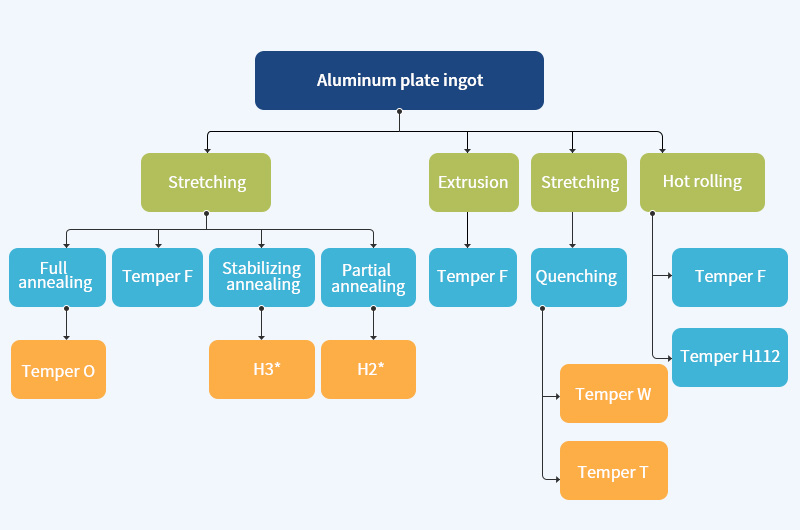
An Important Note: Temper designations represent a "general processing combination, " not specific parameters like temperature, time, or reduction percentage. Final acceptance is typically based on meeting the mechanical property requirements of the relevant standard.
H Temper Explained (Understanding H14, H32, H18, H116)
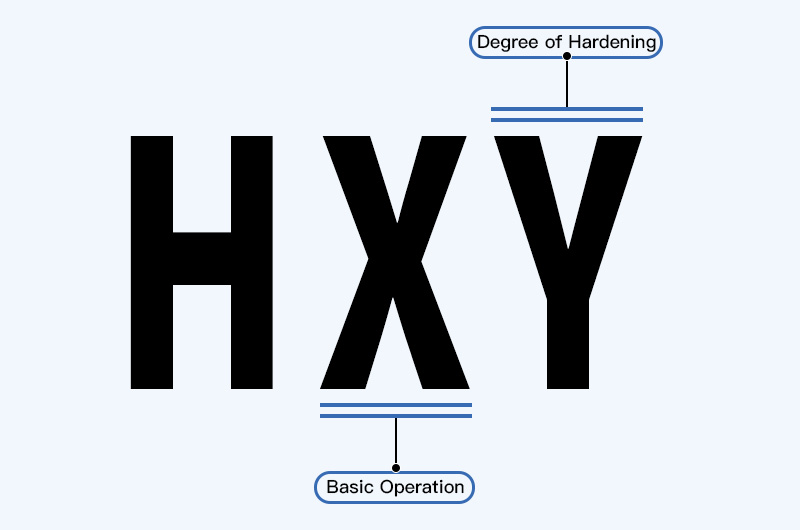
The H temper is usually written as HXY (two digits) or HXXX (three digits).
First Digit (X): Processing Method
- H1 Temper: Strain hardened only.
- H2 Temper: Strain hardened and partially annealed (strength is slightly reduced by partial annealing).
- H3 Temper: Strain hardened and stabilized (a low-temperature thermal treatment or heating during a process stabilizes properties).
- H4 Temper: Strain hardened and then painted or coated, where the baking process causes a slight drop in properties.
Second Digit (Y): Degree of Hardening
| Code | Meaning |
| Hx2 | 1/4 Hard |
| Hx4 | 1/2 Hard |
| Hx6 | 3/4 Hard |
| Hx8 | Full Hard |
| Hx9 | Extra Hard |
Additional Notes:
1, 3, 5, and 7 are used for finer intermediate tempers but are less common in the industry.
The extra-hard H19 is often used for specific applications like thin sheets or can stock that undergo "extreme cold rolling" (e.g., 3004-H19).
Common Meanings of Three-Digit H Tempers
H111 Temper: Annealed and then lightly strain-hardened (less than H11).
H112 Temper: For products hot-worked to shape, with specified mechanical properties.
H116 Temper: Commonly used for 5000 series alloys with higher magnesium content intended for marine or high-humidity environments. This temper has specific requirements for resisting exfoliation corrosion.
Hxx4 Temper: Often used to identify specific products like patterned or embossed sheets.
T Temper Explained (How to Read T5, T6, T651, T73, T76, T62)
The first digit after the T defines the primary processing route. Subsequent numbers or suffixes describe stress relief, special properties, variations in quenching, or who performed the heat treatment.
The Most Common T0-T10 Tempers
| Temper | Meaning | Common Application Keywords |
| T0 | Solution heat-treated + naturally aged + cold worked | Strength adjusted by cold working. |
| T1 | Cooled from an elevated temp shaping process + naturally aged | Some extrusions/hot-worked parts naturally aged. |
| T2 | Cooled from shaping + cold worked + naturally aged | Strength is increased, but less common than T6. |
| T3 | Solution heat-treated + cold worked + naturally aged | Common for 2000 series (e.g., 2024-T3). |
| T4 | Solution heat-treated + naturally aged | Common for 2000 series (e.g., 2024-T4). |
| T5 | Cooled from an elevated temp shaping process + artificially aged | Common for 6000 series extrusions (e.g., 6063-T5). |
| T6 | Solution heat-treated + artificially aged | Common for 6000/7000 series (e.g., 6061-T6, 7075-T6). |
| T7 | Solution heat-treated + overaged (stabilized) | 7000 series, oriented towards SCC/exfoliation resistance. |
| T8 | Solution heat-treated + cold worked + artificially aged | Common for 2000 series (e.g., 2024-T81/T8x). |
| T9 | Solution heat-treated + artificially aged + cold worked | Used for some bars, wires, free-machining stock. |
| T10 | Cooled from shaping + cold worked + artificially aged | Relatively rare in commercial use. |
Key High-Frequency Differences:
- T5 Temper Aluminum: Typically cooled from a forming process (like extrusion) and then artificially aged.
- T6 Temper Aluminum: Explicitly solution heat-treated and then artificially aged (a more standardized and fully strengthened condition).
Residual Stress Relief Suffixes
| Code | Meaning | Common Examples |
| TX51 | Stress-relieved by stretching (thick plates, rolled bars, forgings/rings) | 6061-T651, 7075-T651 |
| TX510 | Stress-relieved by stretching (extruded rods, shapes, tubes), no subsequent straightening | 7075-T6510 |
| TX511 | Stress-relieved by stretching (extruded rods, shapes, tubes), minor straightening permitted | 7075-T6511 |
| TX52 | Stress-relieved by compression (common for forgings) | 2014-T652 |
| TX54 | Stress-relieved by cold work or in the final forging die | 7050-T7454, etc. |
Practical Advice:
- Ordering T6 instead of T651 often leads to "warping complaints" after machining.
- For thick plates, precision-machined parts, or components with deep grooves, prioritize confirming the need for T651, T7351, T7651, etc.
Suffixes Indicating "Who Performed the Heat Treatment": TX2
Common Forms:
- T42: Solution heat-treated and naturally aged, but the heat treatment was performed by a party other than the original producer.
- T62: Solution heat-treated and artificially aged, but the heat treatment was performed by a party other than the original producer.
These designations are often used to clarify responsibility and process control differences, which is very useful for acceptance and claim resolution.
Specialty Tempers for 7000 Series
| Temper | Primary Orientation | Common Alloys & Scenarios |
| T73 | Improves Stress Corrosion Cracking (SCC) resistance, usually at a slight cost to strength. | 7075, 7050, etc., for critical load-bearing parts. |
| T76 | Improves exfoliation corrosion resistance. Strength is typically higher than T73 but lower than T6. | 7050, 7075, etc., for medium-to-thick plates. |
| T74 | An advanced temper system balancing strength, toughness, and corrosion resistance. | Aerospace forgings, critical structural components. |
Understanding Tempers for Cast Aluminum Alloys: F, O, and T are Key
For cast alloys (e.g., 356.0, 319.0, A356.0), the common tempers are:
- F Temper: As-cast (especially common for die castings).
- O Temper: Annealed/stabilized (for dimensional stability and softening).
- T Temper: Heat-treated, with T4, T5, T6, and T7 being common.
Practical Explanations for Cast T-Tempers:
- T4 Temper: Solution heat-treated + naturally aged (many cast alloys will undergo further aging).
- T5 Temper: Cooled from the casting process + artificially aged (improves dimensional stability, machinability, and provides a moderate strength increase).
- T6 Temper: Solution heat-treated + quenched + artificially aged (the common choice for high-strength castings).
- T7 Temper: Overaged (oriented towards stability, toughness, and dimensional control).
The casting industry may also use variations like T51/T52/T53/T571, T61/T62, and T71/T75/T77 to indicate process modifications (e.g., differences in cooling, quenching, or aging practices). When ordering, it's best to specify the "governing standard + performance requirements" to avoid assumptions based on the temper code alone.
Common Alloy and Temper Combinations
| Combination | Common Application Keywords |
| 2024-T4 | Aerospace structural parts, fasteners, mechanical hardware. |
| 3003-H14 | Food/chemical equipment, storage tanks, decorative sheets, pressure vessels, tubing. |
| 5052-H32 | Fuel tanks, oil lines, transportation, appliances, sheet metal parts, rivets. |
| 6061-T6 / T651 | General structural parts, connectors, machined components (T651 is more stable). |
| 6063-T5 | Architectural profiles, railings, furniture, irrigation pipes, transportation extrusions. |
| 7075-T6 / T651 | High-strength structural parts, gears/shafts, aerospace components. |
| 5083-H116 / H321 | Marine applications, ships, cryogenic vessels, corrosion-resistant critical structures. |
How to Choose a Temper: Select Based on Process and Risk Points
Primarily for Forming (Bending/Deep Drawing/Stretching)
-
Priority:
- O (soft)
- Or a softer H temper (balancing strength and formability).
- Common Risks: Cracking during bending, excessive springback, high scrap rates.
Primarily for Strength and Consistency (Load-Bearing Structures)
-
Common Choices (6000/7000 series):
- T5/T6
- Or tempers with stress-relief suffixes like T651/T7351/T7651.
- Common Risks: Neglecting stress relief, leading to machining distortion, assembly difficulties, and unstable flatness.
Primarily for Corrosion Resistance and Service Reliability (Marine/Humid/High-Stress Environments)
- 5000 Series Alloys: Pay attention to corrosion-oriented tempers like H116, H321.
- 7000 Series Alloys: Focus on tempers like T73/T76/T74, which are oriented towards SCC and exfoliation corrosion resistance.
Mandatory Checklist for Ordering and Inspection
At a minimum, you should specify:
- Alloy
- Temper Designation
- Product Form: Sheet, plate, strip, foil, bar, rod, tube, pipe, extrusion, wire, forging, or casting.
- Dimensions and Tolerances
- Governing Standard and Certificate: MTC/COA (add specific inspection items if necessary).
Common Mistakes:
- Specifying the alloy but not the temper (the most common error).
- Using a hardness value as a substitute for a temper designation.
- Ignoring suffixes like T651/T6510/T6511, leading to complaints about machining distortion.
- Arbitrarily combining non-existent or mismatched temper combinations.
FAQ
Q1: Can you reverse-engineer the specific process parameters (temperature, time, reduction) from a Temper Designation?
A: No. A temper designation signifies a "general processing path, " not the complete process details. Tracing the exact parameters requires the manufacturer's process specification or the material standard.
Q2: Why is the W temper rarely delivered as a final product?
A: Because W is an unstable temper. It represents the natural aging phase after solution treatment, and its properties change over time. It is typically an in-process condition.
Q3: Are the "hardness ratios" in H14, H32, etc., precise percentages?
A: No, they are not exact percentages. They are industry-standard codes for strength levels and processing paths. Final acceptance is usually determined by whether the material meets the mechanical property requirements of the relevant standard.
Q4: Why are T5 and T6 so frequently discussed? What's the difference?
A:
- T5: The material is cooled from an elevated temperature from a forming process (like extrusion) and then artificially aged. This is highly efficient and common for extrusions.
- T6: The material undergoes a separate, distinct solution heat treatment and is then artificially aged. This results in more complete strengthening and more standardized properties.
A common engineering example: 6063-T5 is often used for architectural profiles. For applications requiring higher strength or different process standards, 6063-T6 might be used.
Q5: Is the T6 temper for castings exactly the same as for wrought aluminum?
A: The basic logic is the same (solution heat treat + quench + artificial age), but the microstructure, defect characteristics, and processing windows for castings are different. Acceptance criteria and performance expectations should be based on standards for the casting system.
Q6: How can I avoid buying material with the wrong temper?
A: The most effective way is to require a Material Test Certificate (MTC) or Certificate of Analysis (COA) from the supplier. It should clearly state the alloy, temper, product standard, test results, and batch number. When necessary, perform independent checks like hardness testing, conductivity measurement, or tensile testing.
Conclusion
Whether you are dealing with sheet, plate, extrusions, forgings, or castings, the Temper Designation is the common language for cross-departmental communication. It translates "what the material has been through" into a standardized code. By understanding it, you can make better and more consistent choices, balancing strength, formability, corrosion resistance, residual stress, and cost.