


Aluminum Anodizing
Introduction
Why do some aluminum products remain shiny and look brand new for a decade, while others quickly corrode and discolor? The answer lies in the surface treatment process: anodizing.
From skyscraper curtain wall profiles to smartphone casings, from aerospace components to high-end cookware, anodizing silently guards the quality and lifespan of these aluminum products.
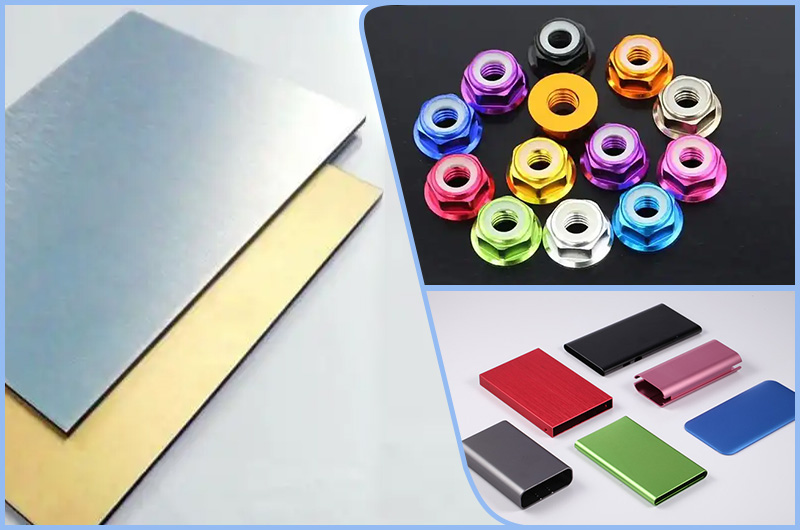
What is Aluminum Anodizing?
Basic Definition
Anodizing is an electrolytic passivation process used to increase the thickness of the natural oxide layer on the surface of metal parts. Through electrochemical means, a dense, durable aluminum oxide (Al₂O₃) protective film is generated on the aluminum surface. The aluminum part being treated acts as the anode (positive electrode) in an electrolytic cell, hence the term "anodizing."
This oxide film grows directly from the aluminum substrate and is fully integrated with the base metal at the molecular level, meaning it will neither peel off nor crack.
The history of the anodizing process dates back to 1923 when it was first used to protect Duralumin seaplane parts (the Bengough-Stuart process). In 1927, Gower and O'Brien patented the sulfuric acid anodizing process, which rapidly became and remains the most mainstream process in use today.
Why Does Aluminum Need Anodizing?
The natural oxide film that forms on aluminum at room temperature is only 2 to 3 nanometers thick. It has high porosity and low mechanical strength, making it difficult to withstand harsh conditions such as seawater, chemical corrosion, and mechanical friction.
Through anodizing, the thickness of the oxide film can be increased to several micrometers or even hundreds of micrometers, enhancing its protective capabilities by hundreds or thousands of times.
It is worth noting that Copper (Cu), Iron (Fe), and Silicon (Si) are the three elements that most significantly reduce the corrosion resistance of aluminum alloys. This is why the 2000, 4000, 6000, and 7000 series aluminum alloys have a more urgent need for anodizing.
The Electrochemical Principles of Anodizing
The aluminum part is immersed in an acidic electrolyte (usually sulfuric acid) and a direct current (DC) is applied. The aluminum part participates in the reaction as the anode, and an aluminum oxide film grows on its surface.
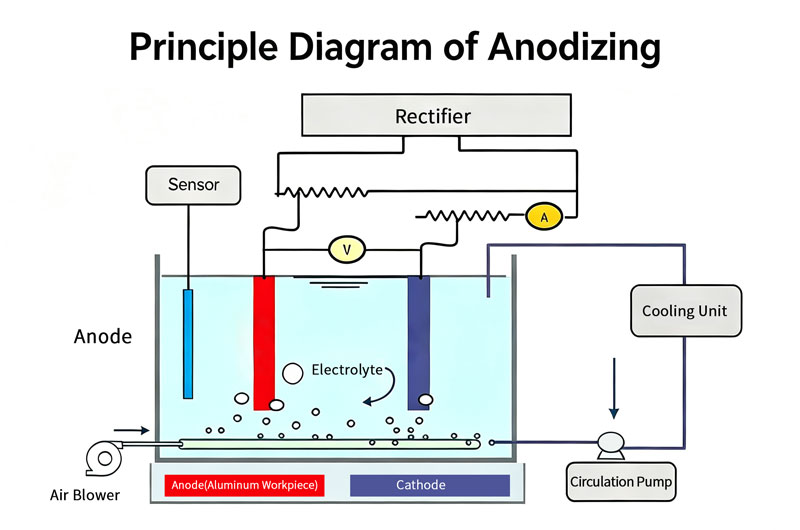
Main Chemical Reactions at the Electrodes:
- Cathode (Reduction Reaction): 2H⁺ + 2e⁻ → H₂↑
- Anode (Oxidation Reaction): 2Al - 6e⁻ → 2Al³⁺; 2Al³⁺ + 3O²⁻ → Al₂O₃
- Complete Overall Reaction: 2Al + 3H₂O → Al₂O₃ + 3H₂↑
Simultaneously, the sulfuric acid electrolyte continuously dissolves the newly formed oxide film: Al₂O₃ + 6H⁺ → 2Al³⁺ + 3H₂O
The formation and dissolution of the oxide film occur simultaneously. The difference between these two rates determines the final thickness and quality of the oxide film. This is the core logic for understanding the control of anodizing process parameters.
Microstructure of the Anodic Film
The anodic oxide film presents a unique two-layer structure (KHR model):
- Barrier Layer: Adjacent to the aluminum substrate. It is thin, dense, and non-porous, with a thickness of about 0.01~0.1 μm. It is the foundation of electrical insulation and corrosion resistance.
- Porous Layer: Composed of regularly packed, hexagonal columnar structures with nanoscale pores in the center. The pore diameter is generally 10~150 nanometers.
In sulfuric acid solution: There are about 800 pores per square micrometer, with a pore diameter of ~0.015 μm and a porosity of ~13.4%.
In oxalic acid solution: There are about 60 pores per square micrometer, with a pore diameter of ~0.025 μm and a porosity of ~8%.
It is exactly these regular nano-micropores that give the anodic film the ability to absorb dyes and achieve rich colors.
Three Stages of Oxide Film Growth
During the anodizing process, the cell voltage changes over time in three typical stages:
- Stage 1 (Stage A — Formation of the non-porous barrier layer): From the first few seconds to tens of seconds of electrification, the voltage rises sharply to a critical maximum value. A continuous, non-porous thin film forms rapidly on the aluminum surface. The barrier layer thickness reaches 0.01~0.1 μm.
- Stage 2 (Stage B — Initiation of the porous layer): The voltage drops by about 10~15% from its peak. The sulfuric acid locally dissolves weak points in the barrier layer to form pores, reducing resistance and allowing the reaction to penetrate deeper.
- Stage 3 (Stage C — Continuous thickening of the porous layer): The voltage stabilizes. The porous layer continues to thicken until the rate of formation equals the rate of dissolution, reaching a dynamic equilibrium where the film thickness no longer increases.
Dimensional Changes in the Oxide Film
The anodic oxide film grows approximately 50% outward and 50% inward (penetrating the aluminum substrate). For example, for a 10μm oxide film, the dimension of the workpiece increases by about 5μm per face. If all six faces are anodized, all linear dimensions will increase by about 10μm.
This is critical for the dimensional control of precision machined parts. Engineers must reserve machining allowances during the design phase, and threaded holes require consideration for tapping corrections after anodizing.
Anodizing Process Flow (Industrial Production Version)
The complete process flow for an industrial aluminum alloy anodizing production line:
Substrate → Racking → Degreasing → Alkaline Etching → Desmutting/Neutralization → Anodizing → Electrolytic Coloring (Optional) → Sealing → Electrophoretic Deposition/ED Coating (Optional) → Curing → Unracking & Packaging → Warehousing
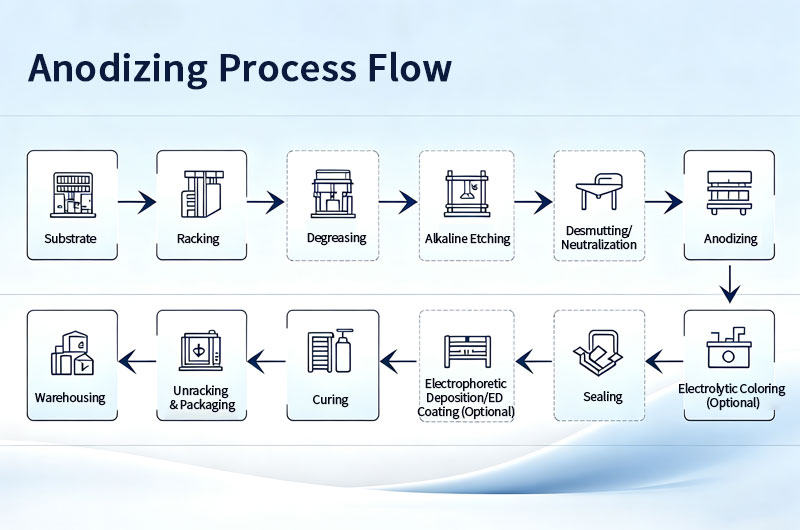
Every step is interconnected, and any negligence can affect the final quality.
Racking
Racking is a crucial step that is easily overlooked.
- Conductive fixtures must ensure excellent electrical contact with the profiles. Poor contact leads to uneven current distribution, resulting in color variations or, in severe cases, burning of the workpiece.
- Profiles must be racked at an angle greater than 5° to facilitate gas exhaustion and prevent air bubbles from leaving spots.
- Clean gloves must be worn — fingerprints and grease are enough to cause local defects in the oxide film.
- Profiles with vastly different cross-sectional sizes or shapes must not be placed on the same rack.
Degreasing
The purpose of degreasing is to remove residual grease, wax, and organic contaminants from the profile surface.
Process parameters: Acidic degreaser, 2~3 minutes. After degreasing, the profile surface should be uniformly wetted without water breaks (water droplets). It can only enter the next process after secondary water rinsing. Incomplete degreasing is one of the most common causes of mottled anodic films.
Alkaline Etching (Alkaline Corrosion)
Uses a sodium hydroxide (NaOH) solution to remove the natural oxide layer, adjust the surface gloss/matte finish, and dissolve minor surface defects.
Flat-matte alkaline etching parameters: NaOH 40–60 g/L, Temperature 45–50°C, Time 1~3 minutes.
After alkaline etching, the parts must be quickly hoisted out, passed through a two-stage overflow water rinse, and moved up and down with a reverse tilt to thoroughly wash away the alkaline solution on the surface and inside the inner holes.
Neutralization / Desmutting
After alkaline etching, alloying elements such as silicon, copper, and manganese in the aluminum alloy tend to form black or gray smut on the surface.
The profiles are immersed in a nitric acid solution (HNO₃ 120 g/L, 5 minutes) to thoroughly remove the smut and simultaneously neutralize residual alkaline solution. Following neutralization, enhanced inspection of surface quality is required, and any defects identified must be reworked promptly.
Anodizing (Electrolysis)
Anodizing is the core of the entire process. Precise control of parameters directly determines the quality of the oxide film.
Standard Process Parameters:
| Parameter | Value |
|---|---|
| Sulfuric Acid Concentration | H₂SO₄ 150±15 g/L |
| Bath Temperature | 20±1°C |
| Anodizing Voltage / Current | 130–150 A/m² |
| Anodizing Time | Calculated based on thickness requirements |
Using the constant current density method requires precise calculation and setting of the current based on the profile's anodizing surface area. Bath temperature must be strictly controlled within ±1°C — higher temperatures result in thin, loose films, while lower temperatures create hard but brittle films. After anodizing, film thickness must be immediately checked with an eddy current thickness gauge; if it fails to meet standards, anodizing time is extended.
Sealing
Sealing is an indispensable step after anodizing (detailed in the Sealing section below).
Electrophoretic Deposition (ED Coating — Optional)
A high-end process primarily used in the architectural aluminum profile industry (detailed in the ED Coating section below).
Curing
Profiles that underwent ED coating must enter a curing oven for high-temperature cross-linking. Curing takes place at 180°C for 45 minutes. After cooling, the paint film's hardness, adhesion, and appearance must be inspected.
Unracking, Packaging, and Quality Inspection
Before unracking, inspections must be conducted for film thickness, sealing quality, paint film hardness, adhesion, color, color variation, and overall appearance. Unracking is only permitted if everything passes. Sealed materials must not be unracked while wet; ED-coated materials must cool to room temperature before unracking. Interleaving paper or protective films must be applied between decorative surfaces, handled with care to prevent scratches.
Main Types of Anodizing
The three types defined by the US Military Specification MIL-A-8625 represent the most widely used international classification standard.
Type I: Chromic Acid Anodizing
The oldest industrial anodizing process (1923, Bengough-Stuart). The electrolyte is chromic acid (CrO₃). The film thickness is only 0.5~18μm. The film has good toughness, excellent ductility, and a certain "self-healing" ability. It dissolves minimal aluminum, making it highly suitable for precision parts, riveted parts, and welded assemblies.
Note: Due to the toxicity and carcinogenicity of Hexavalent Chromium (Cr⁶⁺), EU ROHS regulations have strictly limited its use.
Relevant Standards: MIL-A-8625 Type I / Type IB, Def Stan 03/24
Type II: Sulfuric Acid Anodizing (Standard Decorative Type)
The most widely applied anodizing process globally, remaining unreplaced for nearly a century since its 1927 patent.
The electrolyte is dilute sulfuric acid. Film thickness is 1.8~25μm. It features moderate porosity (~15%), is easy to dye, offers rich colors, is simple to operate, has relatively low costs, and perfectly balances aesthetics and corrosion resistance.
Relevant Standards: MIL-A-8625 Type II / IIB, AMS 2471 (Undyed), AMS 2472 (Dyed)
Type III: Hard Anodizing (Engineering Grade)
Also uses a sulfuric acid electrolyte, but operates at a much lower bath temperature (near freezing), higher voltage, and longer anodizing time.
- Thickness range: 13~300μm
- Hardness: Microhardness on pure aluminum can reach 1500 kg/mm²; on aluminum alloys, it reaches 400~600 kg/mm² (exceeding some tool steels).
- Melting point: Up to 2050°C. When sealed with insulating materials, breakdown voltage can reach 2000V.
- Type III with PTFE: Impregnating the micropores with Polytetrafluoroethylene (PTFE) significantly reduces the friction coefficient, widely used in pistons and sliding guide rails.
Relevant Standards: MIL-A-8625 Type III, AMS 2469, ISO 10074, BS ISO 10074
Organic Acid Anodizing (Type IC / Integral Coloring Type)
Uses organic acids like oxalic acid or sulfosalicylic acid. Under high voltage, high current density, and forced cooling, it generates a colored oxide film directly without external dyes.
Color range: Light yellow → Golden → Dark bronze → Brown → Gray → Black. Film thickness up to 50μm. The color is extremely durable but heavily influenced by alloy composition, making batch-to-batch color consistency difficult to control perfectly. Costs are relatively high.
Phosphoric Acid Anodizing
Generates a thin film with large pores. Primarily used as a surface pretreatment prior to adhesive bonding of aluminum parts, and serves as the foundation for the pore-widening step in the 3-step interference coloring process.
Relevant Standards: ASTM D3933
Borate / Tartrate Anodizing (Barrier Type)
Performed in weak acid solutions like boric acid or ammonium tartrate, generating a dense, non-porous barrier film. Film thickness has a linear relationship with applied voltage. Mainly used for manufacturing dielectric layers in electrolytic capacitors.
Porcelain Anodizing (Enamel-like Anodizing)
Anodized in organic acid solutions to generate a colored film with high density, high hardness, wear resistance, good insulation, and highly decorative enamel-like effects. Often used for instrument panels, electronic component parts, and daily consumer goods.
Technical Parameter Comparison of Anodizing Types
| Type | Electrolyte | Thickness | Corrosion Resistance | Wear Resistance | Dyeability | Eco-Friendliness | Main Applications |
|---|---|---|---|---|---|---|---|
| Type I | Chromic Acid | 0.5~18μm | Good | Poor | Difficult | Restricted (Cr⁶⁺) | Aerospace precision parts |
| Type II | Dilute Sulfuric | 1.8~25μm | Good | Medium | Easy | Good | Decorative/Protection |
| Type III | Low-temp Sulfuric | 13~300μm | Excellent | Excellent | Difficult | Good | Heavy Industry/Military |
| Organic Acid | Oxalic, etc. | Up to 50μm | Good | Good | Integral Color | Good | High-end Architecture |
| Phosphoric | Phosphoric Acid | Thin | Fair | Fair | N/A | Good | Bonding pretreatment |
| Borate | Boric Acid, etc. | Ultra-thin | Good (non-porous) | — | N/A | Good | Electrolytic capacitors |
Key Process Parameters Affecting Oxide Film Quality
Effect of Sulfuric Acid Concentration
Sulfuric acid concentration directly determines the dissolution rate of the oxide film, thereby affecting the thickness, porosity, and coloring performance.
- Higher concentration: Faster dissolution; the film is relatively thin but has high porosity, leading to better dyeing performance.
- Excessive concentration: Aluminum dissolves too quickly, making film formation impossible.
- Low concentration: The oxide film forms quickly but blocks current, failing to reach the required thickness.
Experiments show that as the electrolyte concentration increases from 10% to 30%, film thickness gradually increases, with 30% yielding the best coloring effect. Considering all factors, sulfuric acid concentration is typically maintained at 150~180 g/L (approx. 15%~20%).
Effect of Temperature
Bath temperature is one of the most difficult parameters to control and has the largest impact.
- Higher temperature: Faster film dissolution; film becomes thinner, softer, and highly porous.
- Lower temperature: Film becomes thicker and harder, but porosity decreases and brittleness increases.
Hard anodizing requires bath temperatures to be strictly controlled at -10 ~ +5°C, while standard decorative anodizing is kept at 20±1°C. A deviation of more than ±2°C significantly affects film quality. Industrial production lines must be equipped with precision chilling units.
Effect of Current Density
Current density directly affects the growth rate, hardness, and porosity of the film.
Reasonably increasing current density helps the film grow rapidly, making it harder and more wear-resistant. However, if the current density is too high, the Joule heating effect causes the local temperature of the profile to rise sharply, potentially burning the workpiece.
Experimental data:
- 10 mA/cm²: Maximum film thickness, good insulation, best corrosion resistance.
- 15 mA/cm²: Medium performance.
- 20 mA/cm²: Decreased insulation, worst corrosion resistance.
In industrial production, the current density for colored anodized profiles is usually controlled at 130 A/m².
Effect of Anodizing Time
Extending the anodizing time increases film thickness and the number of pores. Experimental results show that a 30-minute anodizing time yields maximum thickness, while 10, 20, and 30-minute durations all achieve good coloring effects and insulation. However, once dynamic equilibrium is reached, extending the time no longer thickens the film, and excessive time increases film brittleness.
Effect of Additives
- Glycerin: Improves film elasticity. Experiments show that adding 5~15 mL/L of glycerin significantly improves corrosion resistance. The spot test (potassium dichromate) does not turn green for a long time.
- Oxalic Acid: Adding 1 g/L of oxalic acid maximizes film thickness; as concentration increases further, film thickness decreases.
- Chromates & Colloidal Additives: Improve film uniformity. Proper amounts of Ni²⁺ can speed up oxidation and widen the process window.
Effect of Impurities
| Impurity | Allowable Limit | Consequence of Excess |
|---|---|---|
| Copper (Cu²⁺) | <0.02 g/L | Loose oxide film |
| Iron (Fe³⁺) | <0.2 g/L | Dark streaks or spots |
| Aluminum (Al³⁺) | 5~15 g/L (Max 25 g/L) | White spots/patches, difficult to dye |
| Chloride (Cl⁻) | <0.4 g/L (in Oxalic system) | Pitting corrosion |
Suitable Aluminum Alloy Series for Anodizing
1000 Series (Commercial Pure Aluminum, Al≥99%)
High electrical conductivity, excellent corrosion resistance, and good ductility. After anodizing, the film is clear, colorless, uniform, and dense. It is the ideal material for achieving the best anodizing results. Hard anodizing on pure aluminum can reach a microhardness of 1500 kg/mm². Commonly used for electrical components, nameplates, and decorative products.
2000 Series (Aluminum-Copper Alloys)
Contains 2%~7% copper. High strength and good machinability. Because of the high copper content, copper enriches in the alloy matrix during anodizing, accelerating the dissolution of the oxide film. This results in a loose film with poor corrosion resistance. It typically requires special processes like high-concentration sulfuric acid or AC/DC superposition.
3000 Series (Aluminum-Manganese Alloys)
The main alloying element is manganese (1%~1.5%). Good formability, medium strength, excellent corrosion resistance. Anodizing yields good results. Commonly used for heat exchangers, architectural panels, and curtain wall decorative panels.
5000 Series (Aluminum-Magnesium Alloys)
Contains 2%~6% magnesium. High strength-to-weight ratio and outstanding resistance to marine/seawater corrosion. Anodizing yields good results, and sealing further enhances corrosion resistance. Widely used in marine parts, offshore platform components, and architectural window frames.
6000 Series (Aluminum-Magnesium-Silicon Alloys) — Highly Recommended
Main alloying elements are magnesium (0.6%~1.2%) and silicon (0.4%~1.2%). Good extrudability, high strength-to-weight ratio, and excellent corrosion resistance. The 6000 series is universally recognized as the most suitable alloy series for anodizing. It produces uniform, transparent oxide films with bright and highly repeatable coloring effects. 6061 and 6063 are widely used for architectural profiles, automotive body panels, and consumer electronics enclosures.
7000 Series (Aluminum-Zinc Alloys)
Contains 5%~8% zinc, extremely high strength (including the famous 7075 alloy), good fatigue and corrosion resistance. Anodizing results are generally good. It is the preferred material for aerospace structures; NASA satellites and aircraft fuselages use it extensively. Care must be taken with process parameters to prevent high zinc content from affecting film uniformity.
Comparison of Anodizing Effects by Alloy Series
| Series | Main Elements | Anodizing Effect | Recommended Type | Typical Applications |
|---|---|---|---|---|
| 1000 | Pure Al | Excellent | Type I/II/III | Electrical parts, nameplates |
| 2000 | Al-Cu | Poor (Needs special process) | Type II (Special) | Aerospace structural parts |
| 3000 | Al-Mn | Good | Type II | Heat exchangers, architecture |
| 5000 | Al-Mg | Good | Type II/III | Marine, window frames |
| 6000 | Al-Mg-Si | Best (Recommended) | Type I/II/III | Architecture, electronics |
| 7000 | Al-Zn | Good | Type II/III | Aerospace, high-end bicycles |
Detailed Guide to Coloring Types
The nanoporous structure of the anodic film allows aluminum parts to achieve a rich spectrum of colors. Coloring should be done immediately after anodizing, as fresh oxide films have the strongest adsorption activity.
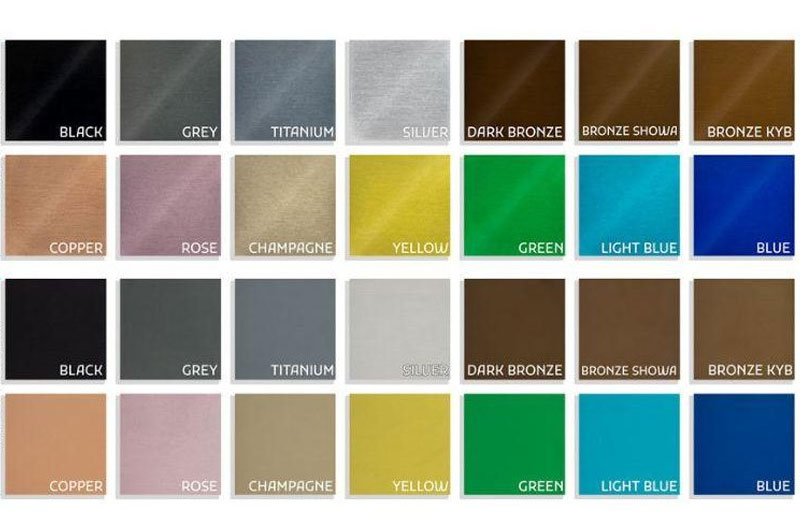
Basic Principles and Precautions for Coloring
- Coloring bath temperature is usually controlled around 40°C. Too high a temperature will cause the micropores to seal prematurely.
- The pH value should be maintained between 4.5~7.0.
- Sealing must be performed immediately after coloring; otherwise, the dye will bleed/leach out.
Inorganic Pigment Coloring
Inorganic pigments are deposited into the micropores through chemical reactions (a physical filling process). Typical applications include gold produced by ammonium ferric oxalate (recognized in the industry as one of the most lightfast colors), yellow from dichromates, and brown from potassium permanganate.
The color tone is less vibrant and the color range is narrow, but its lightfastness and heat resistance are significantly superior to organic dyes, making it ideal for outdoor applications.
Organic Dyeing (Immersion Coloring)
Currently the most common coloring method, covering almost the entire color spectrum.
Coloring Mechanism: Covalent bonds are formed between the aluminum oxide and the sulfonic groups (-SO₃H) on the dye molecules, while hydrogen bonds form with the phenolic groups (-OH). Complexes can also form. This multiple-binding mechanism firmly fixes the dye within the micropores.
Common Colors: Black, blue, red, green, yellow, orange, purple.
Note: Red and blue organic dyes generally have poor lightfastness, so outdoor use should be approached with caution. White cannot be achieved via organic dyeing because the white dye molecules are larger than the diameter of the micropores.
Experimental data: Oxide films prepared in 30% sulfuric acid yield the best dyeing results. Scarlet red dyes uniformly, with no significant change after sealing.
Electrolytic Coloring (Two-Step Coloring)
The most widely used coloring process in the architectural aluminum profile industry, renowned for its outstanding weather resistance and color stability.
Principle: Based on the transparent oxide film formed by sulfuric acid anodizing, the aluminum part is immersed in an electrolyte containing metal salts. AC/DC voltage is applied. Metal ions (Sn²⁺, Ni²⁺, Cu²⁺, etc.) are reduced to metal atoms at the bottom of the porous layer, depositing as colloidal particles. These particles selectively absorb and scatter light waves to reveal colors. The color deepens as the deposition amount increases.
Bronze Series (Tin Salt System) Parameters:
- SnSO₄: 7~30 g/L
- H₂SO₄: 15~20 g/L, pH 1.0
- Voltage: 15~18V
- Time: 20 seconds ~ 15 minutes
Color Range: Champagne → Light Bronze → Bronze → Dark Bronze → Black
Golden Series Parameters:
- Ammonium Sulfate: 35~40 g/L
- CuSO₄: 2~5 g/L, pH 1.0
- Voltage: 12~16V
- Time: 2~6 minutes
Note: Golden yellow cannot be decolorized; coloring time must not be too long.
Nickel Salt System (Bronze): NiSO₄·7H₂O 20~30 g/L, Voltage 14V, Time 10 minutes.
Nickel-Tin Mixed Salt System (One of the optimal formulas): SnSO₄ 16 g/L, NiSO₄ 6 g/L, H₂SO₄ 40 g/L, Stabilizer 3 g/L, Temperature 25°C, Time 3 minutes, Voltage 13V. This system features minimal color variation, strong resistance to impurity interference, fast coloring speed, and easily achieves dark colors.
Nickel-Manganese Mixed Salt System (Economical alternative): NiSO₄ 10 g/L, MnSO₄ 10 g/L, H₃BO₃ 20 g/L, AC Voltage 16V, Temperature 45~55°C, Time 5 minutes. Manganese salts are cheaper than stannous salts, yet yield comparable coloring effects, offering a clear economic advantage.
Core operational points: Profiles must sit still in the bath for 0.5~1 minute after entering before power is applied; the coloring voltage for the same color must be exactly equal; if the bronze color is too light, it can be color-compensated (supplemented); if it is too dark, it can be faded (decolorized). The operation is flexible and adjustable.
Integral Coloring (One-Step Electrolytic Coloring)
Oxidation and coloring are completed simultaneously in specific organic acid electrolytes without a secondary coloring treatment.
Common processes include the oxalic acid method, sulfosalicylic acid method, Kalcolor, and Duranodic. The color range is limited to yellow-to-black series. The wear resistance of the film is superior to standard dyed parts, and the color is incredibly durable. However, batch-to-batch color consistency is hard to control precisely, and costs are relatively high.
Interference Coloring (Three-Step Electrolytic Multi-Coloring Technology)
The most advanced aluminum anodizing coloring technology available today, pioneered in Europe and Japan in the 1980s.
Principle: Relies on thin-film optical interference to produce color (similar to the rainbow colors of an oil slick on water), rather than the particle scattering of standard electrolytic coloring. By adding a phosphoric acid anodizing "pore-widening" step, the pore structure is changed, adjusting the light reflection path to achieve vivid colors like blue, green, yellow, orange, and red-brown.
3-Step Process:
- Sulfuric acid anodizing to form a regular porous structure.
- Phosphoric acid anodizing for pore widening, changing the structure at the bottom of the pores.
- Metal (usually tin) deposition, forming a metal reflective layer of controllable thickness at the pore bottom.
Interference-colored aluminum exhibits an angle-dependent "chameleon" effect (colors change based on the viewing angle), offering immense value in high-end architectural curtain walls, interior decoration, and precision instrument enclosures.
Comprehensive Comparison of Coloring Methods
| Coloring Method | Color Range | UV Resistance | Vibrancy | Repeatability | Cost | Main Applications |
|---|---|---|---|---|---|---|
| Inorganic Pigment | Limited | Excellent | Fair | Medium | Low | Outdoor weatherproof products |
| Organic Dyeing | Extremely Wide | Fair | Vibrant | Medium | Low–Med | Consumer electronics, crafts |
| Electrolytic | Champagne to Black | Excellent | Elegant | High | Medium | Architectural profiles |
| Integral Coloring | Yellow to Black series | Excellent | Elegant | Medium | High | High-end architecture |
| Interference | Blue, Green, Yellow, Red, Rainbow | Excellent | Unique | Medium | High | High-end decoration |
Detailed Guide to Sealing Treatments
Anodizing sealing process is the final and crucial step in the anodizing process, directly determining the ultimate corrosion resistance and color longevity of the product. Unsealed oxide micropores easily absorb corrosive ions (like chlorides and sulfates) and moisture, leading to gradual film erosion. Unsealed dyed parts will suffer from "color bleeding" (leaching), and residual sulfites in the pores can make the film loose.
The quality of the aluminum anodic film largely depends on the quality of the sealing process. Here are the main types of sealing:
Hot Water Sealing (Boiling Water Method)
The most classic and widely used sealing method.
Sealing principle: Anhydrous aluminum oxide (Al₂O₃) undergoes a hydration reaction with water to form aluminum oxide monohydrate (Al₂O₃·H₂O, volume expansion of approximately 33%) or aluminum oxide trihydrate (Al₂O₃·3H₂O, volume expansion of approximately 100%), swelling from within to block and seal the micropores.
Process parameters: Deionized water (the use of tap water is strictly prohibited), temperature 96°C, pH 5.5–6.5, processing time 15~30 minutes.
The hot water method reduces the wear resistance of the film by approximately 20% and cannot completely seal all micropores. For applications requiring high corrosion resistance, it usually needs to be combined with other sealing methods.
Steam Sealing
The principle is identical to hot water sealing, but the sealing effect is better as it penetrates deeper into the micropores.
Parameters: Steam pressure 1 atm, Temp 110°C, Time ~30 minutes. Requires specialized pressure vessels, resulting in higher costs.
Mid-Temperature Sealing
Performed at 70~80°C (180°F) in a solution containing organic additives and metal salts. Highly efficient, but may have a slight impact on the color of lightly dyed parts.
Cold Sealing (Room Temperature Fast Sealing)
Due to its energy efficiency, it has become an increasingly popular choice in modern industrial production.
Parameters: Ni ions 0.8 g/L, F ions 0.6 g/L, pH 5.6, Temp 30°C. Sealing time = Film thickness (μm) × 1.2 minutes.
Uses a nickel acetate/fluoride system. Nickel and fluoride ions hydrolyze in the micropores to form nickel hydroxide precipitates that seal the pores. Care must be taken to prevent "over-sealing blooming" (prolonged sealing causing white powder precipitation on the surface). Cold sealing is not suitable for adhesive bonding applications.
Dichromate Sealing
Suitable for industrial parts requiring extremely high corrosion resistance (e.g., aerospace aluminum).
Chemical Reaction: 2Al₂O₃ + 3K₂Cr₂O₇ + 5H₂O → 2Al(OH)CrO₄↓ + 2Al(OH)Cr₂O₇↓ + 6KOH
Parameters: Potassium dichromate 50 g/L, Temp 95°C, Time 15 minutes, pH 7. Imparts a yellow-green tint. Due to Hexavalent Chromium content, its use is restricted by environmental regulations in regions like the EU.
Hydrolytic Salt Sealing
Aluminum parts are immersed in highly dilute solutions containing nickel and cobalt salts. Upon heating, metal ions undergo hydrolysis within the micropores:
- Ni²⁺ + 2H₂O → Ni(OH)₂ + 2H⁺
- Co²⁺ + 2H₂O → Co(OH)₂ + 2H⁺
The generated hydroxides deposit to seal the pores. This has minimal impact on color and is often used for dyed parts requiring high color fidelity.
Organic Filling/Sealing
Organic materials such as clear lacquer, molten paraffin wax, synthetic resins, and drying oils can be used to fill and seal the micropores. Hard anodic films sealed with insulating materials can reach breakdown voltages of up to 2000V, making them excellent electrical insulators.
Sealing Method Selection Guide
| Sealing Method | Temp | Impact on Wear Resistance | Corrosion Resistance | Energy Efficiency | Suitable Applications |
|---|---|---|---|---|---|
| Hot Water | 96~100°C | Decreases by ~20% | Good | Fair | General purpose |
| Steam | >100°C | Decreases by ~20% | Excellent | Poor | High-end industrial |
| Mid-Temp | 70~80°C | Slight | Good | Medium | General purpose |
| Cold Sealing | Room Temp | Slight | Good | Excellent | Mass industrial production |
| Dichromate | 90~95°C | No significant impact | Outstanding | Poor | Aerospace / High-corrosion parts |
| Organic Sealing | Room Temp ~ 80°C | No significant impact | Varies by material | Medium | Electrical insulation / Special apps |
Electrophoretic Deposition (ED Coating) Process
Electrophoretic coating is a high-end extension process in the aluminum anodizing production line, holding a crucial position in the architectural aluminum profile sector. (In Japan, 90% of aluminum profiles undergo ED coating, proving the maturity and value of this process.)
What is ED Coating?
Under the action of a DC electric field, organic coatings (usually acrylic resins) are uniformly deposited on the surface of the anodized aluminum profiles. After high-temperature curing, a crystal-clear, transparent organic paint film is formed. This film not only enhances decorative aesthetics but also acts as a secondary seal for the oxide film, significantly boosting resistance to water, mud, mortar, and acid rain.
Principles of ED Coating
After anodizing forms a porous honeycomb oxide film (mainly Al₂O₃ and Al₂(SO₄)₃), the aluminum profile is immersed in an ED paint bath. Under DC voltage, current passes through the oxide micropores, electrolyzing water and producing H⁺ at the anode surface. ED coating molecules migrate to the anode and deposit:
- R-COO⁻ + H⁺ → RCOOH↓ (Acrylic deposition)
- 3R-COO⁻ + Al³⁺ → (RCOO)₃Al↓
Once electrodeposition is complete, water is squeezed out of the film to a moisture content of 2%~5%. During baking, the amino resin undergoes a cross-linking reaction, and the paint film hardens.
ED Process Parameters
| Parameter | Value |
|---|---|
| Solid Content | 55% |
| pH | 7.6 |
| Conductivity | 900 μS/cm (25°C) |
| ED Voltage | 90V |
| ED Time | 2 minutes |
Before ED coating, profiles must undergo strict pure water rinsing: 1st wash with pure water (Conductivity <120 μS/cm), 2nd wash with hot pure water (60°C, 5 mins), 3rd wash with cold pure water (Temp <30°C).
Curing Process
Curing temperature is 180°C for 45 minutes, allowing the paint film to fully cross-link and harden into a tough, durable protective coating.
The Environmental Significance of Reverse Osmosis (RO) Recovery
Modern ED production lines integrate RO technology. Driven by high-pressure pumps, RO membranes with a pore size of just 0.0001 micrometers recover the paint solution. This boosts paint recovery rates to nearly 100%, achieving zero-pollution production and drastically reducing manufacturing costs.
Common ED Coating Defects and Solutions
| Defect | Main Cause | Solution |
|---|---|---|
| Orange Peel / Blistering | Bath temp above 25°C (63.7% probability) | Strictly control bath temp, stabilize conductivity and ED voltage |
| Mottling | Improper racking, trapped air bubbles | Steep rack angle entry/exit, rest 1 min before power, gentle swaying |
| Inclusions | Poor pure water quality or unclean ED area | Regularly check/replace pure water baths, keep area clean |
| Cloudy Finish | Al³⁺ > 20 g/L, Current density > 180 A/m² | Adjust anodizing parameters, ensure hot water rinse meets specs |
| Drying Marks (Water marks) | Uneven water film before entering bath | Cool fully after hot wash, transfer rapidly to ED bath |
Hard Anodizing
Hard Coat Anodizing is a specialized process designed for high-performance engineering applications. Both its process requirements and performance outcomes differ significantly from standard anodizing.
Performance Characteristics of Hard Anodizing
- Film Thickness: 13~300μm, far exceeding standard anodizing.
- Hardness: Up to 1500 kg/mm² on pure aluminum, 400~600 kg/mm² on alloys (surpassing some tool steels).
- Heat Resistance: Melting point up to 2050°C (Aluminum oxide is 9 on the Mohs hardness scale, second only to diamond).
- Insulation: Breakdown voltage up to 2000V after sealing.
- Thermal Insulation: Thermal conductivity is only 0.419~1.26 W/(m·K).
- Anti-Friction: Porosity within the film can absorb lubricants, vastly extending the lifespan of mating parts.
Process Requirements for Hard Anodizing
- Edge Radiusing: All sharp edges must be radiused (rounded). The radius should not be less than 0.5mm to prevent "burning" at the edges caused by concentrated current density.
- Dimensional Allowance: The dimensional increase is roughly half the thickness of the oxide film. Sufficient allowance must be reserved before machining.
- Surface Finish: Rougher surfaces tend to smooth out after hard anodizing, while originally highly polished surfaces will see a drop in finish quality by 1~2 grades.
- Specialized Fixtures: Contact points are usually made of aluminum or aluminum-magnesium alloys; non-contact areas must be insulated.
- Localized Protection: Areas not to be anodized must be masked using insulating adhesives (nitrocellulose lacquer or perchloroethylene glue).
Main Methods of Hard Anodizing
- Sulfuric Acid DC Method (Most widely used): Sulfuric acid concentration 200 g/L, Voltage up to 90V. The current is gradually stepped up 2~8 times to reach 2.5 A/dm², then held constant.
- Oxalic Acid AC/DC Superposition: Suitable for aluminum alloys with high copper content (e.g., CY12), overcoming the tendency of the pure sulfuric method to burn these alloys.
- Room-Temperature Mixed Acid Hard Anodizing: Uses a mixed system of sulfuric acid + sulfonated anthracene + lactic acid + boric acid (or citric acid). At room temp (18°C), with a current density of 20 A/dm² for 80 mins, it can yield a 500HV hardness and ~50μm film. Highly suitable for alloys with under 5% copper and for anodizing deep blind holes.
The Core Contradiction: Heat Generation and Cooling
The core challenge of hard anodizing is the massive amount of Joule heat generated by high voltage and current, compounded by the exothermic oxidation reaction itself (2Al + 3O → Al₂O₃ + 375, 800 cal/mol). If heat isn't dissipated instantly, the electrolyte temperature around the profile spikes, accelerating film dissolution and causing "thermal breakdown."
Solution: The system must be equipped with both powerful forced cooling chillers and vigorous agitation/stirring systems.
Common Hard Anodizing Troubleshooting
| Fault | Main Cause | Solution |
|---|---|---|
| Insufficient Thickness | Short time, low current, incorrect area calculation | Extend time, increase current density, recalculate area |
| Insufficient Hardness | Bath temp too high, current too high, film too thick | Lower temp, lower current density, shorten anodizing time |
| Film Breakdown / Burning | Cu too high, poor cooling, poor contact | Change alloy, boost agitation/cooling, improve racking contact |
| Powdery Film | Oxidation rate vastly exceeds dissolution rate | Slightly raise bath temp or lower current density |
Main Applications of Hard Anodizing
Primarily used for engineering parts with stringent wear, heat, and insulation requirements: cylinder walls, pistons, bearings, aircraft cargo floors, rollers and guides, water turbine impellers, gears, and buffer pads.
Hard anodizing is also an excellent alternative to traditional hard chrome plating: it costs less, the film bond is stronger, waste treatment is simpler, and it completely eliminates highly toxic hexavalent chromium, offering massive environmental advantages.
New Technological Advancements in Anodizing
- Micro-Arc Oxidation (PEO/MAO): Applies high voltage and current to reach a discharge threshold, creating micro-arcs (plasma). The combination of thermal energy and electrochemistry generates a dense, ceramic-like oxide film. Its hardness and wear resistance far exceed standard films, and composition/color can be tuned via the solution.
- Composite Anodizing: Co-depositing micro-powders suspended in the electrolyte. Additives include magnetic powders (Fe₃O₄), super-hard powders (SiC/Si₃N₄), and conductive powders (graphite). Adding super-hard powders can double the hardness and corrosion resistance while ensuring rapid film formation.
- High-Efficiency Anodizing (HEA): Increases standard film formation speed (1μm/3 mins) to 1μm/minute, boosting production efficiency by over 300%. This technology integrates computer-controlled power supplies, proprietary additives, powerful agitation, and high-efficiency cooling.
- Reversing Current Method (Pulse Anodizing): Uses polarity-switching pulse power supplies to control color through waveforms. Advantages: Operates at room temperature and lower voltages, breaking the limitation that hard anodic films are difficult to dye. Achieves both high hardness and excellent dyeability.
- Secondary Oxidation (Impregnation): After initial film formation, the part is subjected to secondary electrolysis or impregnation in special solutions to precipitate functional substances into the film. For example, precipitating PTFE (Teflon) particles drastically improves the film's self-lubricating properties.
Performance Advantages of Anodic Oxide Films
- Outstanding Corrosion Resistance: Al₂O₃ is chemically stable. Once sealed, it effectively resists moisture, salts, and most chemical media. (As an amphoteric oxide, however, it will dissolve in strong acids or strong bases).
- Exceptional Wear Resistance: Film hardness ranges from 196 to 1470HV. The porous structure efficiently absorbs lubricants to provide self-lubrication, offering wear resistance far superior to smooth bare metal surfaces.
- Perfect Base Metal Integration (No Peeling): The film grows from within the substrate. There is no bonding interface. It will not age, peel, or delaminate. Even if thermal stress >80°C causes micro-cracking, the film will never flake off.
- Excellent Electrical Insulation: Thermal conductivity is only 0.419~1.26 W/(m·K). Insulation stability holds up to 1500°C. After sealing, breakdown voltage reaches up to 2000V. Ideal for capacitor dielectrics and electrical insulation.
- Great Thermal Dissipation: The microporous structure exponentially increases the microscopic surface area, significantly enhancing thermal convection and dissipation (widely used in consumer electronic heat sinks).
- Eco-Friendly & Sustainable: The process contains no heavy metals, halogens, or VOCs. By-products are non-toxic and recyclable. Anodized aluminum products are 100% recyclable, perfectly aligning with green manufacturing concepts.
- Easy to Clean & Maintain: After sealing, the surface presents high chemical inertness. It resists dirt and does not react with standard cleaners, vastly reducing maintenance costs for large outdoor applications (like curtain walls).
Comparing Anodizing with Other Surface Finishes
Anodizing vs. Powder Coating
| Comparison Dimension | Anodizing | Powder Coating |
|---|---|---|
| Bonding Mechanism | Grown from substrate (no interface) | Adhered to surface (has interface) |
| Film Thickness | Very thin (1~25μm) | Thick (60~120μm) |
| Peeling Risk | Extremely low (will not peel) | Present (can peel/flake as it ages) |
| Wear Resistance | High (Especially Type III) | Medium |
| Color Selection | Limited (mostly metallic tones) | Extremely broad (Full RAL/Pantone) |
| White Color | Cannot be achieved | Easily achieved |
| Dimensional Impact | Minimal | Significant (Adds 60~120μm) |
| Metallic Texture | Preserves original metal look | Covers/hides metal texture |
| Eco-Friendliness | Superior | Good |
Recommendation: Choose anodizing for preserving metallic aesthetics, precision dimensions, and high wear resistance. Choose powder coating if you need rich non-metallic colors (especially white) or lower costs.
Anodizing vs. Electroplating
Anodizing grows from within the substrate, leaving no interface weaknesses, hence no peeling. Electroplating is the deposition of dissimilar metals; a bonding interface exists. In corrosive environments, under-film corrosion can cause large areas of plating to flake off.
Environmentally, anodizing contains no heavy metals (excluding chromic acid type), making waste treatment simpler. Electroplating (especially chrome plating) yields highly toxic heavy metal waste, with exorbitant treatment costs. Anodizing holds a clear advantage in cost and environmental compliance.
Anodizing vs. Chemical Conversion Coating (Chromate/Alodine)
The greatest advantage of chromate conversion coating is its high electrical conductivity, ideal for applications requiring grounding. However, its wear resistance is far inferior to anodizing, and it contains highly toxic hexavalent chromium (currently being phased out by environmental laws).
In engineering, a "Dual-Finishing" approach is sometimes used: the entire part undergoes chemical conversion for conductivity, and specific areas requiring wear protection are subsequently masked and anodized, leveraging the strengths of both processes.
Anodizing vs. Paint
Anodized aluminum is robust, corrosion-resistant, and maintenance-free, perfectly suited for the outdoors and harsh environments. Painted aluminum offers broader color options and lower initial costs, better suited for applications heavily prioritizing aesthetic variety over extreme durability.
Industrial Quality Control
Common Appearance Defects and Cause Analysis
| Defect | Main Cause | Solution |
|---|---|---|
| Spots / Trapped Bubbles | Insufficient racking angle, bubbles trapped | Ensure angle >5°, allow resting time to degas before power |
| Pitting / Corrosion | Uneven pretreatment or high Cl⁻ (>0.4 g/L in oxalic) | Strengthen pretreatment, regularly test impurity levels |
| White Patches | Al³⁺ concentration > 25 g/L, conductivity drops | Decant electrolyte, maintain Al³⁺ at 5~15 g/L |
| Color Variation | Inconsistent coloring voltage, bath fluctuations | Strictly maintain identical voltage per batch, enforce batch management |
| Streaks / Run marks | Incomplete rinse after etching, residual alkali | Rinse immediately and thoroughly, tilt to drain fully |
| Powdery Surface | Over-sealing (time too long) or high bath temp | Strictly limit sealing time to (thickness × 1.2) minutes |
| Burning / Arc Marks | Poor rack contact, localized current spike | Regularly sand/clean contact points, replace bent conductive splines |
Quality Testing Methods for Anodized Films
- Visual Inspection: Check color uniformity, gloss, and defects under natural light or standard light sources.
- Thickness Testing: Non-destructive testing via eddy current gauges; precision measurement via the strip-and-weigh method (dissolving film in phosphoric + chromic acid).
- Formula: δ(μm) = (m₁-m₂)/(ρ×A) (δ=thickness, m₁=initial mass, m₂=mass after stripping, ρ=density ~2.7 g/cm³, A=surface area).
- Corrosion Resistance (Spot Test): Place a drop of dichromate-hydrochloric acid solution on the surface and time how long it takes to turn from orange to green. The longer, the better. Standard Type II (20 mins) takes ~23 mins. With glycerin additives, it remains orange indefinitely.
- Insulation Testing: Measure resistance across two points with a multimeter. A well-sealed film should register infinite resistance (Megohm range).
- Hardness Testing: Measure cross-sections with a microhardness tester. Hard anodizing should not fall below 300 HV.
Daily Maintenance of Electrolyte Baths
- Sulfuric acid conc: Maintain at 150±15 g/L. Add fresh acid when exceeding limits.
- Bath Temp: Confirm 20±1°C before every run. Ensure chillers operate normally.
- Impurities: Cu²⁺ <0.02 g/L, Fe³⁺ <0.2 g/L. Strictly monitor chlorides. Dilute or replace if exceeded.
- Rinse Tanks: Regularly test pH and conductivity. Replace or use overflow replenishment as needed.
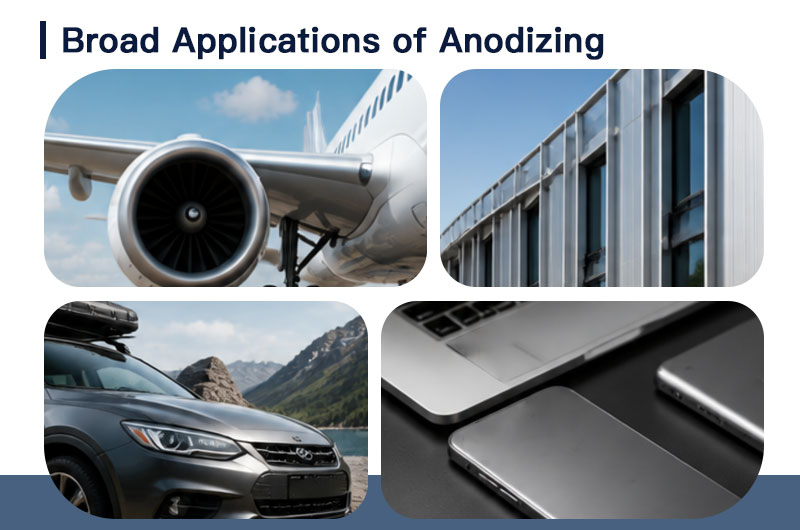
Broad Applications of Anodizing
- Aerospace: Corrosion protection for 7075/2024 alloys (NASA satellites, Boeing structural parts).
- Architecture: Electrolytic colored windows, doors, and curtain walls (e.g., Willis Tower).
- Consumer Electronics: Precision dimensional control (0.001 inches) for Apple device enclosures.
- Automotive / Outdoor: Hard-anodized pistons, wheels, high-end bicycle frames.
- Medical / Home Appliances: Biocompatible instrument casings, scratch-resistant cookware.
- Electronic Components: <0.5μm barrier films for electrolytic capacitors.
How to Choose the Right Anodizing Solution?
- Step 1: Define the Use Environment
-
- Purely indoor decorative → Type II Sulfuric Anodizing
- Outdoor long-term exposure / High-salt marine → Thicker Type II/III + High-quality sealing
- High-wear industrial settings → Type III Hard Anodizing
- Requires electrical insulation → Type III + Organic sealing
- Step 2: Determine Appearance Requirements
-
- Vibrant, rich colors (electronics, crafts) → Type II + Organic dye immersion
- UV-resistant colors (architecture) → Type II + Electrolytic coloring (Bronze/Black series)
- High-end visual effects → Interference coloring (3-step chameleon tech)
- Natural look → Clear anodizing or Integral coloring
- Step 3: Consider the Aluminum Alloy
-
- 6000 Series is the best choice with excellent comprehensive performance.
- 5000 Series is ideal for marine-grade applications.
- 2000 Series requires special process considerations due to copper content.
- Always inform your supplier of the specific alloy grade before ordering.
- Step 4: Focus on Precision Dimensions
-
- For precision mating parts, confirm the film thickness in advance and leave machining allowances.
- Threaded holes may require tapping adjustments post-anodizing.
- Ultra-high precision areas can bypass anodizing via masking treatments.
- Step 5: Understand Environmental Compliance
-
- EU ROHS compliance mandates avoiding Chromic Acid Anodizing (Type I, contains Hexavalent Chromium).
- Pay attention to EU regulations regarding dichromate sealants.
When communicating with Worthwill, please prepare: Specific alloy grade (e.g., 6063-T5), product application, desired thickness range, color, precision tolerances, batch size/lead time, and applicable industry standards (e.g., MIL-A-8625, ISO).
FAQ (Frequently Asked Questions)
- Q: Can aluminum be welded after anodizing?
- It can be, but the extreme heat will destroy the oxide film at the weld joint (Aluminum oxide melts at 2050°C, far higher than pure aluminum's 658°C, which interferes with the welding process). It is highly recommended to weld first, then anodize.
- Q: Will an anodized finish fade?
- It depends on the coloring method. Organic dyes (especially red and blue) are prone to fading under long-term UV exposure and are best for indoor use. Electrolytic coloring and integral coloring offer extraordinary UV resistance, will virtually never fade, and are perfect for outdoor use.
- Q: Can you anodize aluminum white?
- No, this cannot be directly achieved. White dye molecules are physically larger than the micropores of the oxide film and cannot penetrate them. If you need a white finish, consider powder coating or applying a white wet paint over the anodized layer.
- Q: Can you anodize a part twice?
- Generally, no. Aluminum oxide is an electrical insulator, so the part can no longer act as an anode. To re-anodize, the old film must be completely stripped chemically or mechanically first, which will alter the final dimensions and increase labor costs.
- Q: How do I choose between Hard Anodizing and Standard Anodizing?
- For decoration and general corrosion protection, choose standard Type II. For severe mechanical wear, high temperatures, or electrical insulation, choose Type III Hard Anodizing. Note that hard anodizing impacts dimensions more, darkens the natural metal color, and does not yield colors as vibrant as standard anodizing.
- Q: Which is more corrosion-resistant: Anodizing or Electroplating?
- For aluminum parts, anodizing is usually the superior choice. The film grows from within the substrate, eliminating interface weaknesses and preventing peeling over time. Additionally, electroplating (especially chrome) carries massive environmental treatment costs, whereas anodizing is far more eco-friendly.
- Q: Are all aluminum alloys suitable for anodizing?
- Most can be anodized, but results vary wildly. 5000 and 6000 series (especially 6061, 6063) are the absolute best. High-copper 2000 series require special processes. High-silicon cast alloys are very difficult to dye brightly. Always verify with your service provider beforehand.
- Q: Is sealing always necessary after anodizing?
- For parts requiring corrosion resistance or colored finishes, sealing is mandatory. Sealing is only skipped in highly specific engineering applications where the open micropores are needed to continuously absorb lubricating oils.
Conclusion
Aluminum anodizing is a brilliant paradigm of human ingenuity, utilizing electrochemistry to elevate a common metal into a high-performance engineering material. Since its first industrial application in 1923, a century of technological accumulation has transformed anodizing from a simple anti-corrosion process into a comprehensive surface treatment system integrating wear resistance, electrical insulation, decorative coloring, and functional modification.
From shielding space satellites against cosmic radiation to keeping the smartphone in your hand looking flawless; from the structural profiles of towering skyscrapers to the durable aluminum pots in your kitchen — anodizing silently and reliably guards the quality of the products we rely on.
If you have any further questions regarding the aluminum anodizing process or wish to explore the best surface treatment solutions for your specific products, please contact Henan Worthwill Industry Co., Ltd. Our technical team is always ready to provide you with professional support and answers.