


1050 vs. 1100 Aluminum
Why is it necessary to distinguish between 1050 and 1100?
Both 1050 and 1100 belong to the 1000 series of aluminum alloys. They are both commercially pure aluminum, look similar in appearance, and are priced similarly. Many suppliers even mix them up in certain applications.
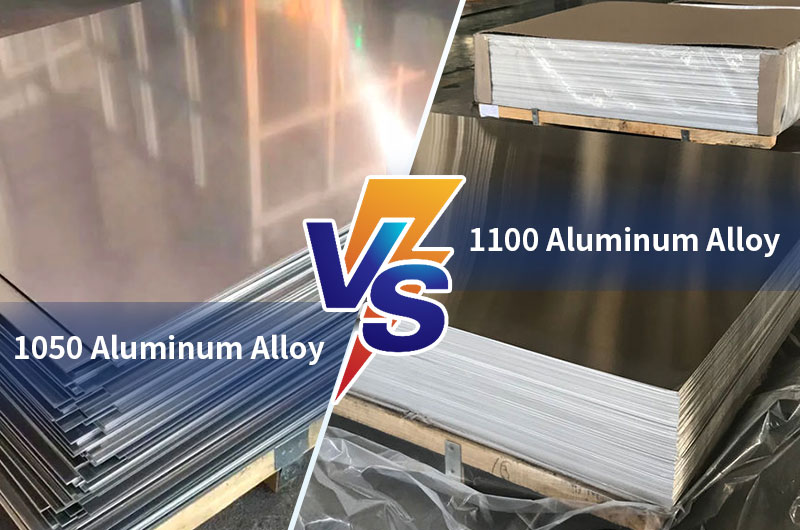
Because of this, many procurement professionals and engineers feel confused when selecting materials: What exactly is the difference between these two materials? Which one is better suited for my project?
1050 vs. 1100 Aluminum:Quick Comparison Table
| Comparison Item | 1050 Aluminum Alloy | 1100 Aluminum Alloy |
| Aluminum Content | ≥99.5% | ≥99.0% |
| Main Alloying Elements | Fe, Si, V | Cu, Fe, Si |
| Copper (Cu) Content | ≤0.05% | 0.05~0.20% |
| Density | 2.71 g/cm³ | 2.71 g/cm³ |
| Thermal Conductivity | 222~230 W/m·K | 218~222 W/m·K |
| Electrical Conductivity | 61% IACS | 59% IACS |
| Max Operating Temp | 170°C | 180°C |
| Machinability | Poor | Fair / Good |
| Weldability | Excellent | Excellent |
| Corrosion Resistance | Excellent | Excellent |
1050 vs. 1100 Aluminum: Material Overview
Both 1050 and 1100 belong to the 1000 series of aluminum alloys. They are commercially pure aluminum and are non-heat treatable, meaning they can only be strengthened through cold working (strain hardening).
The most fundamental difference between the two lies in their aluminum content: 1050 has an aluminum content of no less than 99.5%, offering higher purity; 1100 has an aluminum content of no less than 99.0%, but due to the addition of trace amounts of copper (0.05~0.20%), it boasts the highest strength among the 1000 series alloys.
1100 has a longer history, having been in use since 1888, and is the only alloy in the 1000 series commonly used for rivets. 1050, on the other hand, is known for its higher purity and is highly favored in the electrical and thermal management fields. Both received their Aluminum Association (AA) standard designations in 1954 and are widely circulated in the global market.
| Item | 1050 | 1100 |
| Aluminum Content | ≥99.5% | ≥99.0% |
| UNS Designation | A91050 | A91100 |
| EN Standard | EN AW-1050A | EN AW-1100 |
| ISO Standard | Al99.5 | Al99.0Cu |
| Old Chinese Name | L3 | L5-1 |
| Standardized Year | 1954 | 1954 (Used since 1888) |
1050 vs. 1100 Aluminum: Chemical Composition Comparison
The fundamental difference between the two stems from their chemical composition, specifically the Copper (Cu) content.
The copper content in 1050 is extremely low, not exceeding 0.05%, whereas 1100 contains 0.05% to 0.20% copper. This is the primary reason why 1100 has higher strength.
Furthermore, 1100 has a combined limit for Silicon (Si) and Iron (Fe) set at Si+Fe ≤ 0.95%, providing a wider allowable range. In contrast, 1050 sets individual limits for both, resulting in stricter overall impurity control.
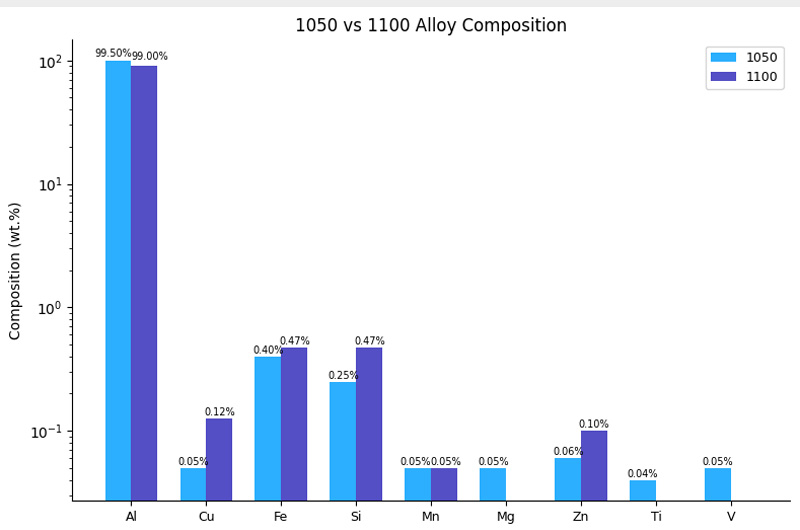
It is also worth noting that 1050 contains trace amounts of Vanadium (V, ≤0.05%), which helps refine the grain structure and raise the recrystallization temperature—an element not present in 1100.
| Element | 1050 | 1100 |
| Al | ≥99.5% | ≥99.0% |
| Cu | ≤0.05% | 0.05~0.20% |
| Fe | ≤0.40% | Si+Fe ≤ 0.95% |
| Si | ≤0.25% | Si+Fe ≤ 0.95% |
| Mn | ≤0.05% | ≤0.05% |
| Mg | ≤0.05% | — |
| Zn | ≤0.05~0.07% | ≤0.10% |
| Ti | ≤0.03~0.05% | — |
| V | ≤0.05% | — |
1050 vs. 1100 Aluminum: Mechanical Properties Comparison
Annealed State (O Temper) Comparison
The annealed state is the softest and most ductile state for both materials, making it suitable for complex forming processes like deep drawing and spinning.
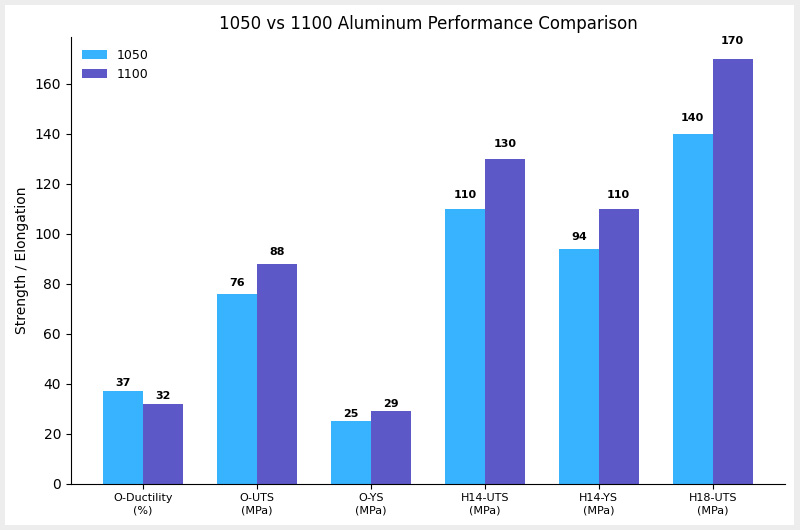
In the O temper, 1050 has an elongation of up to 37%, outperforming 1100's 32%, indicating that 1050 is slightly superior in pure ductility.
However, the tensile strength (88 MPa) and yield strength (29 MPa) of 1100-O are higher than those of 1050-O (76 MPa / 25 MPa), showing a distinct strength advantage.
H14 Temper Comparison (Most Common State)
H14 is the most common supply state for both materials, balancing strength and formability.
In the H14 temper, the tensile strength of 1100 is 130 MPa, while 1050 is 110 MPa, making 1100 about 18% stronger.
Regarding yield strength, 1100-H14 reaches 110 MPa, compared to 94 MPa for 1050-H14, again giving 1100 a clear advantage.
H18 Temper Comparison (Highest Strength State)
H18 is the highest strength state achieved through cold strain hardening, and the gap between the two is most obvious here.
The tensile strength of 1100-H18 reaches up to 170 MPa, while 1050-H18 is 140 MPa—a difference of 30 MPa.
This means that in applications requiring higher strength, such as rivet manufacturing, 1100 holds a significant edge.
Summary of Mechanical Properties by Temper
| Temper | 1050 Tensile Strength | 1100 Tensile Strength | 1050 Elongation | 1100 Elongation |
| O | 76 MPa | 88 MPa | 37% | 32% |
| H12 | 96 MPa | 110 MPa | 10% | 11% |
| H14 | 110 MPa | 130 MPa | 8.4% | 8.2% |
| H16 | 130 MPa | 150 MPa | 6.3% | 6.0% |
| H18 | 140 MPa | 170 MPa | 4.6% | 5.5% |
| H22 | 96 MPa | 110 MPa | 10% | 6.8% |
| H24 | 110 MPa | 130 MPa | 6.8% | 3.9% |
Conclusion:In all tempers, the strength of 1100 is higher than that of 1050, but 1050 has higher elongation in the O temper.
1050 vs. 1100 Aluminum: Physical Properties Comparison
Thermal Conductivity
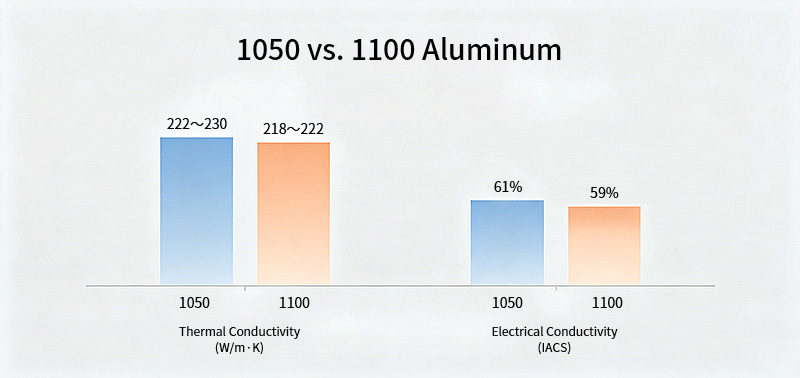
The thermal conductivity of 1050 is 222~230 W/m·K, whereas 1100 is 218~222 W/m·K.
Although the gap is not massive, 1050 holds a clear advantage in applications requiring extremely high heat transfer efficiency, such as heat exchangers and heat sinks.
This is why heat exchanger fins and electrical cooling components predominantly use 1050 rather than 1100.
Electrical Conductivity
The electrical conductivity of 1050 is approximately 61% IACS, while 1100 is about 59% IACS.
With a difference of about 2 percentage points, 1050 is more advantageous in electrical applications such as wires, cables, and aluminum busbars.
Because 1100 has a higher copper content, the copper atoms slightly disrupt the aluminum crystal lattice structure, thereby reducing electrical conductivity. This is determined by the physical nature of the material.
Other Physical Properties Comparison
| Physical Property | 1050 | 1100 |
| Density | 2.71 g/cm³ | 2.71 g/cm³ |
| Melting Point (Solidus) | 646°C | 640°C |
| Melting Point (Liquidus) | 657°C | 660°C |
| Thermal Expansion Coeff. | 24 μm/m·K | 24 μm/m·K |
| Elastic Modulus | 68~71 GPa | 69~80 GPa |
| Poisson's Ratio | 0.33 | 0.33 |
| Max Operating Temp | 170°C | 180°C |
1050 vs. 1100 Aluminum: Processing Capabilities Comparison
Formability
The cold working properties of both are "Excellent." They can undergo various forming processes such as stamping, bending, deep drawing, and spinning.
1050 has an elongation of up to 37% in the O temper, making it slightly more adaptable to complex shapes. Because 1100 contains copper, it work-hardens slightly faster, so more attention must be paid to intermediate annealing processes during deep drawing.
Overall, their formability is comparable, and the difference has a limited impact on most conventional applications.
Machinability
This is where one of the most obvious differences in processing performance lies.
The machinability rating of 1100 is about 30% (H14 temper), which is superior to 1050's 10% (O temper). 1100 is more suitable for precision machining applications that require drilling, turning, and milling.
Since both are pure aluminum, they are soft and gummy, tending to stick to cutting tools. It is recommended to use sharp carbide tools and apply lubricating oil during heavy machining.
Weldability
The welding performance of both is "Excellent, " supporting MIG, TIG, gas welding, resistance welding, and brazing.
When welding 1050, it is recommended to use 1100 filler wire; when welding to 5083/5086 or 7xxx series alloys, 5356 filler wire is recommended; for welding with other alloys, 4043 wire can be used.
For welding 1100, AL 1100 consumable electrodes and filler wires are also recommended, and the weld seam strength can reach approximately 65 MPa.
Anodizing
Both support anodizing to further enhance corrosion resistance and achieve an aesthetically pleasing surface finish.
Because of its higher purity, 1050 produces a more uniform surface and better gloss after anodizing, making it more suitable for decorative applications.
The anodizing effect on 1100 is also good, but due to its slightly higher copper content, the color of the oxide film may have slight variations.
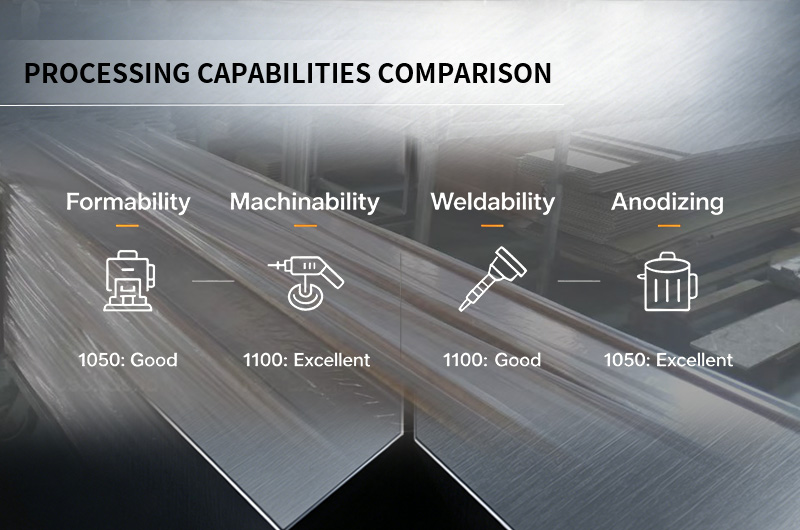
Summary of Processing Capabilities
| Processing Property | 1050 | 1100 |
| Cold Working | Excellent | Excellent |
| Hot Working | Excellent | Excellent |
| Machinability | Poor | Fair / Good |
| Weldability (Gas) | Excellent | Excellent |
| Weldability (Arc) | Excellent | Excellent |
| Weldability (Resistance) | Excellent | Excellent |
| Brazability | Excellent | Excellent |
| Solderability | Excellent | Excellent |
| Anodizing | Excellent | Good |
1050 vs. 1100 Aluminum: Corrosion Resistance Comparison
The corrosion resistance of both 1050 and 1100 falls into the best category among aluminum alloys. Both can be used long-term in atmospheric, industrial, and marine environments without the need for additional protection.
The principle of corrosion resistance for aluminum alloys is the same: aluminum rapidly forms a dense Al₂O₃oxide film on its surface when exposed to air, which effectively prevents further corrosion and possesses self-healing capabilities.
Theoretically, because 1050 has a higher aluminum purity (99.5% vs 99.0%), its corrosion potential (-750 mV) is slightly lower than that of 1100 (-740 mV), meaning it might perform slightly better in highly corrosive media.
However, in the vast majority of practical applications, the difference in corrosion resistance between the two is negligible and does not need to be a deciding factor when selecting materials.
1050 vs. 1100 Aluminum: Applications Comparison
Primary Applications for 1050
Due to its higher purity and superior thermal/electrical conductivity, 1050 holds an advantage in the following fields:
- Electrical Industry:Cable sheathing, conductive busbars, transformer windings strip, electrolytic capacitor foil (its 61% IACS conductivity is its core competitiveness).
- Thermal Management:Heat sinks, heat exchanger fins, air conditioner condenser and evaporator fins (the 222~230 W/m·K thermal conductivity is a key advantage).
- Chemical and Food:Storage tanks, hoses, food containers, brewing industry piping (high purity ensures it is non-toxic and non-contaminating).
- Other Applications:Architectural decorative materials, lighting reflectors, pyrotechnic powder, aluminum foil (food packaging, PCB drilling backup boards).
Primary Applications for 1100
Due to its higher strength and better machinability, 1100 holds an advantage in the following fields:
- Forming and Fabrication:Rivets (the only alloy in the 1000 series commonly used for rivets), deep drawn utensils, spun hollowware, stamped parts.
- Cookware and Daily Commodities:Pots, cooking utensils, tableware, clock dials, gift/decorative hardware (excellent formability and non-toxic).
- Architecture and Decoration:Nameplates, signage, curtain wall decorative panels, architectural flashings (good corrosion resistance and appearance).
- Industrial Equipment:Food industry installations, chemical storage containers, pressure tanks, heat exchanger components (where slightly higher strength than 1050 is required).
Shared Applications
Both can be used in the following fields, and the choice depends on specific performance priorities:
Heat exchangers (1050 has better thermal conductivity), chemical equipment (both excellent), food containers (both non-toxic), architectural decoration (1050 has better anodizing effects), and lighting reflectors (1050 has higher reflectivity).
1050 vs. 1100 Aluminum: How to Choose
Choose 1050 when:
- You have high requirements for electrical or thermal conductivity (wires, radiators, heat exchangers).
- You need the highest purity to avoid copper contamination (high-purity chemical containers, food contact surfaces).
- You require deep anodizing or a highly reflective decorative finish.
- You have extreme demands for ductility, requiring complex spinning or deep drawing.
Choose 1100 when:
- You need higher strength, such as for rivets, structural parts, or load-bearing components.
- You require good machinability, such as precision turning or drilling.
- You need high formability coupled with a certain level of strength, such as for cookware and deep-drawn utensils.
- The application has no strict limits on copper content.
When both are acceptable, how to decide?
If your application has no strict requirements for strength, thermal conductivity, or purity, price is usually the deciding factor.
Because 1050 has a simpler composition and stricter impurity control, its production cost and market price are similar to 1100, though in some markets, 1050 might be slightly cheaper.
Note: In the Chinese market, 1060 aluminum alloy—with an Al content ≥99.6%—has replaced 1050 in many applications as a more common alternative, which can also be considered during procurement.
FAQ
Q1: Can 1050 and 1100 be used interchangeably?
For most general applications, they are interchangeable. However, in applications with strict requirements for electrical conductivity, thermal conductivity, or aluminum purity, 1050 is recommended. In applications requiring strength or machinability, 1100 is recommended.
Q2: 1050 vs. 1100 Aluminum: Which one is cheaper?
Their prices are very similar, and both belong to the most cost-effective materials in the 1000 series. The exact price depends on market conditions, temper (O/H14, etc.), and procurement volume.
Q3: Can I use 1100 filler wire when welding 1050?
Yes. When welding 1050 to itself, the officially recommended filler wire is indeed 1100, as the compatibility between the two is excellent.
Q4: 1050 vs. 1100 Aluminum: Which one is better for food contact?
Both meet food contact safety requirements and are non-toxic. However, 1050 has a higher purity and extremely low copper content, which might make it preferable under certain strict food safety standards.
Q5: 1050 vs. 1100 Aluminum: Can either of them be heat-treated for strengthening?
Neither can be strengthened by heat treatment. Both can only be strengthened through cold working (strain hardening). Annealing is the only heat treatment method used, and its purpose is to soften the material and restore ductility.
Conclusion
1050 and 1100 are two highly similar but distinctly focused commercially pure aluminum alloys.
The core advantages of1050lie in its higher aluminum purity (≥99.5%), superior electrical and thermal conductivity (61% IACS / 222~230 W/m·K), and better anodizing results. It is the top choice for the electrical, thermal management, and high-purity chemical sectors.
The core advantages of1100lie in its higher strength (about 15~25% higher in the same temper), better machinability, and unique suitability for fasteners like rivets. It is the better choice for forming, fabrication, and structural components.
For most general applications, both are highly capable. When making a selection, comprehensively consider strength needs, conductivity requirements, processing methods, and procurement prices to make the most economically rational decision.
Appendix: Comprehensive Performance Data Reference
Appendix A: Complete Mechanical Properties of 1050 by Temper
| Temper | Tensile Strength (MPa) | Yield Strength (MPa) | Elongation (%) | Shear Strength (MPa) | Fatigue Strength (MPa) |
| O | 76 | 25 | 37 | 62 | 31 |
| H112 | 83 | 34 | 20 | 52 | 31 |
| H12 | 96 | 73 | 10 | 57 | 56 |
| H14 | 110 | 94 | 8.4 | 69 | 49 |
| H16 | 130 | 110 | 6.3 | 76 | 50 |
| H18 | 140 | 120 | 4.6 | 81 | 48 |
| H22 | 96 | 73 | 10 | 57 | 57 |
| H24 | 110 | 84 | 6.8 | 63 | 45 |
| H26 | 130 | 95 | 4.6 | 75 | 54 |
Appendix B: Complete Mechanical Properties of 1100 by Temper
| Temper | Tensile Strength (MPa) | Yield Strength (MPa) | Elongation (%) | Shear Strength (MPa) | Fatigue Strength (MPa) |
| O | 88 | 29 | 32 | 61 | 35 |
| H112 | 88 | 36 | 15 | 54 | 32 |
| H113 | 86 | 28 | — | — | — |
| H12 | 110 | 92 | 11 | 70 | 40 |
| H14 | 130 | 110 | 8.2 | 75 | 49 |
| H16 | 150 | 130 | 6.0 | 84 | 61 |
| H18 | 170 | 150 | 5.5 | 90 | 61 |
| H22 | 110 | 85 | 6.8 | 64 | 63 |
| H24 | 130 | 110 | 3.9 | 74 | 55 |
| H26 | 150 | 130 | 2.8 | 84 | 71 |
| H28 | 170 | 140 | 1.1 | 95 | 53 |
Appendix C: Complete Physical Properties Comparison
| Physical Property | 1050 | 1100 |
| Density | 2.71 g/cm³ | 2.71 g/cm³ |
| Melting Point (Solidus) | 646~650°C | 640~643°C |
| Melting Point (Liquidus) | 657°C | 657~660°C |
| Thermal Conductivity | 222~230 W/m·K | 218~222 W/m·K |
| Electrical Conductivity | 61% IACS | 59% IACS |
| Electrical Resistivity | 0.0282×10⁻⁶Ω·m | 0.0299×10⁻⁶Ω·m |
| Thermal Exp. Coeff. (20-100°C) | 23.6 μm/m·°C | 23.6 μm/m·°C |
| Specific Heat Capacity | 900 J/kg·K | 900 J/kg·K |
| Elastic Modulus | 68~71 GPa | 69~80 GPa |
| Poisson's Ratio | 0.33 | 0.33 |
| Shear Modulus | 26 GPa | 26 GPa |
| Max Operating Temp | 170°C | 180°C |
| Thermal Diffusivity | 94 mm²/s | 90 mm²/s |
| Corrosion Potential | -750 mV | -740 mV |
Appendix D: Complete Chemical Composition Comparison
| Element | 1050 (AA Standard) | 1100 (AA Standard) |
| Al | ≥99.5% | ≥99.0% |
| Fe | ≤0.40% | Si+Fe ≤0.95% |
| Si | ≤0.25% | Si+Fe ≤0.95% |
| Cu | ≤0.05% | 0.05~0.20% |
| Mn | ≤0.05% | ≤0.05% |
| Mg | ≤0.05% | — |
| Zn | ≤0.05% | ≤0.10% |
| Ti | ≤0.03% | — |
| V | ≤0.05% | — |
| Others (Each) | ≤0.03% | ≤0.05% |
| Others (Total) | — | ≤0.15% |
Appendix E: International Standards and Equivalent Designations
| Standard System | 1050 Equivalent | 1100 Equivalent |
| China (GB) | 1050A | 1100 |
| USA (ASTM/UNS) | A91050 | A91100 |
| Europe (EN) | EN AW-1050A | EN AW-1100 |
| International (ISO) | Al99.5(A) | Al99.0Cu |
| Japan (JIS) | A1050A | A1100P |
| Germany (DIN) | Al99.5 / 3.0255 | — |
| France (NF) | A91050 | NF 1100 |
| Russia (GOST) | АД0 / 1011 | — |
| Main ASTM Standards | B209, B210, B491 | B209, B210, B211, B221 |