


5052 vs. 5754 Aluminum
Introduction: Two Alloys, Different Missions
In the aluminum alloy world, 5052 and 5754 aluminum are often mentioned together, both are 5000 series aluminum-magnesium alloys with excellent corrosion resistance and weldability. However, the choice of alloy can determine the success or failure of your project.
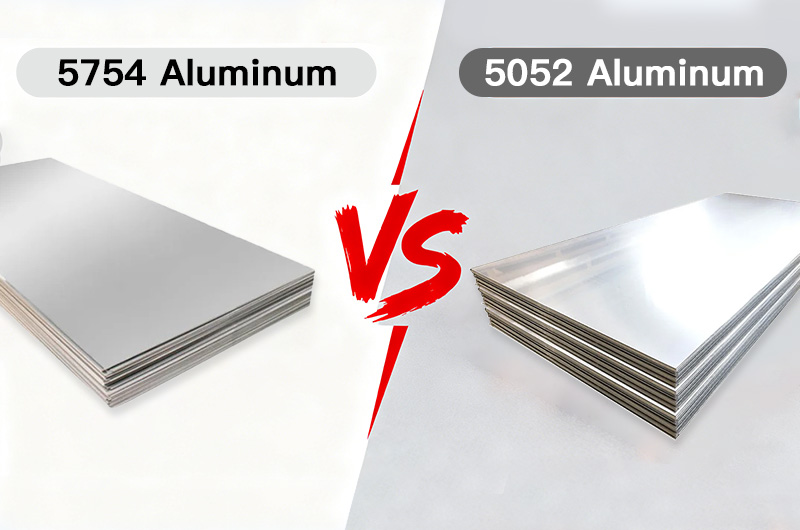
Here's the fundamental difference:
5754 Aluminum is designed for strength and durability in harsh environments—suitable for shipbuilding, automotive body panels, and liquefied natural gas storage tanks.
5052 Aluminum optimizes formability and versatility—ideal for home appliances, signage, and general sheet metal fabrication.
Chemical composition reveals the key: 5754 aluminum has 30% more magnesium (2.6-3.6% vs 2.2-2.8%), resulting in higher tensile strength, but with a slight sacrifice in ductility. In the H32 temper, 5052 aluminum exhibits 43% higher elongation, making it the ideal choice for complex forming processes.
Quick Comparison at a Glance
| Attribute | 5052 | 5754 | Advantage |
| Tensile Strength (H32) | 228 MPa | 245 MPa | 5754 (+7%) |
| Yield Strength (H32) | 193 MPa | 130-150 MPa | 5052 (+40%) |
| Elongation (H32) | 12% | 8.4% | 5052 (+43%) |
| Seawater Corrosion Rate | Good | ≤0.03 mm/yr | 5754 |
| Weld Joint Efficiency | ~85% | ~94% | 5754 |
| Formability | Excellent | Good | 5052 |
| Relative Cost | Baseline | +10-15% | 5052 |
Let's look at the conclusion directly
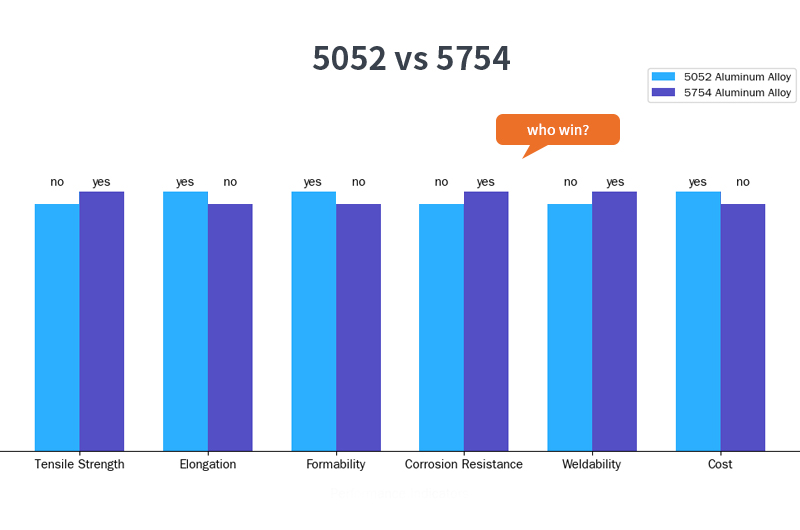
Chemical Composition: The Magnesium Factor
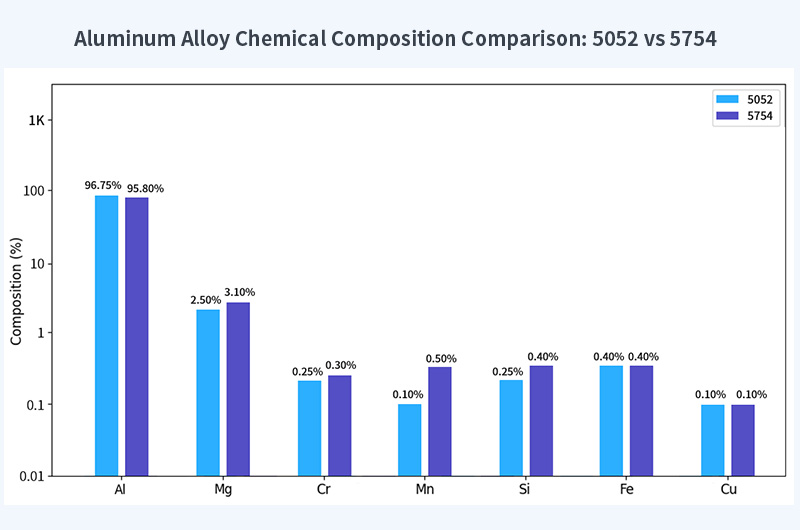
The performance gap between these alloys stems directly from their chemistry:
| Element | 5052 | 5754 | Impact |
| Magnesium (Mg) | 2.2-2.8% | 2.6-3.6% | Higher Mg = higher strength + better corrosion resistance |
| Chromium (Cr) | 0.15-0.35% | ≤0.30% | Cr improves stress corrosion cracking resistance |
| Manganese (Mn) | ≤0.10% | ≤0.50% | Mn enhances work hardening response |
| Silicon (Si) | ≤0.25% | ≤0.40% | — |
| Aluminum (Al) | 95.8-97.7% | 94.2-97.4% | — |
Technical Explanation: The higher magnesium content in 5754 aluminum will form more Mg₂Si precipitates during processing. These precipitates can pin dislocations, thereby increasing strength. However, alloys with a magnesium content exceeding 3.5% may be prone to intergranular corrosion under sustained high temperatures—the magnesium content of 5754 aluminum is just within the safe upper limit.
Mechanical Properties: Strength vs. Ductility Trade-off
O Temper (Annealed - Softest Condition)
| Property | 5052-O | 5754-O | Difference |
| Ultimate Tensile Strength | 190 MPa | 210 MPa | 5754 is 10% stronger |
| Yield Strength | 79 MPa | 90 MPa | 5754 is 14% higher |
| Elongation | 22% | 19% | 5052 is 16% more ductile |
| Brinell Hardness | 47 HB | 52 HB | 5754 is harder |
H32 Temper (Quarter-Hard - Most Common)
| Property | 5052-H32 | 5754-H32 | Difference |
| Ultimate Tensile Strength | 228 MPa | 240 MPa | 5754 is 5% stronger |
| Yield Strength | 193 MPa | 130-150 MPa | 5052 is ~40% higher |
| Elongation | 12% | 8-11% | 5052 is ~43% more ductile |
| Brinell Hardness | 60 HB | 63 HB | Similar |
| Fatigue Strength | 117 MPa | 110 MPa | Similar |
H38 Temper (Full-Hard)
| Property | 5052-H38 | 5754-H38 | Difference |
| Ultimate Tensile Strength | 290 MPa | 320 MPa | 5754 is 10% stronger |
| Yield Strength | 255 MPa | 270 MPa | Similar |
| Elongation | 5.2% | 3.9% | 5052 is 33% more ductile |
| Hardness | 78 HB | 87 HB | 5754 is harder |
Key Observation: The yield strength advantage of 5052 aluminum in the H32 temper disappears in the H38 temper—this is because 5754 aluminum has a higher manganese content, resulting in faster work hardening, and will "catch up" after more cold working. The strength of 5052. For structural components requiring maximum hardness, 5754-H38 is the undisputed choice among non-heat-treatable alloys. More comparisons of 5052 and 5754 aluminum in different tempers.
Physical Properties Comparison
| Property | 5052 | 5754 |
| Density | 2.68 g/cm³ | 2.66 g/cm³ |
| Melting Range | 607-649°C | 600-650°C |
| Thermal Conductivity | 138 W/m·K | 130-147 W/m·K |
| Electrical Conductivity | 35% IACS | 32-35% IACS |
| Coefficient of Thermal Expansion | 23.8 µm/m·K | 23.7-24 µm/m·K |
| Modulus of Elasticity | 70.3 GPa | 68-70 GPa |
Practical Note: Both have almost the same density, resulting in comparable weight reduction. However, 5052 aluminum has a slightly higher thermal conductivity, making it more suitable for heat exchanger applications.
Corrosion Resistance: Where 5754 Shines
Both alloys form a protective oxide film, but 5754's higher magnesium content makes it more resistant to corrosion in harsh environments:
| Environment | 5052 | 5754 |
| Atmospheric Exposure | Excellent | Excellent |
| Fresh Water | Excellent | Excellent |
| Seawater Immersion | Very Good | Exceptional (≤0.03 mm/yr) |
| Industrial Chemicals | Good | Very Good |
| Alkaline Solutions | Moderate | Moderate |
| Ammonia/Nitric Acid | Good | Good |
Why This Matters: For LNG carrier hulls, offshore platforms, and coastal structures, the difference between "Very Good" and "Excellent" can mean decades of additional service life. 5754 has been designated by classification societies such as Lloyd's Register and DNV for critical marine structures.
Weldability: Both Excel, But 5754 Has the Edge
| Welding Method | 5052 | 5754 |
| TIG (GTAW) | Very Good | Excellent |
| MIG (GMAW) | Very Good | Excellent |
| Resistance Welding | Very Good | Excellent |
| Friction Stir Welding | Good | Excellent (≥95% joint efficiency) |
| Recommended Filler Wire | 5356, 5556 | 5356, 5556, 5754 |
| Hot Cracking Sensitivity | Low | Very Low |
| Post-Weld Strength Retention | ~85% | ~94% |
Engineering Tip: Neither alloy requires preheating or post-weld heat treatment. For 5754, using a matching 5754 filler wire in critical applications such as pressure vessels and nuclear facilities maximizes corrosion resistance continuity in the weld zone.
Formability: 5052's Competitive Advantage
| Operation | 5052 | 5754 |
| Deep Drawing | Excellent | Good |
| Stretch Forming | Excellent | Good |
| Bending (minimum radius) | 0-1t | 1-2t |
| Spinning | Excellent | Moderate |
| Stamping Complex Shapes | Superior | Acceptable |
| Work Hardening Rate | Lower | Higher |
| Springback | Less | More |
Practical Example: When forming automotive fender liners or appliance panels with complex curved surfaces, 5052-O aluminum allows for smaller radius bending without breakage. 5754 aluminum requires more sophisticated die design, and complex parts often require intermediate annealing.
Application Guide: Choosing the Right Alloy
Choose 5052 Aluminum When:
- Complex forming is required (deep draws, tight bends)
- Cost optimization is a priority
- Manufacturing consumer products (refrigerators, cookware, fan blades)
- Producing signage, lighting, and architectural trim
- General sheet metal fabrication
- Heat exchangers where thermal conductivity matters
Choose 5754 Aluminum When:
- Marine and offshore environments (ship hulls, LNG tanks, dock equipment)
- Automotive structural applications (body panels, battery trays, fuel lines)
- Welded assemblies requiring maximum joint strength
- Pressure vessels and chemical storage tanks
- Rail transportation (sound barriers, car body panels)
- Applications requiring premium corrosion resistance

Industry Application Matrix
| Industry | 5052 Best Uses | 5754 Best Uses |
| Marine | Small boat fuel tanks, trim | Ship hulls, LNG tanks, offshore platforms |
| Automotive | Brackets, interior trim | Body panels, EV battery enclosures, fuel systems |
| Aerospace | Hydraulic lines, brackets | Structural fuel tanks |
| Architecture | Facades, roofing, gutters | Heavy-traffic flooring, tread plates |
| Industrial | General fabrication, HVAC | Chemical tanks, nuclear structures |
| Consumer | Appliances, cookware, electronics | — |
Cost Considerations
| Factor | 5052 | 5754 |
| Base Material Cost | Baseline | +10-15% |
| Availability | Widely stocked globally | Common in EU/Asia, growing in NA |
| Scrap Value | Standard Al scrap rates | Same |
| Lifecycle Cost (marine) | Higher (more maintenance) | Lower (longer service life) |
Procurement Insight: 5052 aluminum is the "mainstay alloy" stocked by almost all aluminum distributors. While 5754 aluminum is increasingly popular, it may require longer lead times in North America. Since 2014, with the advancement of automotive lightweighting initiatives, the adoption rate of 5754 aluminum among automotive OEMs has increased rapidly.
Other Data comparison (for your reference)
H1x Series (Strain Hardened Only)
H12 (1/4 Hard)
| Property | 5052-H12 | 5754-H12 | Difference |
|---|---|---|---|
| UTS (MPa) | 230 | 240 | 5754 +4% |
| Yield (MPa) | 180 | 190 | 5754 +6% |
| Elongation | 9.4% | 5.5% | 5052 +71% |
| Hardness (HB) | 63 | 66 | Similar |
H14 (1/2 Hard)
| Property | 5052-H14 | 5754-H14 | Difference |
|---|---|---|---|
| UTS (MPa) | 250 | 260 | 5754 +4% |
| Yield (MPa) | 200 | 210 | 5754 +5% |
| Elongation | 8.0% | 4.0% | 5052 +100% |
| Hardness (HB) | 69 | 72 | Similar |
H16 (3/4 Hard)
| Property | 5052-H16 | 5754-H16 | Difference |
|---|---|---|---|
| UTS (MPa) | 270 | 280 | 5754 +4% |
| Yield (MPa) | 230 | 250 | 5754 +9% |
| Elongation | 3.7% | 2.4% | 5052 +54% |
| Hardness (HB) | 76 | 80 | 5754 harder |
H18 (Full Hard)
| Property | 5052-H18 | 5754-H18 | Difference |
|---|---|---|---|
| UTS (MPa) | 300 | 320 | 5754 +7% |
| Yield (MPa) | 260 | 280 | 5754 +8% |
| Elongation | 3.1% | 2.0% | 5052 +55% |
| Hardness (HB) | 83 | 88 | 5754 harder |
H2x Series (Strain Hardened + Partially Annealed)
H22 (1/4 Hard)
| Property | 5052-H22 | 5754-H22 | Difference |
|---|---|---|---|
| UTS (MPa) | 230 | 240 | 5754 +4% |
| Yield (MPa) | 170 | 150 | 5052 +13% |
| Elongation | 9.3% | 8.4% | 5052 +11% |
| Hardness (HB) | 61 | 63 | Similar |
H24 (1/2 Hard)
| Property | 5052-H24 | 5754-H24 | Difference |
|---|---|---|---|
| UTS (MPa) | 250 | 260 | 5754 +4% |
| Yield (MPa) | 190 | 190 | Equal |
| Elongation | 8.0% | 7.8% | Similar |
| Hardness (HB) | 67 | 70 | Similar |
H26 (3/4 Hard)
| Property | 5052-H26 | 5754-H26 | Difference |
|---|---|---|---|
| UTS (MPa) | 270 | 290 | 5754 +7% |
| Yield (MPa) | 220 | 220 | Equal |
| Elongation | 3.8% | 4.7% | 5754 +24% |
| Hardness (HB) | 74 | 78 | 5754 harder |
H28 (Full Hard)
| Property | 5052-H28 | 5754-H28 | Difference |
|---|---|---|---|
| UTS (MPa) | 310 | 330 | 5754 +6% |
| Yield (MPa) | 240 | 260 | 5754 +8% |
| Elongation | 2.6% | 3.4% | 5754 +31% |
| Hardness (HB) | 81 | 87 | 5754 harder |
H3x Series (Strain Hardened + Stabilized)
H34 (1/2 Hard)
| Property | 5052-H34 | 5754-H34 | Difference |
|---|---|---|---|
| UTS (MPa) | 260 | 260 | Equal |
| Yield (MPa) | 200 | 190 | 5052 +5% |
| Elongation | 10% | 7.8% | 5052 +28% |
| Hardness (HB) | 68 | 70 | Similar |
H36 (3/4 Hard)
| Property | 5052-H36 | 5754-H36 | Difference |
|---|---|---|---|
| UTS (MPa) | 280 | 290 | 5754 +4% |
| Yield (MPa) | 230 | 220 | 5052 +5% |
| Elongation | 5.8% | 4.7% | 5052 +23% |
| Hardness (HB) | 73 | 78 | 5754 harder |
Conclusion: The Right Tool for the Right Job
5052 and 5754 aluminum are both exceptional alloys—but they're optimized for different missions:
| If Your Priority Is... | Choose |
| Maximum formability | 5052 |
| Lowest cost | 5052 |
| Highest corrosion resistance | 5754 |
| Best weld performance | 5754 |
| Marine/automotive structural use | 5754 |
| General fabrication | 5052 |
For demanding marine, automotive, and structural applications, 5754 aluminum is the professional choice if strength and durability justify a slight cost premium. For high-volume machining, consumer goods, and applications requiring complex forming, 5052 aluminum offers unparalleled value.