


7005 vs. 7075 Aluminum
Introduction
Within the 7000 series aluminum alloys, 7005 and 7075 represent two distinct design philosophies and market positionings.
7075 is renowned for its extreme strength, having long dominated the aerospace and military sectors. In contrast, 7005 stands out in fields like bicycle frames, rail transit, and sports equipment, thanks to its exceptional weldability and excellent all-around performance.
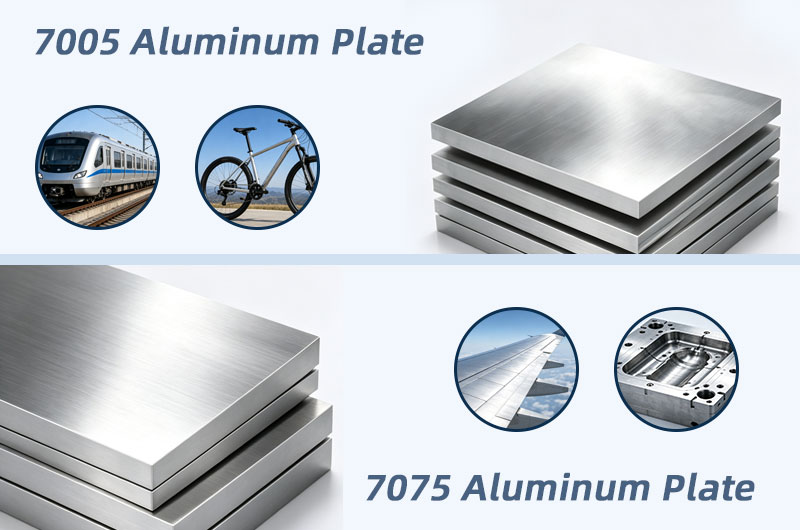
Although both belong to the Al-Zn-Mg series of heat-treatable aluminum alloys, they have taken completely different paths in terms of strength, weldability, corrosion resistance, and application scenarios.
Quick Comparison Table: 7005 vs. 7075 Aluminum Alloy
| Comparison Dimension | 7075 (T651) | 7005 (T6) | Winner |
|---|---|---|---|
| Tensile Strength | 572 MPa | 350 MPa | 7075 |
| Yield Strength | 503 MPa | 290 MPa | 7075 |
| Elongation | 11% | 13% | 7005 |
| Hardness (HB) | 150 | 94 | 7075 |
| Fatigue Strength | 159 MPa | 150 MPa | 7075 |
| Weldability | Poor (Fusion welding not recommended) | Excellent | 7005 |
| Corrosion Resistance | Moderate | Moderate to Good | 7005 (slightly better) |
| Thermal Conductivity | 130 W/m·K | 137–166 W/m·K | 7005 |
| Electrical Conductivity | 33% IACS | 35–43% IACS | 7005 |
One-Sentence Summary: If you are pursuing aerospace-grade applications with maximum strength, choose 7075; if you need a structural component that requires weldability, formability, and overall cost-effectiveness, choose 7005.
Getting to Know These Two Alloys
Although both are 7-series aluminum alloys, their positioning is crystal clear:
- 7075 is the "King of Strength." Because it contains copper and responds exceptionally well to heat treatment, its tensile strength reaches a staggering 572 MPa, rivaling steel. It originates from aerospace and military applications.
- 7005 is the "Welding Prodigy." By removing copper and adding zirconium and manganese, it not only boasts excellent weldability but can also automatically recover its strength after welding. It is the mainstream choice for bicycle frames and high-speed train structures.
Chemical Composition: The Root of Performance Differences
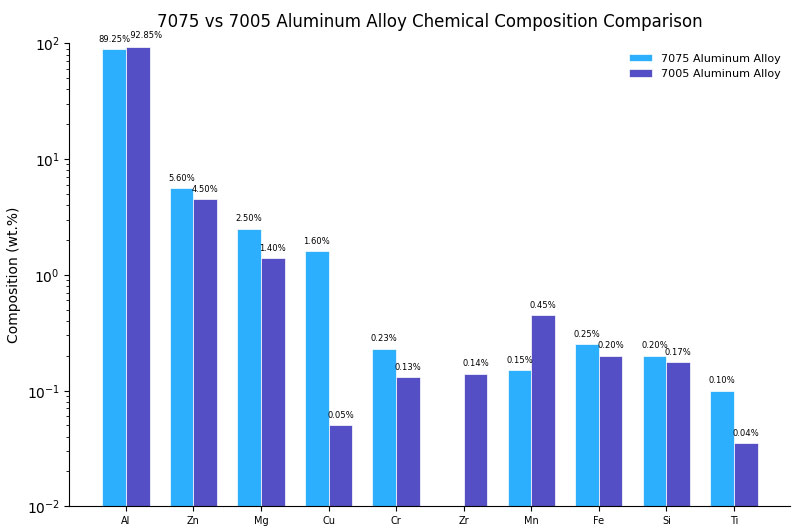
| Element | 7075 (%) | 7005 (%) |
|---|---|---|
| Al | 87.1–91.4 (Remainder) | 91.0–94.7 (Remainder) |
| Zn | 5.1–6.1 | 4.0–5.0 |
| Mg | 2.1–2.9 | 1.0–1.8 |
| Cu | 1.2–2.0 | ≤0.10 |
| Cr | 0.18–0.28 | 0.06–0.20 |
| Zr | None | 0.08–0.20 |
| Mn | ≤0.30 | 0.20–0.70 |
| Fe | ≤0.50 | ≤0.40 |
| Si | ≤0.40 | ≤0.35 |
| Ti | ≤0.20 | 0.01–0.06 |
Because 7075 contains a significant amount of copper, its strength is extremely high, but it is virtually unweldable. 7005 removes this copper and adds zirconium and manganese, making it the most weld-friendly material in the 7-series aluminum family.
Mechanical Properties: Strength vs. Ductility
Absolute Strength and Ductility
In terms of absolute strength and hardness, 7075-T651 is about 1.6 times that of 7005-T6, making it an absolute "tough guy." However, when it comes to ductility, under specific tempers, the elongation of 7005 is nearly twice that of 7075. It has better toughness and is much less prone to cracking during forming.
Mechanical Properties Comparison by Major Tempers
| Alloy & Temper | Tensile Strength (MPa) | Yield Strength (MPa) | Elongation (%) | Hardness (HB) | Shear Strength (MPa) | Fatigue Strength (MPa) |
|---|---|---|---|---|---|---|
| 7005-O | 200 | 95 | 20 | 53 | 120 | 100 |
| 7005-T5 | 345–400 | 290–350 | 12–15 | 94–105 | 215–230 | 150–190 |
| 7005-T6 | 350–380 | 290–310 | 11–13 | 94 | 210–215 | 130–150 |
| 7005-T53 | 390 | 340–345 | 10–15 | 105 | 230–300 | 140–170 |
| 7075-O | 240 | 120 | 12 | 59 | 150 | 120 |
| 7075-T6 | 560 | 480 | 7.9 | 150 | 330 | 160 |
| 7075-T651 | 572 | 503 | 11 | 150 | 331 | 159 |
| 7075-T73 | 500 | 410 | 7.1 | 140 | 290 | 160 |
The Natural Aging Effect
7005 has a remarkable hidden advantage: natural aging. After welding, simply letting it sit at room temperature for two weeks allows its strength to automatically recover to its peak level, completely eliminating the need for complex post-weld heat treatments. While 7075 can also recover 90% of its strength after two weeks, this "skill" is practically useless since 7075 is notoriously difficult to weld in the first place.
High and Low-Temperature Performance
The maximum operating temperature for both alloys is 200°C. Once temperatures exceed 120–150°C, their strength drops significantly, meaning neither is suitable for continuous high-temperature stress applications.
However, in low-temperature environments, both perform better than at room temperature. 7005-T53 can reach a tensile strength of 538 MPa at -196°C and 641 MPa at -269°C, showing excellent low-temperature toughness, making it highly suitable for cryogenic environments.
Weldability: The Core Advantage of 7005
Weldability is the most significant difference between the two and the primary reason most users choose 7005 over 7075.
- 7075: Due to its high copper content, fusion welding will inevitably cause cracking, and the strength will plummet drastically. Therefore, 7075 used on airplanes or high-end structural parts must be joined using rivets.
- 7005: By removing the troublesome copper and adding manganese and zirconium to stabilize the structure, it is incredibly easy to weld. Paired with its "auto-healing" natural aging ability, the weld seam strength can easily surpass 400 MPa.
Tip: Ensure the surface is thoroughly cleaned before welding. Using TIG/MIG welding with ER5356 filler wire is the safest bet, and remember to preheat thicker plates. Never use brazing—because of its awkward magnesium content, forcing a brazed joint will result in very poor quality.
Corrosion Resistance Comparison
In terms of corrosion resistance and surface treatments, 7005 outperforms 7075 across the board. Because it contains no copper, 7005 is not only more corrosion-resistant, but its risk of stress corrosion cracking (SCC) is also much lower, and it anodizes beautifully.
7075, on the other hand, often has to sacrifice 10-15% of its strength (using T73 temper) just to prevent stress corrosion cracking, and its anodized finish is prone to discoloration. However, in harsh environments, both brothers still need proper surface protective coatings.
Heat Treatment Processes
Cooling / Quenching
- 7075: Must be water-quenched. This drastic cooling causes thin-walled parts to warp easily, resulting in a very high scrap rate.
- 7005: Thin parts (<5mm) can be air-cooled. This gentle temperature drop perfectly avoids warping issues, ensuring a high yield rate.
Deep Heat Treatment
- 7075 (Trading strength for protection): To improve corrosion resistance, it must sacrifice some of its peak strength.
- 7005 (Dual enhancement): Through a two-stage artificial aging process, not only does its corrosion resistance improve massively, but its strength actually increases!
Physical Properties Comparison
| Physical Parameter | 7075 | 7005 | Notes |
|---|---|---|---|
| Density (g/cm³) | 2.81 | 2.78 | 7005 is slightly lighter |
| Elastic Modulus (GPa) | 71.7 | 70–72 | Similar |
| Shear Modulus (GPa) | 26.9 | 26.9 | Identical |
| Poisson's Ratio | 0.33 | 0.33 | Identical |
| Thermal Conductivity (W/m·K) | 130 | 137–170 | 7005 is distinctly higher |
| Electrical Conductivity (% IACS) | 33 | 35–43 | 7005 is higher |
| Thermal Expansion Coeff. (μm/m·K) | 23.6 | 23–25 | Similar |
| Specific Heat Capacity (J/kg·K) | 960 | 875–880 | 7075 is slightly higher |
| Solidus Temperature (°C) | 477 | 604–610 | 7005 is distinctly higher |
| Liquidus Temperature (°C) | 635 | 640–643 | Similar |
| Max Operating Temp (°C) | 200 | 200 | Identical |
Takeaway: 7005 has better thermal and electrical conductivity, and a higher tolerance for thermal processing, making it more suitable for heat dissipation structural parts, welding, and heat-treated scenarios compared to 7075.
Machinability Comparison
Both alloys perform very well in CNC machining—they do not stick to the cutting tools and offer excellent chip evacuation.
- 7075 is harder (150 HB), which wears out tools faster but yields an excellent surface finish. It is ideal for machining thick, high-precision solid parts.
- 7005 is softer (94 HB), meaning machining deformation is minimal. It can even be dry-cut (without coolant), making it the perfect choice for thin-walled, complex, and precision parts.
How to Choose and Apply (Plus Pitfalls)
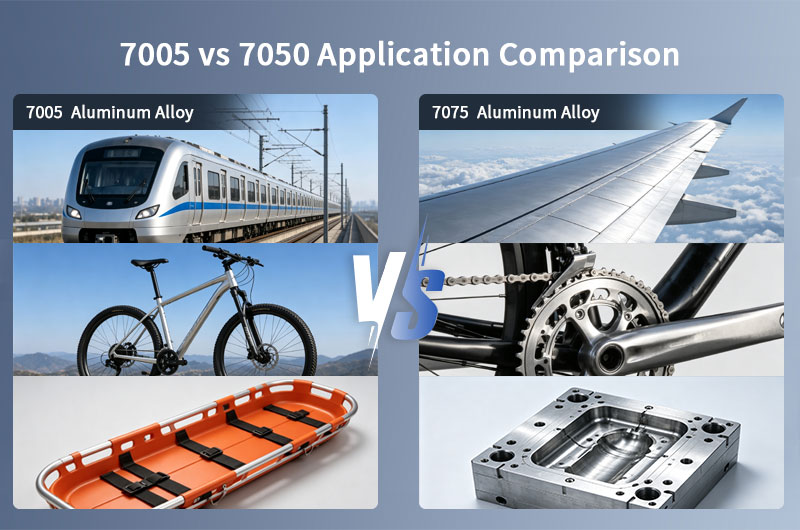
Choose 7075: High Strength, No Welding Required
Core Advantages: Extreme sheer strength (Tensile >500 MPa), high hardness, excellent dimensional stability, and great polishing performance.
- Aerospace & Military: Aircraft wing skins/landing gears, missile components, rifle receivers (e.g., M16), armor plating.
- Precision Molds: Blow molds, injection molds, ultrasonic plastic welding molds.
- High-End CNC Unibody Parts: Bicycle chainrings, carabiners, golf club heads, and other non-welded, high-stress sports equipment.
Choose 7005: Welding and Forming Required
Core Advantages: Exceptional weldability (strength recovers via natural aging), good formability and ductility, and higher strength than 6061.
- Large Welded Structures: Rail transit car bodies/profiles, lightweight automotive welded parts, large heat exchangers.
- Welded Sports Equipment: Bicycle frames (the only 7-series alloy widely used for frames), tennis rackets, baseball bats, portable scaffolding.
- Specialty Aerospace Structures: Rescue stretcher profiles, rocket ejection seat guide rails.
Where BOTH are unsuitable:
If you encounter the following extreme conditions or budget constraints, abandon both 7075 and 7005:
- High-Temperature Environments (>200°C): Strength drops dramatically. Switch to titanium alloys or heat-resistant steel.
- Highly Corrosive Environments: Insufficient corrosion resistance for exposed marine environments. Switch to 5083 or 6061.
- Extremely Cost-Sensitive Basic Structures: Overkill on performance and too expensive. Switch to standard 6061.
Frequently Asked Questions (FAQ)
- Q1: Can 7005 replace 7075 for bicycle frames?
- Yes. In fact, 7005 is the mainstream choice for bicycle frames, while 7075 is highly unsuitable. This is because bicycle frames rely heavily on welding. 7075 has terrible weldability, whereas 7005 welds beautifully, recovers its strength post-weld, and offers great toughness, making it perfect for frames.
- Q2: How much lower is the strength of 7005 compared to 7075?
- In the T6 temper, 7075-T651's tensile strength (572 MPa) is about 1.6 times that of 7005-T6 (350 MPa). By optimizing dual-stage aging, 7005 can reach a maximum of about 480 MPa, but still falls short of 7075's peak. If your application doesn't require strength exceeding 400–480 MPa but does require welding, 7005 is the right choice.
- Q3: Can 7005 be used in the aerospace industry?
- Yes, but its positioning differs from 7075. 7005 is primarily used for medium-strength structural parts that require welding, such as specialized aerospace stretcher profiles (T5 state) and ejection seat guide rails. 7075 is used for primary load-bearing structures like wing spars and high-stress bulkheads.
- Q4: Which one is easier to machine, 7005 or 7075?
- Both have good machinability. However, because 7005 has lower hardness (94 HB vs 150 HB), it causes less tool wear and less machining deformation, giving it an edge in thin-walled and complex shapes. 7075's higher hardness results in better chip breakage, making it suitable for high-speed precision cutting.
- Q5: How much strength does 7005 lose after welding?
- When welded using TIG/MIG with ER5356 wire, the weld seam strength is about 90% of the base metal (approx. 320–340 MPa). After a two-week natural aging or artificial dual-stage aging, strength recovers to over 400 MPa. Using advanced methods like oscillating laser welding, joint strength can even hit 370.8 MPa.
- Q6: What is the price difference between 7005 and 7075?
- 7005 is generally cheaper than 7075. Because 7075 requires higher alloying elements and a more complex heat treatment process, its production cost is higher. For cost-sensitive applications that don't need ultimate extreme strength, 7005 offers a better cost-to-performance ratio.
Conclusion
7075 and 7005 represent two distinct design philosophies within the 7-series aluminum alloys: 7075 pursues absolute ultimate strength, cementing its dominance in aerospace and military fields; 7005 focuses on comprehensive balance, granting it exceptional weldability rarely seen in high-strength aluminum. There is no absolute winner between the two—the key lies in matching the material to your specific application scenarios and manufacturing processes.
Appendices: 7005 vs. 7075 Aluminum Alloy Performance Data Summaries
Appendix A: 7005 Mechanical Properties (Major Tempers)
| Temper | Tensile Strength (MPa) | Yield Strength (MPa) | Elongation (%) | Hardness (HB) | Shear Strength (MPa) | Fatigue Strength (MPa) |
|---|---|---|---|---|---|---|
| O | 195–200 | 80–95 | 20 | 53 | 120 | 100 |
| T5 | 345–400 | 290–350 | 12–15 | 94–105 | 215–220 | 150–190 |
| T6 | 350–380 | 290–310 | 11–13 | 94 | 210–215 | 130–150 |
| T53 | 390 | 340–345 | 10–15 | 105 | 230–300 | 140–170 |
| Dual-stage Opt. | Up to 480 | Up to 451 | ~8.4 | — | — | — |
Appendix B: 7075 Mechanical Properties (Major Tempers)
| Temper | Tensile Strength (MPa) | Yield Strength (MPa) | Elongation (%) | Hardness (HB) | Shear Strength (MPa) | Fatigue Strength (MPa) |
|---|---|---|---|---|---|---|
| O | 240 | 120 | 12 | 59 | 150 | 120 |
| T6 | 560 | 480 | 7.9 | 150 | 330 | 160 |
| T651 | 572 | 503 | 11 | 150 | 331 | 159 |
| T73 | 500 | 410 | 7.1 | 140 | 290 | 160 |
| T7351 | 510 | 410 | 7.5 | 140 | 300 | 160 |
| T76 | 560 | 480 | 7.9 | 150 | 330 | 190 |
Appendix C: Heat Treatment Process Parameters Comparison
| Process Parameter | 7075 | 7005 |
|---|---|---|
| Solution Temperature (°C) | 466–482 | 470 (optimal) |
| Holding Time (1–2mm plate) | 40–60 min | 30–50 min |
| Quenching Medium | Cold water (≤30°C), water-cooling only | ≤5mm air-coolable; ≥6mm water/spray cooling req. |
| Annealing Temperature (°C) | 413 | 343 |
| Optimal Single-stage Aging | 120°C / 24h | 110°C / 24h |
| Dual-stage Aging | 120°C/8h + 170°C/20h | 100°C/8h + 120°C/24h |
Appendix D: Welding Performance Comparison
| Welding Parameter | 7075 | 7005 |
|---|---|---|
| Overall Weldability | Poor (Fusion welding not recommended) | Excellent (Best in 7000 series) |
| TIG Welding | Welds crack, poor quality | Good, ER5356 wire recommended |
| MIG Welding | Not recommended | Good, ER5356 wire recommended |
| Friction Stir Welding (FSW) | Feasible | Feasible |
| Post-Weld Strength Recovery | ~200 MPa (Extremely low) | 320–370 MPa (~90% of base metal) |
| Brazing | Not feasible (Mg > 2%) | Feasible for thin parts only (manual flame) |
| Post-Weld Treatment | — | Natural aging for 2 weeks or artificial dual-stage aging |
Appendix E: 7005 and 7075 Specification Ranges (Reference)
| Product Form | 7075 Specification Range | 7005 Specification Range |
|---|---|---|
| Plate/Sheet Thickness | 0.5–350 mm | 1.0–600 mm |
| Plate/Sheet Width | Max 4000 mm | Max 2500 mm |
| Bar/Rod Diameter | 3–800 mm | 6–500 mm |
| Tube/Pipe Outer Diameter | 8–1500 mm | — |
| Common Supply Tempers | T6, T651, T73, T7351, O | T5, T6, T53, O |
| Common Standards | ASTM B209 / AMS-QQ-A-250/12 | ASTM B221 / GB 7005 |