


5754 vs. 6061 Aluminum
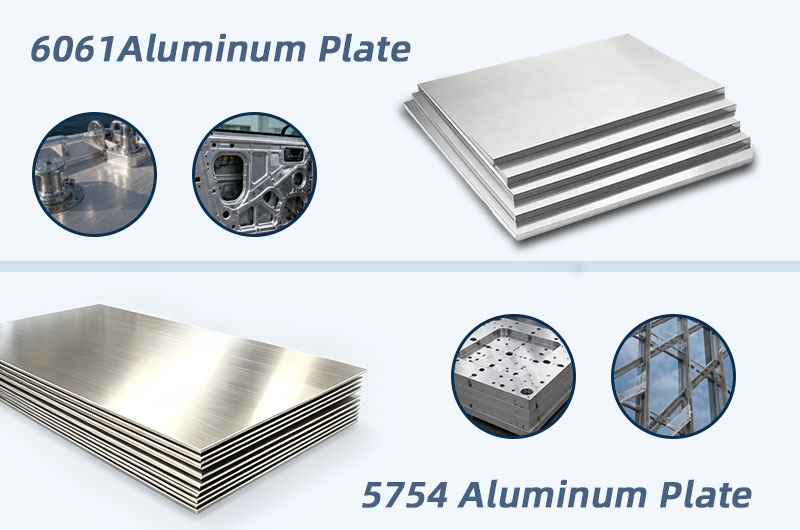
In the field of aluminum alloy material selection, 5754 and 6061 aluminum are two of the most frequently compared alloy grades. The former belongs to the Al-Mg series of non-heat-treatable alloys, renowned for its corrosion resistance and welding stability; the latter belongs to the Al-Mg-Si series of heat-treatable alloys, famous for its high strength and excellent machinability.
There is no absolute superiority or inferiority between the two; the core difference lies in their distinct focus on application scenarios.
Basic Alloy Introduction
5754 Aluminum Alloy
Al-Mg · 5000Belongs to the non-heat-treatable 5000 series (aluminum-magnesium). Relying on its excellent formability, corrosion resistance, and weldability, it is widely used in automotive body stamping, sheet metal structures, and marine engineering.
6061 Aluminum Alloy
Al-Mg-Si · 6000Belongs to the heat-treatable 6000 series (aluminum-magnesium-silicon). Due to its high strength (e.g., T6 temper) and superb CNC machinability, it is a universal top choice for precision machinery, structural frames, and industrial components.
Quick Comparison Table
Below is a summary of the most highly concerned core comparison items for the two alloys, helping you quickly pinpoint your material selection direction.
| Comparison Item | 5754 (AlMg3) | 6061 (AlMg1SiCu) |
|---|---|---|
| Alloy Series | Al-Mg Series (5000) | Al-Mg-Si Series (6000) |
| Strengthening Method | Non-heat-treatable (Cold working) | Heat-treatable (Solid solution + Aging) |
| Typical Tensile Strength | 190–240 MPa (H111) | 290–310 MPa (T6) |
| Typical Yield Strength | 80–130 MPa | 240–270 MPa |
| Marine Corrosion Resistance | Excellent (Anodizing not required) | Good (Anodizing recommended) |
| Post-Weld Strength Retention | Stable, no obvious decrease | Decreases by ~40%, requires re-heat treatment |
| Heat Treatment Required | No | Yes (Solid solution + Aging) |
| Machinability | Fair | Excellent |
| Anodizing Effect | Good | Excellent |
| Suitable for Deep Drawing | Yes (O temper elongation 19%) | Limited (Poor formability in T6) |
| Food Contact Certification | Complies with DIN EN 602 | Applicable (Specs must be confirmed) |
Chemical Composition Comparison
Chemical composition is the fundamental basis determining an aluminum alloy's performance. The differences in the elemental ratios of these two alloys directly dictate their respective strengthening mechanisms and performance characteristics.
| Element | 5754 | 6061 |
|---|---|---|
| Al | Remainder (94.2%–97.4%) | Remainder (95.85%–98.56%) |
| Mg | 2.6%–3.6% | 0.80%–1.20% |
| Si | ≤0.40% | 0.40%–0.80% |
| Fe | ≤0.40% | ≤0.70% |
| Cu | ≤0.10% | 0.15%–0.40% |
| Mn | ≤0.50% | ≤0.15% |
| Cr | ≤0.30% | 0.04%–0.35% |
| Zn | ≤0.20% | ≤0.25% |
| Ti | ≤0.15% | ≤0.15% |
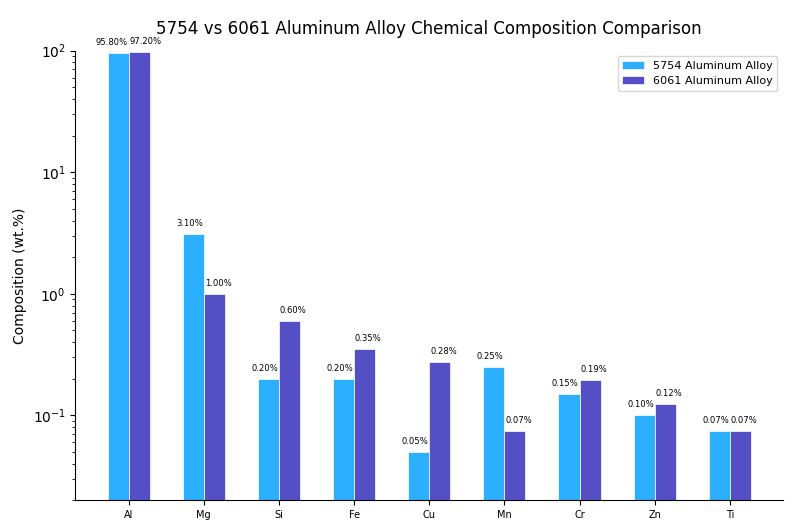
Relying on a high-magnesium, copper-free formula, 5754 achieves superior rust prevention and bending formability. 6061, on the other hand, adds silicon and trace amounts of copper, allowing it to achieve hardness and strength far exceeding that of 5754 via heat treatment, though it is slightly inferior in seawater corrosion resistance.
Mechanical Properties Comparison
Strength Comparison
Overall, the strength of 6061 is much higher than that of 5754. Especially in the commonly used 6061-T6 temper, its compressive and load-bearing capacity is extremely strong, making it the preferred choice for various load-bearing structural parts. Although 5754 can increase its hardness to some extent through cold working, it is still primarily used in medium-strength load-bearing scenarios.
Elongation and Formability Comparison
In practical processing, the toughness and formability of 5754 completely beat 6061. During sheet metal operations like deep drawing and complex bending, 5754 is extremely easy to form and not prone to cracking. In contrast, high-strength 6061 (T6 temper) is relatively brittle and carries a high risk of fracturing when bent.
Fatigue Strength Comparison
| Alloy | Fatigue Strength Range (MPa) | Description |
|---|---|---|
| 5754 | 66–140 MPa | Meets high-frequency vibration conditions for vehicles |
| 6061-T6 | 96–110 MPa | Meets usage requirements for general structural parts |
Both alloys' fatigue performances fall within a reasonable range for aluminum alloys. The upper limit of 5754's fatigue strength (140 MPa in H12 temper) is superior to 6061 in specific states.
Hardness Comparison
| Alloy / Temper | Brinell Hardness (HB) |
|---|---|
| 5754-H111 | 52 |
| 5754-H22 | 63 |
| 5754-H24 | 70 |
| 5754-H28 | 87 |
| 6061-O | 33 |
| 6061-T4 | 63 |
| 6061-T6/T651 | 93–95 |
The hardness of 6061 (T6) is significantly higher than most tempers of 5754, giving it an advantage in application scenarios requiring high wear resistance.
Summary of Main Mechanical Properties
| Performance Indicator | 5754 (H111) | 5754 (O Temper) | 6061 (T6) | 6061 (O Temper) |
|---|---|---|---|---|
| Tensile Strength (MPa) | 190–240 | 190–210 | 290–310 | 125–130 |
| Yield Strength (MPa) | 80 | 80–90 | 240–270 | 55–76 |
| Elongation (%) | 14–18 | 19 | 8–12 | 20–25 |
| Hardness (HB) | 52 | 44 | 93–95 | 33 |
| Fatigue Strength (MPa) | ~96 | ~96 | 96–110 | ~61 |
| Elastic Modulus (GPa) | 68–70 | 68–70 | 69 | 69 |
Physical Properties Comparison
Physical properties are crucial in applications such as heat dissipation, thermal management, and precision assembly. There are obvious differences between the two alloys in this regard.
Thermal Properties Comparison
6061 has significantly stronger thermal conductivity, making it the top choice for thermal management components like radiators and heat exchangers. However, under high-temperature working conditions, 5754 has better thermal stability, whereas 6061 is prone to a massive drop in strength due to high temperatures.
Summary of Physical Properties
| Physical Property | 5754 | 6061 |
|---|---|---|
| Density (g/cm³) | 2.66–2.67 | 2.70 |
| Elastic Modulus (GPa) | 68–70.5 | 68.9–69 |
| Thermal Conductivity (W/m·K) | 130–147 | 152–170 |
| Thermal Diffusivity (mm²/s) | 54 | 68 |
| Max Service Temperature (°C) | 190 | 170 |
| Electrical Conductivity (% IACS) | 30–34 | 43 |
| Solidus Temperature (°C) | 600 | 580 |
Corrosion Resistance Comparison
5754's Corrosion Resistance Advantages
5754 is a standard "marine-grade" anti-rust aluminum material. Even when exposed to highly corrosive environments like seawater and heavy salt spray, it is highly resistant to rust and remains stable and safe at high temperatures.
6061's Corrosion Resistance
The rust-prevention capability of 6061 is suitable for normal, everyday environments. In marine or humid salt-spray environments, its anti-corrosion performance is not as good as 5754, usually requiring additional anodizing or protective coating.
Summary of Corrosion Resistance
| Environment Type | 5754 | 6061 |
|---|---|---|
| Normal Atmosphere | Excellent | Good |
| Marine Atmosphere | Excellent | Good (Anodizing recommended) |
| Seawater Immersion | Excellent | Fair |
| Industrial Polluted Atmosphere | Excellent | Good |
| SCC (Stress Corrosion Cracking) Risk | Extremely Low (Safe >65°C) | Low |
| Pitting Resistance | High | Medium |
Welding Performance Comparison
5754's Welding Advantages
The strength of 5754 barely degrades after welding, requiring no complex post-weld treatments. Its weld seams are dense and leak-free. When paired with 5356 or 5554 filler wire, it maintains outstanding overall anti-corrosion properties and is highly adaptable to automated welding.
6061's Welding Precautions
After welding 6061, the strength in the Heat Affected Zone (HAZ) will drop drastically by about 40% (down to a T4 state of ~165 MPa). If the high strength of T6 needs to be restored, it must undergo re-heat treatment (solid solution + artificial aging). Commonly used filler wires are 4043 or 5356.
Welding Performance Comparison Table
| Comparison Item | 5754 | 6061 |
|---|---|---|
| TIG Welding (GTAW) | Excellent | Good |
| MIG Welding (GMAW) | Excellent | Good |
| Resistance Welding | Good | Good |
| Post-Weld Strength Retention | Stable, basically no loss | Drops by ~40% (in HAZ) |
| Post-Weld Heat Treatment Needed? | No | Yes (To restore T6 strength) |
| Recommended Filler Wire | 5356 / 5554 | 4043 / 5356 |
| Automated Welding Adaptability | High | Medium |
Heat Treatment Process Comparison
5754: No Heat Treatment, Simple Process, Low Cost
5754 is a non-heat-treatable alloy and cannot be hardened through quenching; its strength is regulated entirely through cold working. Because it does not require complex post-heat treatments, production costs are lower and lead times are more stable. Common tempers include O (soft), H111 (most common), and H22/H24 (half-hard).
6061: Heat Treatment Strengthening, Massive Performance Boost
6061 is a typical heat-treatable alloy. After undergoing a complete T6 state (solid solution + artificial aging), its yield strength can skyrocket from ~76 MPa in the O temper to ~270 MPa (a nearly 4x increase). The T651 temper, which relieves internal stress, is the premier choice for precision CNC machining and deformation-resistant parts.
Heat Treatment Comparison Table
| Comparison Item | 5754 | 6061 |
|---|---|---|
| Heat Treatable? | No | Yes |
| Solid Solution Treatment | Not Applicable | 530–540°C, Water Quench |
| Artificial Aging | Not Applicable | 160–177°C × 8–18h |
| Annealing Temperature | 360–380°C × 1–2h | 415°C × 2–3h |
| Strengthening Method | Cold Working (Strain Hardening) | Solid Solution + Aging (Precipitation) |
| Processing Cost | Low | Medium to High |
| Common Tempers | O, H111, H22, H24, H26, H28 | O, T4, T6, T651 |
Processing Performance Comparison
Machinability (Cutting)
6061 has a significant advantage in precision machining. It offers high cutting finish and dimensional stability, making it the top choice for CNC milling, turning, and high-precision parts. In contrast, 5754's machinability is relatively average, making it more suitable for forming rather than precision cutting.
Cold Forming and Deep Drawing
5754 boasts phenomenal sheet metal stamping and bending performance, with high elongation and strong resistance to cracking (minimum bending radius can reach 0.5t). It is born for complex curved surfaces and deep-drawn parts. Conversely, 6061 (T6 temper) has high hardness, is prone to cracking, and is unsuitable for large-angle bending.
Extrusion Performance
6061 is the ace material for industrial extruded profiles. It can be easily extruded into profiles and frames with various complex cross-sections. 5754 falls short of 6061 in both complex cross-section extrusion and surface quality.
Surface Treatment Performance
| Treatment Method | 5754 | 6061 |
|---|---|---|
| Anodizing (Protective) | Excellent | Excellent |
| Anodizing (Decorative EQ Grade) | Excellent | Excellent |
| Painting / Coating | Fair | Good |
| Polishing | Good | Good |
| Laser Cutting Adaptability | Excellent | Good |
Temperature and Heat Resistance Comparison
High-Temperature Performance
5754 has a higher heat resistance upper limit (up to 190°C) and better stability under medium-temperature conditions. Meanwhile, the maximum usage temperature for 6061 is 170°C; once it exceeds 100°C, its strength drops significantly (at 200°C, yield strength decreases by about 33%).
Low-Temperature Performance
5754 maintains stable comprehensive performance at low temperatures and is widely used in refrigeration and marine equipment. For 6061, in extreme low temperatures (e.g., -40°C), its impact toughness will drop by about 30%, requiring caution against brittle fracture risks.
Application Scenarios and Selection Guide
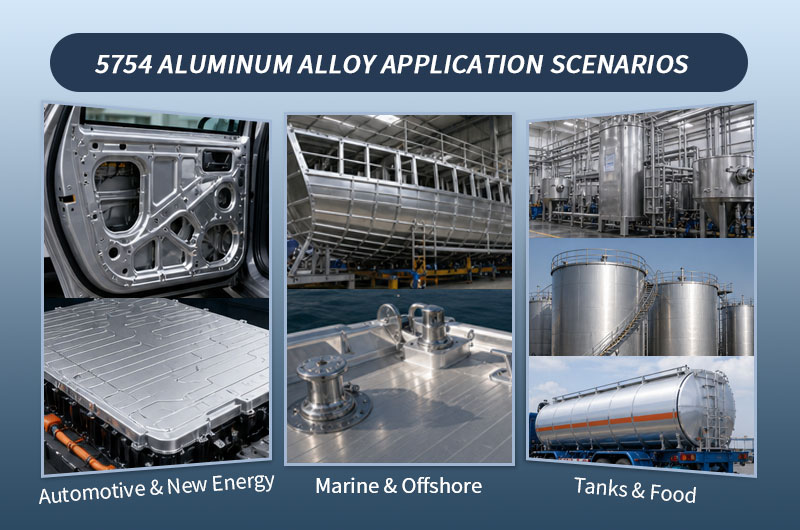
5754 Aluminum Alloy Application
- Automotive & New Energy: Inner door panels, battery pack upper covers, vehicle body frames, and industrial anti-slip tread plates.
- Marine & Offshore: Secondary hull structures, deck fittings, and seawater-contacting components (rust-proof without coatings).
- Tanks & Food: Liquid tanker trucks, chemical storage tanks, and food processing equipment (excellent welding sealing, complies with food-grade certifications).
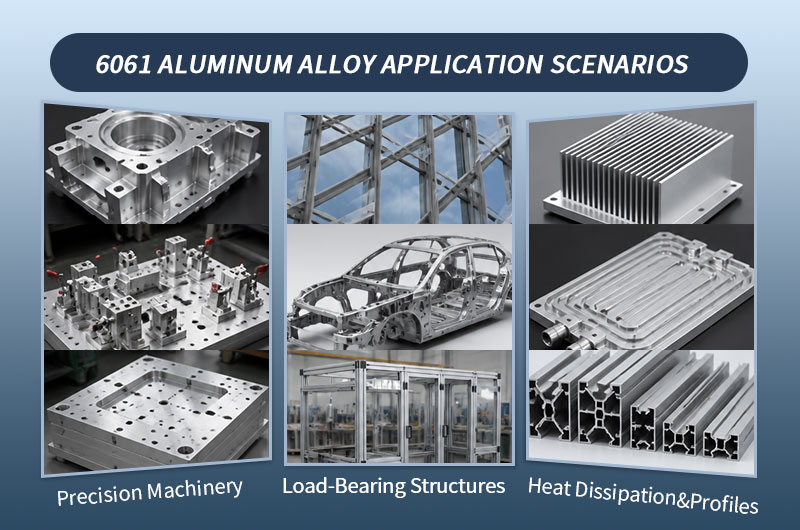
6061 Aluminum Alloy Application
- Precision Machinery: CNC machined parts, jigs and fixtures, mold base plates (dimensionally stable, no deformation).
- Load-Bearing Structures: Industrial equipment frames, automotive chassis frames, architectural curtain wall supports (high yield strength).
- Heat Dissipation & Profiles: Radiator bases, water-cooling plates, and various industrial extruded profiles with complex cross-sections (efficient thermal conductivity).
Selection Summary
- Choose 5754 Aluminum Alloy if your project focuses on:
- Sheet metal stamping (requires large-angle bending/deep drawing), OR strong corrosion resistance (contact with seawater/salt spray), OR large-area welding (requires no strength loss post-weld).
- Choose 6061 Aluminum Alloy if your project focuses on:
- High-strength load bearing (must withstand heavy pressure/prevent bending), OR precision CNC cutting (requires fine finishing), OR efficient heat dissipation/extrusion (making radiators or complex profiles).
International Standards Cross-Reference Table
| Region / Standard System | 5754 Equivalent Grade / Spec | 6061 Equivalent Grade / Spec |
|---|---|---|
| China (GB) | GB/T 3880 / GB/T 3190 | GB/T 3880 / GB/T 3190 |
| USA (ASTM) | ASTM B209 | ASTM B209 / B211 / B221 |
| USA (UNS) | UNS A95754 | UNS A96061 |
| Europe (EN) | EN AW-5754 (AlMg3) | EN AW-6061 (AlMg1SiCu) |
| Germany (DIN) | 3.3535 | 3.3214 |
| Japan (JIS) | - | JIS A6061 |
| International (ISO) | ISO AlMg3 | ISO AlMg1SiCu |
Supply Forms and Specifications
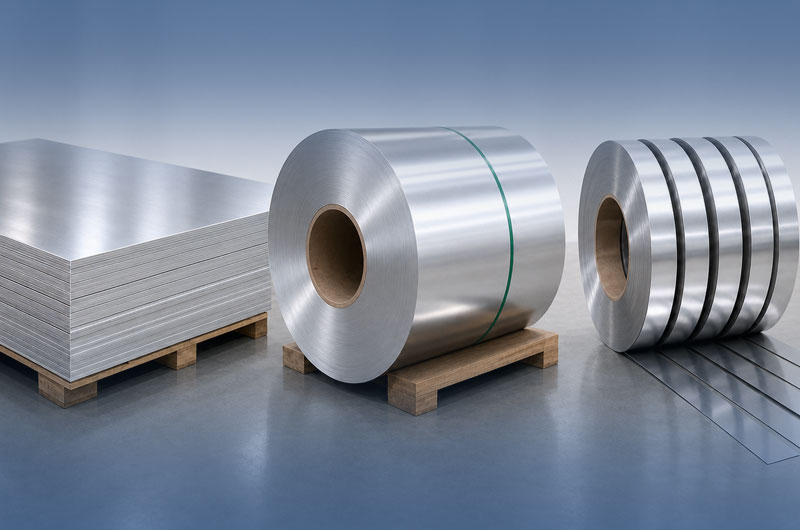
Worthwill focuses on providing you with high-quality core plate, sheet, and coil products for 5754 and 6061, supporting cut-to-length, flattening, and custom cutting according to drawings:
Core Product Forms
- Sheet & Plate: Widely used for sheet metal bending, auto body stampings, and CNC precision machined plates.
- Coil: Suitable for mass continuous stamping and automated production; can be slit on demand.
- Strip: Suitable for narrow-width stamping, cladding, and continuous forming processes.
- Circle / Disc: Exclusively used for deep-drawn containers, tank covers, and spin-formed parts.
Grades and Common Supply Tempers
- 5754 Common Tempers: O (soft), H111 (most common), H22, H24, H32, H112, etc. (Focuses on good formability and weldability).
- 6061 Common Tempers: O (annealed), T4, T6 (high strength), T651 (pre-stretched stress-relieved, first choice for deformation-free machining).
Specification Range Reference
- Thickness Range: 0.2 mm – 200 mm (Covering ultra-thin aluminum strips to ultra-thick machined aluminum plates).
- Width Range: 100 mm – 2650 mm (Supports custom ultra-wide plates/coils).
- Custom Services: Supports cut-to-length flattening, strip slitting, circle stamping, and surface protective film application.
About Worthwill
Henan Worthwill Industry Co., Ltd. specializes in the R&D, production, and global trade of aluminum alloy materials. We provide a variety of aluminum alloy plates, coils, and custom machined parts, including 5754 and 6061.
We strictly implement international standards such as GB/T, ASTM, and EN, and support Material Test Reports (MTR), third-party inspections, and customized specification supply. For specific product parameters, quotes, or material selection advice, please feel free to contact the professional Worthwill team.
Appendix: 5754 and 6061 Aluminum Alloy Performance Data Reference Tables
This appendix summarizes supplementary performance data not cited in the main text of the article, for the reference of engineers and procurement professionals.
Appendix A: 5754 Complete Mechanical Properties by Temper
| Temper | Tensile Strength (MPa) | Yield Strength (MPa) | Elongation (%) | Hardness (HB) | Fatigue Strength (MPa) | Shear Strength (MPa) |
|---|---|---|---|---|---|---|
| O | 190–210 | 80–90 | 19 | 44–52 | 96 | 130 |
| H111 | 190–240 | 80 | 14–18 | 52 | 96 | 130 |
| H12 | 240 | 190 | 5.5 | 66 | 140 | 140 |
| H14 | 260 | 210 | 4.0 | 72 | 100 | 150 |
| H16 | 280 | 250 | 2.4 | 80 | 100 | 160 |
| H18 | 320 | 280 | 2.0 | 88 | 100 | 180 |
| H22 | 220–270 | 130 | 7–10 | 63 | 110 | 140 |
| H24 | 240–280 | 160 | 6–8 | 70 | 100 | 150 |
| H26 | 265–305 | 190 | 4–5 | 78 | 120 | 170 |
| H28 | 300–330 | 260 | 3–4 | 87 | 110 | 190 |
| H32 | 240 | 150 | 8.4 | 63 | 120 | 140 |
| H34 | 260 | 190 | 7.8 | 70 | 110 | 150 |
| H36 | 290 | 220 | 4.7 | 78 | 110 | 170 |
| H38 | 320 | 270 | 3.9 | 87 | 120 | 190 |
Appendix B: 6061 Complete Mechanical Properties by Temper
| Temper | Tensile Strength (MPa) | Yield Strength (MPa) | Elongation (%) | Hardness (HB) | Fatigue Strength (MPa) | Shear Strength (MPa) |
|---|---|---|---|---|---|---|
| O | 125–130 | 55–76 | 20–25 | 33 | 61 | 84 |
| T1 | 210 | 110 | 16 | — | 86 | 130 |
| T4 | 210–241 | 110–145 | 16–22 | 63 | 96 | 170 |
| T42 | 230 | 110 | 18 | 57 | 58 | 140 |
| T451 | 240 | 130 | 20 | 63 | 95 | 170 |
| T51 | 270 | 230 | 7.8 | — | 110 | 160 |
| T6 | 290–310 | 240–276 | 8–12 | 93–95 | 96–110 | 207–210 |
| T62 | 320 | 270 | 8.7 | 88 | 100 | 190 |
| T651 | 290–320 | 240–270 | 10–12 | 93–95 | 95 | 207–210 |
| T6510 | 300 | 270 | 9.1 | — | 100 | 180 |
| T6511 | 290 | 270 | 9.0 | — | 100 | 170 |
| T652 | 280 | 250 | 3.4 | — | 81 | 160 |
| T89 | 410 | 370 | — | — | — | — |
| T94 | 410 | 370 | — | — | — | — |
Appendix C: 5754 Complete Physical Properties Data
| Property Item | Value |
|---|---|
| Density | 2.66–2.67 g/cm³ |
| Elastic Modulus | 68–70.5 GPa |
| Shear Modulus | 26–26.5 GPa |
| Poisson's Ratio | 0.33 |
| Thermal Conductivity | 130–147 W/m·K |
| Thermal Diffusivity | 54 mm²/s |
| Max Service Temp (Mechanical) | 190°C |
| Thermal Expansion Coefficient (20–100°C) | 23.7–24 μm/m·K |
| Electrical Conductivity | 30–34% IACS |
| Solidus Temperature | 600°C |
| Liquidus Temperature | 646–650°C |
| Latent Heat of Fusion | 400 J/g |
| Specific Heat Capacity | 900 J/kg·K |
| Carbon Footprint | 8.7 kg CO₂/kg |
| Embodied Energy | 150 MJ/kg |
Appendix D: 6061 Complete Physical Properties Data
| Property Item | Value |
|---|---|
| Density | 2.70 g/cm³ |
| Elastic Modulus | 68.9–69 GPa |
| Shear Modulus | 26 GPa |
| Poisson's Ratio | 0.33 |
| Thermal Conductivity | 152–170 W/m·K |
| Thermal Diffusivity | 68 mm²/s |
| Max Service Temp (Mechanical) | 170°C |
| Thermal Expansion Coefficient (20–100°C) | 23.6–24 μm/m·K |
| Electrical Conductivity | 43% IACS |
| Solidus Temperature | 580°C |
| Liquidus Temperature | 650°C |
| Latent Heat of Fusion | 400 J/g |
| Specific Heat Capacity | 900 J/kg·K |
| Fracture Toughness (KIC, T6) | 20–29 MPa·m½ |
| Calomel Potential | -740 mV |
| Carbon Footprint | 8.3 kg CO₂/kg |
| Embodied Energy | 150 MJ/kg |
Appendix E: 6061 Mechanical Property Changes at Different Temperatures (T6 Temper)
| Temperature (°C) | Tensile Strength (MPa) | Yield Strength (MPa) | Elongation (%) |
|---|---|---|---|
| 20 | 275–310 | 240 | 12 |
| 100 | 220–300 | 220 | 15 |
| 200 | 180–260 | 180 | 20 |
| 300 | 150–230 | 150 | 25 |
Appendix F: 5754 vs. 6061 Process Performance Comprehensive Rating Comparison
| Process / Performance | 5754 | 6061 | Description |
|---|---|---|---|
| TIG Welding | Excellent | Good | 5754 needs no post-weld heat treatment |
| MIG Welding | Excellent | Good | 5754 weld seams are more stable |
| Deep Drawing | Good | Poor | 5754 O-temper elongation is 19% |
| Cold Bending | Good | Good | Bending T6 temper 6061 requires caution |
| Machinability | Fair to Good | Excellent | 6061 is the top choice for CNC |
| Laser Cutting | Excellent | Good | 5754 is more suitable for laser cutting |
| Anodizing (Protective) | Excellent | Excellent | Both perform well |
| Anodizing (Decorative EQ) | Excellent | Excellent | 5754 EQ grade must be separately ordered/confirmed |
| Atmospheric Corrosion Res. | Excellent | Good | — |
| Marine Corrosion Res. | Excellent | Fair | 5754 is significantly superior to 6061 |
| Food Contact Suitability | Yes (DIN EN 602) | Must be confirmed | — |
| Extrusion Forming | Poor | Good | 6061 is a mainstream extrusion alloy |
| Heat Treatable | No | Yes (T6, etc.) | A fundamental difference |