


5083 vs. 6061 Aluminum Alloy
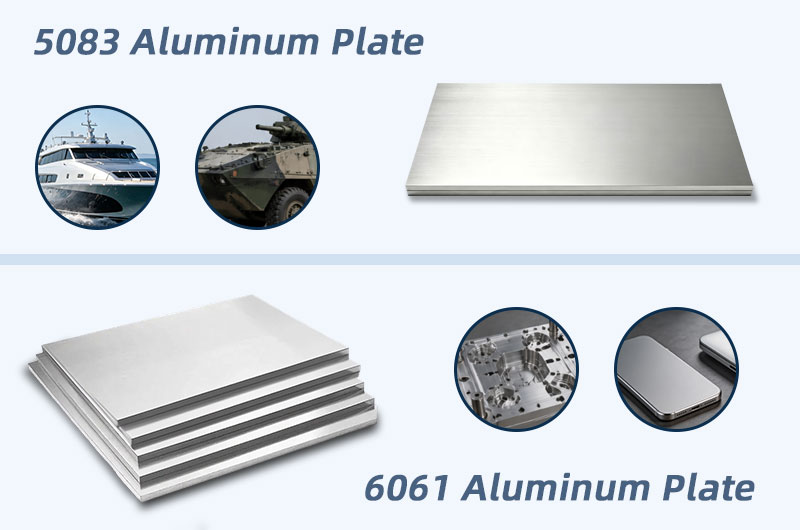
In the world of aluminum alloys, 5083 and 6061 aluminum are two classic grades that are frequently discussed and widely procured.
They both belong to wrought aluminum alloys, share a similar density, and offer reasonable pricing. Yet, when it comes to performance orientation, they take entirely different paths.
Based on real performance data, this article will systematically compare 5083 and 6061 aluminum across multiple dimensions — alloy composition, mechanical properties, corrosion resistance, weldability, machinability, and typical applications. Our goal is to help you find the most suitable answer for your project.
Quick Comparison Table: 5083 vs. 6061 at a Glance
Before diving deep, take a look at this table to quickly determine which alloy is closer to your needs.
| Comparison Item | 5083 (H116 Temper) | 6061 (T6 Temper) |
|---|---|---|
| Alloy Series | Al-Mg (5xxx Series) | Al-Mg-Si (6xxx Series) |
| Tensile Strength | 305–320 MPa | 290–310 MPa |
| Yield Strength | 215–230 MPa | 240–270 MPa |
| Fatigue Strength | 150–160 MPa | 95–96 MPa |
| Thermal Conductivity | 120 W/m·K | 167–170 W/m·K |
| Electrical Conductivity | 29% IACS | 43% IACS |
| Max Service Temp (Corrosion) | 65°C | No specific limit |
| Seawater Corrosion Resistance | Excellent | Good (Requires surface treatment) |
| Weldability | Excellent, good post-weld strength retention | Weldable, significant post-weld strength drop |
| Machinability (Mechanical) | Fair (30%) | Excellent |
| Anodizing Effect | Fair | Excellent |
For more data comparisons, please refer to the data summary in the Appendix below.
5083 vs. 6061: Alloy Composition Comparison
The fundamental difference between 5083 and 6061 lies in their alloy systems and strengthening mechanisms:
- 5083 Aluminum: Al-Mg series. Because it does not contain silicon and copper, it cannot form age-hardening phases and belongs to non-heat-treatable aluminum alloys.
- 6061 Aluminum: Al-Mg-Si series. It can significantly increase its strength through aging treatments and belongs to heat-treatable aluminum alloys.
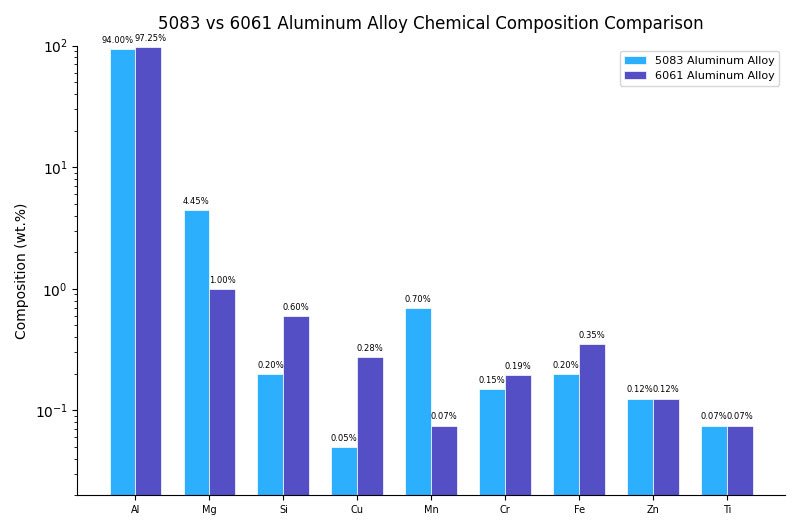
5083 vs. 6061 Chemical Composition Chart (Weight %)
| Element | 5083 | 6061 |
|---|---|---|
| Al (Aluminum) | 92.4–95.6 (Rem.) | 95.9–98.6 (Rem.) |
| Mg (Magnesium) | 4.0–4.9 | 0.8–1.2 |
| Si (Silicon) | ≤0.40 | 0.40–0.8 |
| Cu (Copper) | ≤0.10 | 0.15–0.40 |
| Mn (Manganese) | 0.40–1.0 | ≤0.15 |
| Cr (Chromium) | 0.05–0.25 | 0.04–0.35 |
| Fe (Iron) | ≤0.40 | ≤0.70 |
| Zn (Zinc) | ≤0.25 | ≤0.25 |
| Ti (Titanium) | ≤0.15 | ≤0.15 |
Core Conclusion
The fundamental divergence in composition determines all their subsequent differences in mechanical properties, machinability, and corrosion resistance.
5083 vs. 6061: Mechanical Properties Comparison
Strength Comparison
In similar application states, the tensile strength of 5083 (H116) is about 305–320 MPa, while 6061 (T6) is around 290–310 MPa — quite close to each other.
However, in terms of yield strength, 6061-T6 reaches 240–270 MPa, higher than 5083-H116's 215–230 MPa. This means 6061 has an advantage in preventing permanent deformation of structural components.
Conversely, the fatigue strength of 5083 is significantly higher (160 MPa vs. 96 MPa, H116 vs. T6 temper), which is crucial in applications that endure alternating loads, such as ships and pressure vessels.
Hardness and Ductility
The Brinell hardness of 6061-T6 is about 93–95 HB, notably higher than 5083-H116's 75–83 HB. Therefore, 6061 offers better wear resistance, making it more suitable for precision parts that require surface hardness.
The elongation of both alloys in their common tempers is roughly 10–12%, meaning their plasticity is comparable.
Elastic Modulus
The elastic moduli of the two are very close: 5083 is about 68–70 GPa, and 6061 is about 69 GPa, showing equivalent structural stiffness.
Effect of Temperature on Strength
5083 experiences a relatively slow decline in strength at high temperatures, with an upper limit for mechanical use at about 190°C. However, its corrosion resistance drops significantly above 65°C, so its practical upper limit in corrosive environments is 65°C.
6061's upper limit for mechanical use is about 170°C, above which its strength drops noticeably. At 200°C, the yield strength drops from 240 MPa to about 180 MPa, and further to about 150 MPa at 300°C.
Conclusion
Neither is suitable for long-term high-temperature service, but both perform stably in the room to medium temperature range.
5083 vs. 6061: Corrosion Resistance Comparison
5083 Corrosion Resistance Features
- Self-healing protection mechanism: Its high magnesium content (4.0–4.9%) allows its surface to form a dense and self-healing oxide protective layer. It offers outstanding corrosion resistance in seawater, industrial chemical media, and atmospheric environments (pH 4–9).
- Marine grade standard: The H116 temper has passed the ASTM G66 exfoliation corrosion test, making it a recognized benchmark for marine-grade aluminum alloys.
- Operating temperature limit: Long-term operating temperature must not exceed 65°C; otherwise the risk of intergranular and exfoliation corrosion will significantly increase.
6061 Corrosion Resistance Features
6061 has good corrosion resistance in atmospheric environments and fresh water, naturally forming an aluminum oxide protective layer about 4 nm thick.
However, due to the presence of copper, 6061's corrosion resistance is inferior to that of pure aluminum or 5xxx series alloys. In marine atmospheres or chlorine-containing media, untreated 6061 carries a risk of pitting corrosion.
The good news is that 6061 responds exceptionally well to anodizing. Anodizing significantly enhances its corrosion resistance and provides an aesthetically pleasing decorative effect, which leads to its wide application in architectural exteriors and consumer electronics.
Corrosion Resistance Conclusion
| Corrosion Scenario | Recommended Material |
|---|---|
| Long-term seawater immersion / Shipbuilding | 5083 |
| Industrial chemical contact | 5083 |
| Atmospheric environment (No anodizing needed) | 5083 is slightly better |
| Atmospheric environment (After anodizing) | 6061 is highly competitive |
| Freshwater environment | Both are suitable |
5083 vs. 6061: Welding Performance Comparison
5083's Welding Advantages
5083 is recognized as an excellent weldable aluminum alloy. Not only does it have a wide welding process window, but more importantly: the post-weld joint strength is exceptionally well-retained, and the performance loss in the heat-affected zone (HAZ) is far less than that of 6061.
- Recommended welding wires: 5183, 5356, 5556 — all matching 5xxx series consumables with good chemical compatibility with the base metal.
- Both TIG and MIG welding can be used, and its arc welding performance is rated as "Excellent." This makes it an ideal structural welding material for shipbuilding — where post-weld heat treatment to restore lost performance is almost impossible.
6061's Welding Limitations
6061 can be welded, but there is an unavoidable issue: the strength in the welding heat-affected zone (HAZ) drops significantly, approaching the annealed (O) state level. The yield strength plummets from 270 MPa (T6 temper) to about 125–145 MPa.
To restore strength close to that of the base metal, post-weld solution + aging treatment must be performed again. This increases process complexity and cost, and is often impossible to execute on large structural components.
Weldability Comparison Conclusion
| Weldability Indicator | 5083 | 6061 |
|---|---|---|
| Arc Weldability | Excellent | Good |
| Post-weld Strength Retention | Excellent (Low loss) | Poor (Requires post-treatment) |
| Recommended Filler Wire | 5183 / 5356 / 5556 | 4043 / 5356 |
| PWHT Requirement | Not required | Usually required |
| Suitability for Large Structures | Highly suitable | Conditionally suitable |
If your project requires extensive welding and post-weld heat treatment is impossible, 5083 is the undisputed choice.
5083 vs. 6061: Machinability & Processing Comparison
Mechanical Machinability
The mechanical machinability of 6061 is one of its most significant advantages. In the T6 temper, 6061 machines smoothly, offers good chip breaking, causes low tool wear, and yields a high surface finish post-machining. It is the ideal material for manufacturing precision parts, fixtures, mold bases, and optical instrument mounts.
5083 has a relatively lower machinability rating (only 30%). It tends to be "gummy" and stick to the cutting tools, making surface roughness harder to control. This is directly related to its higher plasticity and toughness caused by the high magnesium content.
Forming Machinability
In terms of cold forming, 5083 (in O temper or H111 temper) has good bending formability, suitable for press forming and folding processes. This is also its key advantage in manufacturing ship plates and storage tanks.
6061 has good formability in O and T4 tempers, but in the high-strength T6 temper, formability decreases, requiring springback control during complex bending.
Extrusion Performance
6061 is a standout representative for excellent extrusion performance among the 6xxx series alloys. It can be manufactured into profile cross-sections with complex shapes and is widely used in architectural profiles and industrial frames.
5083 can also be extruded, but due to its higher strength, it requires much greater extrusion force, and creating complex cross-sections is relatively more difficult.
Anodizing and Surface Treatment
The anodizing effect of 6061 is highly outstanding. The oxide film is uniform and dense, and it offers a wide range of coloring options. This is a major reason why 6061 is widely chosen in the consumer electronics and architectural decoration sectors.
5083 can be anodized, but the results are only average. It is better suited for using protective coatings to enhance corrosion resistance rather than pursuing aesthetic, decorative appearances.
5083 vs. 6061: Physical Properties Comparison
Both alloys share the same density (2.7 g/cm³) and equivalent weight, inherently possessing the natural lightweight advantages of aluminum alloys.
| Physical Property | 5083 | 6061 |
|---|---|---|
| Density (g/cm³) | 2.66–2.70 | 2.70 |
| Elastic Modulus (GPa) | 68–70 | 69 |
| Thermal Conductivity (W/m·K) | 117–121 | 167–170 |
| Coeff. of Thermal Expansion (μm/m·K) | 23.8–24.2 | 23.6–24 |
| Electrical Conductivity (% IACS) | 29 | 43 |
| Specific Heat Capacity (J/kg·K) | 900 | 900 |
| Solidus Temperature (°C) | 574–591 | 580 |
| Liquidus Temperature (°C) | 638–640 | 650 |
Differences in Thermal Conductivity deserve special attention: The thermal conductivity of 6061 (~170 W/m·K) is about 1.4 times that of 5083 (~120 W/m·K). For applications requiring high thermal conductivity, such as heat sinks and heat exchangers, 6061 has a distinct advantage.
The same goes for Electrical Conductivity: 6061 (43% IACS) is significantly higher than 5083 (29% IACS), making 6061 more suitable for applications requiring a certain degree of electrical conductivity.
5083 vs. 6061: Common Tempers Breakdown
Understanding temper designations is a prerequisite for accurate procurement.
5083 Common Tempers
| Temper | Description | Typical Use |
|---|---|---|
| O | Annealed and soft, highest elongation (17%) | Forming, bending |
| H111 | Slight strain hardening, good formability | Storage tanks, LNG tanks |
| H112 | Hot working temper, with mechanical property requirements | Thick plates, forgings |
| H116 | Optimized for marine environments, passes ASTM G66 | Ship hulls, marine structures |
| H321 | Strain hardened + thermally stabilized, anti-intergranular corrosion | Pressure vessels, marine uses |
| H131 | Dedicated military armor specification | Armor plates, APCs |
When used for shipbuilding, it is recommended to prioritize H116 or H321 tempers, both of which comply with the ASTM B928M marine-grade aluminum alloy standard.
6061 Common Tempers
| Temper | Description | Typical Use |
|---|---|---|
| O | Annealed and soft, best plasticity | Deep drawing, complex forming |
| T4 | Solution + natural aging, good formability | Complex bent parts |
| T6 | Solution + artificial aging, optimum strength | Structural parts, general high-strength uses |
| T651 | T6 + stress-relieved by stretching, dimensionally stable | CNC precision parts, mold bases |
| T89 / T94 | Aged + strain hardened, max strength up to 410 MPa | Ultra-high-strength special occasions |
When used for precision machining, it is recommended to choose the T651 temper, which has low internal stress and minimal deformation after machining.
Typical Applications Comparison
Core Applications of 5083 Aluminum Alloy
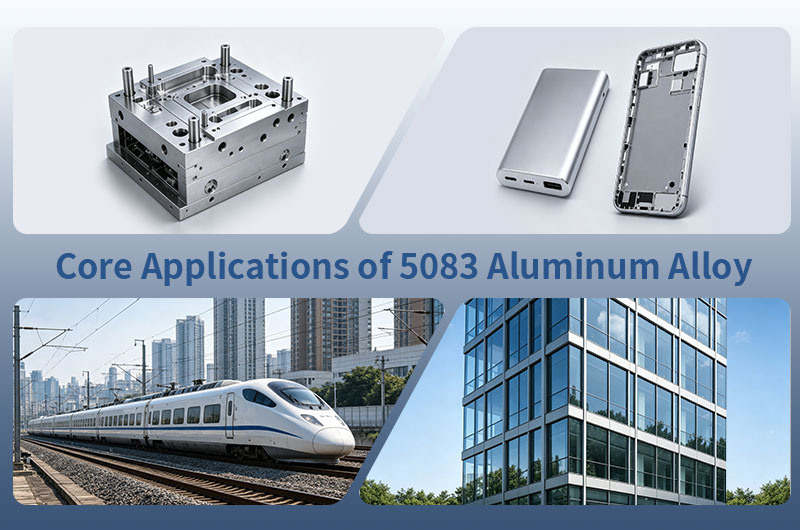
Having obtained certifications from multiple classification societies such as CCS, BV, LR, ABS, and DNV, it is a benchmark material in marine engineering and heavy industry.
- Shipbuilding and Marine Engineering: Hull outer plates, side plates, decks, yachts, and workboat structural components.
- Cryogenic and Pressure Vessels: LNG storage tanks, cryogenic vessels, pressure vessels complying with AS1210 standards (≤65°C).
- Defense and Heavy Equipment: MIL-spec armor plates (H131 temper), armored personnel carriers, missile components, drilling equipment.
Core Applications of 6061 Aluminum Alloy
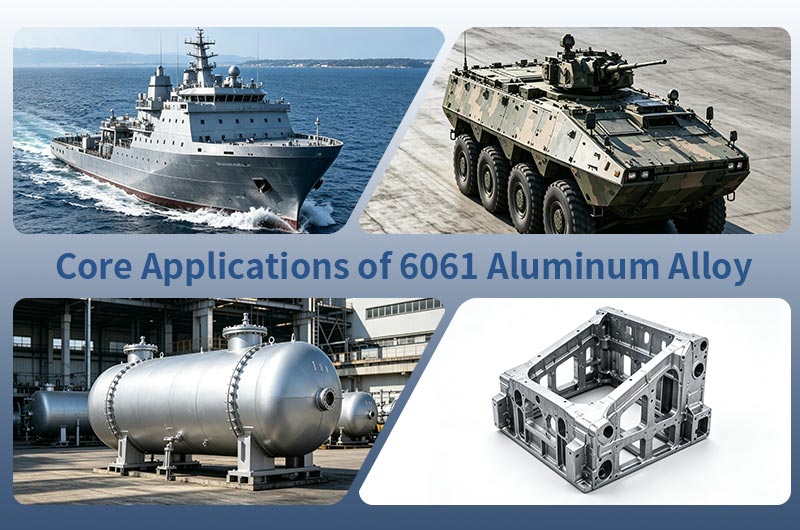
Possessing excellent machinability and surface treatment effects, it is the most widely applied general-purpose material in the industrial sector.
- Precision Manufacturing and Molds: CNC precision parts, automated robotic arms, jigs and fixtures, mold bases.
- Electronics and Lightweight Products: 3C device enclosures, heat sinks, high-end bicycle frames, drone skeletons.
- Automotive and Rail Transit: Car bumpers, chassis parts, railway and subway car structural components.
- Architecture and Aerospace: Premium curtain walls, doors and windows, aircraft non-load-bearing structural parts, and cargo floorings.
Cost and Market Supply
Pricing Factors
Overall, the raw material prices for 5083 and 6061 are similar, both sitting in the mid-range price segment of the aluminum alloy market.
However, due to specific marine-grade certifications (H116/H321) and military armor certifications (H131), certain specifications of 5083 will be priced higher than standard 6061.
Because 6061 is so universally used, market supply is abundant, and common specifications (T6/T651) generally offer more affordable pricing and shorter lead times.
Form of Supply: Both can be supplied as aluminum plates, coils, bars, tubes, profiles, and forgings.
Worthwill In-Stock Specifications Coverage
| Specification | 5083 | 6061 |
|---|---|---|
| Aluminum Plate Thickness | 1–250 mm | 1–250 mm |
| Aluminum Plate Width | ≤2650 mm | ≤2500 mm |
| Aluminum Bar Diameter | 3–200 mm | 6–250 mm |
| Execution Standards | ASTM B209, B928M, EN 485, GB/T 3880 | ASTM B209, EN 485, GB/T 3880 |
How to Choose
For overlapping application scenarios like transportation structural parts, specific pressure vessels, and ship superstructures, we recommend following this priority logic to make a quick decision:
Decision Priority Logic
- 1. Do you have anti-corrosion and welding needs?
- If the project involves seawater, marine atmospheres, or industrial chemical environments; or if large-area welding is required and post-weld heat treatment is impossible — prioritize 5083.
- 2. Do you have machining and appearance needs?
- If the project requires precision mechanical machining (CNC milling) with strict dimensional stability demands; or if you need anodizing treatments for aesthetic effects; or if you have clear requirements for thermal/electrical conductivity — prioritize 6061 (T651 temper recommended).
- 3. Do you have purchasing cost and lead time needs?
- If the project does not involve the special requirements above, the performance of both materials will suffice. Make a flexible decision based on your supplier's pricing and in-stock lead times.
Reference Execution Standards
| Standard | Scope of Application | 5083 | 6061 |
|---|---|---|---|
| ASTM B209 | Aluminum and Aluminum-Alloy Sheet and Plate | Yes | Yes |
| ASTM B928M | Marine Grade High-Mg Aluminum Plate | Yes | No |
| MIL-DTL-46027 | Military Armor Aluminum Plate | Yes (H131) | No |
| EN 485 | European Standard Aluminum Sheet and Plate | Yes | Yes |
| GB/T 3880 | Chinese National Standard Aluminum Sheet/Plate | Yes | Yes |
| GB/T 3190 | Chemical Composition of Wrought Aluminum | Yes | Yes |
| AMS 4057/4058 | Aerospace Aluminum Alloy Plate | Yes | Yes |
| AS/NZS 1734 | Aus/NZ Standard Aluminum Sheet and Plate | Yes | Yes |
Conclusion
Between 5083 and 6061, there is no absolute superiority or inferiority — only whether it is suitable for your application scenario.
5083 is the guardian of extreme environments — when your product needs to face ocean waves, chemicals, and repetitive welding, it is your most reliable choice.
6061 is the all-rounder of industrial applications — when you need precision machining, beautiful surfaces, and flexible heat treatment adjustments, it gives you the most possibilities.
Worthwill Industry is a long-term supplier of a full range of 5083 and 6061 aluminum alloy products, covering tempers like O, H111, H116, H321, T4, T6, and T651. We support mainstream standards such as ASTM, EN, and GB, and can provide third-party certifications, Classification Society certificates, and military compliance reports.
Appendix: 5083 & 6061 Aluminum Alloy Performance Data Summary
Data is sourced from the internet for technical comparison and procurement decision reference only. Not to be used as an absolute purchasing basis.
Appendix Table 1: 5083 Mechanical Properties by Temper
| Temper | Tensile Strength (MPa) | Yield Strength (MPa) | Elongation (%) | Hardness (HB) | Fatigue Strength (MPa) |
|---|---|---|---|---|---|
| O | 275–300 | 125–140 | 17–23 | 75 | 150 |
| H111 | 300 | 145–150 | 13 | 75 | 120 |
| H112 | 275–300 | 125–130 | 10–13 | 75 | 110 |
| H116 | 305–320 | 215–230 | 10–12 | 83 | 160 |
| H321 | 305–385 | 215–295 | 10–13 | 89 | 160 |
| H32 | 305–330 | 215–240 | 9.8–10 | 89 | 160 |
| H12 | 340 | 250 | 5.1 | 94 | 180 |
| H14 | 360 | 290 | 3.4 | 100 | 140 |
| H16 | 390 | 340 | 1.1 | 110 | 140 |
| H22 | 340 | 240 | 8.8 | 89 | 190 |
| H24 | 360 | 270 | 4.5 | 99 | 140 |
| H26 | 390 | 320 | 2.2 | 110 | 170 |
| H34 | 360 | 290 | 7.5 | 99 | 160 |
| H36 | 390 | 320 | 2.2 | 110 | 160 |
Appendix Table 2: 6061 Mechanical Properties by Temper
| Temper | Tensile Strength (MPa) | Yield Strength (MPa) | Elongation (%) | Hardness (HB) | Fatigue Strength (MPa) |
|---|---|---|---|---|---|
| O | 130 | 76 | 20 | 33 | 61 |
| T1 | 210 | 110 | 16 | — | 86 |
| T4 | 230 | 130 | 18 | 63 | 96 |
| T42 | 230 | 110 | 18 | 57 | 58 |
| T451 | 240 | 130 | 20 | 63 | 95 |
| T51 | 270 | 230 | 7.8 | — | 110 |
| T6 | 310 | 270 | 10 | 93 | 96 |
| T62 | 320 | 270 | 8.7 | 88 | 100 |
| T651 | 320 | 270 | 11 | 93 | 95 |
| T6511 | 290 | 270 | 9.0 | — | 100 |
| T652 | 280 | 250 | 3.4 | — | 81 |
| T89 / T94 | 410 | 370 | — | — | — |
Appendix Table 3: Physical Properties Comparison
| Physical Property | 5083 | 6061 |
|---|---|---|
| Density (g/cm³) | 2.66–2.70 | 2.70 |
| Elastic Modulus (GPa) | 68–70 | 69 |
| Shear Modulus (GPa) | 26 | 26 |
| Poisson's Ratio | 0.33 | 0.33 |
| Thermal Conductivity (W/m·K) | 117–121 | 167–170 |
| Coeff. of Thermal Expansion (μm/m·K) | 23.8–24.2 | 23.6–24 |
| Specific Heat Capacity (J/kg·K) | 900 | 900 |
| Electrical Conductivity (% IACS) | 29 | 43 |
| Solidus Temperature (°C) | 574–591 | 580 |
| Liquidus Temperature (°C) | 638–640 | 650 |
| Thermal Diffusivity (mm²/s) | 48 | 68 |
| Max Mechanical Service Temp (°C) | 190 | 170 |
| Max Corrosion Service Temp (°C) | 65 | No specific limit |
| Calomel Potential (mV) | -780 | -740 |
Appendix Table 4: Process Performance Comparison
| Process Performance | 5083 | 6061 |
|---|---|---|
| Heat-treatable Strengthening | No | Yes |
| Arc Weldability | Excellent | Good |
| Post-weld Strength Retention | Excellent | Poor (PWHT required) |
| Machinability | Fair (30%) | Excellent |
| Cold Forming | Good | Good (Low strength tempers) |
| Anodizing Effect | Fair | Excellent |
| Brazability | Poor | Poor |
| Electroplating | Fair | Good |
Appendix Table 5: High-Temperature Tensile Strength Reference
| Temperature (°C) | 5083 Tensile Strength (MPa) | 6061-T6 Tensile Strength (MPa) |
|---|---|---|
| 20 | 290–320 | 310 |
| 100 | — | 300 |
| 200 | — | 260 |
| 300 | — | 230 |
Note: 5083 experiences a decline in corrosion resistance above 65°C and is not recommended for high-temperature corrosive environments. 6061 experiences significant mechanical performance degradation above 170°C.