


8011 vs. 8021 vs. 8079 vs. 8006 Aluminum
In aluminum foil procurement, one question is repeatedly asked:
"8021, 8079, 8011, and 8006 are all 8-series aluminum foils. What exactly is the difference? Which one should I choose?"
This seemingly simple question causes headaches for many procurement decision-makers—because the cost of choosing the wrong alloy is not small. Insufficient elongation leading to stamping cracks, inadequate strength causing packaging breakage, or paying a premium for a high-end alloy without utilizing its value... These issues are not uncommon in actual production.
Core Summary
- 8011:The most versatile and cost-effective, the first choice for general food/pharmaceutical/industrial packaging.
- 8021:High iron, low silicon; the industry standard for pouch battery Alu-plastic film and cold-formed blister foil.
- 8079:The highest elongation; the "king of flexibility" for high-end pharma packaging and pouch batteries.
- 8006:Hot-rolled exclusive; the only correct answer for wrinkle-free containers and heat exchanger fins.
This article will help you thoroughly understand the core differences between these four alloys in the most direct way, helping you quickly find the best choice for your needs.
Let's Start with the Conclusion: What is Each Alloy Best At?
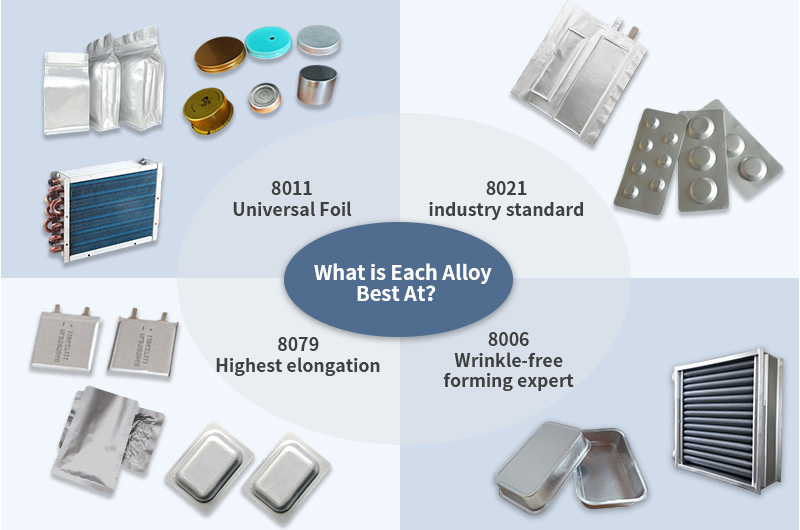
If you are short on time, look at this summary table first:
| Alloy | One-Sentence Positioning | Most Typical Applications |
| 8011 | The "Universal Foil": most versatile and highest cost-performance | Food packaging, PTP pharma foil, bottle cap material, AC fins |
| 8021 | High Fe, low Si: the industry standard for pouch batteries and cold-formed pharma foil | Lithium battery Alu-plastic film, cold-formed pharmaceutical foil |
| 8079 | Highest elongation: the outstanding "deep drawing choice" for flexibility | Tropical blister packaging, high-end flexible food packaging, pouch batteries |
| 8006 | Wrinkle-free forming expert: the exclusive material for containers | Airline containers, takeout containers, heat exchanger fins |
Why Does the 8-Series Aluminum Foil Dominate the Packaging Market?
Pure aluminum, such as 1235 aluminum foil, has excellent conductivity but low strength and easily deforms, meaning it cannot support the mechanical requirements of packaging forming.
The 8-series aluminum foil solves this by adding elements likeIron (Fe), Silicon (Si), and Manganese (Mn)to the aluminum. While maintaining aluminum's natural advantages of being lightweight, non-toxic, and having excellent barrier properties, it significantly improves strength, ductility, and processing performance.
Because of this, 8-series aluminum foil accounts for the largest consumption volume globally, widely covering core markets such as food packaging, pharmaceutical packaging, new energy batteries, and heat exchangers.
Among them, these four alloys—8011, 8021, 8079, and 8006—together cover the vast majority of global 8-series aluminum foil consumption.
Chemical Composition Comparison
| Element | 8011 | 8021 | 8079 | 8006 |
| Al | ≥97.5% | 97.9~98.8% | ≥98.1% | 95.9~98.5% |
| Fe | 0.60~1.00% | 1.20~1.70% | 0.70~1.30% | 1.20~2.00% |
| Si | 0.50~0.90% | ≤0.15% | 0.05~0.30% | ≤0.40% |
| Cu | ≤0.10% | ≤0.05% | ≤0.05% | ≤0.30% |
| Mn | ≤0.20% | — | — | 0.30~1.00% |
| Mg | ≤0.05% | — | — | ≤0.10% |
| Zn | ≤0.10% | ≤0.10% | ≤0.10% | ≤0.10% |
| Ti | ≤0.08% | ≤0.08% | — | — |
The higher the iron content (e.g., 8006, 8021), the stronger and tougher the material. The unique "extremely low silicon" formula of 8021 gives it very few pinholes and unbeatable deep drawing performance. In contrast, because 8011 and 8006 contain manganese, they sacrifice some flexibility in exchange for higher mechanical strength.
Production Process Comparison: Cast Rolling vs. Hot Rolling
This is the most easily overlooked yet most profound factor affecting aluminum foil performance.
Cast Rolling (CC) is a process where molten aluminum is directly solidified into a strip through a caster. It has a short process and low cost. 8011, 8079, and 8021 are usually produced via cast rolling, and the resulting foil meets the vast majority of packaging needs. There are also cast-rolled 8006 products, suitable for standard container foil applications.
Hot Rolling (DC) involves casting aluminum ingots into thick slabs first, which are then thinned through multi-pass hot rolling. The internal structure undergoes sufficient deformation and recrystallization, resulting in finer, more uniform grains, higher elongation, and flat, wrinkle-free edges after stamping. High-end 8006 aluminum foil uses the hot-rolling process, which is the core reason it achieves wrinkle-free stamping and an exquisite appearance.
Simply put: Hot-rolled 8006 is suitable for applications with extremely high aesthetic requirements, like airline containers; cast-rolled 8006 meets regular container foil needs at a lower cost. When purchasing, you must confirm the supplier's production process to avoid buying cast-rolled products passed off as hot-rolled specifications.
| Process Type | Grain Size | Elongation | Stamping Appearance | Cost | Typical Models |
| Cast Rolling | 30~100 μm | Moderate | Average | Low | 8011, 8079, 8021, 8006 (Standard) |
| Hot Rolling | 5~30 μm | Higher | Wrinkle-free | Higher | 8006 (High-end), 8021 (Optional) |
In-Depth Comparison of Mechanical Properties
| Performance Indicator | 8011 | 8021 | 8079 | 8006 |
| Tensile Strength (O Temper) (MPa) | 80~110 | 70~100 | 80~100 | 123~135 |
| Elongation (O Temper) (%) | Approx. 10~15 | ≥18 | ≥20 | Excellent |
| Cupping Value (O Temper) (mm) | 4.5~6.0 | 5.5~7.0 | 6.2~7.5 | Higher |
| Tensile Strength (H14 Temper) (MPa) | 125~165 | 110~140 | Approx. 120~150 | — |
| Tensile Strength (H18 Temper) (MPa) | Approx. 150~170 | ≥160 | Approx. 150 | — |
| Density (g/cm³) | ~2.71 | 2.71~2.73 | 2.72 | 2.74 |
Quick Key Takeaways:
- Crack Resistance (Deep Drawability):8079 > 8021 > 8011. The higher the value, the less likely it is to crack during stamping.
- Strongest in Soft State (O Temper):8006 maintains leading strength even in the soft state. It holds its shape directly after stamping into containers without needing additional hardening.
- Highest Upper Limit in Hard State (H Temper):8011 reaches the maximum strength after hardening, making it the first choice for applications requiring high structural integrity (like bottle caps and industrial foils).
Pinhole Rate: The Often-Overlooked Barrier Indicator
Pinholes are tiny defects in aluminum foil production that are almost impossible to eliminate entirely, but their impact on packaging barrier properties cannot be underestimated.
Due to their special alloy ratios, 8021 and 8079 have extremely fine grain sizes, resulting in a significantly lower pinhole rate than other alloys at the same thickness. Take 7 μm ultra-thin foil as an example: the number of pinholes in 8021/8079 is reduced by about 70% compared to traditional foil. This has a direct impact on the sealing reliability of pharmaceutical packaging and pouch batteries.
Barrier Properties and Health & Safety
Barrier Properties
| Barrier Indicator | 8011 | 8021 | 8079 | 8006 |
| Water Vapor Transmission Rate (WVTR) (g/m²·24h) | <0.5 | Extremely Low | ≤0.1 | Good |
| Oxygen Transmission Rate (OTR) (cm³/m²·24h·0.1MPa) | <0.5 | Extremely Low | ≤0.5 | Good |
| Light Blockage Rate | 100% | 100% | 100% | 100% |
All four alloys provide a 100% light blockage rate when thick enough. This is the absolute advantage of aluminum foil over plastic films and is irreplaceable for packaging light-sensitive drugs.
In terms of water vapor and oxygen barriers, 8021 and 8079 perform the best thanks to their extremely low pinhole rates, making them the first choice for applications with strict moisture and oxygen barrier requirements.
Food and Drug Safety
All four alloys meet safety standards for food contact materials:
- Non-toxic and odorless, passing bacteria and mold tests.
- Surface water brushing test reaches Grade A standard.
- Compliant with GB 4806.7-2016 (Food Contact Materials), YBB00152002 (Pharmaceutical Foil), and other domestic and international standards.
Among them, 8021has the strictest control over heavy metals: Lead (Pb) ≤0.01 mg/kg, Cadmium (Cd) ≤0.005 mg/kg, with total heavy metals not exceeding 0.25 ppm, making it the highest health and safety standard among the four.
Corrosion Resistance and Temperature Adaptability
Corrosion Resistance
Aluminum naturally forms a dense oxide film (Al₂O₃) on its surface, giving it good corrosion resistance in neutral and weakly acidic environments. The four alloys have different strengths:
- 8011:Contains Mn and Mg, possessing the strongest general corrosion resistance, suitable for industrial environments.
- 8021:Optimized through specific processes, it has outstanding corrosion resistance against lithium battery electrolytes (LiPF₆-based), which is a core performance requirement for pouch battery Alu-plastic films.
- 8079:Corrosion resistance in the pH 3~11 range is about 30% higher than traditional foil, suitable for various special food packaging.
- 8006:Performs stably in food contact and heat exchanger working environments.
Temperature Adaptability
| Alloy | Working Temperature Range | Remarks |
| 8079 | -73℃ to +371℃ | Widest temperature adaptation range |
| 8006 | -73℃ to +371℃ | Thermal conductivity 190~210 W/m·K, first choice for heat exchangers |
| 8011 | Wide temperature range | Suitable for 121℃/30 min retort sterilization food packaging |
| 8021 | Normal packaging temp | Starts melting at 640~650℃, fully stable in working state |
Detailed Alloy Breakdown
8011: The "All-Rounder" with the Largest Market Volume
8011 is the most widely used alloy in the 8-series aluminum foil family, bar none.
It has a balanced alloy composition, containing small amounts of manganese and magnesium, making its combined strength and corrosion resistance among the strongest of the four. In the H14 state, its tensile strength can reach 125~165 MPa. Its barrier properties meet the needs of most food and drug packaging. The production process is mature, market supply is abundant, and the price is the most economical.
The downside is its relatively low elongation, making it unsuitable for applications requiring deep drawing.
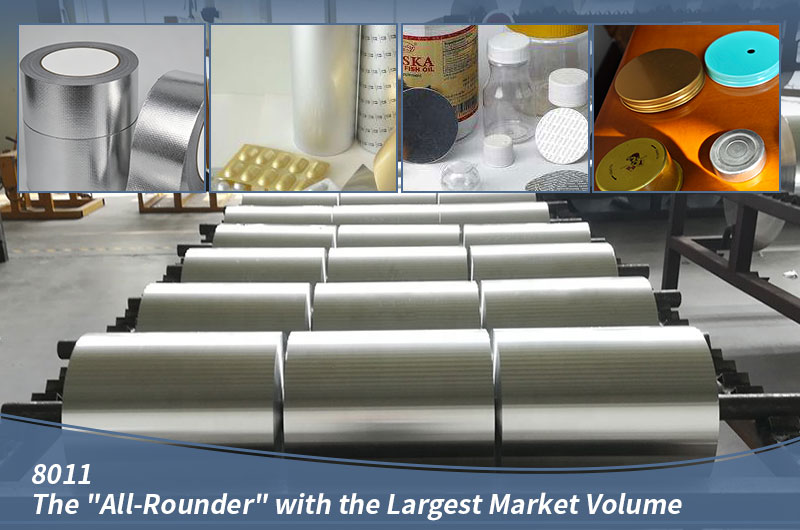
Typical Applications:
- Pharmaceutical Packaging:PTP pharmaceutical foil (H18 temper), pharmaceutical bottle cap material.
- Food Packaging:Household foil, dairy sealing film, meal box sealing film.
- Closure Materials:Liquor bottle caps, cosmetic caps, milk powder caps.
- Industrial Uses:Air conditioning fins (hydrophilic foil), cable shielding foil, aluminum foil tape, transformer winding foil.
Suitable for you if:You need large-batch, general-purpose aluminum foil procurement and are sensitive to costs.
8021: The Ultimate Choice for Pouch Batteries and Cold-Formed Pharma Foil
8021 is the most technologically advanced alloy with the most concentrated application scenarios—its existence is largely tailored for pouch lithium battery Alu-plastic films.
The high iron (1.21.7%) and extremely low silicon (≤0.15%) formulation gives it a high cupping value (5.57.0 mm), excellent deep drawing performance, and an extremely low pinhole rate. Combined with optimization for resistance against lithium battery electrolytes, 8021's status in the pouch battery sector is virtually irreplaceable.
In the pharmaceutical packaging sector, cold-formed blister foil (Alu-Alu foil, OPA/Al/PVC structure) also predominantly uses 8021-O as the mainstream standard, with a common thickness of 0.04~0.065 mm.
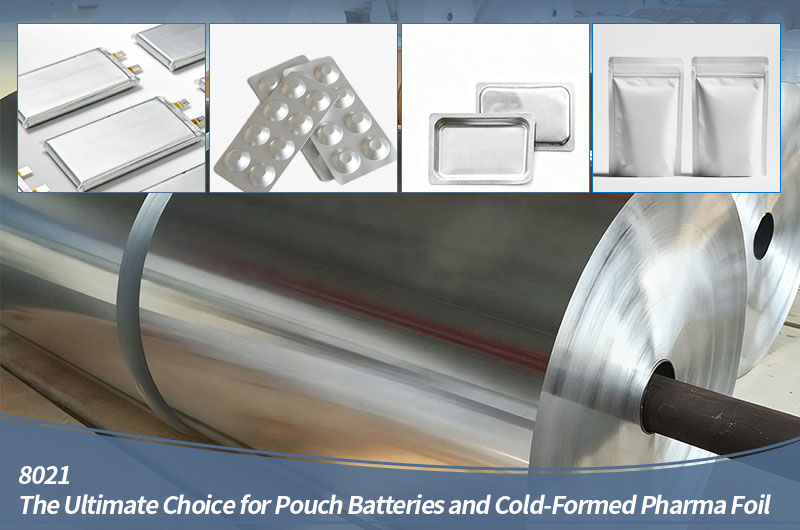
Typical Applications:
- Lithium Battery Alu-Plastic Film:Consumer electronics, EVs, energy storage devices.
- Cold-Formed Pharmaceutical Foil.
- Tropical Blister Packaging:For drug exports to high-temp, high-humidity environments.
- High-End Flexible Food Packaging:Alu-foil composite bags, yogurt lid foil.
Suitable for you if:Your products are pouch lithium battery Alu-plastic films, cold-formed pharma foil, or high-end packaging requiring high barrier properties and formability simultaneously.
8079: Highest Elongation, Most Stable Forming
8079 Aluminum foil has the highest elongation among the four alloys, usually ≥20% in the O temper, with a cupping value of 6.2~7.5 mm, ranking first among the four.
Its composition design allows iron and silicon to form a more uniform distribution of intermetallic compounds, resulting in fine grains. At ultra-thin thicknesses (e.g., 7 μm), the pinhole rate is extremely low, making its barrier properties highly reliable. Additionally, 8079 retains a stable shape in the range of -73℃ to 371℃, giving it the widest temperature adaptability of the four.
Compared to 8021, 8079 has higher elongation and superior flexibility. In scenarios requiring extremely complex forming or stricter forming depth, 8079 is often the safer choice.
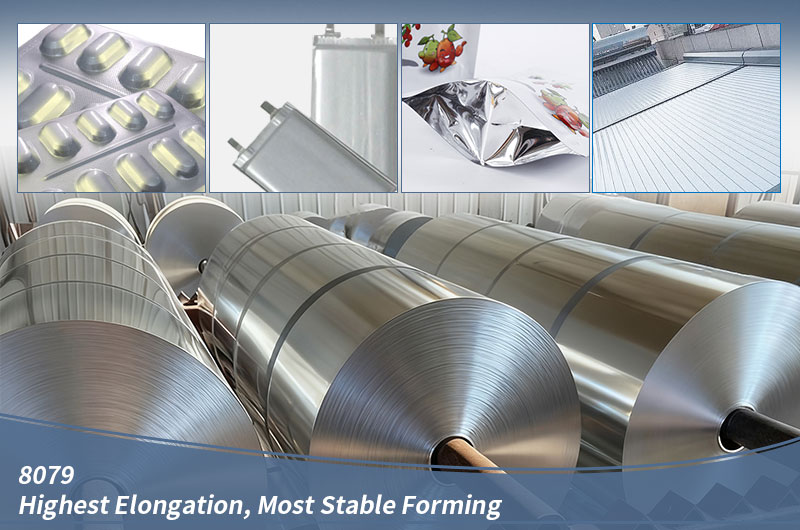
Typical Applications:
- Tropical Blister Packaging:First choice for drug exports to high-temp/humidity markets.
- Pouch Lithium Battery Alu-Plastic Film:For scenarios with high forming depth requirements.
- Aseptic Liquid Food Packaging, High-Fat Food Packaging.
- High-End Flexible Food Packaging:Stand-up pouches, spout pouches.
- Color-Coated Foil:Roof waterproofing, exterior wall insulation.
Suitable for you if:Your products require extremely high elongation and forming precision, or need to be used in extreme temperature environments.
8006: The Exclusive Material for Wrinkle-Free Containers
High-end 8006 is produced using the hot rolling process. The internal structure is dense and uniform, with fine grains. After stamping, the four corners and edges remain wrinkle-free, and the appearance is flat and smooth—an effect that cast rolling cannot perfectly replicate. Even in the O temper, its tensile strength reaches 123~135 MPa, meaning it maintains its shape after being stamped into containers without needing extra hardening.
Standard cast-rolled 8006 also has good formability, suitable for container applications where aesthetic requirements aren't as extreme but a certain forming depth is still needed.
In the heat exchanger field, 8006's thermal conductivity (190~210 W/m·K) and excellent mechanical properties make it the ideal material for high-performance AC fins and automotive radiators.
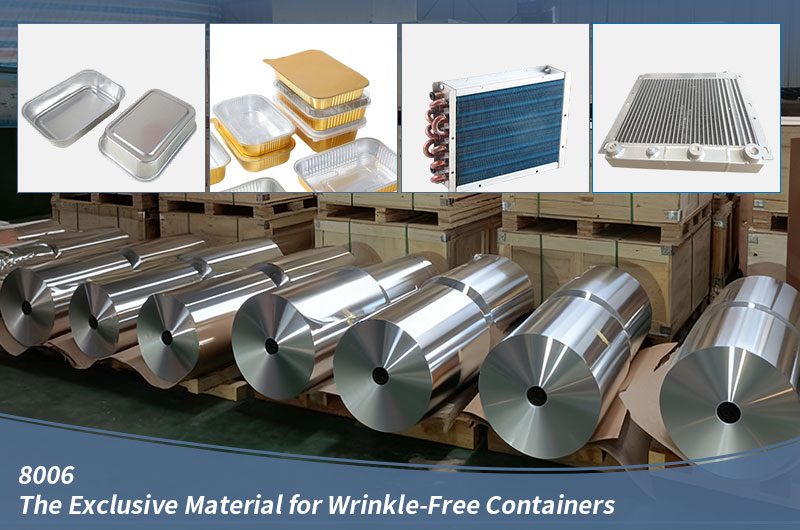
Typical Applications:
- Airline Wrinkle-Free Containers:The mainstream standard for the European market.
- High-End Takeout Containers, Egg Tart Trays, Baking Containers.
- AC Evaporator/Condenser Fins:Hydrophilic or hydrophobic coated products.
- Automotive Radiator Fins.
Suitable for you if:You focus on manufacturing food containers or producing high-performance heat exchanger fins.
How to Choose
When facing these four alloys, you can make decisions based on the following logic:
- Pouch Lithium Battery Alu-Plastic Film:8021 is the first choice; it has the highest comprehensive cost-performance and is the industry mainstream. If the cell shape is complex and forming depth requirements are extremely high, consider 8079 for its greater elongation and more stable forming.
- Pharmaceutical Packaging:Differentiate by packaging type: For PTP blister lidding foil, choose 8011-H18 (sufficient strength, low cost). For cold-formed blister foil (Alu-Alu), choose 8021-O. For tropical blister exports, choose 8079-O (better guaranteed barriers and elongation). For pharmaceutical bottle caps, choose 8011 (low earing rate, good stampability).
- Food Packaging:For most scenarios, 8011 is the optimal solution with an unbeatable ROI. If producing airline containers or high-end takeout containers with strict aesthetic stamping requirements, choose hot-rolled 8006 for noticeably better results. For high-end aseptic packaging or stand-up composite pouches needing both formability and barriers, 8079 or 8021 is more appropriate.
- Heat Exchanger Fins:For high-end ACs or auto radiators requiring high heat exchange efficiency and lifespan, choose 8006. For standard household AC fins, choose 8011 (lower cost, abundant supply).
- Industrial Applications:For cable shielding, tape, transformer windings, insulation, etc., 8011 covers the vast majority of needs with good conductivity, low cost, and abundant market supply.
Pricing & Procurement Advice
The price from lowest to highest is roughly: 8011 < 8006 < 8079 ≈ 8021
The price of aluminum foil consists of the aluminum ingot price (referencing the Changjiang spot A00 aluminum ingot closing price) plus the processing/conversion fee. The difference in processing fees reflects the complexity of the production process.
8011 has the most mature process and largest output, hence the lowest price. The hot-rolling processing fee for 8006 is higher, but the premium from wrinkle-free products easily covers the material price difference. 8021 and 8079 require the strictest control over raw material purity, alloy formulation, and production, resulting in the highest processing fees, making them suitable for high-value-added products.
Worthwill Aluminum Foil Product Line
Henan Worthwill Industry Co., Ltd.offers a complete line of 8-series aluminum foil products, fully covering 8011, 8021, 8079, and 8006 models.
Product Specifications
| Parameter | 8011 Foil | 8021 Foil | 8079 Foil | 8006 Foil |
| Thickness Range (mm) | 0.006~0.2 | 0.006~0.2 | 0.006~0.2 | 0.014~0.2 |
| Width Range (mm) | 100~1700 | 100~1700 | 100~1700 | 100~1700 |
| Common Tempers | O/H14/H18/H22/H24 | O/H14/H18/H22/H24 | O/H14/H18/H22/H24 | O/H14/H16/H18/H22/H24 |
| Core Inner ID (mm) | 76/152 | 76/152 | 76/152 | 76/152 |
| Executive Standards | GB/T 3198, ASTM B373 | GB/T 3198, ASTM B373 | GB/T 3198, ASTM B373 | GB/T 3198, ASTM B373 |
We support precision slitting down to a minimum width of 10 mm and accept both small-batch sample orders and large-volume long-term supply agreements.
Surface Treatment
Bare Foil (Mill Finished), Coated Foil, Embossed, etc.
Quality Assurance
We use high-purity aluminum ingots (purity ≥99.7%) as raw materials, with three-stage filtration during melting. Our rolling mills are equipped with AGC/AFC automatic thickness control systems, keeping thickness tolerance within ±2%. Annealing temperature deviation is controlled within ±3℃ to ensure consistent performance across batches. Finished products undergo pinhole detection under ≥3000 lux illumination. Every batch comes with a complete quality inspection report, supporting full batch traceability.
Certifications & Compliance
Compliant with GB/T 3198, ASTM B373, YBB00152002, EN 546-2, and other domestic/international standards. RoHS, FDA, and REACH compliance documents are available upon request.
Conclusion
8021, 8079, 8011, 8006—there is no absolute "best" model, only the model that best fits your specific needs.
Understanding their differences in composition, processes, performance, and applications is the foundation for making correct procurement decisions. If you still have questions about material selection or need a quote and samples, feel free to contact the Worthwill team. Our technical consultants will provide specific recommendations based on your product requirements and production processes.
Appendix: Comprehensive Technical Parameters Comparison
Appendix A: Physical Properties Comparison
| Performance Indicator | 8011 | 8021 | 8079 | 8006 |
| Density (g/cm³) | ~2.71 | 2.71~2.73 | 2.72 | 2.74 |
| Elastic Modulus (GPa) | Approx. 70 | 70 | 69 | 70 |
| Thermal Conductivity (W/m·K) | 190~220 | 160~220 | 210~230 | 190~210 |
| Melting Point Starts (℃) | ~640 | ~640 | ~640 | ~640 |
| Coefficient of Thermal Expansion (μm/m·K) | Approx. 23 | 23.1 | 23 | Approx. 23 |
| Electrical Conductivity (% IACS) | Approx. 55~58 | Approx. 56 | Approx. 58~59 | — |
Appendix B: Mechanical Properties by Temper
| Temper | Indicator | 8011 | 8021 | 8079 | 8006 |
| O Temper | Tensile Strength (MPa) | 80~110 | 70~100 | 80~100 | 123~135 |
| O Temper | Elongation (%) | Approx. 10~15 | ≥18 | ≥20 | Excellent |
| O Temper | Cupping Value (mm) | 4.5~6.0 | 5.5~7.0 | 6.2~7.5 | Higher |
| H14 | Tensile Strength (MPa) | 125~165 | 110~140 | Approx. 120~150 | — |
| H14 | Yield Strength (MPa) | ~110 | ≥85 | Approx. 90~120 | — |
| H14 | Elongation (%) | 2~5 | ≥4 | Approx. 2~4 | — |
| H18 | Tensile Strength (MPa) | Approx. 150~170 | ≥160 | Approx. 150 | — |
| H22 | Tensile Strength (MPa) | Approx. 100~130 | 90~120 | Approx. 100~130 | — |
| H22 | Elongation (%) | Approx. 4~6 | ≥8 | Approx. 5~8 | — |
Appendix C: Application Scenario Quick Reference
| Application Scenario | Recommended | Alternative | Key Reason |
| Pouch Lithium Battery Alu-Plastic Film | 8021 | 8079 | High elongation, electrolyte corrosion resistance |
| Cold-Formed Pharmaceutical Foil | 8021-O | 8079-O | High cupping value, low pinhole rate |
| Tropical Blister Packaging | 8079-O | 8021-O | Highest elongation, strongest barrier |
| PTP Pharma Foil (Blister Lidding) | 8011-H18 | — | High strength, good sealing, low cost |
| Pharma Bottle Cap Material | 8011 | — | Low earing rate, good deep drawing |
| Airline Wrinkle-Free Containers | 8006 (Hot-rolled) | — | Hot-rolled process, wrinkle-free stamping |
| Takeout Box / Container Foil | 8006 | 8011 | Excellent formability, beautiful appearance |
| General Food / Household Foil | 8011 | 8079 | Highest cost-performance, large supply |
| High-End Flexible Food Pouch (Stand-up) | 8079 | 8021 | High elongation, no cracking in complex forming |
| Aseptic Liquid Food Packaging | 8079 | 8021 | Extremely strong barrier, long shelf life |
| High-Performance AC Fins | 8006 | — | High strength, good conductivity, coating adaptable |
| Standard AC Fins | 8011 | 8006 | Low cost, abundant supply |
| Cable Shielding Foil | 8011-O | — | Good conductivity, low cost |
| Aluminum Foil Tape | 8011 | — | Good flexibility, strong adhesion |
| Transformer Winding Foil | 8011 | — | Excellent conductivity, moderate strength |
| Building Roof Insulation | 8079 (Color) | 8011 | High reflectivity, strong weather resistance |