


7050 vs. 7075 Aluminum
Introduction
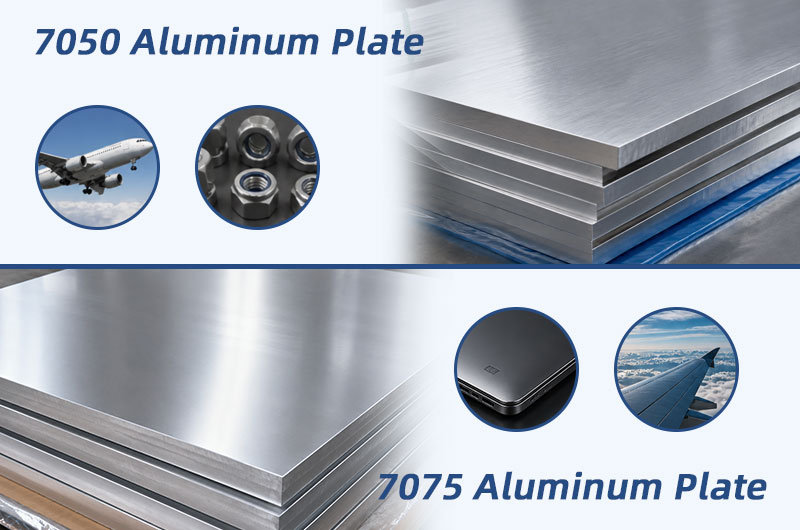
In the 7000 series aluminum alloy family, 7050 and 7075 aluminum are two of the most representative "star alloys." Belonging to the Al-Zn-Mg-Cu ultra-high-strength alloy series, both are hailed as "aerospace-grade materials, " possessing strength far exceeding ordinary mild steel, and are widely used in aerospace, national defense, military, and high-end equipment manufacturing.
What are their differences? How should you choose between them? Let's get started.
Quick Comparison Table: 7050 vs. 7075 Aluminum Alloy
Before diving deep, take a quick look at this table to understand their core differences.
| Comparison Dimension | 7075 (T651) | 7050 (T7451) | Winner |
|---|---|---|---|
| Tensile Strength | 572 MPa | 524 MPa | 7075 |
| Yield Strength | 503 MPa | 469 MPa | 7075 |
| Fracture Toughness (L-T) | 25 MPa·m½ | 31 MPa·m½ | 7050 |
| Fatigue Strength | 159–190 MPa | 200–210 MPa | 7050 |
| Stress Corrosion Cracking (SCC) Resistance | Fair (T6 is sensitive) | Excellent (T7451) | 7050 |
| Exfoliation Corrosion Resistance | Good | Excellent | 7050 |
| Thermal Conductivity | 130 W/m·K | 153 W/m·K | 7050 |
| Weldability | Poor | Poor | Tie |
One-sentence summary: For ultimate strength and widespread applications, choose 7075; for toughness in thick sections, corrosion resistance, and structural safety, choose 7050.
Getting to Know These Two Alloys: Where Do They Come From?
- 7075 Aluminum: Born in the 1940s (originated from the Japanese Zero fighter, later reverse-engineered by the US). Extremely hard, it is the mainstream choice for aerospace, military, and sporting goods.
- 7050 Aluminum: Introduced in 1971, it is the "upgraded version" of 7075. Its composition was optimized to solve the problems of corrosion susceptibility and poor toughness in thick plates, making it specifically designed for heavy-duty, critical components like aircraft frames.
Chemical Composition Comparison: The Root Cause of Performance Differences
The core differences between the two alloys first manifest in their chemical compositions. Understanding the composition is key to truly understanding their performance.
| Element | 7075 (%) | 7050 (%) |
|---|---|---|
| Aluminum (Al) | Remainder (87.1–91.4) | Remainder (87.3–90.3) |
| Zinc (Zn) | 5.1–6.1 | 5.7–6.7 |
| Magnesium (Mg) | 2.1–2.9 | 1.9–2.6 |
| Copper (Cu) | 1.2–2.0 | 2.0–2.6 |
| Chromium (Cr) | 0.18–0.28 | ≤0.04 |
| Zirconium (Zr) | None | 0.08–0.15 |
| Iron (Fe) | ≤0.50 | ≤0.15 |
| Silicon (Si) | ≤0.40 | ≤0.12 |
| Manganese (Mn) | ≤0.30 | ≤0.10 |
7050 perfectly resolves 7075's issues of uneven strength and insufficient toughness in thick parts through three major improvements: "Replacing chromium with zirconium (to solve uneven strength), adding copper (to increase toughness), and reducing iron and silicon (to prevent cracking)."
Mechanical Properties Comparison: Strength Isn't the Only Metric
Many people only look at tensile strength when selecting materials, but for highly demanding applications like aerospace, fracture toughness, fatigue strength, and elongation are equally crucial.
Strength Comparison
In terms of pure strength, 7075-T651 (572 MPa tensile / 503 MPa yield) slightly outperforms 7050-T7451 (524 MPa tensile / 469 MPa yield).
However, it must be noted that 7075's high strength is only fully realized in thin sections or when fully quenched. For thick plates exceeding 75mm, 7075's actual strength drops significantly as thickness increases due to its high quench sensitivity.
Because 7050 has low quench sensitivity, it can maintain high strength close to nominal values even in heavy plates ranging from 3 to 6 inches thick—something 7075 cannot achieve.
Mechanical Properties of Main Tempers
| Alloy Temper | Tensile Strength (MPa) | Yield Strength (MPa) | Elongation (%) | Hardness (HB) | Shear Strength (MPa) |
|---|---|---|---|---|---|
| 7075-O | 240 | 120 | 12 | 59 | 150 |
| 7075-T6 | 560 | 480 | 7.9 | 150 | 330 |
| 7075-T651 | 572 | 503 | 11 | 150 | 331 |
| 7075-T73 | 500 | 410 | 7.1 | 140 | 290 |
| 7075-T7351 | 510 | 410 | 7.5 | 140 | 300 |
| 7050-T7451 | 524 | 469 | 11 | 135 | 310 |
| 7050-T7651 | 552 | 490 | 11 | 147 | 324 |
| 7050-T73510 | 496 | 434 | 12 | 132 | 300 |
Fracture Toughness: 7050's True Advantage
Fracture toughness (KIC) measures a material's ability to resist crack propagation, which is a core metric for aerospace structural safety. In this category, 7050 completely dominates 7075.
| Test Direction | 7075-T651 | 7050-T7651 | 7050 Advantage |
|---|---|---|---|
| L-T Direction | 25 MPa·m½ | 31 MPa·m½ | +24% |
| T-L Direction | 25 MPa·m½ | 31 MPa·m½ | +24% |
| S-L Direction | 20 MPa·m½ | 26 MPa·m½ | +30% |
7050's fracture toughness is comprehensively higher than 7075's. This means that when micro-cracks exist in a structural component, 7050 can more effectively stop the crack from spreading, providing a higher structural safety margin. This is the core reason why 7050 is the preferred material for main load-bearing components like aircraft fuselage frames and wing spars.
Fatigue Strength
The fatigue strength of 7050-T7651 reaches 210 MPa (at 5×10⁸cycles), higher than 7075-T76's 190 MPa. In aerospace structures subjected to repeated cyclic loads, fatigue strength directly dictates the component's service life.
Corrosion Resistance: The Most Overlooked Factor in Material Selection
7000 series alloys generally face the risk of stress corrosion cracking (SCC), a critical factor affecting long-term reliability.
- Stress Corrosion (Crack Resistance): To prevent cracking, 7075 must drastically sacrifice strength (a drop of 10-15%); 7050, through special processing, perfectly balances high strength with excellent crack resistance.
- Exfoliation Corrosion (Peeling Resistance): Aluminum surfaces can easily peel off in layers due to corrosion. 7050's resistance to exfoliation is much more stable and noticeably superior to 7075.
- Surface Treatment: Both can undergo anti-corrosion treatments like anodizing and painting. However, due to its high zinc content, 7075 may show a slight brownish tint after anodizing, requiring attention for applications with strict cosmetic requirements.
Heat Treatment & Processing: Crucial Steps Dictating Final Performance
Heat Treatment Process Comparison
| Process Parameter | 7075 | 7050 |
|---|---|---|
| Solution Treatment Temp | 466–482°C | 475–477°C |
| Quench Medium | Cold water (Room temp) | Warm water (54–66°C) |
| Quench Transfer Time | ≤15 seconds | ≤15 seconds |
| T6 Aging | 120°C / 24h (Single-stage) | — |
| T7451 Aging | — | 121°C/5h + 177°C/4–10h (Two-stage) |
| Annealing Temp | 413°C | 413–415°C |
Key Differences in Quenching Methods:
- 7075 Aluminum: Requires rapid cooling in cold water. Thick parts are prone to severe distortion due to "thermal shock, " and uneven internal and external cooling leads to weak centers.
- 7050 Aluminum: Can be cooled gently in warm water. This mild approach preserves high strength while avoiding material distortion, making it highly suitable for manufacturing large, thick parts.
Machinability & Weldability
Both 7075 and 7050 receive a "B" rating in the Aluminum Association's machinability grading system. 7075 has slightly better chip breakage suitable for high-speed cutting. 7050 offers a more uniform structure, making it ideal for precision milling of large structural components.
The weldability of both alloys is poor; conventional fusion welding (TIG/MIG) is not recommended. The primary connection methods are riveting, adhesive bonding, or Friction Stir Welding (FSW).
Physical Properties Comparison
| Physical Parameter | 7075 | 7050 | Notes |
|---|---|---|---|
| Density | 2.81 g/cm³ | 2.83 g/cm³ | Almost identical |
| Elastic Modulus | 71.7 GPa | 71.7 GPa | Identical |
| Thermal Conductivity | 130 W/m·K | 153–157 W/m·K | 7050 is ~18% higher |
| Electrical Conductivity | 33% IACS | 35–41% IACS | 7050 is higher |
| Coefficient of Thermal Expansion | 23.6 μm/m·K | 23–23.5 μm/m·K | Similar |
| Poisson's Ratio | 0.33 | 0.33 | Identical |
| Max Working Temp | 200°C | 190°C | 7075 is slightly higher |
| Solidus Temp | 477°C | 488–524°C | 7050 is slightly higher |
| Liquidus Temp | 635°C | 629–635°C | Similar |
7050 significantly outperforms 7075 in thermal and electrical conductivity, providing an extra advantage in applications requiring thermal management (such as electronic structural parts and precision molds).
Application Areas: Each Excels in Its Own Field
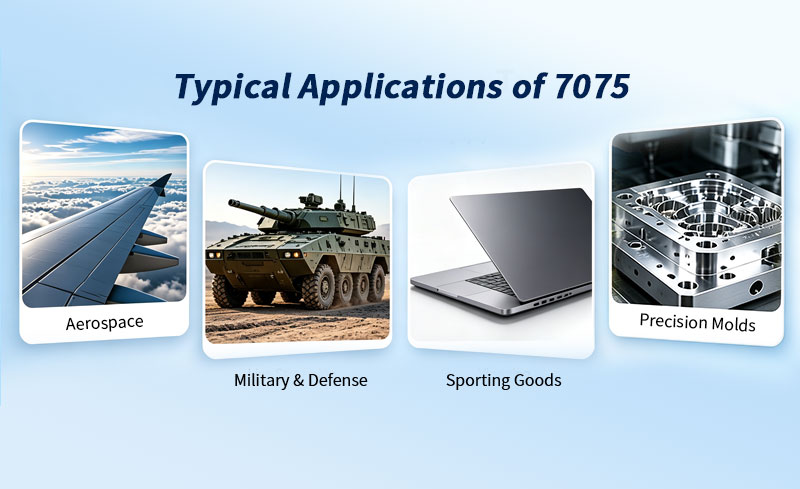
Typical Applications of 7075
Relying on its extremely high strength, 7075 excels in:
- Aerospace: Aircraft wing skins, landing gear parts, wing spars (thin-walled).
- Military & Defense: Upper and lower receivers for rifles, precision rifles, armored blast doors.
- Sporting Goods: High-end bicycle frames, carabiners, climbing gear, glider frames.
- Precision Molds: Blow molds, ultrasonic plastic welding molds, injection molds.
- Others: Racing engine connecting rods, high-end consumer electronics casings.
Typical Applications of 7050
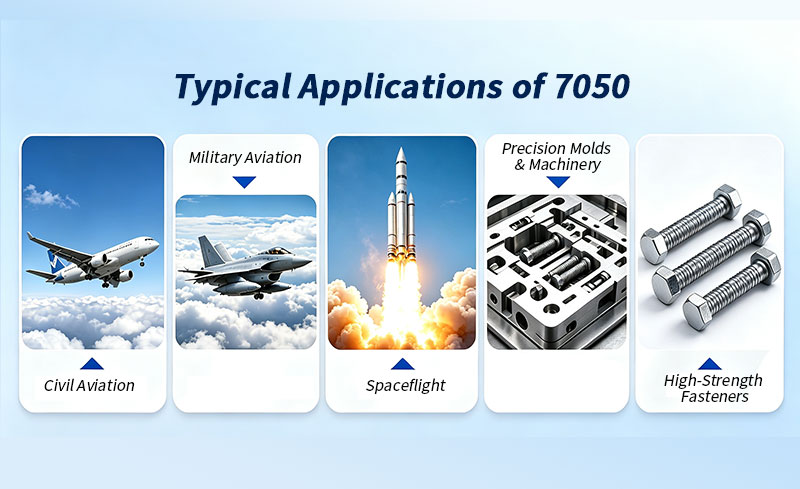
Due to its comprehensive performance advantages in thick sections, 7050 is mainly concentrated in high-end aerospace structures:
- Civil Aviation: Primary load-bearing structures such as aircraft fuselage frames, bulkheads, wing spars, and stringers.
- Military Aviation: Military aircraft body structures, bulkheads, landing gear components.
- Spaceflight: Rocket forged rings, satellite structural parts, missile shells.
- Precision Molds & Machinery: Large blow molds, injection molds, CNC machine tables, vacuum chucks.
- High-Strength Fasteners: Flat cone head rivets and other aerospace fasteners.
Material Selection Decision Guide
Choose 7075 if:
- You require the highest pure strength (thin-walled structural parts).
- The application is for sporting goods or high-end civilian products.
- You need a wide selection of sizes (plates, bars, tubes, wires are readily available in stock).
- You are cost-sensitive but still require high performance.
Choose 7050 if:
- You are using heavy plates or large forgings over 75mm (approx. 3 inches) thick.
- It is a primary load-bearing aerospace structure with strict fracture toughness requirements.
- It will operate long-term in humid, corrosive environments.
- You require warm water quenching to minimize distortion and residual stress.
- There are explicit requirements for stress corrosion cracking (SCC) resistance.
Consider other alloys (neither is suitable) if:
- The structure requires extensive welding (recommend 6061).
- It will be continuously exposed to high temperatures (>200°C) (recommend Titanium or Nickel-based alloys).
- You are highly cost-sensitive for general structural parts (recommend 6061 or 2024).
Frequently Asked Questions (FAQ)
- Q1: Which is stronger, 7050 or 7075?
- In terms of pure tensile strength, 7075-T651 (572 MPa) is slightly higher than 7050-T7451 (524 MPa). However, in thick sections, 7050 retains actual strength better than 7075 due to its lower quench sensitivity. When considering fracture toughness, fatigue strength, and corrosion resistance altogether, 7050 offers a more well-rounded performance.
- Q2: Can 7050 replace 7075 for aerospace structures?
- For heavy plate and large forging applications, 7050 is a superior choice to 7075 and represents the current mainstream trend in the aviation industry. However, because they differ in composition and performance, they cannot be simply swapped out; decisions must be based on specific design codes and certification requirements.
- Q3: Why is 7050 better than 7075 in heavy plate applications?
- The core reason is 7050's low quench sensitivity. By replacing chromium with zirconium, 7050 can uniformly achieve high strength throughout thick sections even at slower cooling rates (warm water quenching). In contrast, 7075 requires rapid cold water quenching; the core of thick parts often cannot be quenched thoroughly, leading to uneven strength.
- Q4: Can 7050 and 7075 be welded?
- The weldability of both is poor, and conventional fusion welding (TIG/MIG) is not recommended. Welding causes a drastic drop in strength in the heat-affected zone and is prone to hot cracking. In practical engineering, riveting, adhesive bonding, or Friction Stir Welding (FSW) are typically used for joining.
Conclusion
7050 and 7075 aluminum alloys are both elite members of the 7000 series, representing the highest standard of engineering applications for aluminum alloys. Choosing between them is not about judging which is "good" or "bad, " but about weighing "maximum strength" against "optimal comprehensive performance."
7075 is a synonym for strength, ideal for projects demanding ultimate strength, broad application scenarios, and economic viability. 7050 is a synonym for safety, suited for primary aerospace structures requiring heavy sections, high toughness, and strong corrosion resistance.
Henan Worthwill Industry Co., Ltd. supplies a full range of 7050 and 7075 aluminum alloy products long-term, including plates, bars, tubes, profiles, and forgings. To request product specifications, technical parameters, or a custom quote, please contact the Worthwill technical team.
Appendix: 7050 and 7075 Aluminum Alloy Performance Data Summary
Appendix A: Chemical Composition Comparison (wt.%)
| Element | 7075 (Standard Range) | 7050 (Standard Range) |
|---|---|---|
| Al | 87.1–91.4 (Remainder) | 87.3–90.3 (Remainder) |
| Zn | 5.1–6.1 | 5.7–6.7 |
| Mg | 2.1–2.9 | 1.9–2.6 |
| Cu | 1.2–2.0 | 2.0–2.6 |
| Cr | 0.18–0.28 | ≤0.04 |
| Zr | None | 0.08–0.15 |
| Fe | ≤0.50 | ≤0.15 |
| Si | ≤0.40 | ≤0.12 |
| Mn | ≤0.30 | ≤0.10 |
| Ti | ≤0.20 | ≤0.06 |
Appendix B: Mechanical Properties of 7075 by Main Temper
| Temper | Tensile Strength (MPa) | Yield Strength (MPa) | Elongation (%) | Hardness (HB) | Shear Strength (MPa) | Fatigue Strength (MPa) |
|---|---|---|---|---|---|---|
| O | 240 | 120 | 12 | 59 | 150 | 120 |
| T6 | 560 | 480 | 7.9 | 150 | 330 | 160 |
| T62 | 560 | 460 | 7.2 | 160 | 330 | 170 |
| T651 | 572 | 503 | 11 | 150 | 331 | 160 |
| T6510 | 590 | 510 | 5.7 | — | 340 | 180 |
| T6511 | 580 | 510 | 5.6 | — | 340 | 180 |
| T652 | 470 | 370 | 1.8 | — | 270 | 110 |
| T7 | 500 | 410 | 9.3 | — | 320 | 160 |
| T73 | 500 | 410 | 7.1 | 140 | 290 | 160 |
| T7351 | 510 | 410 | 7.5 | 140 | 300 | 160 |
| T76 | 560 | 480 | 7.9 | 150 | 330 | 190 |
| T7651 | 550 | 470 | 7.3 | 150 | 320 | 190 |
| T76510 | 570 | 490 | 6.8 | — | 330 | 190 |
| T76511 | 560 | 500 | 6.7 | — | 330 | 190 |
Appendix C: Mechanical Properties of 7050 by Main Temper
| Temper | Tensile Strength (MPa) | Yield Strength (MPa) | Elongation (%) | Hardness (HB) | Shear Strength (MPa) | Fatigue Strength (MPa) |
|---|---|---|---|---|---|---|
| T73510 | 496 | 434 | 12 | 132 | 300 | 190 |
| T73511 | 500 | 440 | 12 | — | 300 | 190 |
| T74 | 530 | 440 | 4.5 | 150 | 310 | 160 |
| T7451 | 524–540 | 469–480 | 10–11 | 135–147 | 310 | 200 |
| T7452 | 490 | 390 | 2.2 | — | 280 | 130 |
| T7651 | 552–570 | 490–500 | 10–11 | 147 | 324–330 | 210 |
Appendix D: Fracture Toughness Comparison (KIC, MPa·m½)
| Test Direction | 7075-T651 | 7050-T7651 | Difference |
|---|---|---|---|
| L-T Direction | 25 | 31 | +24% |
| T-L Direction | 25 | 31 | +24% |
| S-L Direction | 20 | 26 | +30% |
Appendix E: Physical Properties Comparison
| Physical Parameter | 7075 | 7050 |
|---|---|---|
| Density (g/cm³) | 2.81 | 2.83 |
| Elastic Modulus (GPa) | 71.7 | 71.7 |
| Shear Modulus (GPa) | 26.9 | 26.9 |
| Poisson's Ratio | 0.33 | 0.33 |
| Thermal Conductivity (W/m·K) | 130 | 153–157 |
| Electrical Conductivity (% IACS) | 33 | 35–41 |
| Coefficient of Thermal Expansion (μm/m·K) | 23.6 | 23–23.5 |
| Specific Heat Capacity (J/g·K) | 0.96 | 0.86 |
| Solidus Temperature (°C) | 477 | 488–524 |
| Liquidus Temperature (°C) | 635 | 629–635 |
| Max Working Temperature (°C) | 200 | 190 |
Appendix F: Heat Treatment Process Parameters Comparison
| Process Parameter | 7075 | 7050 |
|---|---|---|
| Solution Treatment Temperature (°C) | 466–482 | 475–477 |
| Quench Medium | Room Temp Cold Water | Warm Water (54–66°C) |
| Quench Transfer Time | ≤15 seconds | ≤15 seconds |
| Annealing Temperature (°C) | 413 | 413–415 |
| T6 Aging Temperature/Time | 120°C / 24h | — |
| Two-stage Aging (T74/T7451) | — | 121°C/5h + 177°C/4–10h |
Appendix G: Main Specification Ranges for 7050 and 7075
| Product Form | 7075 Specification Range | 7050 Specification Range |
|---|---|---|
| Plate Thickness | 0.5–350 mm | 1.0–600 mm |
| Plate Width | Max 4000 mm | Max 2500 mm |
| Bar Diameter | 3–800 mm | 4–500 mm |
| Tube Outer Diameter | 8–1500 mm | 10–1000 mm |
| Common Spec Standards | ASTM B209 / AMS-QQ-A-250/12 | AMS 4050 / AMS 4201 |
| Common Supply Tempers | T6, T651, T73, T7351, O | T7451, T7651, T73511, O |