


Types of Coating for Aluminum
Why Does Aluminum Need a Coating?
The natural oxide film that forms on aluminum is only about 2 to 5 nanometers thick. Under long-term exposure to salt spray, acid rain, ultraviolet (UV) rays, or industrial corrosive media, this thin film cannot provide reliable long-term protection.
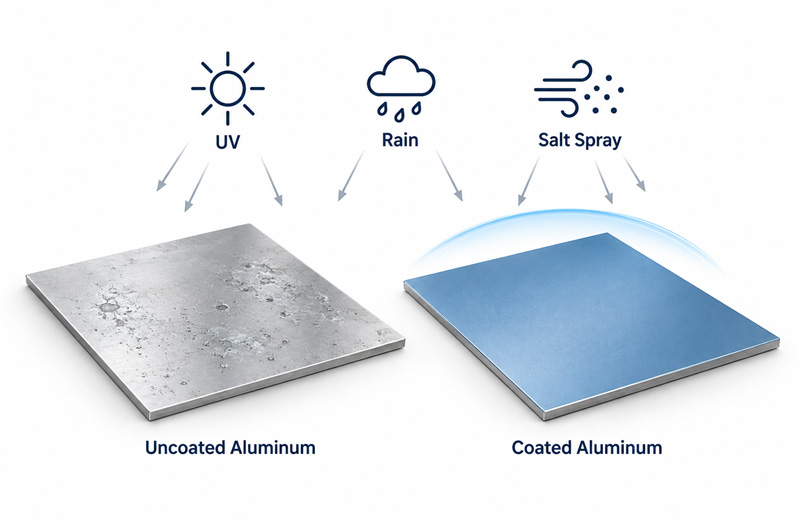
Applying a coating to aluminum is a critical step in enhancing the product's lifespan, appearance, and functionality. The core value of coatings lies in three main dimensions:
- Protection: Acts as a barrier against corrosion, wear, UV damage, and other external elements.
- Decoration: Offers a rich variety of colors and textures to improve aesthetics.
- Functionality: Enhances specific properties such as electrical conductivity, thermal insulation, or self-cleaning capabilities.
Overview of Main Aluminum Coating Types
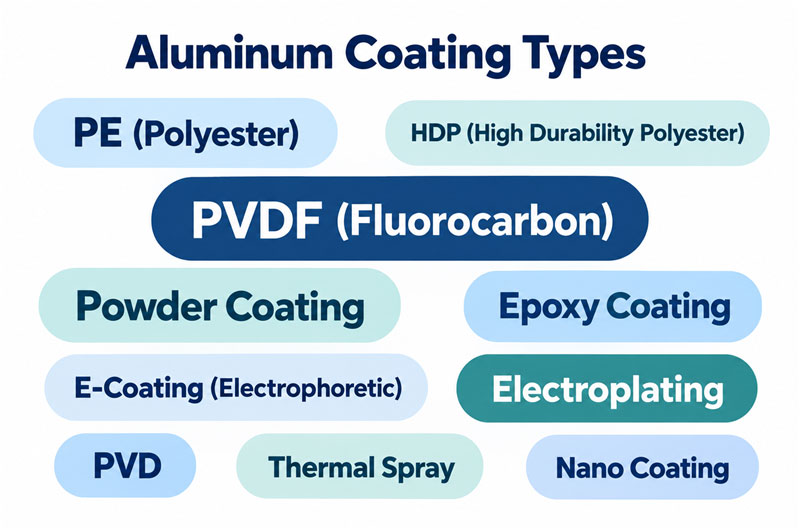
| Coating Type | Process Principle | Main Advantages |
|---|---|---|
| PE (Polyester) | Roller coating & curing | Rich colors, economical cost |
| HDP (High Durability Polyester) | Roller coating & curing | Strong weather resistance, high cost-performance |
| PVDF (Fluorocarbon) | Roller or spray coating & curing | Ultra-durability, 20–30 years lifespan |
| Powder Coating | Electrostatic spray & curing | Eco-friendly, impact-resistant, diverse colors |
| Epoxy Coating | Spray or roller coating & curing | Strong adhesion, excellent chemical resistance |
| E-Coating (Electrophoretic) | Electro-deposition & curing | Highly uniform coverage, metallic texture |
| Electroplating | Electrolytic metal deposition | Highly decorative, good conductivity |
| PVD | Vacuum evaporation/sputtering | Extreme hardness, premium high-end finish |
| Thermal Spray | High-temp melting & spraying | Heavy-duty anti-corrosion, for large structures |
| Nano Coating | Molecular-level coating | Self-cleaning, anti-bacterial, thermal insulation |
Detailed Breakdown of Aluminum Coating Types
PE (Polyester) Coating
PE coating is the most widely used system for color-coated aluminum. It is continuously applied to aluminum coils via a roller coating process and cured at high temperatures.
- Core Features: Extremely rich color options (supports the full RAL range), excellent formability (can be bent and stamped without cracking), highly economical, average outdoor lifespan of 8–12 years (slight fading may occur under long-term exposure).
- Applications: Indoor ceilings, ACP (Aluminum Composite Panel) substrates, home appliance panels, and low-rise building roofing.
- Selection Tip: Offers the highest cost-performance ratio. Ideal for indoor and general outdoor projects. For coastal or high-UV areas, upgrading to HDP or PVDF is recommended.
HDP (High Durability Polyester) Coating
Positioned as a mid-to-high-end option, HDP features an optimized resin formula that significantly extends outdoor weatherability.
- Core Features: Weather resistance is noticeably superior to standard PE (approx. 15 years outdoors); rich color selection; complies with AAMA 2604 standards; outstanding cost-effectiveness (priced between PE and PVDF).
- Applications: Commercial building facades, industrial factory roofing, and general outdoor aluminum panel systems.
PVDF (Fluorocarbon) Coating
Recognized as the most premium organic coating in the architectural industry, PVDF is renowned for its ultra-strong weather resistance. Coatings utilizing Kynar 500® or Hylar 5000® resins meet the stringent AAMA 2605 standard.
Performance Comparison: PVDF vs. HDP vs. PE
| Performance Metrics | PVDF Coating | HDP Coating | PE Coating |
|---|---|---|---|
| Outdoor Lifespan | 20–30 Years | ~15 Years | 8–12 Years |
| UV / Acid Rain / Salt Spray Resistance | Excellent | Good | Fair |
| Anti-Chalking & Self-Cleaning | Outstanding | Fair | Fair |
| Relative Price | High | Medium-High | Low |
PVDF Liquid Coating vs. PVDF Powder Coating
| Comparison Item | PVDF Liquid Coating | PVDF Powder Coating |
|---|---|---|
| Production Process | Roller coating (for coils/panels) | Electrostatic spray (for extrusions) |
| Coating Layers | Multiple (Primer + Topcoat + Clearcoat) | Single layer |
| Gloss Level | Mostly low gloss (20–35%) | Wider range (15–80%) |
| Eco-Friendliness | Contains VOCs (requires treatment) | Zero VOC emissions |
Applications
High-end architectural facades, iconic building exteriors, color-coated aluminum coils (roofing/ACP), and coastal projects with high salt spray.
Powder Coating
Applies dry powder via electrostatic attraction, followed by high-temperature curing (180–200°C). While roller coating is ideal for continuous coil production, powder coating is better suited for formed parts like aluminum extrusions and single panels.
- Core Features: Zero VOC emissions (highly eco-friendly); thick and uniform film (60–120 µm); high hardness and scratch resistance; excellent edge and complex-shape coverage.
- Common Types: Polyester/Epoxy blend (mainly indoor), Standard Polyester (general windows/doors), Super-durable HDP powder, PVDF fluorocarbon powder.
- Limitations: High curing temperatures can deform thin panels; difficult to touch up locally; precision parts require pre-calculated dimensional allowances.
Epoxy Coating
Known for its exceptional adhesion and chemical resistance. Because it lacks UV stability, it is rarely used alone as an outdoor topcoat.
- Core Features: Extremely strong adhesion; excellent resistance to acids, alkalis, and chemicals; good electrical insulation.
- Applications: Industrial pipe linings, storage tanks, electrical equipment, and as anti-corrosion primers/back-coatings for color-coated aluminum.
E-Coating (Electrophoretic Coating)
Uses an electrical field to deposit water-based paint uniformly onto the aluminum surface. Often combined with anodizing to provide both protection and a premium look.
- Core Features: Uniform coverage, even in complex internal cavities; superior corrosion resistance compared to bare anodizing; semi-transparent, premium metallic finish; eco-friendly water-based system.
- Applications: High-end aluminum window/door profiles, bathroom hardware, architectural decorative parts.
Electroplating
An electrolytic process that deposits a thin layer of metal (e.g., nickel, chrome, or copper). Plating on aluminum requires a special zincate pretreatment.
- Core Features: Strong metallic luster, excellent decorative effect; increases surface hardness and wear resistance; improves electrical conductivity and solderability; however, wastewater treatment costs are high.
- Applications: Electronic connectors, automotive trim, precision instruments, medical devices.
PVD (Physical Vapor Deposition) Coating
Metals are vaporized or sputtered in a vacuum to form an ultra-thin (0.1–10 µm), dense functional film.
- Core Features: Extreme hardness (some >2000 HV); achieves premium metallic colors like gold or black titanium; highly wear and scratch-resistant; solvent-free and highly eco-friendly; high cost.
- Applications: High-end decorative hardware, 3C (computer, communication, consumer electronics) housings, luxury accessories.
Thermal Spray Coating
Melts metals or ceramics at high temperatures and sprays them onto the substrate at high speeds for heavy-duty anti-corrosion.
- Core Features: Not limited by component size (can be applied on-site); high-temperature and extreme corrosion resistance; porous coating usually requires a sealing post-treatment; relatively rough surface.
- Applications: Bridge steel structures, offshore platforms, large machinery exteriors.
Nano Coating
An emerging, fast-growing technology that uses molecular-level structures to give aluminum special functions.
- Super-hydrophobic: Water rolls off automatically, providing a self-cleaning function (ideal for facades).
- Nano-ceramic (PEO): Ultra-high hardness, withstands up to 800°C (for aerospace/precision industries).
- Anti-bacterial: Inhibits bacterial growth (for medical/food processing equipment).
- Thermal Reflective: Reflects heat radiation, lowering energy consumption (for energy-saving roofing/walls).
Anodizing: A Quick Reference Comparison
Strictly speaking, anodizing is a surface conversion treatment rather than a coating—it converts the aluminum surface itself into aluminum oxide without applying a new material.
| Comparison Item | Anodizing | Powder Coating | PVDF Roller Coating |
|---|---|---|---|
| Nature | Surface conversion | Organic coating | Organic coating |
| Weatherability | High | Good to Excellent | Excellent |
| Color Options | Medium (Metallic shades) | Extremely rich | Rich |
| Eco-Friendliness | Excellent | Excellent (Zero VOC) | Good |
| Thickness | 5–100 µm (Conversion layer) | 60–120 µm | 30–60 µm |
| Base Material | Mainly extrusions | Extrusions, panels | Coils, panels |
For detailed anodizing processes, please refer to: [Aluminum Anodizing] / [Anodizing Sealing Process]
Comprehensive Comparison of Coating Types
| Coating Type | Weatherability | Color Richness | Eco-Friendliness | Cost | Main Applications |
|---|---|---|---|---|---|
| PE Roller Coating | Medium (8–12 yrs) | Extremely Rich | Good | Low | Roofing, ACP, Ceilings |
| HDP Roller Coating | Good (~15 yrs) | Extremely Rich | Good | Medium | Commercial facades, Roofing |
| PVDF Coating | Excellent (20–30 yrs) | Rich | Good | High | High-end facades, Exteriors |
| Powder Coating (PE) | Good | Extremely Rich | Excellent | Medium | Window profiles, Outdoor furniture |
| Powder Coating (PVDF) | Excellent | Rich | Excellent | High | High-end facade extrusions |
| Epoxy Coating | Low (Not UV resistant) | Low | Fair | Low | Industrial primers, Pipe linings |
| E-Coating | Good | Medium (Metallic) | Good | Med-High | Premium doors/windows, Hardware |
| Electroplating | Good | Medium (Metallic) | Fair | Med-High | Electronics, Auto trim |
| PVD | Good | Medium (Metallic) | Excellent | High | Premium hardware, 3C electronics |
| Thermal Spray | Excellent | Low | Fair | Med-High | Heavy industry, Bridges, Marine |
| Nano Coating | Excellent | Medium | Excellent | High | Self-cleaning buildings, Aerospace |
Coating vs. Surface Treatment
A Coating is a specific type of surface treatment that involves applying a new layer of protective or decorative material onto the aluminum.
Other aluminum surface treatments do not add new materials; instead, they alter the physical or chemical state of the aluminum surface itself.
| Surface Treatment | Principle & Function |
|---|---|
| Brushing | Grinds linear textures; prevents fingerprints and hides scratches. |
| Sand/Bead Blasting | Shoots micro-particles for a matte finish; removes machining marks. |
| Polishing | Mechanical polishing to create a mirror-like, high-gloss surface. |
| Bright Dipping | Chemical polishing using acids to give the surface a mirror finish. |
| Chemical Conversion (Alodine) | Creates a protective base film; anti-corrosive while retaining conductivity. |
| Wood Grain Heat Transfer | High-temp pressing to transfer highly realistic wood or stone patterns. |
| Laser Engraving | High-precision laser etching for logos and patterns. |
| Micro-arc Oxidation (MAO) | Electrical discharge creates an ultra-hard ceramic film for extreme wear resistance. |
In practical applications, these surface treatments are often combined with coating processes. For instance, sandblasting before anodizing significantly improves adhesion; brushing prior to anodizing retains the metallic texture while enhancing protection; and applying a chemical conversion coating before powder coating drastically increases coating adhesion and corrosion resistance.
How to Choose the Right Aluminum Coating?
By Application Environment
| Environment | Recommended Coating |
|---|---|
| Indoor Decoration | PE (Polyester) Coating |
| General Outdoor (Residential/Commercial) | HDP (High Durability Polyester) Coating |
| High-End Outdoor (Facades/Landmarks) | PVDF (Fluorocarbon) Coating |
| Coastal / High Salt Spray Areas | PVDF + Anti-corrosion primer + 5052 Marine Alloy |
| Industrial Chemical Environments | Epoxy Primer + Chemical-resistant Topcoat |
| Heavy Industrial / Large Structures | Thermal Spray |
| High-End Decorative Hardware | PVD or Electroplating |
By Expected Lifespan
| Expected Lifespan | Recommended Coating |
|---|---|
| Under 5 Years (Indoor) | PE (Polyester) Coating |
| 10–15 Years (General Outdoor) | HDP (High Durability Polyester) |
| 20–30 Years (High-End Outdoor) | PVDF (Fluorocarbon) Coating |
| Long-Term Industrial Anti-Corrosion | Thermal Spray or Thick-film Epoxy |
By Appearance Requirements
| Appearance Requirement | Recommended Coating |
|---|---|
| Solid Colors, Highly Customized | PE or PVDF Color-Coated Aluminum (Roller) |
| Rich Colors + Matte/Gloss Options | Powder Coating |
| Premium Metallic Tones (Gold/Black Titanium) | PVD |
| Metallic Texture + Protective Coating | E-Coating (Electrophoretic) |
By Budget
| Budget Level | Recommended Coating |
|---|---|
| Economical | PE Polyester Pre-painted Aluminum |
| Mid-Range | HDP High Durability Polyester |
| Premium | PVDF Fluorocarbon Coating |
| Specialized Industrial | PVD, Nano Ceramic, Thermal Spray |
Regulations & Certification Reference
- AAMA 2605: Applicable to PVDF coatings (Highest weatherability standard).
- AAMA 2604: Applicable to HDP coatings (Weatherability > 5 years).
- AAMA 2603: Applicable to standard Polyester coatings (Indoor or general use).
- QUALICOAT: European quality label for powder/liquid coatings on aluminum.
- RoHS / REACH: Restricts hazardous substances (Hexavalent chromium is restricted).
- GB/T 3880: Chinese national standard for aluminum and aluminum alloy plates/strips.
Worthwill Color Coated Aluminum Products
Worthwill specializes in the manufacturing and export of color-coated aluminum coils and panels, offering diverse coating systems including PE, HDP, and PVDF.
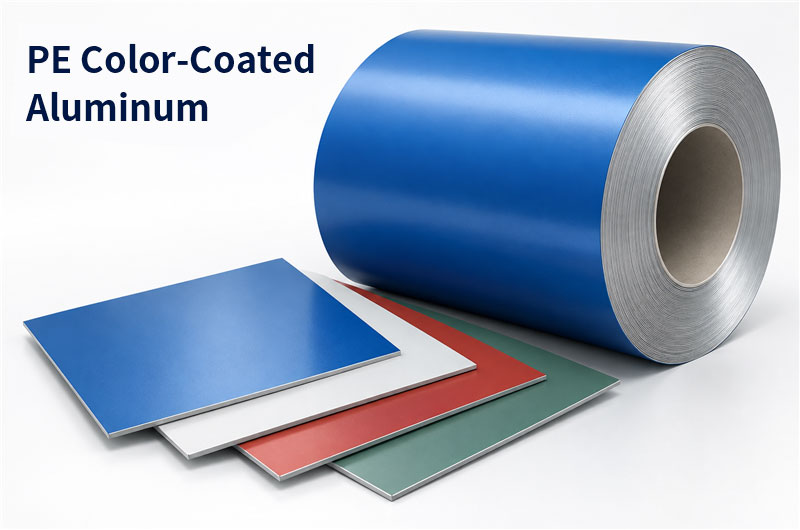
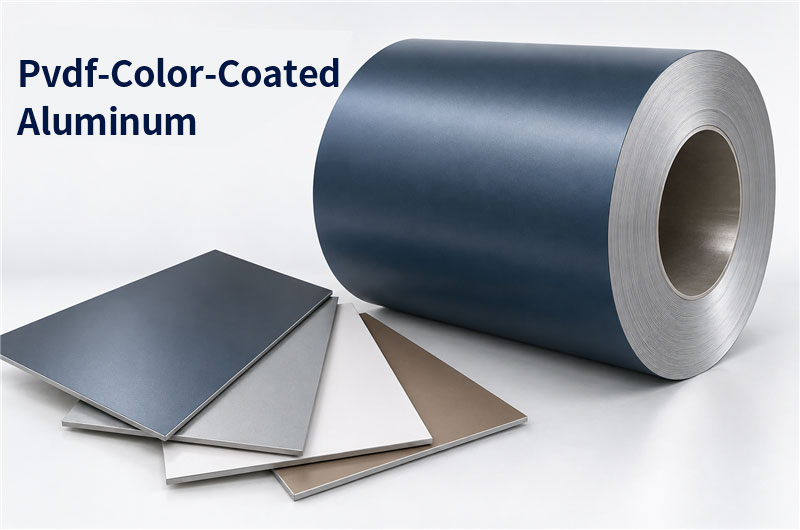
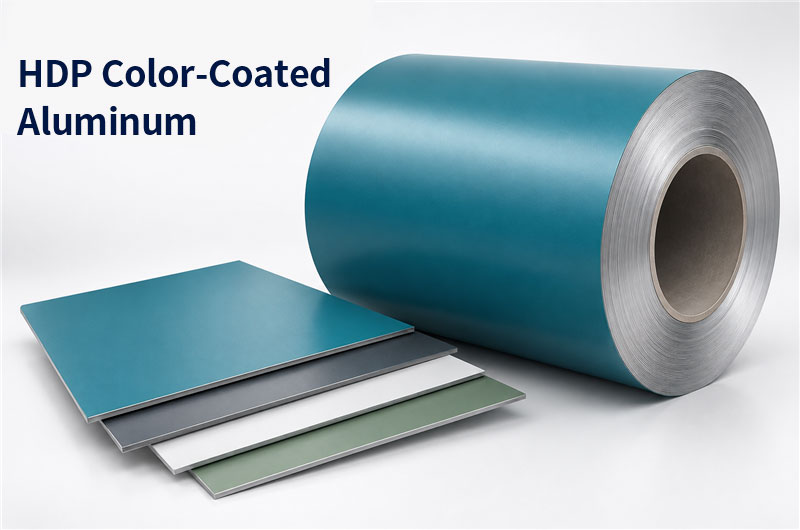
Our products utilize a continuous roller pre-coating process. Compared to post-painting, our pre-painted aluminum features more uniform coating, minimal color difference, stable quality, and lower overall costs, making it the mainstream choice for global architectural facades, roofing systems, and ACP applications.
| Parameters | Specification Range |
|---|---|
| Alloy Grades | 1060, 1100, 3003, 3004, 3005, 5052, etc. |
| Thickness | 0.08 mm – 6.0 mm |
| Width | 100 mm – 2000 mm |
| Coating Systems | PE / HDP / PVDF / Epoxy Back-coating |
| Surface Effects | Solid Colors / Wood Grain / Marble / Brushed |
| Color Customization | Supports full RAL range & customer-provided samples |
| Quality Standards | GB/T 3880, ASTM, EN, ISO |
Frequently Asked Questions (FAQ)
- Q: Which aluminum coating has the longest outdoor lifespan?
-
A:
PVDF (Fluorocarbon) and FEVE coatings offer the strongest weather resistance, with outdoor warranties typically lasting 20–30 years. They possess exceptional resistance to UV rays, chalking, and acid rain, meeting AAMA 2605 standards. They are the top choice for high-end building facades and severe climates.
- Q: What are the differences between PE, HDP, and PVDF coatings? How should I choose?
-
A:
The main differences lie in resin composition, weather durability, and cost:
- PE (Polyester): Low cost with rich gloss options; ideal for indoor decor or mild environments (5–10 year lifespan).
- HDP (High Durability Polyester): Performance sits between PE and PVDF; excellent for general commercial outdoor applications.
- PVDF (Fluorocarbon): Ultimate durability and anti-corrosion properties; designed for high-end outdoor architecture and coastal environments requiring 20+ years of life.
- Q: What is the difference between Pre-painted Aluminum (Roller Coating) and Post-painted Aluminum?
-
A:
Pre-painted aluminum (color-coated aluminum) is coated continuously via rollers before fabrication. It offers a more uniform finish, stable quality, zero color variance, and lower overall costs, making it ideal for mass production. Post-painting is done after forming the metal; it offers high flexibility for custom shapes or small batches but is generally more expensive.
- Q: Will the coating crack or peel off during bending or stamping?
-
A:
No. High-quality color-coated aluminum from Worthwill utilizes a high-temperature curing process, giving the paint film excellent flexibility. It passes 0T–2T T-bend tests, meaning it will not crack or peel during normal secondary fabrication like bending or stamping.
- Q: Which coating and base material should be used for coastal or high salt spray environments?
-
A:
It is highly recommended to use a PVDF coating (paired with a dedicated anti-corrosion primer) applied over a marine-grade alloy like 5052 aluminum. This combination maximizes the material's ability to withstand salt spray and high-humidity environments.
- Q: What customization options does Worthwill offer for color-coated aluminum?
-
A:
We offer comprehensive customization, including base material specifications (thickness 0.2–4.0mm / various widths), coating systems (PE / PVDF / FEVE), colors and gloss levels (RAL colors / matte / high gloss), and surface patterns (wood grain / stone, etc.).
Conclusion
Choosing the right aluminum coating is essentially about finding the optimal balance between protection performance, aesthetic requirements, expected lifespan, and procurement budget.
For Cost-Efficiency: PE color-coated aluminum
For Ultimate Weatherability: PVDF fluorocarbon color-coated aluminum
For Eco-Friendliness & Vivid Colors: Powder coating
For Premium Decorative Finishes: PVD or Electroplating
For Heavy-Duty Industrial Anti-Corrosion: Thermal spraying
Worthwill offers a complete product line of color-coated aluminum from PE to PVDF, supporting full customization of thickness, width, color, and alloy grades to meet diverse demands—from standardized mass procurement to personalized architectural projects.