


2024 vs. 7050 Aluminum
Introduction
In high-end manufacturing fields such as aerospace, military equipment, and precision molds, the selection of aluminum alloy materials often directly determines the performance boundaries and service life of the products.
2024 aluminum alloy and 7050 aluminum alloy are currently two of the most highly regarded aerospace-grade high-strength aluminum alloys in the industrial sector. Both are heat-treatable alloys widely used in the manufacturing of aircraft structural parts, load-bearing components, and high-performance parts.
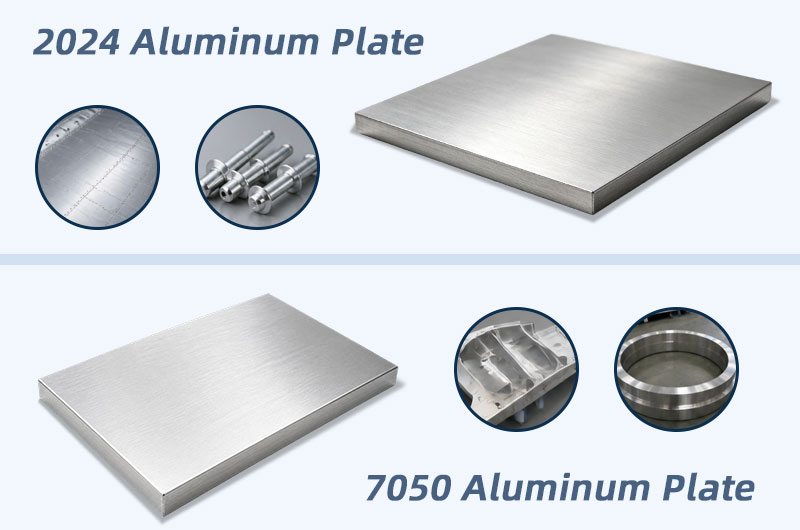
However, there are significant differences between the two in terms of alloy series, strength characteristics, corrosion resistance, and fatigue performance. Choosing the wrong material can result in increased costs at best, and compromise structural safety at worst.
2024 vs. 7050: Quick Comparison
Here is a summary of the most critical parameters. For detailed data and values of various tempers, please refer to the appendix at the end of the article.
| Comparison Item | 2024 Aluminum Alloy (Typical T3 Values) | 7050 Aluminum Alloy (Typical T7451 Values) |
|---|---|---|
| Alloy Series | 2000 (Al-Cu-Mg Series) | 7000 (Al-Zn-Mg-Cu Series) |
| Main Alloying Element | Copper (Cu: 3.8–4.9%) | Zinc (Zn: 5.7–6.7%) |
| Tensile Strength | 483 MPa | 524 MPa |
| Yield Strength | 345 MPa | 469 MPa |
| Fatigue Strength | 138–207 MPa | 150–200 MPa |
| Fracture Toughness | Medium | Excellent (Higher than 7075) |
| Corrosion Resistance | Poor (Requires AlClad / coating protection) | Medium (SCC resistance superior to 2024) |
| Stress Corrosion Cracking (SCC) | Poor (Obvious in T3/T4 tempers) | Excellent (T7451 temper) |
| Weldability | Extremely poor (Fusion welding not recommended) | Extremely poor (Fusion welding not recommended) |
| Machinability | Good (Rated approx. 70%) | Good |
2024 vs. 7050: Alloy Overview
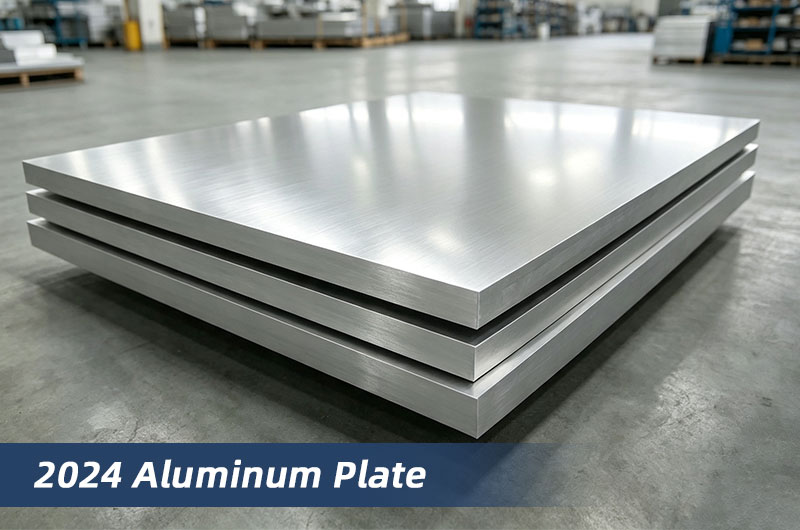
2024 Aluminum Alloy — Classic "Duralumin"
- Properties: 2xxx series (Copper-based), one of the high-strength aviation aluminum alloys with the longest history.
- Advantages: Extremely high specific strength and excellent fatigue resistance; heat resistance above 125°C is superior to 7075.
- Applications: Aircraft skins, fuselage tension components.
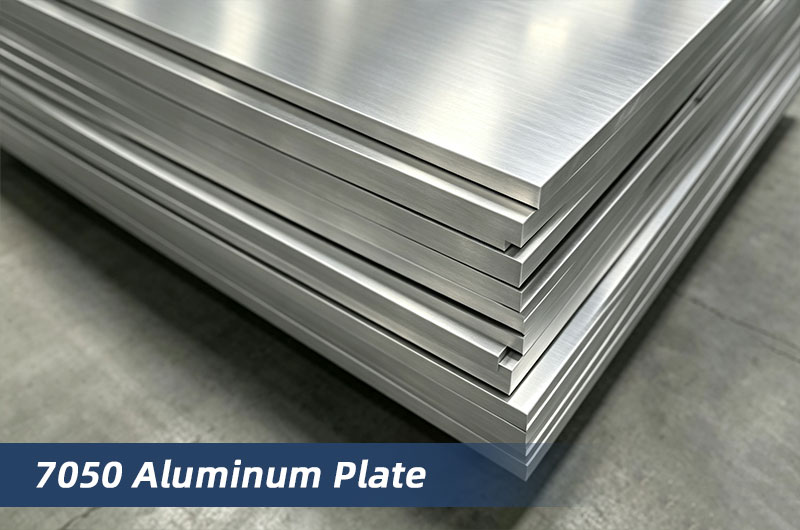
7050 Aluminum Alloy — Third-Generation "Super Duralumin"
- Properties: 7xxx series (Zinc-based), an upgraded version of 7075.
- Advantages: Optimized formula (using Zirconium instead of Chromium), suitable for manufacturing large thick plates; best-in-class fracture toughness and stress corrosion cracking (SCC) resistance.
- Applications: Key load-bearing components in modern large passenger aircraft, such as bulkheads and wing spars.
2024 vs. 7050: Chemical Composition Comparison
The fundamental reason for the performance differences between the two alloys lies in their different chemical composition design logics.
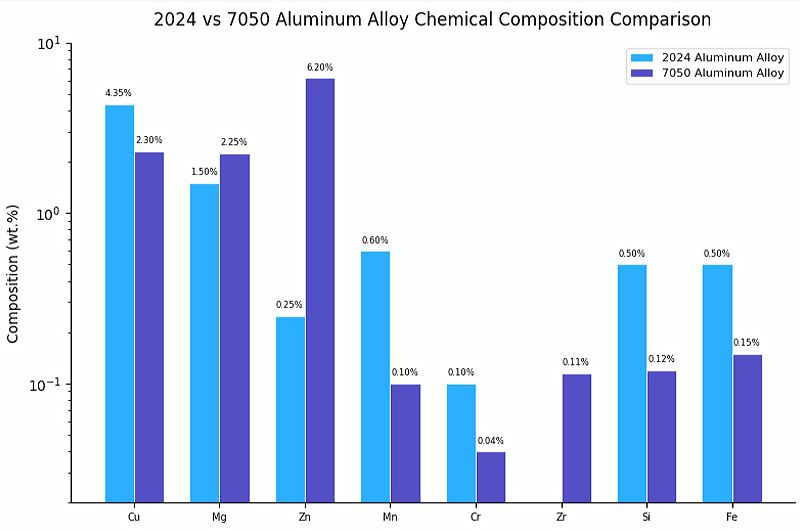
| Element | 2024 (wt.%) | 7050 (wt.%) |
|---|---|---|
| Al | Remainder (approx. 90.7–94.7%) | Remainder (approx. 87.3–90.3%) |
| Cu | 3.8–4.9 | 2.0–2.6 |
| Mg | 1.2–1.8 | 1.9–2.6 |
| Zn | ≤ 0.25 | 5.7–6.7 |
| Mn | 0.3–0.9 | ≤ 0.10 |
| Cr | ≤ 0.10 | ≤ 0.04 |
| Zr | — | 0.08–0.15 |
| Si | ≤ 0.50 | ≤ 0.12 |
| Fe | ≤ 0.50 | ≤ 0.15 |
Simply put: 2024 is the "specialist" that gets harder by adding copper but is prone to rust, while 7050 is the "all-rounder" with a purer formula that achieves hardness, toughness, and corrosion resistance simultaneously.
2024 vs. 7050: Mechanical Properties Comparison
In summary, the core difference between 7050 and 2024 lies in the trade-off between "strength and toughness" versus "fatigue resistance":
- 7050 Aluminum Alloy focuses on "high strength and high toughness." It has higher strength and is less prone to sudden fracture, making it particularly suitable for large-cross-section, thick load-bearing components. Therefore, it is the first choice for the internal skeleton of an aircraft (e.g., wing spars, bulkheads).
- 2024 Aluminum Alloy, while having slightly lower absolute strength, focuses on "excellent fatigue resistance." It can endure micro-cracks without them spreading for a long time, making it the long-standing primary material for external skins and other components subjected to repeated stress.
Hardness Comparison
| Temper | 2024 Alloy (HB) | 7050 Alloy (HB) |
|---|---|---|
| Annealed (O) | 47 | Approx. 60 |
| T3 / T6 | 120 | — |
| T7451 | — | 135–145 |
| T7651 | — | 150 |
| T851 | 140 | — |
2024 vs. 7050: Corrosion Resistance Comparison
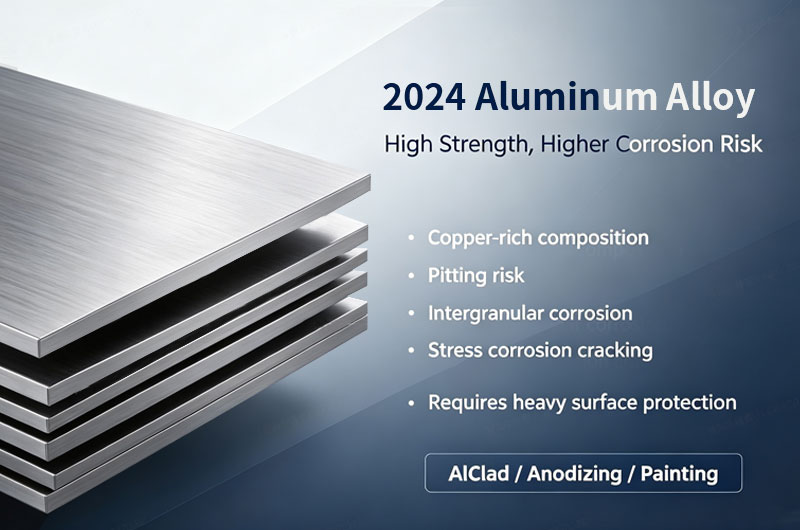
2024 — Poor Corrosion Resistance, Requires Heavy Protection
- Defects: Due to high copper content, it is highly susceptible to pitting, intergranular corrosion, and stress corrosion cracking (SCC).
- Countermeasures: The industry must rely on pure aluminum surface cladding (AlClad) or anodizing + painting to solve the anti-corrosion problem.
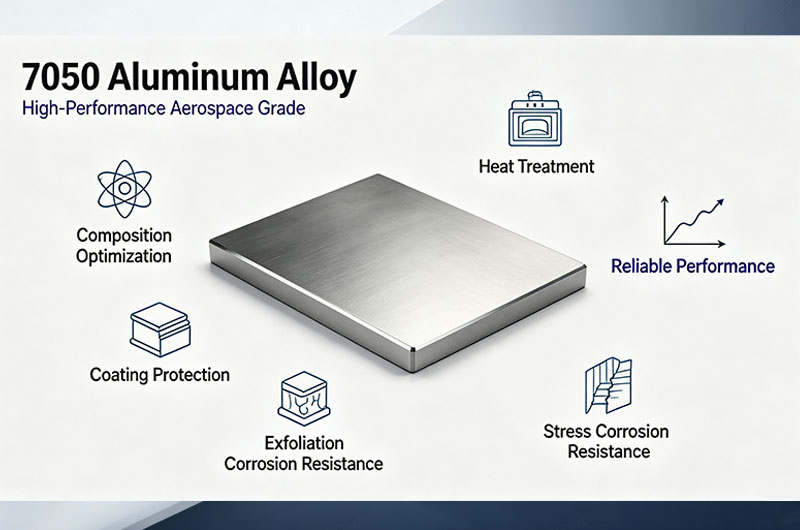
7050 — Better Corrosion Resistance, Strong Self-Resistance
- Advantages: Through composition optimization and heat treatment, its resistance to SCC and exfoliation corrosion is significantly superior to 2024, making it suitable for hot, humid, and high-stress environments.
- Note: Although the resistance is improved, conventional anodizing or coating protection is still required in harsh environments like marine conditions.
2024 vs. 7050: Heat Treatment & Temper Selection
Common Tempers for 2024 Aluminum Alloy:
- T3 / T351 (Most common): T3 combines high strength with excellent fatigue resistance, making it the main material for aircraft skins; T351 adds stress-relief stretching, offering better dimensional stability, suitable for precision machining.
- T851 (Ultimate strength): Has the highest strength but the lowest toughness/elongation. Used only in specific situations requiring extreme strength.
- O Temper (Softest state): Has the lowest strength and is easiest to form. Used only for preliminary processing; subsequent heat treatment is mandatory.
Common Tempers for 7050 Aluminum Alloy:
- T7451 (Aviation mainstream): Achieves the perfect balance of strength, fracture toughness, and SCC resistance. It is the top choice for thick-plate structures like aircraft bulkheads.
- T7651 (Highest strength): Offers the highest strength in the 7050 family, along with excellent resistance to exfoliation corrosion.
- T73 Series (Highest anti-corrosion): Offers the strongest SCC resistance at a slight sacrifice of strength, often used for high-corrosion-risk fasteners (like rivets).
- Note: 7050 also frequently utilizes an exclusive "two-stage overaging process" specifically to optimize the comprehensive performance of thick and heavy forgings.
2024 vs. 7050: Machinability & Weldability Comparison
Machinability
Both alloys have good machinability, scoring approximately 70% in heat-treated states (using pure copper as the 100% baseline).
- 2024 has low machinability in the annealed (O) state (about 30%), but it significantly improves after heat treatment, providing a good surface finish suitable for precision CNC machining.
- 7050, due to its higher hardness, offers good chip-breaking properties, making cutting parameters relatively easy to control. The machining dimensional stability of large-section thick plates is superior to 2024. Note that the cutting zone temperature should be controlled below 100°C to prevent thermal deformation.
Weldability
This is a notable weakness shared by both alloys.
- 2024 is extremely unfriendly to fusion welding. High copper content makes it highly prone to hot cracking and liquation cracking during welding, and joint strength drops significantly after conventional TIG/MIG welding. The industry typically uses riveting or Friction Stir Welding (FSW) as alternative joining methods.
- 7050 is also unsuitable for fusion welding, and its weldability is even more restricted than 2024. Resistance welding is possible, and FSW is an advanced joining technology recommended for both alloys.
2024 vs. 7050: Application Scenarios Comparison
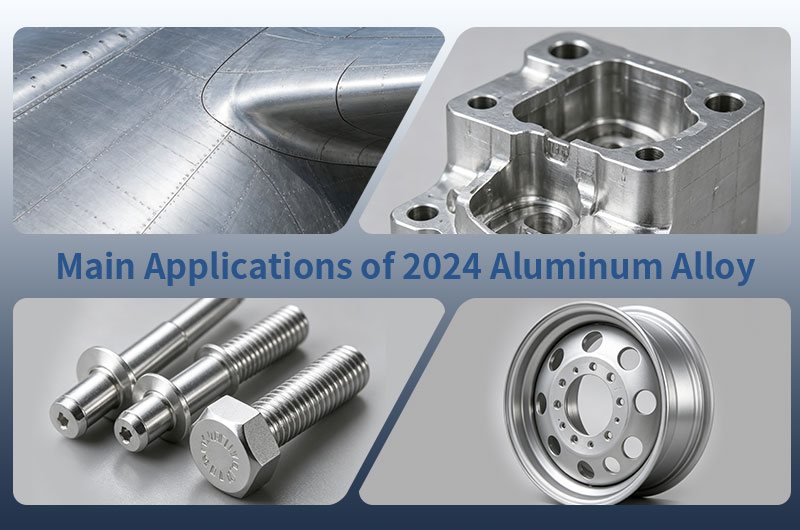
Main Applications of 2024 Aluminum Alloy
- Aviation Thin-Sheet Components: Leveraging its fatigue resistance advantage, it focuses on tension areas subjected to long-term cyclic loading, such as aircraft skins and lower wing panels.
- Fasteners & Precision Parts: Used extensively for manufacturing high-strength rivets, bolts, and hydraulic valve bodies.
- General Industry: Covers conventional components requiring high strength, such as gears, shafts, truck hubs, and instrument housings.
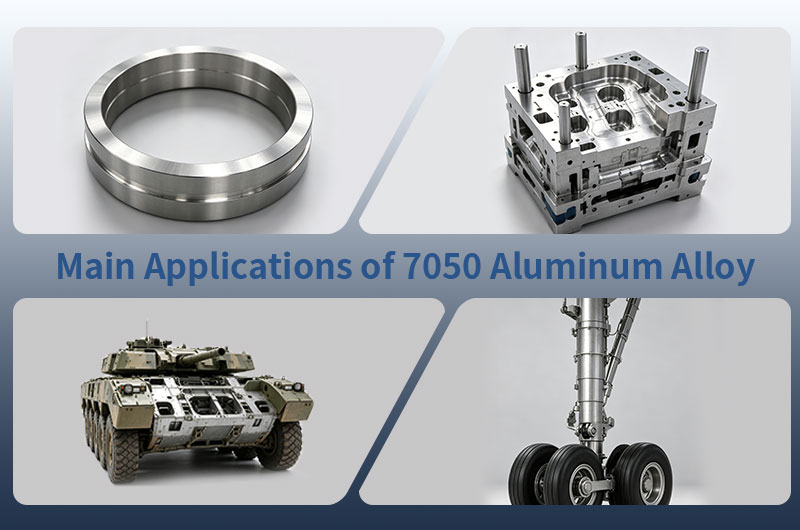
Main Applications of 7050 Aluminum Alloy
- Aviation Thick & Heavy Skeletons: Leveraging its high strength and toughness in thick sections, it focuses on core load-bearing parts like aircraft bulkheads, upper wing spars, and landing gear. It has also been successfully adopted in key wing components of the domestic C919 large aircraft, breaking foreign monopolies.
- Military & Aerospace: Used for manufacturing heavy equipment such as rocket forging rings, spacecraft panels, and armored vehicle chassis.
- Precision Molds: Relying on excellent dimensional stability and internal uniformity in the thick plate state, it has become an ideal material for high-end injection and blow molds.
2024 vs. 7050: How to Choose
In actual engineering practice, you can quickly make decisions based on the following five core working conditions:
- 1. Check Fatigue Load
- If the component needs to withstand long-term cyclic loading (e.g., aircraft skin), prioritize 2024. Its fatigue resistance and crack propagation prevention are significantly superior.
- 2. Check Component Thickness
- If the material cross-section is thick (greater than 50 mm, e.g., bulkheads, wing spars), prioritize 7050. Its low quench sensitivity ensures that the performance inside and outside the thick plate is uniform.
- 3. Check Corrosion Risk
- If the operating environment involves hot, humid, or marine conditions prone to stress corrosion, prioritize 7050 (T7451 or T7651 temper recommended). Its corrosion resistance far exceeds that of 2024.
- 4. Check Machining Difficulty
- If the part requires complex bending or forming, prioritize 2024 (O or T3 temper). Its formability is better, and it can be heat-treated for strengthening after processing.
- 5. Check Fracture Toughness
- If the design specification has clear and strict requirements for preventing "sudden fracture, " prioritize 7050. Its fracture toughness is leading among alloys in the same strength class.
Comprehensive Selection Advice: If your project involves thick sections and requires an "all-around" combination of high strength, high toughness, and corrosion resistance, 7050-T7451 is the most comprehensive choice. If the project involves thin sections (like outer panels) and has extremely stringent requirements for fatigue life, 2024-T3 remains the irreplaceable classic first choice.
About Worthwill's Supply Capability
Henan Worthwill Industry Co., Ltd. has long focused on the supply and technical service of high-quality aluminum alloy materials, providing a variety of tempers and specifications for 2024 and 7050 series aluminum alloys.
- 2024 Aluminum Alloy Supply Specifications: Plate thickness covers 0.3 mm to 350 mm; common tempers include O, T3, T351, T4, T851. Available in bare plates and AlClad (aluminum-clad) plates, complying with standards such as ASTM B209 and AMS 4037.
- 7050 Aluminum Alloy Supply Specifications: Plate thickness covers 1 mm to 600 mm, width up to 2, 500 mm; common tempers include T7451, T7651, T6, H112. Complies with aviation standards such as AMS 4050 and AMS 4201. NADCAP heat-treatment certified products can be provided.
Bars, tubes, profiles, and forgings can all be customized on demand, supporting both small-batch procurement and large-scale stable supply. If you require Mill Test Reports (MTR), ultrasonic testing reports, or other technical documents, welcome to contact our professional team.
Conclusion
2024 and 7050 aluminum alloys represent two different paths in the development of aviation aluminum materials.
2024, centered on copper, excels in fatigue strength and mature processes, making it the optimal solution for thin-plate tension structures. 7050, centered on zinc with zirconium as a key upgrade element, excels in comprehensive thick-section performance and fracture toughness, making it the preferred material for modern large aircraft structures.
There is no absolute superiority or inferiority between the two; it only depends on whether they suit your specific application scenario. Choosing the right material is the first step in controlling costs, ensuring quality, and extending service life. The Worthwill team is always ready to provide you with professional material selection advice and quotation services.
Appendix: Summary and Comparison Tables of Performance Data for 2024 and 7050 Aluminum Alloys
The following data are derived from the literature in this article and are for engineering reference only, not as a design basis. For actual applications, please refer to the latest standards or material certificates.
Appendix A: Comparison of Mechanical Properties under Different Tempers
| Alloy / Temper | Tensile Strength (MPa) | Yield Strength (MPa) | Elongation (%) | Hardness (HB) | Shear Strength (MPa) | Fatigue Strength (MPa) |
|---|---|---|---|---|---|---|
| 2024-O | 186 | 75.8 | 20 | 47 | 124 | 89.6 |
| 2024-T3 | 483 | 345 | 18 | 120 | 283 | 138 |
| 2024-T4 | 469 | 324 | 16 | 120 | 283 | 138 |
| 2024-T351 | 448–469 | 290–324 | 13–15 | 120 | 283 | 138 |
| 2024-T851 | ≥ 455–485 | ≥ 400–415 | Approx. 5 | 140 | 296 | 117 |
| 7050-T73510 | 496 | 434 | 12 | 135 | 303 | Approx. 150 |
| 7050-T7451 | 524 | 469 | 11 | 135 | 303 | Approx. 150–200 |
| 7050-T7651 | 552 | 490 | 11 | 135–150 | 324 | Approx. 200–210 |
Appendix B: Comparison of Physical Properties
| Performance Parameter | 2024 Alloy | 7050 Alloy |
|---|---|---|
| Density (g/cm³) | 2.78 | 2.83 |
| Melting Point Range (°C) | 502–638 | 488–629 |
| Coefficient of Thermal Expansion (μm/m·°C, 20–100°C) | 23.2 | 23.5 |
| Thermal Conductivity (W/m·K, T3 state) | 121 | 153 (T7651) / 155 (T73) |
| Electrical Conductivity (% IACS) | 30 | 40–41 |
| Elastic Modulus (GPa) | 73.1 | 71.7 |
| Shear Modulus (GPa) | 28.0 | 26.9 |
| Poisson's Ratio | 0.33 | 0.33 |
| Annealing Temperature (°C) | 413 | 413 |
| Solution Temperature (°C) | 493 | 475–477 |
| Aging Temperature (°C) | 191 (T6/T851) | 121–177 (Two-stage) |
Appendix C: Fracture Toughness Comparison (7050-T7651, KIC)
| Sampling Direction | Fracture Toughness (MPa·m½) |
|---|---|
| L-T Direction | 34 |
| T-L Direction | 31 |
| S-L Direction | 26 |
Note: The fracture toughness data for 2024 alloy varies greatly depending on the temper and cross-section; it is recommended to refer to specific product certificates. The fracture toughness data for 7050 are typical values for the T7651 temper.