


7050 vs. 7005 Aluminum
Introduction
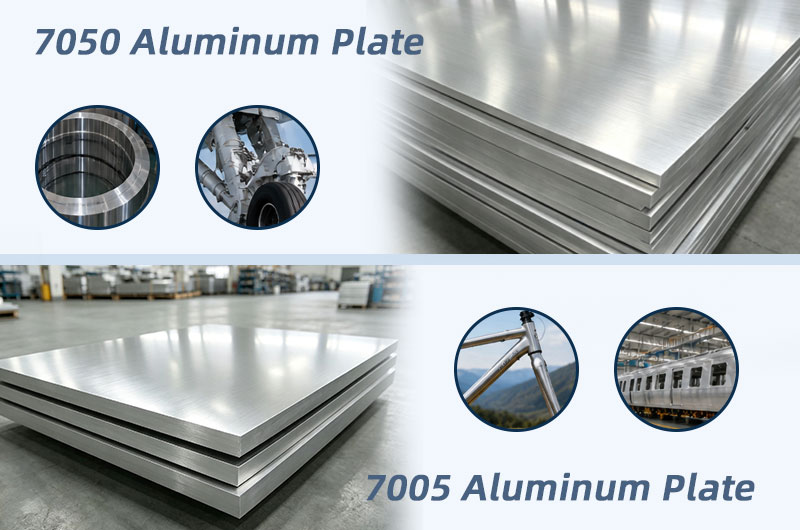
In the 7000 series aluminum alloy family, 7050 and 7005 aluminum are two highly representative high-strength alloys. Both belong to the Al-Zn-Mg system, look similar in appearance, and have overlapping price ranges. However, in practical engineering applications, their market positioning is completely different.
Choosing the wrong material can lead to increased costs at best, and compromise structural safety at worst. This article will help buyers and engineers quickly find the most suitable answer for their projects from multiple dimensions, including composition, performance, processing, and applications.
Quick Comparison Table
Before diving into the detailed analysis, here is a table providing the most direct answers.
| Comparison Item | 7050 (T7451) | 7005 (T6) | Advantage / Winner |
|---|---|---|---|
| Tensile Strength | 524 MPa | 350 MPa | 7050 |
| Yield Strength | 469 MPa | 290 MPa | 7050 |
| Elongation | 10–11% | 8–12% | Comparable |
| Fatigue Strength | 200 MPa | 150 MPa | 7050 |
| Weldability | Extremely poor, not recommended | Excellent | 7005 |
| Quench Sensitivity | Low | Moderate | 7050 |
| Machinability | Good | Excellent | 7005 (Slightly better) |
Core Selection Logic: If your parts require welding, 7005 is your first choice. If you pursue ultimate strength or need thick-section structural parts, 7050 is your top choice.
Understanding These Two Alloys: Where Do They Come From?
The 7050 aluminum alloy is an upgraded version based on 7075, while the 7005 alloy boasts the best welding performance among all 7000 series alloys.
- 7050 Aluminum Alloy: Specially developed for aerospace. Its main characteristic is "maintaining high strength even in thick sections." It is primarily used to manufacture core load-bearing skeletons for large aircraft like the C919.
- 7005 Aluminum Alloy: The best weldability in its class. Characterized by being "lightweight, high-strength, and easy to weld, " it is widely used in civil and industrial fields such as high-end bicycles and high-speed rail components.
Chemical Composition: The Root of Performance Differences
Composition determines performance. Understanding the chemical differences between the two is the first step in material selection.
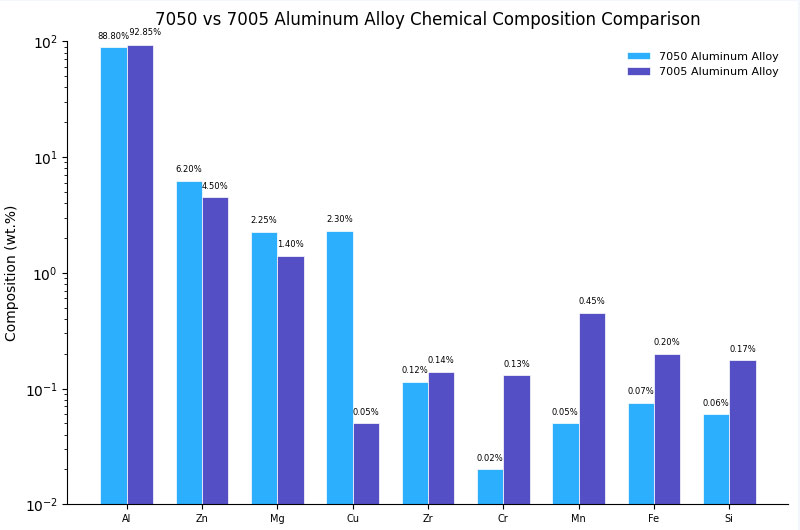
| Element | 7050 (wt.%) | 7005 (wt.%) |
|---|---|---|
| Al (Aluminum) | Balance (87.3–90.3%) | Balance (91–94.7%) |
| Zn (Zinc) | 5.7–6.7% | 4.0–5.0% |
| Mg (Magnesium) | 1.9–2.6% | 1.0–1.8% |
| Cu (Copper) | 2.0–2.6% | ≤0.10% |
| Zr (Zirconium) | 0.08–0.15% | 0.08–0.20% |
| Cr (Chromium) | ≤0.04% | 0.06–0.20% |
| Mn (Manganese) | ≤0.10% | 0.20–0.70% |
| Fe (Iron) | ≤0.15% | ≤0.40% |
| Si (Silicon) | ≤0.12% | ≤0.35% |
Mechanical Properties Comparison
Simply put: 7050 is essentially the "enhanced version" of 7005. There is almost no difference in weight and flexibility between the two. If you pursue extreme performance and need to withstand extreme pressure, choose 7050; for general daily use, 7005 is more than sufficient.
- Load-bearing & Compression: 7050 is about 50% stronger than 7005 and can withstand extreme heavy loads.
- Durability: 7050 is more rugged; it is less prone to failure even under long-term repeated stress.
- Hardness: 7050 is much harder, making it less susceptible to deformation from bumps or scratches.
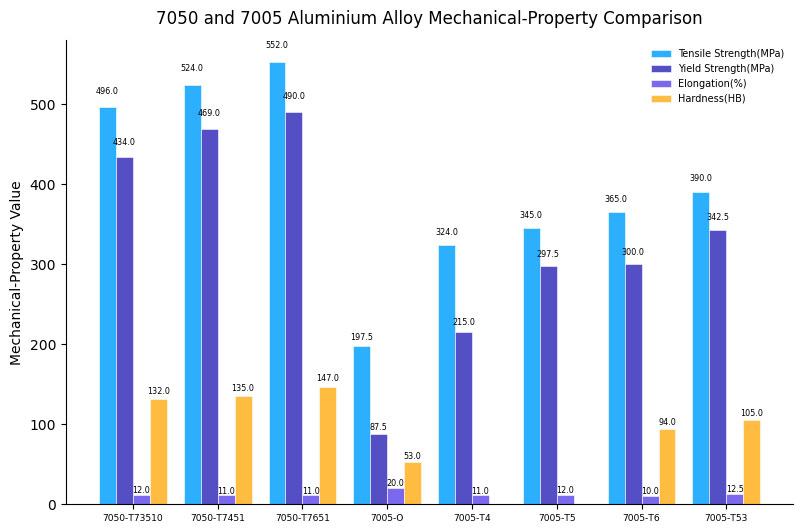
Detailed Mechanical Properties Comparison by Temper
| Alloy & Temper | Tensile Strength (MPa) | Yield Strength (MPa) | Elongation | Hardness (HB) |
|---|---|---|---|---|
| 7050-T73510 | 496 | 434 | 12% | 132 |
| 7050-T7451 | 524 | 469 | 11% | 135 |
| 7050-T7651 | 552 | 490 | 11% | 147 |
| 7005-O | 195–200 | 80–95 | 20% | 53 |
| 7005-T4 | 324 | 215 | 11% | — |
| 7005-T5 | 345 | 290–305 | 9–15% | — |
| 7005-T6 | 350–380 | 290–310 | 8–12% | 94 |
| 7005-T53 | 390 | 340–345 | 10–15% | 105 |
Welding Performance: The Core Key to Material Selection
When it comes to weldability, there is a world of difference between 7050 and 7005, which is the most critical factor in deciding which one to choose.
7005: An Excellent "Weldable" Material
7005 is one of the very few aluminum materials in its class that can be perfectly welded. It is not only easy to weld but also very convenient—after welding, if left naturally for a period, the strength at the welded joint will "automatically recover" to near-normal levels without the need for complex post-treatments. It is highly suitable for structural parts that require splicing and welding.
7050: Strongly Advised to "Avoid Welding"
7050 is inherently unsuitable for conventional high-temperature welding. Once conventional welding is performed, numerous cracks and porosity will form inside the material, causing its proud "ultra-high strength" to be instantly lost, making it very brittle. If joining is absolutely necessary, only highly expensive non-fusion processes (such as friction welding) can be used.
Corrosion Resistance: Different Protection Focuses
- 7050: Specialized for Harsh Environments. Its anti-corrosion and anti-fracture capabilities are extremely strong. It is particularly suitable for long-term work in extreme environments characterized by "high stress + humidity, " making it very safe and durable.
- 7005: Capable of General Outdoor Use. Its intrinsic corrosion resistance is moderate. If used outdoors under the sun and rain or in coastal areas, surface treatments (such as anodizing or coating) are recommended to achieve excellent long-term rust prevention.
| Corrosion Type | 7050 (T7451) | 7005 (Double Aging) | Notes |
|---|---|---|---|
| SCC Resistance (Stress Corrosion) | Excellent | Moderate to good | 7050 is significantly better |
| Exfoliation Corrosion | Excellent | Good | 7050 is better |
| General Atmospheric Corrosion | Moderate | Moderate to good | Comparable |
| Marine Environment (Bare) | Requires protective coating | Requires protective coating | Both require treatment |
Heat Treatment Process Comparison
Both materials have their own specialties in the "heating and shaping" phase. The specific parameter comparison is as follows:
| Process Step | 7050 | 7005 |
|---|---|---|
| High-Temp Heating (Solution) | Approx. 475°C | Approx. 470°C |
| Cooling Method (Quenching) | Water cooling or warm water cooling | Thin parts can be air-blown; thick parts require water cooling |
| Quench Sensitivity | Extremely low (Core Advantage) | Moderate |
| Subsequent Shaping (Aging) | Requires high-temp oven baking | Can be oven-baked, but also supports natural room-temp aging |
Machinability Comparison
- 7005: Extremely Smooth to Machine. It does not stick to the cutting tool and causes low tool wear. Machined parts have minimal deformation and smooth surfaces. It is highly suitable for manufacturing conventional precision parts.
- 7050: Supports High-Speed Machining, but Requires Deformation Control. The machining technology is very mature, but because internal "stress" can easily build up in the material, deformation can occur after cutting. It is recommended to directly select tempers that have been "stress-relieved by pre-stretching" (such as T7451) to ensure precise part dimensions.
7050 vs. 7005: Application Scenarios Comparison
Positioning of the Two Alloys:
- 7050: Extreme strength, no welding, suitable for thick-section, high-load structural parts. The main alloy in the aerospace field.
- 7005: Sufficient strength, weldable, suitable for extruded profiles and welded spliced structures. The main alloy in the transportation and sports equipment fields.
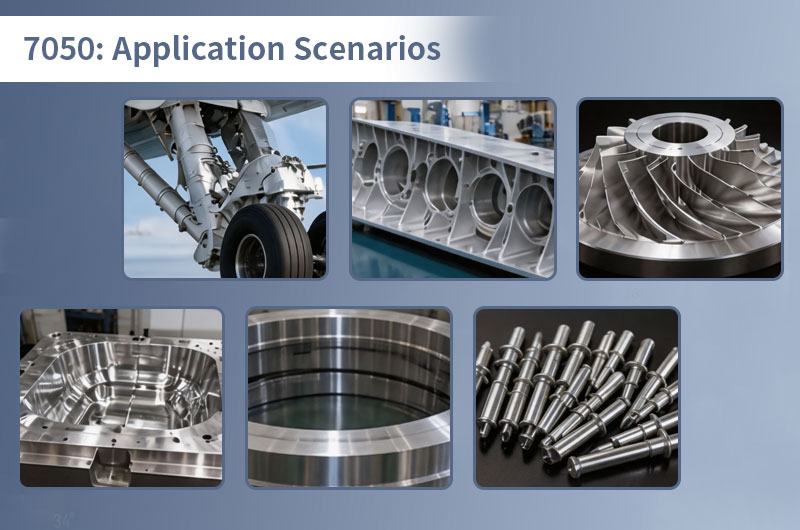
Where is 7050 used?
Aircraft wing spars, fuselage frames, landing gear, wing spars and panels of the C919, satellite structures, rocket forged rings, large precision molds, high-strength rivets, precision rotors, and centrifuge impellers.
Common trait: Extremely high strength requirements, no welding required, many are thick-section parts.
Where is 7005 used?
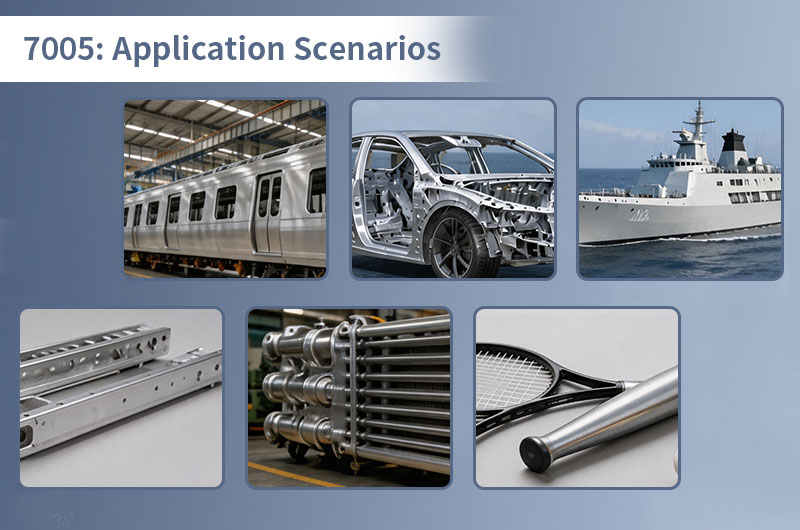
Bicycle frames, high-speed rail carriage welded profiles, tennis rackets, baseball bats, radar and military electronic structural parts, ejection seat guide rails, large heat exchangers, ship and automotive welded structural parts.
Common trait: Requires welding, or has specific cost and processing efficiency requirements, with mid-to-high level strength needs.
How to Choose
| Scenario | Which to Choose |
|---|---|
| Requires welding | 7005 |
| Cross-section thickness exceeds 50mm | 7050 |
| Strength requirement exceeds 400 MPa | 7050 |
| Long-term exposure to corrosive environments | 7050 |
| Focus on cost and supply convenience | 7005 |
About Worthwill's Aluminum Alloy Supply Capabilities
Henan Worthwill Industry Co., Ltd. specializes in the production and customized supply of 7000 series high-strength aluminum alloys.
We can provide 7050 aluminum alloy plates (thickness 1–500mm) that comply with mainstream international specifications such as AMS 4050, AMS 4201, and ASTM B209. Concurrently, we supply 7005 aluminum alloy extruded profiles, plates, and bars covering various heat treatment tempers like T5, T6, and T53.
For specific specifications, quotes, or professional material selection advice, please feel free to contact the Worthwill technical team.
Conclusion
7050 and 7005 are not competitors on the same track, but rather complementary materials that serve different engineering needs.
With its extremely high strength, outstanding fracture toughness, and excellent thick-section performance, 7050 has become the premier choice for aerospace structural parts. Meanwhile, 7005, with its unique weldability and mid-to-high strength, has established an irreplaceable position in the field of welded structures.
Only by understanding the fundamental differences between the two can you make a truly correct material selection decision—this is not just a matter of cost, but a guarantee of product safety and performance.
Appendix: Performance Data Quick Reference Tables
A. Mechanical Properties of 7050 by Temper
| Temper | Tensile Strength (MPa) | Yield Strength (MPa) | Elongation | Hardness (HB) | Shear Strength (MPa) | Fatigue Strength (MPa) |
|---|---|---|---|---|---|---|
| T73510 | 496 | 434 | 12% | 132 | 300 | 190 |
| T73511 | 500 | 440 | 12% | 132 | 300 | 190 |
| T74 | 530 | 440 | 4.5% | 150 | 310 | 160 |
| T7451 | 524–540 | 469–480 | 10–11% | 135 | 303–310 | 200 |
| T7452 | 490 | 390 | 2.2% | — | 280 | 130 |
| T7651 | 552–570 | 490–500 | 10–11% | 147 | 324–330 | 210 |
B. Mechanical Properties of 7005 by Temper
| Temper | Tensile Strength (MPa) | Yield Strength (MPa) | Elongation | Hardness (HB) | Fatigue Strength (MPa) |
|---|---|---|---|---|---|
| O (Annealed) | 195–200 | 80–95 | 20% | 53 | 100 |
| T4 | 324 | 215 | 11% | — | — |
| T5 | 345–400 | 290–350 | 9–15% | — | 190 |
| T6 | 350–380 | 290–310 | 8–12% | 94 | 130–150 |
| T53 | 390 | 340–345 | 10–15% | 105 | 140–170 |
| Double Aging Opt. | Up to 480 | 451 | 8.4% | — | — |
C. Physical Properties Comparison
| Performance Parameter | 7050 | 7005 |
|---|---|---|
| Density (g/cm³) | 2.83 | 2.78 |
| Melting Range (°C) | 488–629 | 607–643 |
| Solidus (°C) | 488 | 607 |
| Liquidus (°C) | 629 | 643 |
| Thermal Conductivity (W/m·K) | 140–180 | 137–166 |
| CTE (µm/m·°C, 20–100°C) | 23–23.5 | 23.1 |
| Specific Heat Capacity (J/g·°C) | 0.86 | 0.875 |
| Electrical Conductivity (% IACS) | 35–43% | 35–43% |
| Elastic Modulus (GPa) | 70–71.7 | 70–72 |
| Poisson's Ratio | 0.32–0.33 | 0.33 |
| Max Operating Temp (°C, Mech.) | 190–200 | 200 |
D. Main Standard Specifications Comparison
| Standard Type | 7050 | 7005 |
|---|---|---|
| Aluminum Association (US) | AA 7050 / UNS A97050 | AA 7005 / UNS A97005 |
| Chinese National Standard | GB/T 3190-2008 | GB/T 3190 / GB 7005 |
| European Standard | EN AW-7050 / AlZn6CuMgZr | EN AW-7005 |
| Japanese Standard | — | JIS 7N11 |
| AMS Spec (Main) | AMS 4050 (T7451) / AMS 4201 (T7651) | — |